Showing posts with label Bobby. Show all posts
Showing posts with label Bobby. Show all posts
Saiyaara among the biggest newcomer films of all times
9:25 AM

Box Office India Trade Network
SAIYAARA will join the list of biggest newcomer films in the history of Hindi cinema. There are seven films in the list so far and SAIYAARA will be the eighth but it has taken twenty five years for such a success with newcomers while the other seven films came in the preceding thirty years. The films generally have to be love story to reach such huge success with newcomers though PHOOL AUR KAANTE is the exception. But even here, there was a love story and it was the blockbuster music which was a huge driver of the film.
The music factor is there for all the films and there some films like LOVE STORY (1981) and QAYAMAT SE QAYAMAT TAK (1988) missing on the list which in terms of footfalls will be higher than SAIYAARA but in their time they were not as big as SAIYAARA is in todays time. BARSAAT (1995) also deserves a mention as that was the first time that the most costly film ever made was with newcomers and such is risk is unlikely to be ever taken again.
The films listed below are not only the biggest newcomers films but will be among the biggest Love Story genre films ever made even if we count films with established actors. MUGHAL-E-AZAM (1960) remains the biggest ever Love Story film ever made in India and if we take this film out, as it had huge scale and opulence, then it could be MAINE PYAR KIYA (1989).
Where SAIYAARA stands with the others in the list below is actually tough to say as admits is the measure but in each era admits have been up and down to due to various of reasons; at present, footfalls are down in the industry. The fact that the comparison of SAIYAARA in terms of its success is with these films shows how big the film has become.
The biggest films with newcomers of all time are listed below. There will be films below where the one the main artistes had some sort of role in another film earlier but generally the films are seen as debut films.
Bobby (1973)
Ek Duuje Ke Liye (1981)
Betaab (1983)
Hero (1983)
Maine Pyaar Kiya (1989)
Phool Aur Kaante (1991)
Kaho Naa Pyaar Hai (2000)
Saiyaara (2025)
Ranbir Kapoor on Animal, Sanju: "We have to be more responsible towards the kind of films we make"
8:26 AM
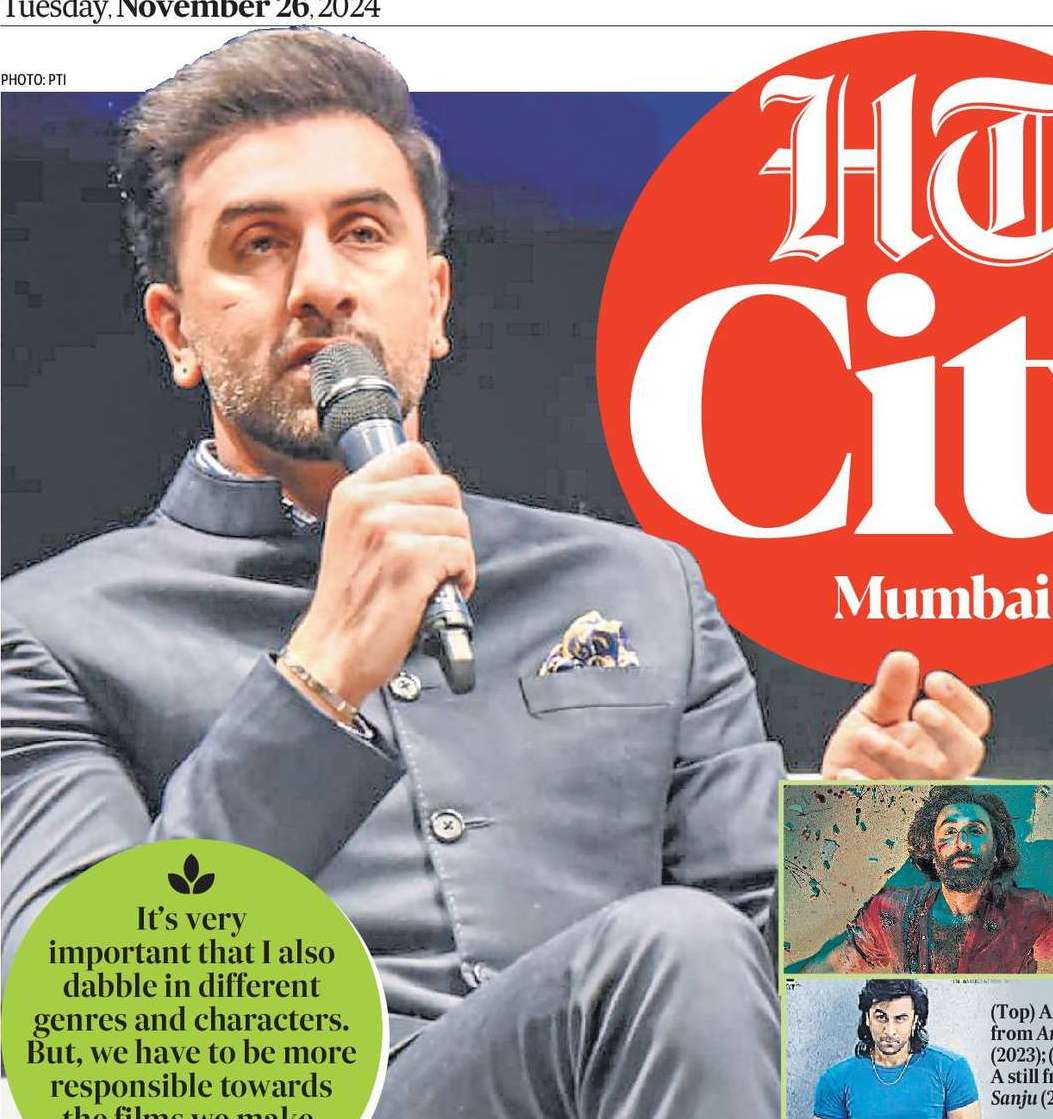
Niharika Lal (BOMBAY TIMES; November 26, 2024)
Ranbir Kapoor recently took the stage at the ongoing International Film Festival of India (IFFI) in Goa for a discussion celebrating the work of Raj Kapoor. “He was this big man with blue eyes,” the actor said as he began reminiscing about his grandfather. Ranbir confessed that it was only after he began understanding cinema that he fully grasped Raj Kapoor’s contribution to Indian cinema.
Sharing that 10 of Raj Kapoor’s films are being restored, Ranbir said that some of them will be screened at a film festival next month. “Raj Kapoor was Raj Kapoor because he didn’t follow any model. I think that if you want to carry any legacy forward, you have to approach it in a very individualistic way,” he told the audience.
‘I would love to have a take on Shree 420’
When asked which of Raj Kapoor’s films he would like to remake as a director, Ranbir said, “I would have directed every film in a different way, but all of them would have been atrocious. I don’t believe in remakes; I think every film is made to the best of its capabilities and should not be touched, especially Raj Kapoor’s. But I would love to have a take on Shree 420 – it is my favourite film.”
‘RAJ KAPOOR WAS CONSTANTLY IN TOUCH WITH THE COMMON MAN, THE MASSES’
In response to a question, Ranbir said, “Honestly, I want to say this – I’m a bigger fan of Raj Kapoor as a director than as an actor.” Raj Kapoor, the filmmaker, always explored different themes at different stages of his life.
Talking about his oeuvre, Ranbir shared, “If you look at his early films, Awara was based on casteism, in Shree 420, he spoke about greed.” Ranbir spoke about how in the later years of his career, Raj Kapoor made powerful films grounded in Indian moral values, tackling societal issues in a commercial and really entertaining way.
“Raj Kapoor had the courage to make a film with newcomers – a 50-year-old man making a film (Bobby) for the youth. It means that he really kept up with the times. He wasn’t stuck in a cocoon. He was not high up in an ivory tower. He was constantly in touch with the common man, the masses, and the kind of stories people would like to see,” Ranbir said.
The National Film Development Corporation of India (NFDC), National Film Archives of India (NFAI), and Film Heritage Foundation (FHF) and Kunal Kapoor have started restoring 10 films of Raj Kapoor. Ranbir said, “We are going to organize the Raj Kapoor Film Festival from December 13 to 15 all over India. We will show the restored version of 10 of Raj Kapoor’s films.”
-----------------------------------
Which film of his would Ranbir have wanted to be directed by Raj Kapoor?
Yeh Jawaani Hai Deewani (2013)
Which Raj Kapoor film would he like to direct?
Shree 420 (1955)
For which of his films did he take inspiration from Raj Kapoor?
Barfi! (2012)
-----------------------------------
Actor Ranbir Kapoor, who took the brunt of criticism for portraying toxic characters in his recent projects, opened up about leaning towards more responsible storytelling at a recent event
HINDUSTAN TIMES (November 26, 2024)
Actor Ranbir Kapoor’s films Sanju (2018) and, more recently, Animal (2023), have been at the end of fierce criticism for glorifying violence and toxic masculinity. Addressing the same on Sunday, the actor shared his take on the widespread debate at the 55th International Film Festival of India (IFFI) in Goa.
Prompted by an attendee, who asked him about “responsible storytelling” in context with Animal and Sanju, the actor responded, “I completely agree with your opinion. As an actor, it is our responsibility to bring movies which bring a positive change to the society.”
However, the 42-year-old maintained that doing diverse roles is important to him. “Having said that, I’m an actor, it’s very important that I also dabble in different genres and characters, and play varied roles. But what you are saying is absolutely correct. We have to be more responsible towards the kind of films we make.”
Earlier this year, in Nikhil Kamath’s podcast People by WTF, Ranbir had responded to the criticism that Animal had received, stating, “Social media played havoc. They needed something to talk about, so they really went to town claiming it was a misogynistic film.”
On a separate note, Ranbir also touched upon his dream of creating a biopic on his grandfather, late filmmaker-actor Raj Kapoor’s life, calling it a “challenging yet worthwhile endeavour.” Revealing his take on a biopic, the actor said at the event, “A biopic is not just about celebrating someone’s success but honestly portraying their struggles, relationships and low points. I’ve spoken to (filmmaker) Sanjay Leela Bhansali about it, but it’s a tough project. I’m not sure if my family would agree to show that side of his life.” htc
Ranbir reveals Alia didn’t know about Kishore Kumar
Speaking at IFFI, Ranbir disclosed that his wife, actor Alia Bhatt didn’t know about the legendary playback singer, musician and actor Kishore Kumar. “The first time I met Alia, she asked me, ‘Who is Kishore Kumar?’ [But] it’s just the circle of life. People forget [old artistes] and then new artistes come in. So, I think it’s very important to remember our roots.”
The video, which has now gone viral, has been dubbed as ‘Ranbir’s revenge’ by social media users, as a response to Bhatt’s earlier interview where she had claimed that Ranbir asked her to “wipe off” her lipstick. One social media user shared, “He took the revenge for ‘wipe it off’”, while another said, “Are these two in a competition: who can embarrass the other more... (sic).”
Raj Kapoor believed that his films should definitely carry a social message-Rahul Rawail
8:00 AM

Avijit Ghosh (THE TIMES OF INDIA; December 18, 2021)
Film director Rahul Rawail (‘Betaab’, ‘Arjun’) worked as an assistant to Raj Kapoor in ‘Mera Naam Joker’ and ‘Bobby’. In a conversation with Avijit Ghosh, Rawail talks about his book, ‘Raj Kapoor: The Master At Work’, which offers a first-hand view of the art and craft of the filmmaker who regaled millions in India and the world with his conscientious social dramas and passionate romances. Edited excerpts:
What was unique about Raj Kapoor the director?
The way he organised everything, the way he paid attention to all the departments. He was like a music director conducting a symphony.
Can you give an example?
The circus scene in Mera Naam Joker. He was working with a unit of 300 people, 5,000 junior artistes, 100 Russian circus artistes. Indian circus artistes. Animal trainers. And there was this one man controlling everything like clockwork, like he knew everything that he was doing.
What were the key features in his work? His driving force?
His attention to detail. And also his thinking about the film all the time. That process never ended. The driving force was to deliver the best possible film that he could. That’s what he aimed for and wanted to achieve.
You write about the party scene in Bobby.
Normally in a party scene, you have people who are supposed to be drinking alcohol. You mixed Thums Up with water to make it look like whiskey. To the viewer, it was normal; to the unit it was inexpensive. In Bobby, he wanted champagne to be served for the scene. So we mixed Limca with soda. He said: “This is a billionaire’s party. It has to be real champagne.” I said that would be very expensive. He said: “I don’t care. The look of the man drinking champagne would be different from the look he would have when drinking Limca with soda.”
Raj Kapoor not only made great films, he also built a great banner, set up a studio.
It was just the passion with which he made films. It was all a master plan in his mind which he executed piece by piece.
Along with B R Chopra, Raj Kapoor was a rare filmmaker of his generation who started out in the 1950s but he was still in his creative prime when he passed away in 1988.
He believed that his films should definitely carry a social message. He did what he believed in. That’s why the films worked and in a big way. His last film, Ram Teri Ganga Maili, was the biggest hit R K Films ever had. Starting from Aag in 1948, we can see flashes of a genius. The progression was huge. Technology was changing but he didn’t pay much attention to it. He said: “What I say is from my heart. That doesn’t change. There may be a different way to shoot it. But I shoot a film, the way I see it.” He never went for any kind of gimmickry.
As a filmmaker, what are the key lessons you learnt from him?
Pay attention to your film, think about it all the time. Don’t let your mind waver from the film. Do what your heart says. Almost 95%, it will be the right thing. Maybe 5% it will not. But it doesn’t matter. And if it doesn’t work, don’t give up hope.
Not many know that Raj Kapoor was also a foodie and every meal at RK studio was an elaborate spread. Can you talk about it?
He was a complete foodie. His life revolved around films and food. He used to drive from Chembur to the town, then an hour’s drive, to take the Deccan Queen to Pune for the food it served. I think even when he was eating, his mind was working on the film. Suddenly, he would say, I am thinking about this and let us do it like this in the shooting tomorrow. I think those were just tools which he used for his mind to be working.
There was also a democratic aspect to the way food was served during shootings or editing.
Absolutely. We were all given the same food to eat. There was never any differentiation. We would have chicken, fish, mutton, prawns or crabs. It was a huge spread. The food was laid on one table together. Everybody had to come there to eat. During a film’s final editing, he would first sit and work out the menu. Somebody would say, the dal is very good, or the chicken there is very good. He would say write it down. Then 2-3 cars would go in various directions to pick up the food. That’s the way he worked. Somewhere that not only made him happy but also made people working for him happy.
IFFI 2021 to pay homage to 19 Indian & 9 international stars
8:15 AM

Niharika Lal (BOMBAY TIMES; January 16, 2021)
The 51st edition of the International Film Festival of India (IFFI) will pay homage to 19 Indian film personalities and nine international personalities, who we lost last year, for their contribution to cinema with the screening of their films. The number of films in the homage section is the highest in recent years – last year, IFFI paid tribute to 13 Indian personalities.
An IFFI official says, “Unfortunately, last year we lost many geniuses from the world of cinema. We have curated the homage section to pay tribute to these geniuses, who immensely contributed to cinema. IFFI acknowledges their work, and we have planned a screening of their films.”
Among the films that will be screened are Irrfan’s Paan Singh Tomar, Rishi Kapoor’s Bobby and Sushant Singh Rajput’s Kedarnath. These will have physical screenings in Goa. Sushant’s Chhichhore will also be screened at IFFI, in the Indian Panorama section.

INTERNATIONAL ARTISTES WILL BE REMEMBERED WITH THESE FILMS
Chadwick Boseman (right) – 42
Ivan Passer – Cutter’s Way
Goran Paskaljevic – Dev Bhoomi
Allen Daviau – The Extra-Terrestrial
Max Von Sydow – Extremely Loud & Incredibly Close
Sir Alan Parker – Midnight Express
Kirk Douglas – Paths Of Glory
Ennio Morricone – The Hateful Eight
Olivia De Havilland – The Heiress

--------------------------------------

A retrospective of Satyajit Ray films at IFFI
This year, IFFI has organised a retrospective on Satyajit Ray — Classics of the Maestro, which will give cinephiles an opportunity to watch some of the works of Satyajit Ray in Goa from January 16-24. Five films which have been selected for the retrospective are Charulata (1964), Ghaire Baire (1984) Pather Panchali (1955), Sonar Kella (1974), Shatranj ke Khilari (1977). The opening film of the retrospective is Pather Panchali. The film revolves around the child protagonist Apu in 1920s Bengal. It is based on a Bengali novel of the same name, which was written by Bibhutibhushan Bandopadhyay. Pather Panchali won several international awards, including the Best Human Document at Cannes in 1956. Satyajit Ray was born on May 2, 1921 in Kolkata, and as part of centenary celebrations, these films have been selected.
The 51st edition of IFFI was rescheduled from November to this January.

Away from his stardom, Rishi Kapoor was a very warm person-Zeba Bakhtiar
8:24 AM

The Pakistani actress, who made her Bollywood debut opposite Rishi Kapoor in Henna,recalls her fondest memories of the actor and the days of the shoot
Richa Shukla (BOMBAY TIMES; May 8, 2020)
 Pakistani actress Zeba Bakhtiar made her film debut in 1991 with the movie Henna, opposite Rishi Kapoor. Sharing her fond memories of the time spent with the late actor, Zeba says the news of Rishi’s demise is yet to sink in.
“It was an unfortunate day when I woke up to this news. I got a call from a journalist, who informed me about Rishi’s death. It was heartbreaking. All the good old memories came flooding back. I’m yet to believe that my dear friend is gone. He will always remain a mentor to me,” she says. The actress had been in regular touch with Rishi through phone calls and messages. She tells us, “Whenever Ranbir’s film released, Rishi would ask me to watch it. The last I met him was almost a decade ago, in 2010, in India. He was as charming and jovial as ever.”
Recalling her debut with Rishi, Zeba shares, “Henna will always hold a special place in my life. It was a dream come true for me. The title role demanded a girl from Pakistan and for authenticity, Raj sahab and Randhir, too, wanted an actress from Pakistan. In 1989, I was in London when I got a call from Randhir, who asked me to come to Mumbai for a screen-test.” She adds, “I didn’t know much about Bollywood then, but I had seen Rishi’s films and loved Bobby. I was literally in awe of him! At the screen-test, Randhir introduced me to him and our bond grew stronger with time.”
Praising the actor and his family for making her feel at home during the shoot, Zeba says, “From day one, the Kapoors became my extended family. Away from his stardom, Rishi was a very kind-hearted and warm person. I remember we went to Austria to shoot a few songs there, Rishi’s family, too, accompanied us. It became like a family holiday for all of us.”
---------------------------------
Shreya Mukherjee (HINDUSTAN TIMES; May 8, 2020)
Pakistani actor Zeba Bakhtiar remembers being intimidated by her immensely popular co-star Rishi Kapoor on the sets of her debut film, Henna. In this 1991 drama, helmed by Randhir Kapoor, Bakhtiar played the titular role. While working on the project, the Pakistani actor came close to the Kapoor family and found friends in both the Kapoor brothers.
The news of Rishi Kapoor’s demise came as a shock to her. Kapoor, 67, died in Mumbai on April 30. “I spoke to Randhir two days before this happened. He said, ‘Chintu is getting better’…Nobody saw this coming. After his treatment (in the US), he was so happy to be back home,” says Bakhtiar.
It was Kapoor’s “honesty and strong demeanour” that made Bakhtiar “respect” him all the more. “He was straightforward yet funny. He had a very active mind, knew about all kinds of films being made, newer technologies and techniques that were being used. He was knowledgeable,” says the actor who worked with Kapoor again in Mohabbat Ki Aarzoo (1994).
Reminiscing the days of making Henna, Bakhtiar, 57, shares, “While Randhir was collected and chill, Rishi was electrifying and full of energy. I was new then and he would help me with my performance.”
The last time they spoke this year, they had plans of catching up, she reveals. Bakhtiar shares that Kapoor is hugely popular in Pakistan and they were “devastated with the news as he was the ultimate romantic hero who everybody would miss”.
Rishi Kapoor's first film Bobby was a 500-crore grosser at the average ticket rate of 2018
8:26 AM

Box Office India Trade Network
Rishi Kapoor is among the ten actors in the Hindi film industry to have given 25 HITS as male lead in the 100 year history of Hindi cinema. The other nine being Dilip Kumar, Dharmendra, Rajesh Khanna, Jeetendra, Amitabh Bachchan, Mithun Chakraborty, Salman Khan, Akshay Kumar and Shah Rukh Khan. This is not counting the HITS given as character artistes which will add to the numbers. These actors are the biggest that the Hindi film industry has ever seen.
The biggest BLOCKBUSTER of Rishi Kapoor is BOBBY (1973) which was also his first film as main lead. The film will have business of 500 crore nett plus based on its footfalls at the average ticket rate of 2018. The film was a huge craze celebrating around 30 silver jubilees across the country. In Mumbai it went silver at Metro and Broadway while in Delhi it hit 25 weeks at Regal and Moti. The film actually had a late release in Delhi as the initial release came in Mumbai and East Punjab circuits and both circuits saw record breaking initial. The East Punjab centres of Haryana like Gurgaon and Rohtak saw groups of youths coming from Delhi (where the film was yet to be released) to watch the film only to struggle for tickets. But the East Punjab exhibitors were famous for allowing the theatres to go over capacity by putting seats up on the sides and aisles which meant some of the Delhi crowd was able to watch.
Many of the Rishi Kapoor blockbusters are musicals and this is where the actor scored heavily. A sign of a popular actor in India is the comfortabilty in songs and Rishi Kapoor excelled here. The songs are the toughest part in Hindi cinema because it is very easy to look out of place and very few have managed to succeed here and this is proven by the fact that every generation has so few genuinely popular actors. Actually in India its the ability to perform in songs that separates the greats with the others. Its one of the reasons that in the 100 year history of Hindi cinema that many actors have been called great by the media but the audience never put them on the same pedestal and this will continue in the future also as the audience demands the near perfect hero. All the actors in the 25 plus HIT group above were supremely comfortable in songs whether they could dance or not;
The list of Rishi Kapoor films which will have a value of 200 crore nett or today is below. All the films listed below will have a classification of SUPER HIT or higher. The numbers are apprx and grouped as the films have not been entered into the database to get the exact number.
500 crore plus
1. Bobby (1973)
400 crore plus
2. Coolie (1983)
3. Naseeb (1981)
300 crore plus
4. Amar Akbar Anthony (1977)
5. Laila Majnu (1976)
250 crore plus
7. Hum Kisise Kum Naheen (1977)
8. Prem Rog (1982)
9. Kabhi Kabhie (1976)
10. Sargam (1979)
11. Nagina (1986)
200 crore plus
12. Kaatilon Ke Kaatil (1981)
13. Henna (1991)
14. Chandni (1989)
15. Deewana (1992)
Rishi Kapoor delivered solo grossers of the 70s in the midst of multi-starrers
8:42 AM

Box Office India Trade Network
Rishi Kapoor who had a huge body of work with fifty years as an actor is no more. The actor had been suffering from leukemia for two years and passed away on Wednesday morning. The actor had a great innings as male lead with some hugely popular musical films which are remembered till date. It is a very sad day for the industry as it loses a huge personality.
The actor started his career as a child artist in the 1970 film MERA NAAM JOKER and then made his full fledged debut in 1973 with BOBBY which is probably the biggest debut ever. The film smashed all records and was not just the biggest hit of that year but remains one of the biggest blockbusters of Hindi cinema till date.
BOBBY made Rishi Kapoor a sensation and the stardom was consolidated a few years later with blockbusters like LAILA MAJNU (1976) and HUM KISISE KUM NAHEEN (1977). The 70's was the golden period of Hindi cinema with huge multi starrer blockbusters but it was Rishi Kapoor who delivered the biggest solo grossers of the 70's. It was the time of box office titans but Rishi Kapoor made a place for himself among these titans.
A sign of a huge popular career in Hindi cinema is a silver jubilee (25) or more HIT films as male lead and Rishi Kapoor is one of those very few actors in over 100 years of the industry who achieved this. There will be around ten actors who have achieved this in history which puts the popularity and career of Rishi Kapoor into perspective.
I’ll cherish every moment spent with Rishi Kapoor-Chunky Panday
8:26 AM

Titas Chowdhury (HINDUSTAN TIMES; May 2, 2020)
“I remember watching Bobby (1973) in the theatre. I’ve been Rishi Kapoor’s biggest fan,” says Chunky Panday as he walks down the memory lane. As the veteran actor breathed his last yesterday, Panday reminisces the time when he couldn’t share a single frame with him despite working in a film with him. He shares, “After I became an actor, I worked with him in Kasak (1992) where we didn’t have a single scene together. I was quite upset back then.”
Talking about the time when he closely worked with Kapoor during the shoot of Housefull 2 (2012), he nostalgically says, “Then I got a chance to work with him in Housefull 2. When we had the first screening of Housefull 2, I couldn’t make it because I was travelling. After the show, he called me and said to me, ‘You’re a fine actor!’ That coming from him was bigger than receiving any award.”
Panday says that Kapoor had a huge influence in his career. “I took on negative roles because I saw him as Rauf Lala in Agneepath (2012) and I was shaken up by that performance. The reason I did Saaho (2019) and Begum Jaan (2017) was because he inspired me to take that route. There’s going to be no one like him,” says Panday.
With a heavy heart, he says that his “biggest regret” would be to not have met the senior actor in the past couple of years. “The last time we worked together was when we went to Bengaluru for an event. Then he went to New York for his treatment. While I was there, I wanted to meet him. So, I called him up and I came to know that he was resting. I didn’t want to disturb. When he came back to India, I wanted to visit him but he went to Delhi to resume shooting and got very busy. But I’ll cherish every moment that I spent with him,” he signs off.
I wondered why Rishi Kapoor won the Filmfare award for Best Actor only once-Pritish Nandy
8:04 AM

Remembering the actor who went from a teen heartthrob to one of Hindi cinema’s finest
Pritish Nandy (MUMBAI MIRROR; May 1, 2020)
 Rishi Kapoor was a clever, witty man always ready to discover a repartee even when there was no reason for one. He enjoyed the art of one-upmanship, particularly when it came to conversations. And yet bonhomie was not just part of his craft as an actor, it was second nature for him.
Rishi entered movies a decade before I came to this city. It was 1973 and his father, the legendary Raj Kapoor, launched him opposite a stunningly beautiful Dimple Kapadia in a teenage romance called Bobby which he directed on the basis of a flimsy K A Abbas story that went on to become the year’s biggest hit-- and the second biggest hit of the seventies. Adjusted for inflation, Bobby is still one of the twenty biggest hits of Hindi cinema.
In the same year, another young man who also started his career with a K A Abbas film, found his defining role in a Salim-Javed scripted actioner called Zanjeer that went on to become a big hit. Though Zanjeer collected much less at the box office than Bobby, it launched a new trend for action movies that made Amitabh Bachchan the popular star he soon became. So, 1973 was the year when both the hottest teenage romance and the Angry Young Man hit the ground running. A decade later, when I took charge of Filmfare, they were both at the top of their careers. The critics swore by Rishi. But Amitabh had an unparalleled fan club that ensured the focus never shifted from him.
They worked together in quite a few films, most famously in Manmohan Desai’s Amar Akbar Anthony, Naseeb and Coolie. And then 36 years later, I watched them together in 102 Not Out. It wasn’t much of a film but the two of them were a riot together. Curiously, over the years while Amitabh got embroiled in controversies, in movies as much as in politics, Rishi stayed away from the limelight and continued to build his repertoire of remarkable roles. He chose few and he chose wisely, and his reputation as an amazing actor kept growing.
The last film of his that I watched and loved was Mulk. It was about a Muslim family trying desperately hard to reclaim its lost honour when one of its members is accused of being involved in terrorism. Rishi’s was a compelling act and, as I watched the film mesmerised by his performance, I wondered why he won the Filmfare award for Best Actor only once and that too for his debut film 46 years ago. He was an actor who deserved many more. But then, as Rishi once asked me over a long phone conversation, are all Best Actor Awards really meant for best actors or only big stars who get their fan clubs to vote en masse? I really had no answer for him then. I still don’t have one today. But yes, I would have loved him to win the Filmfare Best Actor Award for Mulk.
He was always one for the ages. The romantic teenager who stole our hearts eventually turned into one of our finest actors, one who will be forever remembered for the roles he made so memorable. There are some things that even the Grim Reaper cannot take away from us.

Rishi Kapoor: The original 'chocolate boy' passed on
8:02 AM

Rishi Kapoor took stage-exit, just as he'd dived headlong into the most eclectic stage of his career!
Mayank Shekhar (MID-DAY; May 1, 2020)
Actor Rishi Kapoor died young, at 67. If he'd passed on few decades later, he would've still died young. And I don't mean that cliché about being 'young at heart' and all. I mean, literally, young in the head—where it counts.
Think he was between 25 to 30 years old; tops. This infused into his natural persona that casual aliveness of late youth—he's the guy you could chill at the corner-bar with, all through a party, as I did, couple of times. Feel blessed.
It also made him impulsive, tad impatient, moody, on occasion; unreasonable, even. Not an easy man to know and walk around, without care. Also he was therefore (mentally) a decade younger to me, and so there arose the minor/moral dilemma over what to call him! He didn't like Mr Kapoor ("Waddyathink, am an uncle or what?"). Rishi ji wouldn't cut it. He preferred Rishi. I carried on with Mr Kapoor.
In the hierarchy of naam-karan (naming ceremony) in Indian popular culture, the apex of the pyramid belongs to the person the public bestows upon a common nickname, short-form, or epithet. It's not so much a mark of honour as it denotes the level of familiarity the public feels with a public figure!
This cuts across professions. It is most common in films—whether that be Shahenshah or Big B for Amitabh Bachchan; or Baadshah, King Of Romance, King Khan or SRK for Shah Rukh Khan. Tells you something about their image too.
Rishi went by the short, cute sobriquet, Chintu, at best, Chintuji—eternally that boy, at any rate India's first 'chocolate hero', who debuted as the National Award winning child-star of Raj Kapoor's magnum opus, Mera Naam Joker (MNJ; 1970). In fact, if you observed him closely, when he spoke with that impish smile—he still had a sweetly chubby face—it was quite easy to transpose him into the little Raju, besotted by his teacher Mary (Simi Garewal), from MNJ.
Thereafter he held a list of firsts for Bollywood that may not occur to you instantly, if I don't bring them to mind here. For one, up until Rishi's debut as the lead actor in Bobby (1973), he told me, Bollywood's heroes and heroines used to be men and women—holding books and going to college in their 30s and 40s! It's true. Rishi was 21; his leading lady, Dimple Kapadia, after whose character the film is titled, was 16.
While Bobby gave birth to a super-hit romantic pair, Dimple got married, and quit movies altogether. This posed a peculiar problem for Rishi. He was left to swim around a leading ladies' pool—Zeenat Aman, Parveen Babi, etc—that was considerably older, and therefore unfit to be cast as his conventional, romantic leads. There was Neetu Singh, absolutely his perfect onscreen better-half— later his off-screen wife. "But then, how many films could I do with her? So it had to be Neetu, or a new girl," he said.
Don't know if such an entry is allowed into the Guinness book, Rishi held the glorious record of introducing 23 female leads as his on-screen partner in the movies. And even that number he wasn't sure about. Besides that he wished to add even Alia Bhatt (Student Of The Year; 2012), Taapsee Pannu (Chashme Baddoor; 2013), into the list, since they had debuted in Bollywood with him, although he wasn't the lead in those movies.
Did he even remember all those 23 heroines he worked with; was he in touch with any of them? "Don't know where's Kajal Kiran (Hum Kisise Kum Naheen; 1977), Shoma Anand (Barood; 1976), Bhavana Bhatt (Naya Daur; 1978)…" Gah! Would've been a great idea to click Rishi seated in the centre as the good old Gopi surrounded by his debuting leading ladies — an eclectic array, almost stacked up like sardines — to celebrate 50 years of his debut, which falls on September 28, 2020.
A mart is really how the movie business/trade has traditionally perceived itself — setting a price for what sells, and a sell-by-date for what doesn't. This is as true for stars as the image or genres associated with them. In that sense Rishi, although he liked to call himself the "right person at the wrong time", had an absolutely uninterrupted 25-year run at the movies — between 1973 and 1998 (averaging around five to six films a year) — which for its time is also a record of sorts: "Shelf life for a hero then was 20 years; 10 years for heroines."
He said the reason to quit films was also his. He had just got bored of the proverbial dancing around trees. Nothing exciting seemed to exist in the horizon. And so one fine day, he rounded up the four to five producers he owed advances to, and simply returned them their money.
This is when Rishi was 46. Shammi Kapoor, Rishi's uncle, and the seminal singing-dancing star of the generation he took over from, had retired at 37. Amitabh Bachchan, Rishi's older contemporary, left films (to return only much later) at 40. Of course none of these age restrictions/rules for retirement matter anymore. Shah Rukh Khan, 54, has currently taken a break to recalibrate his leading man's career.
Note: I mention Shahenshah, and Badshah or King Of Romance, again! This is because in the pantheon of Bollywood stars, Rishi saw himself sandwiched between the two: "I should've entered films in the '90s," he said. The year of Rishi's debut, 1973, is also when Prakash Mehra's Zanjeer proclaimed Amitabh Bachchan as the 'angry young man'— simultaneously killing that flowery phase of Rajesh Khanna romances; and gently pricking at the bud the romantic Rishi Kapoor from coming into full-potential, glorious bloom.
At the box office, Rishi, in many ways, would've been Rajesh Khanna's natural successor. In terms of a female fan-following, he sort of already was — with hordes of women, by his own account, taking their clothes off, so he could autograph their bras! And special 'Bobby buses', matched with theatre timings, plying between Punjab, Faridabad and (what was then) Gurgaon, so people from far-off towns could catch his first film.
Except the phase that followed, especially in the '80s, was full of, as he put it, "B and C centre maar-peet; Lahu Ke Khoon [both mean blood] kind of films, and some skin-show. The ambience, mahaul, was only for action." Rishi, on the other hand, had been secure enough in his masculinity to go drag with Rafoo Chakkar (1975). One such "totally wahiyaat (crappy)" film, he told me about, was called Hawalaat (1987), where he starred alongside the 'action types', Mithun Chakraborty and Shatrughan Sinha. He was of course the "guitar and dafli playing type." When it came to promoting the film, the producer asked him "to pose with a chaku (knife)" for the poster, to draw in audiences!
It is in this backdrop that one has to register the fact that Subhash Ghai's cracker musical Karz (1980) had tanked at the box-office. Ghai recently sold its remake rights for Rs. 3 crore, which is a sum he'd not even come close to with the original. Likewise, Rishi's Tina Munim, Poonam Dhillon, Rakhee Gulzar co-starrer, Yeh Vaada Raha (1982), based on Danielle Steele's novel The Promise, showed no promise either. Neither did Zehreela Insaan (1974). Nor was Ramesh Saagar (1985) quite the Sholay!
The above is merely a short Spotify playlist I'm making for you, so after you're through with the Hum Kisise Kum Naheen medley, you check out the opening riffs of Karz's Ek Hasina Thi, the title track of Yeh Vaada Raha, and the finest R D Burman number, O Hansini, from Zehreela Insaan, or O' Maria from Saagar. These soundtracks have been around us all along. Post Rajesh Khanna, R D arguably equalled Rishi, on screen. R D is very much alive. So will Rishi. Music is the medium through which Hindi movies survive public memory.
Also, only a proper desi film aesthete would be able to tell how Rishi was uniquely gifted at lip-syncing, to perfectly own a song, before the camera. It's called song-acting—a talent that has no use in any another film culture. The first time Rishi was asked to perform a track (Main shayar toh nahin, from Bobby), he recalled, his father, Raj Kapoor, allowed him no choreographer. The logic being the choreographer would give him steps that other stars had already performed to. He would automatically be compared to them!
Even as an actor, it can be argued, Rishi looked and behaved like no one else—of his time, or from the generations before. Let alone other Kapoors. None of whom seemed like shadows of each other — carving niches of their own — while being raised under the banyan tree of Prithviraj, a full-time theatre and later film-studio actor, who began a four-generational legacy that Rishi was a proud and aware progeny of.
Contrary to popular perception — mainly because so many get to take a shot at stardom in the first place — most superstar-kids don't make it in the movies. Comparisons do them in. What separated Rishi from his father Raj, for one, was the lack of being — a word he used himself — the "stylised" actor.
By which you mean certain tics, manners, or andaaz, as it were, that instantly marked out say Dilip Kumar, Raj Kapoor, Dev Anand, and others. Rishi didn't have that. And this is what made his return to "character-driven" or more realistic films, at a larger stage, easily possible. Which wasn't the case with most others before him. It's the lightheartedness of his films that rendered him an underrated actor—hardly ever taken seriously by the critical establishment; something that bothered him much. He told me comedian Johnny Lever had a bone to pick with him. Rishi was the only star who'd been around for so long, that Lever couldn't find a way to mimic on stage! Fair point.
In 2017, I had the honour to host Rishi's first (and as yet only) retrospective of films at the Jagran Film Festival. From a filmography of over 150, we had to pick five. This was impossible. Going back and forth with his suggestions, we kept widening the quota. Until we reached a point that we could no longer accommodate more than eight films. And yet, how could MNJ be left out? We decided to play eight and half films in all—the half comprising Rishi's section from the three-part MNJ!
To be fair, an artiste/entertainer's self-perception should be at the core of his fan-base. And for this moment, don't care what Rishi Kapoor gems you've found — let's make it about the jeweller foremost. According to him, besides Karz and Bobby, Rishi's greatest works were—Habib Faisal's Do Dooni Char (2010), Raj Kapoor's Prem Rog (1982), Karan Malhotra's Agneepath (2012), Shakun Batra's Kapoor & Sons (2016), Manmohan Desai's Amar Akbar Anthony (1977), and Yash Chopra's Chandni (1989).
Notice his latent bias towards more recent releases. You can gauge the phase he was enjoying the most — placing his acting chops on display. It doesn't seem as if fate had mortally attacked a man who's young or old — just someone with such vitality and zest for life, that he was looking to soar. That's what hurts far more. Rishi had battled leukemia for two years.
The reason for his return to films, he told me, was a lovers' tiff of sorts that he'd had with his filmmaker buddy Rakesh Roshan, who'd pricked his ego with some loose talk about his career (or the lack of it). The expectedly emotional Rishi reasoned that he had retired from stardom, yes, but not from acting. He decided to stage a comeback — also to prove a point to Roshan, who, along with Jeetendra, Prem Chopra, and his Campion schoolmate, director Rahul Rawail, were known to be his close friends.
Basically the Rishi Kapoor I observed from a private quarter was no different from the Rishi Kapoor one experiences from a distance, in public. Meaning, what you saw is what you got. No overt agendas as such. This often cofounded political coteries on social media, with a lot of his tweets driving traffic to the Right, and then swerving conveniently to the Left-Liberal, as they say!
Guess if you've lived your adult life entirely in the public eye, you'll either always fake it, or just stop caring beyond a point. Of course he also had a socially well-connected, mature, adult side to him, with an eye on the lay of the land. But for the most part, it seemed, Rishi kept it real.
With personal disclaimers, he had no qualms admitting to the world he'd frickin' bought the Filmfare Award, for Bobby! He wrote it in his book, and explained further at an interview with me before a live audience. What're you gonna shame him for?
As a Bollywood star, he didn't think twice before drunk-dialing me past midnight, referring to how I had obliquely compared his son Ranbir's performance in Rockstar (2011) to Amitabh Bachchan, Aamir Khan, Hrithik Roshan — "Abey, beta toh mera hai!" True.
He could get childishly excited even about wearing a delegate-badge at a film festival, given that he said, surprisingly (for me), he'd never been formally invited to one before. But then again, despite his first and only retrospective being held across 16 cities over three months, he could bail out a day before the all-important closing ceremony, for a conversation before a packed house.
Because? He had an issue with an absolutely random cartoon published in Mid-day, about the fire at R K Studio. No, you couldn't console him. Just couldn't. That was Rishi. His friends say the same. Everyone loved him just the way he was though. Good luck God. And thank you, Mr Kapoor.

Bobby (1973)
All time runners in Kolkata: Sholay ranks 2nd, Hum Aapke Hai Koun 4th
9:02 AM

Box Office India Trade Network
Kolkata which was the biggest centres for Hindi films till the mid 60's has seen 81 films hit the jubilee mark. Mumbai took over as the biggest centre in the mid 60's and then in the multiplex era it has been Delhi which has become the biggest. These are genuine jubilees in Kolkata where films ran for 25 weeks on four shows a day. There will be some films which got there on matinee shows but that is not a real jubilee. Also there are some films which were pushed on matinee shows for a few weeks by distributors to claim a jubilee but it was just a distributor thing to show his producer they managed a jubilee. These have not been included.
Kolkata was not like Mumbai where every other film was pushed to a jubilee as the perception came from Mumbai for the industry at that time and also Kolkata mostly released weeks or even months after Mumbai so there was never pressure from the producer as pressure of a jubilee was where the early release was. The greatest Hindi film ever SHOLAY released in Kolkata more than 2 months after its initial release in Mumbai and Ahmedabad.
The longest running film ever in Kokata is the 1943 film KISMET which ran for 184 weeks at Roxy though looking at the whole picture in Kolkata in the last 100 years or so then the biggest BLOCKBUSTER of the city has to be BOBBY. The film ran for 52 weeks in the main cinema Metro and then had silver jubilees in a further 3 cinemas which is history not just for Kolkata but for all India. Four genuine silver jubilees in a city without matinee shows and none of the theatres running on deficits.. The last film to get a jubilee in Kolkata was KAHO NAA PYAAR HAI way back in 2000 while the last golden jubilee film was HUM AAPKE HAIN KOUN in 1994 which had a huge 69 week run and another week to make it 70 but those were matinee shows.
The one thing that the list shows is the huge success of love stories in the city. All the great love stories of Hindi cinema are there like KAHO NAA PYAAR HAI, DIL TO PAGAL HAI, DILWALE DULHANIA LE JAYENGE, MAINE PYAR KIYA, QAYAMAT SE QAYAMAT TAK, RAM TERI GANGA MAILI, BETAAB, EK DUUJE KE LIYE, LOVE STORY, ARADHANA, JUNGLEE and the grandest of them all SANGAM and BOBBY. The list is full of love stories and its not just these films mentioned but others as well and this also explains why Shah Rukh Khan has remained the biggest star in Kolkata for the last 25 years. Even though the last years have not been so great he is still the biggest star in the city due to the romantic image which was built in the late 90's.
Dharmendra has the most jubilees in Kolkata with 3 golden jubilees and 5 silver jubilees and that is a case with most cities across India but the biggest stars of the city have been Ashok Kumar, Rajesh Khanna and Shah Rukh Khan. We are talking just the city which is now practically the West Bengal circuit for Hindi films though earlier Hindi films had a good following across West Bengal. Ashok Kumar was a local favorite while Rajesh Khanna and Shah Rukh Khan are probably the biggest romantic stars in history and its this genre which scores big in Kolkata.
The list of jubilees in Kolkata are as follows and the last released film is named first if the films have run for the same numbers weeks though if a film is in more than one cinema than that gets precedence. There is one huge grosser which is omitted and that is MUGHAL-E-AZAM but that film had 24 cinema release in Kolkata which is mad considering it started with 4 in Mumbai and 6 in Delhi. MUGHAL-E-AZAM fell short of a jubilee due to an insane release in Kolkata though despite being a big grosser, its footfalls will still not be among the top 25 in Kolkata though in the whole of West Bengal it would be easily be among the top ten ever. The years are not the release years but when the respective jubilee was celebrated. Also the cinema where it was a jubilee is in brackets. Paradise which is still the leading single screen in the city has the most jubilees with 15 and BARSAAT (released in 1949) being the longest runner in paradise with a 100 week run.
1. Kismet (1947) - 184 weeks (Roxy)
2. Sholay (1977) - 103 weeks (Jyoti)
3. Barsaat (1951) - 100 weeks (Paradise)
4. Hum Aapke Hain Koun (1995) - 69 weeks (Hind)
5. Bandhan (1941) - 57 weeks (Paradise)
6. Shikar (1969) - 56 weeks (Regal)
7. Bhabhi (1958) - 54 weeks (Paradise)
8. Bobby (1974) - 52 weeks (Metro). The film also ran for 25 weeks in 3 more cinemas, Gem, Menoka and Darpan. Probably the biggest BLOCKBUSTER ever in Kolkata.
9. Aradhana (1970) - 51 weeks (Lotus)
- Junglee (1962) - 51 weeks (Roxy)
11. Sangam (1965) - 50 weeks (Orient). The film also ran for 25 weeks in Priya and Darpan
-- Basant (1943) - 50 weeks (Roxy). The film also ran for 25 weeks at Majestic.
-- Yaadon Ki Baraat (1974) - 50 weeks - (Hind)
14. Jis Desh Mein Ganga Behti Hai (1961) - 42 weeks (Paradise)
15. Muqaddar Ka Sikandar (1979) - 41 weeks (Moonlight)
16. Azaad (1956) - 40 weeks (Paradise)
17. Nagin (1955) - 38 weeks (Hind)
-- Achhut Kanya (1937) - 38 weeks (Paradise)
19. Betaab (1984) - 36 weeks (Jyoti)
- Geet Gata Chal (1976) - 36 weeks (Lotus)
21. Nadiya Ke Paar (1983) -35 weeks (Lotus)
22. Dilwale Dulhania Le Jayenge (1996) - 34 weeks (Metro 25 weeks plus 9 weeks at Paradise)
23. Hum Kisise Kum Nahin (1978) - 33 weeks (New Cinema)
24. Ram Teri Ganga Maili (1986) - 32 weeks (Majestic)
25. Ek Duuje Ke Liye (1982) - 31 weeks (Jyoti)
26. Qayamat Se Qayamat Tak (1988) - 30 weeks (Paradise)
-- Dushman (1972) - 30 weeks (Moonlight)
-- Shaadi (1942) - 30 weeks (Jyoti)
29. Satyam Shivam Sundaram (1979) - 29 weeks (Metro)
-- Chaudvin Ka Chand (1960) - 29 weeks (Orient)
31. Anarkali (1953) - 28 weeks (Society). The film also ran for 25 weeks at Purnasee.
-- Love Story (1981) - 28 weeks (Lighthouse)
-- Anurag (1973) - 28 weeks (Jyoti)
-- Ziddi (1964) - 28 weeks (Jyoti)
-- Grihasthi (1948) - 28 weeks (Majestic)
-- Shehnai (1948) - 28 weeks (Paradise)
37. Nikaah (1983) - 27 weeks (Paradise)
-- Ajanabee (1975) - 27 weeks (Jyoti)
-- Zanjeer (1973) - 27 weeks (Opera)
-- Hare Rama Hare Krishna (1972) - 27 weeks (Lotus)
-- Sasural (1961) - 27 weeks (Hind)
-- Naya Daur (1958) - 27 weeks (Majestic)
-- Pyaasa (1957) - 27 weeks (Janata)
-- Actress (1949) - 27 weeks (Paradise)
-- Zeenat (1946) - 27 weeks (Majestic)
-- Kangan (1940) - 27 weeks (Paradise)
-- Bhabhi (1939) - 27 weeks (Paradise)
48. Kaho Naa... Pyaar Hai (2000) - 26 weeks (Hind)
-- Maine Pyaar Kiya (1990) - 26 weeks (Elite)
-- Trishul (1979) - 26 weeks (Majestic)
-- Samjhauta (1974) - 26 weeks (Lotus)
-- Jugnu (1974) - 26 weeks (New Cinema)
-- Amar Prem (1972) - 26 weeks (Paradise)
-- Arzoo (1966) - 26 weeks (Hind)
-- Madhumati (1959) - 26 weeks (Janata)
-- Gumashta (1951) - 26 weeks (Majestic)
-- Chandralekha (1949) - 26 weeks (Orient)
58. Haathi Mera Saathi (1971) - 25 weeks (Regal). The film also celebrated 25 weeks at Priya and Mitra
-- Jai Santoshi Maa (1976) - 25 weeks (Kalika). The film also had a 87 week run in noon shows at Ganesh
-- Dil To Pagal Hai (1998) - 25 weeks (Metro)
-- Sharaabi (1985) - 25 weeks (Majestic)
-- Laawaris (1982) - 25 weeks (Majestic)
-- Naseeb (1981) - 25 weeks (Hind)
-- Kranti (1981) - 25 weeks (Gem)
-- Noorie (1979) - 25 weeks (Majestic)
-- Julie (1975) - 25 weeks (Paradise)
-- Deewaar (1975) 25 weeks (Majestic)
-- Pran Jaaye Par Vachan Na Jaye (1974) - 25 weeks (Regal)
-- Prem Nagar (1974) - 25 weeks (Paradise)
-- Seeta Aur Geeta (1973) - 25 weeks (Hind)
-- Naya Zamana (1971) - 25 weeks (Lotus)
-- Johny Mera Naam (1971) - 25 weeks (Moonlight)
-- Sharafat (1970) - 25 weeks (Moonlight)
-- Milan (1969) - 25 weeks (Hind)
-- Aankhen (1969) - 25 weeks (Moonlight)
-- Khandan (1965) - 25 weeks (Roxy)
-- Jab Pyar Kisise Hota Hai (1961) - 25 weeks (Society)
-- Ganga Jamuna (1961) - 25 weeks (Majestic)
-- Jhanak Jhanak Payal Baje (1955) - 25 weeks (Orient)
-- Lal Haveli (1944) - 25 weeks (Majestic)
-- Punarmilan (1940) - 25 weeks (Jyoti)
Rishi Kapoor is a fighter, and I’m happy that he’s out of all the trouble now-Satish Kaushik
8:30 AM

Titas Chowdhury (HINDUSTAN TIMES; December 21, 2019)
 Veteran actors Rishi Kapoor and Satish Kaushik’s friendship dates back many summers. Four years after Wedding Pullav (2015), the duo is all set to share the screen space in Honey Trehan and Abhishek Chaubey’s production venture, where they play best friends. Kaushik reveals that Kapoor has been a loving friend. “I’ve known Chintu ji as a very straightforward person. He isn’t pretentious. He says what he feels. With me, he has always been very loving. Spending evenings with him sometimes, over drinks, is a treat and his sense of humour is amazing. He’s an absolute cinema person, much like his father, who has devoted his life to films for four decades which is incredible,” he says.
Kaushik was part of Kapoor’s directorial debut, Aa Ab Laut Chalen (1999). Talking about it, Kaushik says, “We had a ball shooting for the film in New York (USA) because Kapoors are people with king-sized hearts. Chintu ji is a cool, happy-go-lucky person, who spreads positive vibes. He really took care of his actors. To work under him was like a dream come true. But I remember him being very strict on the sets, even with Ranbir Kapoor, who was a clapper boy in the film.”
He takes us back to the time when he watched Bobby (1973) on the big screen. “I was in college when I went to watch Bobby in Delhi’s Amba Cinema. I wanted to see this good-looking and romantic star who had become a rage with his very first film,” he shares.
Kaushik says he’s glad that Kapoor has “managed to bounce back to work” after undergoing treatment for cancer in New York. He elaborates, “I never visited him there. Sometimes, in certain situations, it is better to just pray for the happiness and well-being of your loved ones when they’re in a problem and that’s what I did. He’s a fighter, and I’m happy that he’s out of all the trouble now.”
Chandan shuts down; Film buffs and industry members revisit their fondest memories
7:55 AM

As the Juhu-based single-screen theatre downs shutters for a makeover, film buffs and members of the fraternity revisit their fondest experiences at the establishment
Himesh Mankad (MUMBAI MIRROR; April 2, 2019)
Mirror had earlier reported (January 2) that Chandan Cinema will be downing shutters to make way for three mini-plexes. The deed is now done. Akshay Kumar-starrer Kesari was the last film to be screened at Juhu’s last single screen theatre on Friday. “It was named after my mother, Chandrakanta, fondly called Chandan. The story behind its birth is one of the greatest untold love stories between my parents,” reminisces its owner, Sameer Joshi.
The cinema hall opened in 1974 with Raj Kapoor’s Bobby. The seats were wooden then and the fans creaked. Twenty years later, air-conditioners and granite flooring were installed on the insistence of Sooraj Barjatya who was adamant about his family drama, Hum Aapke Hain Koun..! only playing in theatres that met certain standards and offered a comfortable setting. “It cost me around Rs 3 crore but the response was overwhelming,” smiles Sameer, equally optimistic about the new transformation.
 In the late ’70s, Chandan was one of the few suburban theatres to screen English films. Saturday Night Fever ran for the longest time there. Bandra boy Sanjay Gupta trekked to Juhu frequently to watch Hollywood movies. “Saturday Night Fever was the first film I saw there. Years later, my office was located right opposite and I would chat up the guys selling tickets in black outside to find out how a film was doing. Their predictions were always bang-on,” he flashbacks, adding that Salman Khan’s Kick was among the last films he watched there. “Chandan was the place to go for a Salman Khan film as the atmosphere there was incredible… electric.”
 Tusshar Kapoor spent his childhood in Bandra but shifted to Juhu in the early ’90s and since then has been a regular patron. “The audience reaction would begin at Chandan, and there was a time when it became a barometer for a film’s success. The first film I watched there was Dil. As an Aamir Khan fan, I enjoyed the euphoria,” he smiles.
Movie buff Dilip Parmar recalls the David Dhawan-Govinda films. “Hero No 1 was a blast! Govinda was a huge star then and the audience greeted him with whistles and claps. I loved the theatre because the tickets were reasonably priced so going to Chandan wasn’t heavy on the pocket. I will definitely miss it,” he sighs.
Dhavid Dhawan’s actor son Varun reciprocates his feelings, having grown up watching films there. “I lived for the most part in Juhu and as a child I remember sitting in the stall with samosas and screaming loudly with the audience. Watching a film there was like a festival,” he informs.
Chandan continued to pack in the crowds even at the turn of the millennium. Trade analyst Amod Mehra saw Sunny Deol’s 2001 release, Gadar - Ek Prem Katha, there and remembers the hysteria it generated showcasing the Indo-Pak conflict. “The experience of watching films with 800 people was unique. It was a prestigious thing for a producer to have his film screened at Chandan,” he says.
Anurag Kashyap hosted the premiere of his 2009 film Dev D there and it is his most cherished memory of the theatre. “During the show, I was strolling the car park outside. When we saw that The Times of India had given our film a five-star review, it made us cry,” he says.
Quiz Balkrishna Shroff on the theatre’s future and the man who, with brother Shyam founded the first multiplex chain in Mumbai, Fame Adlabs, applauds Sameer for his decision. “He should have made it five years ago. Multiplexes have taken over the exhibition sector since 2000. Chandan was not competition for us because Fame was the first one to provide a world-class movie-watching experience,” he signs off.


The Kapoor surname didn’t make me an overnight star-Rishi Kapoor
8:04 AM

Rishi Kapoor on his legacy, his father and his son, and why acting is more enjoyable now
Roshmila Bhattacharya (MUMBAI MIRROR; April 25, 2018)
When watching the trailer of your upcoming film 102 Not Out, noting the changing expressions, mood swings and subtle inflections in the voice, one realises that playing a 75-year-old character couldn’t have been easy.
It was a challenge but that makes it exciting for an actor. Umesh (director Umesh Shukla) and I took the character forward from Saumya Joshi’s original play, giving him creased shirts two sizes large and shoulders stooped from the tension he’s lugging around. Babulal Vakharia is khadoos, depressed and in denial. His 102-year-old father who aspires to be the world’s oldest man, wants to send him away to an old age home because he’s the most depressed man around. Herein lies the conflict and the story of the film.
What made the journey more interesting was Preetisheel Singh’s make-up. While playing a 90-year-old man in Kapoor & Sons I’d relied on prosthetics, this time it was just a wig, moustache and Amit ji (Amitabh Bachchan) complementing me with his getup. It wasn’t an easy walk-on part but no character actor has it easy because you’re not running around trees, serenading the heroine.
When the character requires you to be low, does the emotion spill over into real life?
Babulal’s not low, he’s straitjacketed with a short circuit, picky about details, bound by timetables and finicky about rituals.
Are you that finicky in real life?
Not like Babulal, who’s an eccentric, an extremist. I’m a normal person who takes life as it comes. In his case his life is disrupted if his routine is disturbed.
You’re in an interesting phase in your career with films like 102 Not Out, Mulk and Rajma Chawal, taking elderly characters out of the stereotype and towards newer horizons...
It’s a bloody high! I’m finally getting to play characters and not just be Rishi Kapoor. The Kapoor in Kapoor & Sons was not Rishi Kapoor. Ditto Santosh Duggal in Do Dooni Chaar, Romy Rolly in Luck By Chance, Rauf Lala in Agneepath and Iqbal Seth in D-Day. Even DCP Ravikant Phogat in Aurangzeb was an exciting role but it was a boring film and flopped so no one saw it. I keep changing Rishi Kapoor’s face all the time. I’m looking for challenges because all my life I only sang songs and romanced heroines. As I tell my wife, I’ll even lose weight for a film if I must but not just for the heck of it.
Even in your prime you were seen as an actor who could deliver…
But except for Prem Rog, Tawaif and Damini the rest were just romantic roles in films shot in Ooty, Kashmir and Switzerland. Back then we didn’t experiment. Even now the front benchers want maar dhaad — such films will always run in India — but we also have a new multiplex audience that is cinema literate and looking for different content. Films are no longer about song and dance, romance and the youth. For me content has always been king and I welcome this change.
What was your relationship with your father, Raj Kapoor, like?
He wasn’t just my father but also my guru who taught me the ropes and introduced me twice, in Mera Naam Joker and Bobby. I was in awe of him which was born out of love, respect and admiration. He was Raj Kapoor; there was a halo around his head. Till we completed school, we hardly saw him because he was busy making films. We didn’t know he was a popular actor-director, but we knew he was an important man because everywhere we went, people would look at us. Even in this hotel, if we came for dinner without a reservation, we got a table easily because of him. We never misused that privilege but he remained an awe-inspiring figure even when I was working with him.
Was he a jovial man?
No, he was a serious man whose work was his nirvana. But he was a kind father who went away too soon.
Has Rishi Kapoor changed with time?
Why would I change? Am I not doing good work? Have I not lasted in this industry for 45 years?
I meant as a person, not an actor...
I am a difficult man and not easy to get along with. I’m God-fearing and ritualistic. I pray twice a day, I’m bound by tradition and I am conservative. I’m also a big boozer.
And as a father?
I’m a loving father now but there was a time when my son and I didn’t get along because I was so busy. I’ve never given my son the liberty of being on back-slapping terms with me. There was this invisible glass pane between us… It’s like history repeating itself as it seems almost like my equation with my father. Now, I want Ranbir to get married, have some kids, so I can be a grandfather and make up for everything there.
Both of you are passionate about acting…
That’s the family trademark. Ranbir is the fourth generation of Kapoor males in the industry. In 107 years of Indian cinema, our contribution has been 90-plus years. Films are our livelihood, that’s the only thing I know how to do, but I also enjoy it and I am a hardworking actor. The Kapoor surname or Bobby, which I got because my work was appreciated in Mera Naam Joker, didn’t make me an overnight star. There are many Kapoors who didn’t make it, we were chosen by the people. There is no nepotism in films.
Please elaborate…
Well, perhaps I didn’t sleep on the road and didn’t starve because I came from a well-to-do family, but I also struggled as much as my contemporaries. Maybe not for a break but later to regain ground. Zanjeer released in the same year as Bobby and romance made way for action. I had to struggle to withstand such cyclones and that’s no mean feat. Today, thanks to my autobiography, Khullam Khulla, I’m getting invited by big corporate houses and even Google to tell my inspirational story.
Like you, Ranbir isn’t afraid to go against the ‘hero’ image…
(Smiling proudly) Yes, and the reactions to his new film Sanju have been phenomenal. All the calls and messages I’ve been getting since morning are about him. He always wanted to be an actor but told his mother that he wouldn’t wear a twisted cap on his head and have 40 dancers suddenly appear behind him. He wanted a different career graph and took on serious films like Wake Up Sid and Rocket Singh. Some films, like Jagga Jasoos and Bombay Velvet, failed, but no actor has a 100 per cent track record. But as the saying goes, ‘Form is temporary, class is permanent’.
I worked hard, avoided politics and steered clear of controversies-Prem Chopra on completing 60 years in Bollywood
7:51 AM

Shaheen Parkar (MID-DAY; December 14, 2017)
One of Bollywood’s most iconic villains, Prem Chopra completes 60 years in the industry, today. The veteran will mark the milestone with a celebration at ISKCON auditorium in Juhu this evening, which will see Amitabh Bachchan, Jeetendra, Dharmendra and several other actors, including son-in-law Sharman Joshi, in attendance.
At 82, Chopra says he still gets offers — his next, Udanchhoo, is slated to release next month. The senior actor describes his journey as “full of twists and turns laced with failures, setbacks and rewards.”
What kept him going, he reflects, was his determination. “I always wanted to be an actor even though my family had no connection with the film industry. My father was an IAS officer. When I decided to leave Shimla [his hometown] and move to Bombay in the late ’50s, my father warned me that I was opting for the most insecure profession.”
It wasn’t a red carpet welcome into the world of movies. Chopra began by balancing his Punjabi film assignments with a day job in the circulation department of a leading newspaper in Bombay. “I must have juggled at least 10-12 films with the job till it became impossible.”
After the initial struggle, it was the National Award-winning Punjabi film Chaudhary Karnail Singh (1960) that trained the spotlight on him. This was followed by the Hindi film, Hum Hindustani the same year, which had Sunil Dutt and Joy Mukherjee as co-actors. Initially eyeing positive roles, including that in Manoj Kumar's award-winning Shaheed (1965), he later switched to negative roles when he realised that playing the baddie could keep him going for long. Chopra broke into the big league of baddies after the wild success of Teesri Manzil (1966).
When Raj Kapoor approached Chopra for Bobby (1971; pictured below), he was already an established actor. Kapoor's wife Krishna and Chopra's wife Uma are sisters. "Initially, I had reservations about doing the film as it was not a big role, but Rajji insisted I do it. I later relented. This was the film that gave me my most iconic dialogue, 'Prem naam hai mera, Prem Chopra.' I would have regretted had I not done the film," says Chopra of the role.
What set the veteran actor apart from his contemporaries was that he didn’t resort to theatrics to drive home the evil. “It was always pure acting,” he says. Chopra has seen several of his peers quit years ago. “But then, it was my goal to keep going. I worked hard, avoided politics and steered clear of controversies. This has been my success mantra.”

Rajesh Khanna would behave strangely with me-Hema Malini
8:07 AM

In her just-launched biography, Hema Malini says she shared an uncomfortable working relationship with Rajesh Khanna
MID-DAY (October 29, 2017)
While Hema Malini shared a cordial equation with most of her co-actors, there were exceptions. Though she has never said it in so many words, working with Rajesh Khanna was almost always unpleasant. In Andaz, he played the role of Hema’s first husband and apparently his starry tantrums and unprofessional attitude used to enrage her.
For a long time, Rajesh Khanna was hailed as the greatest-ever superstar of Indian cinema. In fact, his legions of fans treated him as nothing less than a demigod. Letters in blood, women committing suicide — the Rajesh Khanna craze reached manic proportions during his heydays. It is a known fact that sometimes he would make a film unit wait for eight to 10 hours before showing up for his shot. But no one dared to complain. For Hema Malini — always a no-nonsense person and by now a rising star herself — Kaka’s high-handedness was unbearable. In fact, after Andaz, no producer was willing to cast them together again.

Something was amiss
Hema shares, “I don’t know what the issue was but something was amiss with Rajesh Khanna. He would behave strangely with me in the initial days. No doubt he was the reigning superstar and women would adore him for his charm. But I didn’t give him any special bhaav as a co-actor. People around him would often tell him false stories about me. And the same set of people would come to me and tell me stories about him. Rajesh thought that I was arrogant while I thought that he was too full of himself. But eventually we broke the ice when we started working together in back-to-back movies.”
Neither Hema or Kaka, however, have ever been vocal about their differences. In fact, Hema was one of the chosen few to be invited to the Rajesh Khanna-Dimple Kapadia wedding. Ironically, despite starting off on the wrong foot, the two went on to do about 13 films together — one of which, Prem Nagar (1973), helped Rajesh Khanna get back on his feet at a time when he was losing shine and the Amitabh Bachchan era was threatening to take over. It was also rumoured that when Kaka was planning a comeback with the film Babu (1985), Hema readily agreed to play his love interest, despite knowing that it wasn’t a leading role. All she did was request for a few more scenes and a dance number. Kaka was seemingly thrilled. Hema was not the kind of person who would take any undue advantage or favours from anyone, be it her own family or friends in this industry.
Rare camaraderie
Why Hema Malini still went ahead and helped Kaka on so many occasions despite everything, it was because of someone else. When Hema Malini talks about Dimple Kapadia, her face lights up. The first time she ever saw her, Dimple was a teenager. Over the years, the two struck up a rare camaraderie that blossomed into a warm and loving friendship. If Dimple treated Hema as the ultimate symbol of respect, for Hema, Dimple was the only true and real friend she ever made in the industry.
Hema vividly remembers the first time the two of them met. “Raj ji (Raj Kapoor) had invited me to the first song recording of Bobby (1973). And you know how it is when a film star attends such functions. All these fans come for autographs. In the crowd was this very young attractive kid, I don’t know what it was about her, but I liked her at first sight. She was very sweet, flitting about like a butterfly in a dress, so young. Later on, I came to know that she was the heroine of the film. I think Krishna ji (Raj Kapoor’s wife) introduced me to Dimple.”
She adds, “After Bobby, Dimple attained that fantastic success and everybody said that she was now in competition with me, but I never felt that way. I just had a warm feeling towards her, like one has for a kid sister. Suddenly, I got to know she was married — so young — and this kid was all wrapped up in a big sari, with a jooda and bangles covering her arms. Then she had a baby soon after.”
Breaking the ice with Sunny Deol
Years later, when Hema launched her first directorial venture, Dil Aashna Hai (1992), she signed on her good friend as the mother of the female protagonist. Incidentally, it was during the shooting of this film that the ice finally broke between Hema and Sunny Deol. ‘I wanted to shoot a paragliding scene with Mithun (Chakraborty) in Dil Aashna Hai, and there was an aeroplane scene which was required for a song sequence,’ Hema tells me. ‘A few days before the shoot, a pilot had met with an accident and Dimple was very scared to do the shoot. She informed Sunny, and out of concern, Sunny came and met me. I assured Sunny that she would be safe, and that’s when I started talking to him.’
R K Studios: Raj Kapoor shot all his movies after 1950 in 4-acre space
8:02 AM

Bella Jaisinghani (THE TIMES OF INDIA; September 17, 2017)
Hindi cinema's famous showman Raj Kapoor constructed R K Studios in Chembur in 1950, reportedly with profits earned from his first hit picture, Barsaat in 1949.
This sprawling four-acre campus also served as the headquarters of his film company, RK Films, which had been founded two years earlier in 1948. His first film as independent director was Aag.
Raj Kapoor reportedly shot all his pictures after 1950 here at RK, beginning with the famous dream sequence of Awara to Mera Naam Joker, Bobby, Jis Desh Mein Ganga Behti Hai, Kal Aaj Aur Kal, Satyam Shivam Sundaram and Prem Rog. Shree 420 and Sangam were also filmed in studio.
Over the decades, the fortunes of RK Studios peaked as hundreds of popular movies, not just those under the home banner, were shot here. Studio representative Kishore Darekar said on Saturday, “Manmohan Desai shot all his pictures here. Newer RK productions such as Henna, Ram Teri Ganga Maili and Aa Ab Laut Chalein were filmed here.“
As time passed, private bungalows and outdoor locations became more economically viable and a popular option to shoot rather than creating lavish expensive sets in film studios. The family stopped making films a few years after Raj Kapoor's death. Television shows do continue to rent the space, though.
Compensating distributors is a noble initiative from Salman and Salim Khan-Distributor J P Choksey
7:54 AM

Manishaa R (DNA; July 23, 2017)
A fortnight ago, there was news that Salim Khan had announced his decision to compensate distributors for their losses in Tubelight, after some of them had met Salman at his Galaxy residence in Bandra. According to sources, Khan Sr has now called for a meeting with leading distributors to discuss and evaluate the extent of losses they suffered with the film. Prior to that, he has also asked for a list of exhibitors to examine the terms and look into possible losses. Apparently, some exhibitors had booked the film on huge Minimum Guarantees, expecting it to make box-office history keeping in mind that it was an Eid release.
Veteran Central India distributor J P Choksey, who has been consistently releasing Salman starrers in the past, has hailed the gesture. “My office releases all the films directly through Salim Khan’s office, but it is true that Khan Sr has called for this meeting. Salim saab felt that the distributors who had released the film needed to be compensated to some extent. It is a very noble initiative from Salman and his father and it will set a precedent to all other stars to follow,” he said.
According to Choksey, this would be the second big instance after Raj Kapoor where a producer is going ahead to compensate his distributors, “Raj Kapoor was a generous person at heart. When Mera Naam Joker flopped, he told the distributors of the subsequent film Bobby, to deduct the losses before fixing the price of the film. It had come as a huge relief,” Choksey said, adding that another great actor is Rajinikanth, “Rajinikanth’s films hardly suffer losses, but when there was an exception like Lingaa, he compensated each and every distributor.”
The former FFI (Film Federation of India) President insists it wasn’t Salman’s star value but the script and story of Tubelight that got the disastrous response, “Salman’s presence in the film saved it to an extent, but it was his submissive characterization that went completely against his image. The story was a letdown towards the end when the girl who was initially projected as Chinese, went on to reveal her real identity from Kolkata. It didn’t seem convincing.”
Meanwhile, the exhibitors have hailed the decisions. Leading exhibitor, Akshaye Rathi, who released the film at several theatres, feels it would be a big step in ensuring the well-being of the industry, “It’s a thoughtful gesture for the health of the industry. Distributors invest crores of rupees and it is the responsibility of producers to make sure that they at least don’t lose money. Raj Kapoor and Rajinikanth have done it in the past and that’s what makes them the superstars of stars,” he said, adding that even Shah Rukh had done it in Dilwale and several other occasions when he along with Juhi Chawla and Aziz Mirza had their company, Dreamz Unlimited.
I will pay back distributors if my movie fails-Ranbir Kapoor
7:58 AM

MID-DAY (July 13, 2017)
After superstar Salman Khan decided to compensate the distributors over Tubelight’s debacle, looks like Ranbir Kapoor is following in his footsteps. The actor said that if he makes money out of a film which hasn’t fared well at the box-office, he will definitely pay back the distributors.
At a promotional event of his upcoming film, Jagga Jasoos, Kapoor said, “The trend has been going on since my grandfather’s (Raj Kapoor) time in the 1950s... The style of making films where everyone makes money, not just the producers, but also distributors and exhibitors. It is a healthy exercise. If someone loses money on something and you have made money out of it, it’s good to compensate. But that depends on the person and film.”
Kapoor cited the example of his grandfather who followed a similar practice. “When Mera Naam Joker (1970) released, distributors incurred losses. So when Bobby (1973) released, my grandfather gave a bigger share to the distributors than the exhibitors. Personally, if my film fails and I am making money out of it, then I will pay back the distributors,” said Kapoor.
Filmi memories up for grabs at an auction by Osian's on June 22
7:43 AM
MID-DAY (June 9, 2017)
Rare glimpses of Bollywood over the years will be put up for auction here later this month. Original artworks by the likes of Baburao Painter and M F Husain, publicity material of leading banner-hoarding artists and designers apart from vintage photographs since the '50s will be part of Osian’s The Greatest Indian Show on Earth 2: Vintage Film Memorabilia, Publicity Materials & Arts Auction on June 22.
Structured across eight major sections, it will have original artworks by Satyajit Ray, Mani Kaul and Deepti Naval, to a focus on thespian Dilip Kumar from Mughal-E-Azam (1960). It will also include unique jubilee trophies of Bobby (1973), Deewaar (1975) and original publicity material art for Andaz (1949), Anari (1959) and Guide (1965) to rare vintage posters.
There will be focus on the Kapoors — the first family of Indian cinema — besides rare posters, showcards, lobby cards, photographic stills from the golden 1950s period to the era of Amitabh Bachchan and the Khan trio — Salman, Shah Rukh and Aamir. An opening preview will be held on June 16 at Osian’s. Its chairman Neville Tuli spent nearly 20 years to put together the foremost archive, library and collection on India’s cinematic heritage.
Rare glimpses of Bollywood over the years will be put up for auction here later this month. Original artworks by the likes of Baburao Painter and M F Husain, publicity material of leading banner-hoarding artists and designers apart from vintage photographs since the '50s will be part of Osian’s The Greatest Indian Show on Earth 2: Vintage Film Memorabilia, Publicity Materials & Arts Auction on June 22.
Structured across eight major sections, it will have original artworks by Satyajit Ray, Mani Kaul and Deepti Naval, to a focus on thespian Dilip Kumar from Mughal-E-Azam (1960). It will also include unique jubilee trophies of Bobby (1973), Deewaar (1975) and original publicity material art for Andaz (1949), Anari (1959) and Guide (1965) to rare vintage posters.
There will be focus on the Kapoors — the first family of Indian cinema — besides rare posters, showcards, lobby cards, photographic stills from the golden 1950s period to the era of Amitabh Bachchan and the Khan trio — Salman, Shah Rukh and Aamir. An opening preview will be held on June 16 at Osian’s. Its chairman Neville Tuli spent nearly 20 years to put together the foremost archive, library and collection on India’s cinematic heritage.
Subscribe to:
Posts (Atom)