Showing posts with label Bikas Mishra. Show all posts
Showing posts with label Bikas Mishra. Show all posts
Huma Qureshi in Shiladitya Bora's Rajasthan-based police procedural drama Bayaan
8:27 AM

Ready to take Bayaan on floors soon, maker Bora says Huma was the first choice for the police procedural drama
Priyanka Sharma (MID-DAY; July 6, 2024)
Rajasthan is calling Huma Qureshi back. Two months after wrapping up Jolly LLB 3’s schedule, the actor is returning to the state to begin her next, Bayaan. Shiladitya Bora, who is co-producing the police procedural drama, is thrilled that Qureshi—who was the first actor to whom director Bikas Mishra pitched the script—gave her nod to the role.
“Bikas had met Huma in Los Angeles in 2019, during the Film Independent residency. She is the first actor Bikas had pitched the story to, and we’re so excited that it worked out with her,” he says.
In the drama that rolls mid-month, Qureshi plays an investigator, who is sent to a small town in Rajasthan to lead her career’s first case. Bayaan is supported by the International Film Festival Rotterdam’s Hubert Bals Fund and was developed at LA Residency. Mishra, who previously helmed Chauranga (2014), was mentored by Craig Mazin, the creator of Chernobyl (2019) and The Last Of Us (2023), on his second feature film. If Mazin’s guidance helped him enrich the story on paper, he trusts Qureshi to elevate it on screen.
Mishra states, “Huma is a powerhouse of performance and enthusiasm. Her ability to inhabit complex characters is undeniable, and her energy will elevate Bayaan to a new level.”
The film also stars Chandrachur Singh and Sachin Khedekar. Bora reveals that he approached Singh hesitatingly. “We believe in contrarian casting. We knew that Chandrachur is known for playing the charming hero. But he is such a warm and receptive actor that he instantly agreed to this part.”
Debutante director Anshuman Jha shares reason behind shooting Lord Curzon Ki Haveli with single lens
8:38 AM
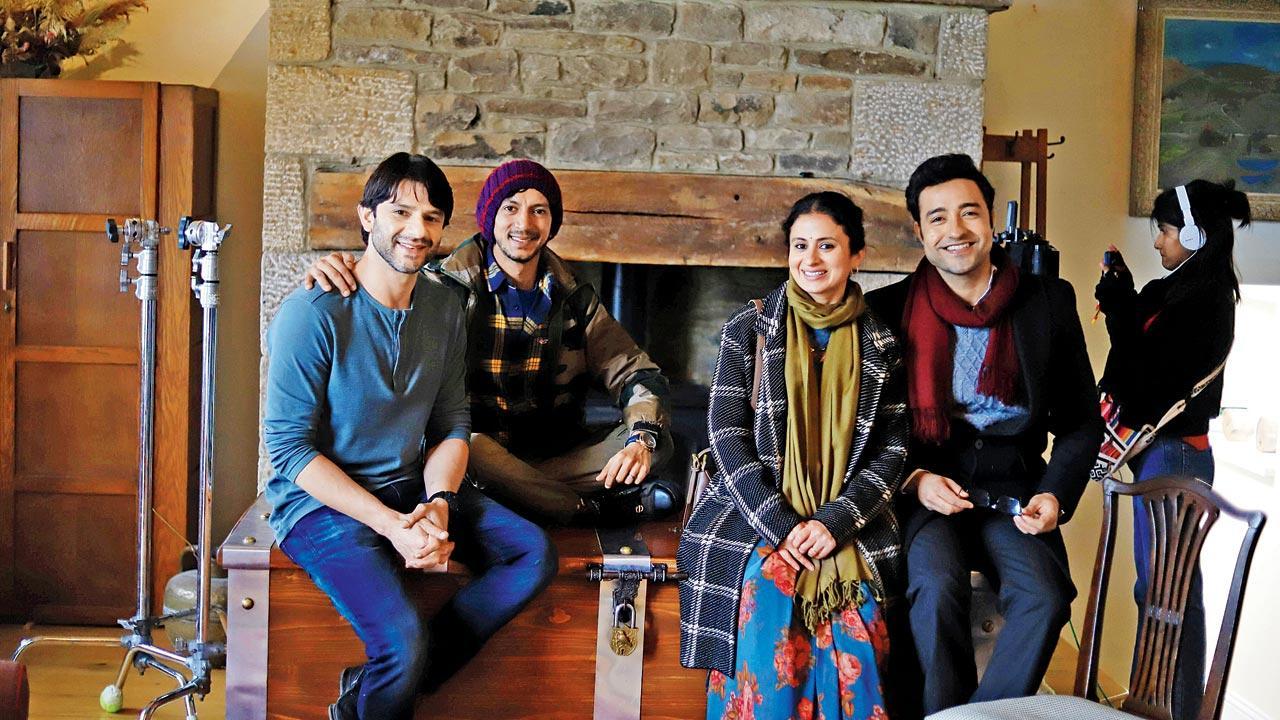
Hiren Kotwani (MID-DAY; April 16, 2023)
Almost 12 years after he made his acting debut, Love Sex Aur Dhokha actor Anshuman Jha is set to foray into direction. An ensemble cast including Arjun Mathur, Rasika Dugal, Zoha Rahman, Paresh Pahuja, Tanmay Dhanania, and Garrick Hagon (of Star Wars fame) join him for his directorial debut, Lord Curzon Ki Haveli.
Interestingly, Jha adopted the rarely-employed technology of shooting the movie on a single lens of 35mm, a technique that was used by legendary filmmakers Alfred Hitchcock and Akira Kurosawa for classics like Psycho and Rashomon, respectively.
Writer Bikas Mishra, who has penned the script of Lord Curzon Ki Haveli, reveals, “Anshuman had made the choice on the writing table to shoot the film on a single lens.” French DoP Jean Marc Selva and Indian cinematographer Ramanuj Dutta believe the move is a “brave and ballsy one” by the first-time filmmaker.
Selva says, “Anshuman had a clear vision and is not afraid to take risks as an artiste.”
As he oversees the post-production of the film, Jha says, “While I had lens options at my disposal, using this technique implied that the viewers would be able to watch the film with a vision that was as close to how we normally perceive things. A single lens film has a subconscious viewing effect, and I wanted the film to look and feel like a cohesive one.”
Jha shares that Lord Curzon Ki Haveli is a contemporary homage to his favourite filmmaker, Hitchcock, and his cult classic, The Rope. The black comedy thriller, which revolves around four South Asians who meet in London over an unplanned dinner, is being readied for a release later this year.
It’s satisfying that our film was liked by New York’s LGBTQIA community-Anshuman Jha
8:07 AM

Tanvi Trivedi (BOMBAY TIMES; December 2, 2019)
Film and theatre actor Anshuman Jha, who debuted in Bollywood with Dibakar Banerjee’s Love, Sex Aur Dhoka (2010) and went on to do offbeat films like Yeh Hai Bakrapur (2014), Chauranga (2014), Angrezi Mein Kehte Hain (2017) and No Fathers In Kashmir (2019), is thrilled. His new film Hum Bhi Akele Tum Bhi Akele (HBATBA), directed by Harish Vyas, has bagged the Best Film Audience Choice Award at the HBO South Asian International Film Festival at its World Premiere in New York City. Excerpts from a chat:
You have done several impressive offbeat films, but a role like this must have been a different challenge. Tell us about your part and prep for the film?
HBATBA is India’s first LGBTQIA film after the Supreme Court’s landmark judgement decriminalising homosexuality in 2018. The film revolves around the friendship between a gay man and a lesbian (played by Zareen Khan) as they embark on a road journey. Veer’s role (my character) was offered to many actors before it finally came to me, and I am glad they all rejected it (laughs!). I was never hesitant to play a gay character, but everyone around me told me that it was not a good idea. However, I took it up as a challenge and did a lot of homework. I read up a lot and met people from the community. HBATBA has been an immensely draining yet satisfying experience. We received great appreciation from the LGBTQIA community in New York. And, the best part is, we were voted the winners. That makes me proud. In India, the community has been repressed for long and judged by society. So, my job as a heterosexual man was to portray Veer in the most sensitive manner possible — without playing him in a conventional way (as we have often seen in our cinema) and making a caricature of the character.
You have played a variety of characters in your career so far. Which of them do you identify the most with?
Over the years, I have realised that I identify the most with vulnerable characters - on stage and screen. Luckily, I have been offered unconventional roles. In my next, Midnight Delhi, I play reallife serial killer, Blademan. I think that even a criminal has a human side to him, and I find portraying that vulnerability challenging. I have never networked for roles and have picked the best from what I was offered.
How was it working with Zareen Khan in HBATBA?
There is a good actor in her, and she must do more roles like this. Our equation and chemistry translated well on screen.
Do you think films like HBATBA will change the way LGBTQIA characters are written for our films?
I think that it’s already changing. Shakun Batra did it with Kapoor & Sons (2016), and our film will take it a step further. Harish Vyas has written the two characters (played by Zareen and me) as a celebration of the community. There was a popular line from a Karan Johar film that I grew up on — ‘Pyaar Dosti Hai’. This film is about discovering that love in friendship.
You are also turning director in 2020…
Bikas Mishra, who I worked with in Chauranga, has written the script of Lord Curzon Ki Haveli, and we both felt that it would be best if I directed it as I am very close to it. It’s a black comedy and features Tannishtha Chatterjee and Arjun Mathur. Two more leads are yet to be locked. It will roll out in the UK in early 2020.
Apart from working on your directorial, what else is on the cards in 2020?
On the personal front, 2019 has been a tough year. My mother is battling cancer, and I have shifted her from Delhi to Mumbai. Hopefully, she will be better soon. For now, I want to cherish every moment with her. Professionally, it’s inspiring to see the kind of work actors like Ranveer Singh, Ayushmann Khurrana, Vicky Kaushal and Vikrant Massey are doing. I also admire Anurag Kashyap and Zoya Akhtar’s work, and hopefully, I will get an opportunity to work with them in 2020.

I’m feeling angry and frustrated thanks to the Censors-Onir
5:06 AM

Producer Onir lashes out at the Censor Board for chopping two crucial scenes in Chauranga
Upala KBR (DNA; November 29, 2015)
 Onir’s Chauranga, produced by him and Sanjay Suri and
directed by Bikas Ranjan Mishra, based on the story of a Brahmin
zamindar from Jharkhand, has run into censor trouble. Sanjay’s (the
village head) lovemaking scene between him and Tannishtha Chatterjee,
who works in his home, is a very crucial part of the film, but the
Censors have asked Onir to remove part of it, as they feel the
lovemaking scene is derogatory to women. Another scene involving a Dalit
boy being pushed into a well has also been asked to be deleted.
Crucial scenes
About these scenes, Onir says, “Every scene is crucial for a film as it contributes to the narrative, otherwise it should not be there. Having said that, I feel the sequence of the boy being pushed into the well being objectionable is ridiculous as we see much more of gender/caste/religious violence on screen even in U/A films. And here, we had no shots of the boy in the water. It is all suggested and not graphic. The act was very important as it depicts caste violence which is so prevalent in our society and how even children are not spared. Similarly, the act of love-making in the film was not to sensationalize but to explain power politics.”
Moving backwards
Does he feel that the Censor Board is being unnecessarily harsh? “I think the film certification board needs a total fresh approach to certification. Introducing grading is long overdue. Also, they need to accept that in the day of internet/TV and print, this form of censorship is discrimination towards the film industry. We have a huge adult population and should have the right to see adult films and they should also be shown by satellite channels post 11 pm. And yes, we seem to be moving backwards in terms of what is acceptable. About the scenes, we are discussing it with the director Bikas Mishra. It is his baby and we will let him make the final call.”
Censoring minds
The Board’s decision has left the filmmaker feeling angry and very frustrated. Onir says, “One seems to be subconsciously censoring one’s mind. The creative process is getting hampered as this affects the economics of the film. I am angry when I see people get away with what is actually questionable. While the Board is apparently strict with films like Chauranga, they let others with more adult/controversial scenes. I suppose it has to do with sensibility. There are people who understand that the way many “item numbers” depict women” need to be questioned in terms of what it tells a largely male chauvinistic society is okay and others think “just harmless entertainment’. I wondered why would I AM gets certified ‘A’ and Bombay Talkies ‘U/A’. The reason for this dialogue and the constant discussion is a hope for change. The film industry as a whole, and not just me, want the certification process revamped.”
The ‘real’ story
Bikas says, “Chauranga was prompted by a news story. The film is my understanding of the village life where a gruesome act of killing is possible in the name of preserving the sanctity of caste system. It’s a fictional re-telling of the actual incident set in a real village where I grew up and which I was part of.”
Chauranga is the story of an infatuated young boy, Santu, who faced death for writing a love letter in a remote village, steeped deeply in caste hierarchy, oppression and debauchery. Unaware of the consequences, Santu nurtures defiance and infatuation. It won the Best Indian Film award at MAMI last year and also the Grand Jury prize at Indian Film Festival of Los Angeles IFFLA, is slated to release on January 8 next year.
Winning National Award doesn't always translate into theatrical release
9:06 AM

Bharati Dubey (MID-DAY; April 21, 2014)
If the fate of some films is any indication, winning a National Award is not enough for the movie to get a theatrical release. Three films — The Coffin Maker, Liar’s Dice, Astu, and Kaphal — that won National Awards this year are yet to get a proper Friday release. Saeed Mirza, who heads the jury for National Awards, concedes that this is a reality. “It is true that many award-winning films have not released yet. It could be lack of marketing and distribution; it could be a certain socio-political and economic situation, but that’s no reason to deny their validity. It doesn’t deter us from judging these films for the National Awards.”
In such a scenario, should the government make it mandatory for National Award-winning films to get at least a one-week release in cinema halls? Mirza replies with a matter-of-fact question: “ Who does one put pressure on in order to get these film screened in cinema halls?” Actor Adil Husain, who is best known for his role in Gauri Shinde’s English Vinglish (2012), stars in the National Award-winning film, Lessons in Forgetting. He wants the government to formulate a policy where feted movies get a theatrical release.
He says, “My film got a limited release through PVR Director’s Rare, but they don’t really have enough money to market the film and reach out to a wider audience. I think there is a need to make it mandatory for cinema halls to screen such films for at least a week.”
 Veena Bakshi, who directed
the Naseeruddin Shah-starrer, The Coffin Maker — it won this year’s
National Award for the Best Feature Film in English and is yet to
release in cinemas — says, “We have been in talks with a corporate
house even before the film bagged a National Award and now we are hoping
that winning this honour will help the film get some distributors. But
yes, I feel that the loss of traditional distributorship is affecting
the sale of films like these.”
The success of films like Ship of Theseus and The Lunchbox has definitely added to filmmakers’ confidence. Veena adds, “The success of Ship of Theseus lies in the fact that it opened in five theatres and its audience grew due to word of mouth. These films will not set the cash register ringing within a weekend. But it will bring in audiences over time.”
In the earlier days, films, once completed, would be screened for distributors, who’d then go with their gut feeling. Trade analyst Taran Adarsh says, “Back then, films were sold territory-wise. Also, winning a National Award is often construed as a sign of the film being more art-house and thus offering less commercial viability. This attitude has not really changed. Unlike in the West, where, if a film is nominated for the Oscars, it immediately gets screened in cinema halls.” Similarly,
 Geetanjali Thapa (right)
may have won the Best Actress award for her work in Liar’s Dice. But the
film, that was completed more than a year ago, hasn’t got a theatrical
release. Nawazuddin Siddiqui (below, right), who plays a lead role in the film, says, “The film has been doing the rounds of the festival circuit for some
time now. Thanks to the National Award, the film should now get a
better release. The film’s producers are planning to release it soon.”
He also feels that often films are victims of ‘bad luck’. “Even a
beautiful film like Ankhon Dekhi barely got noticed due to the lack of
marketing,” he says.
 It may be pointed out here that Nitin
Kakkar’s film, Filmistaan (below, left), bagged the National Award for the Best
Feature Film in Hindi in 2012. But the film is releasing in June this year — thanks to UTV and Shringar Films — after a gap of two years. Shyam Shroff from Shringar films adds, “When we came on board as its
distributors, Filmistaan was already ready and it had received its
certification. It was a mutual decision to edit the film further and
give it a major marketing fillip. We even recorded an additional audio
track and then UTV came on board. Of course, all this happened
over time.”
 Bikas Mishra, the editor of the website Dear Cinema, points
out that a new wave of cinema has now hit Bollywood. “These are
films that have been reaching out to audiences both in terms of
storytelling and distribution. Ship of Theseus found a supporter in
Kiran Rao and UTV; the documentary Gulabi Gang has now won the award for
the Best Film on Social Issues. These are exciting times for
independent filmmakers as the channels of release have certainly
expanded. Then again, releasing such a film continues to be
challenging because you still need a star-presenter or a mainstream
studio to back your indie production.”
Other instances include the Usha Jadhav-starrer Dhag (2012), which won three National Awards in 2012; the film released in theatres only last month. Marathi films such as Shala, Anumati, and Samhita too released more than a year after winning top honours. Another example is Priyadarshan’s bilingual film, Kanchivaram, that also released a year after it bagged won two National Awards.

Subscribe to:
Posts (Atom)