Showing posts with label Bhoot. Show all posts
Showing posts with label Bhoot. Show all posts
Behind the screams: Decoding the craft of horror filmmaking
10:08 AM

Vinay MR Mishra (BOMBAY TIMES; October 29, 2025)
What makes a good horror film truly terrifying? It’s not just the blood-curdling screams, eerie silences or sudden jump scares — it’s the invisible architecture behind the fear. The best horror filmmakers know that real terror lies in storytelling, emotion and technical precision. Crafting fear that lingers long after the credits roll demands far more than prosthetics and dim lighting; it requires vision, patience and a deep understanding of human psychology.
As Halloween approaches, BT speaks to directors who have ventured into the dark corridors of horror cinema to decode what makes the genre so challenging and rewarding to create.
‘Invest in the story, the scares are just packaging’
For any director, the heart of a horror film is its story. Without it, scares feel hollow. Pavan Kirpalani, who directed Ragini MMS and Phobia, emphasizes that a strong script and invested characters are the foundation. “What makes a good horror film is a good script, a good story and a good theme. You have to invest in the story; invest in the world you’re entering into. Then the scares are just packaging. An action movie without a story is hollow. Once you have characters that you care about, the horror becomes intriguing, and the stakes are higher,” he explains.
‘When you fear the unknown, it has to exist in a world you recognize’
Aditya Sarpotdar, director of Munjya and Thamma, believes relatability amplifies fear. “What always works in a good horror film is a relatable set-up. When you fear the unknown, it has to exist in a world you recognise,” he says. Recalling Bhoot directed by Ram Gopal Varma, he adds, “A ghost in a Mumbai apartment was terrifying. I thought... why wouldn’t the ghost be around where I am? That relatability is everything.”
‘It’s difficult to get horror films backed by producers’
Despite the recent success of films like Shaitaan and Stree 2, directors admit that pure horror remains a hard sell. “It’s difficult to get horror films backed by producers. A horror comedy is easier because it casts a wider net. Straight horror, production-wise and money-wise, is tougher to mount. We are still nowhere close to what the West is doing with it. We are still barely scratching the surface when it comes to horror,” says Pavan Kirpalani.
‘Unfortunately, people here make horror films to make a quick buck’
For director Vishal Furia, passion is paramount. “A filmmaker’s absolute love for the genre is what it takes to make a horror film. Unfortunately, people in India make horror films just to make a quick buck. But then they end up making a shoddy horror film, which is why the genre has not evolved in Bollywood. But if a filmmaker really puts his passion and love into the film, then he can make something interesting out of it,” he states.
‘Only when the actor feels scared is when the audience feels scared’
When asked if it is a challenging genre to direct, Aditya Sarpotdar says, “Horror is difficult to direct because making the audience enter the world that you’re building depends on many factors, like the way you tell the story, the performances and other technicalities.”
Vishal Furia adds, “When the actor feels scared is when the audience feels scared. Even the person playing the ghost has to be mentally and physically strong. Under layers of prosthetic and constant retakes, performance can suffer. That’s why it’s one of the hardest genres to direct.”
On the other hand, Pavan Kirpalani believes, “A horror movie is easier to make as you’re only striding one tone.”
‘Horror is a very technical genre’
Once the story is set, horror lives in the craft. Vishal Furia, of Chhorii fame, believes this is a very technical genre. “Every department has to work perfectly. One misstep, and the scene could look funny or pull the audience out. The mood has to be consistent. The DOP, sound designer, prosthetics team, editor — everyone must be in rhythm. One bad lighting cue can kill a scare,” he explains.
Pavan Kirpalani echoes this and adds, “Making a horror film is a technical process. Sound, prosthetics, VFX, camera work, lighting — everything has to align. But most important is, what the character is doing, driven by the story.”
There was no fallout between Ram Gopal Varma and me-Urmila Matondkar
8:34 AM

Renuka Vyavahare (BOMBAY TIMES; January 21, 2025)
Urmila Matondkar made fitness fashionable much before Bollywood lapped up the gym culture. Her chiselled body and glam quotient, especially in Rangeela, and her dance moves in songs like Kambakth Ishq and Chamma Chamma were a game changer in the ’90s. When it came to her performances, the director with whom she delivered some of the highs of her career was Ram Gopal Varma (RGV) with films like Rangeela. Bhoot, Jungle, Kaun? and Satya. With Satya (1998) back in the cinemas, Urmila reunited with the talented cast and crew of the film recently, including RGV, who for the longest time considered Urmila his muse. Over the years, rumours of a fallout between the two have been a topic of chatter within industry circles. In an exclusive conversation with us, Urmila addressed the speculations for the first time and recalled her memories of Satya.
‘Rangeela made me a huge star and Satya made me unlearn that’
Talking about how she had to drop the glam girl image and remodel herself as a girl-next-door for the film, Urmila says, “When Satya happened, I was probably the only known face in the movie. Rest were talented newcomers. RGV was counting on me to pull it off. Rangeela made me a huge star and Satya made me unlearn that. When you have spent many years trying to become somebody and have to shed that status overnight to become a nobody, that was me in Satya. My character Vidya in the film has no identity of her own, she is literally relevant because she happens to be Satya’s neighbour. To step back into a girl next door avatar was a huge challenge. I remember using my mother’s old saris which she was on the verge of giving up and draping them because I felt it was perfect for the role. I am glad I could use my star status in a film that went on to become one of our finest.”
‘RGV is one of our finest filmmakers’
Appreciating RGV’s contribution to cinema, Urmila adds, “Ramu ji is undoubtedly one of our finest filmmakers. Look at his body of work and the kind of talent he got into the film industry. Not just actors, but cinematographers, technicians, writers and music directors. At the screening of Satya’s re-release, Sriram Raghavan, Madhu Mantena and Anurag Kashyap were there for him as they all had started out with him. He is an institution in cinema. I am proud of the work I have done with Ram Gopal Varma. If the right opportunity comes along, I would love to collaborate with Manoj Bajpayee and Ramu ji again.”
‘I made it on my own without anyone’s backing’
Dismissing rumours about their fallout, Urmila revealed, “There is no such thing as we stopped working. There was no fallout between RGV and me. I even did special songs in his movies like Company and Ram Gopal Varma Ki Aag. The 90’s media was obsessed with everything about me except for my acting capability. Today, people openly talk about nepotism. Back in the day, too, there were actors around me who came from film families. Many couldn’t handle the fact that this nobody coming from a middle-class Marathi background was simply doing her work and shining. I made it on my own without anyone’s backing. I will say this proudly, that I am a people made star. My work has always spoken for itself.”
‘I’m glad the media today has a different perspective on women’
Urmila’s biggest grouse is her portrayal by the media in the 90’s. “My body of work included films like Kaun?, Bhoot, Ek Hasina Thi, Pinjar, Rangeela, Maine Gandhi Ko Nahin Mara… but I was still slotted as an item girl or a sex siren. Rangeela is also about a simple girl, who dreams big. The sexy image you see of her is her screen image or a character’s fantasy. I am glad the media today has a deeper understanding and a different perspective on women,” she says.
The great and not so great side of working with RGV
Speaking of the process of working with RGV, Urmila says, “It’s not that I was in every movie that Ramuji made. I am sure he didn’t think that he would put me in every movie either. He is a director who gives you great freedom to explore and that is a lot of work. He expects the actor to do a lot of work. He puts you in a dark room and tries his voice to guide you through that room, but it is you, who has to find your way out. It is you who must take that character to the finality. This work process is great and not so great part of him. It grows you tremendously as an actor, but those who cannot find their own way will not be able to make it.”
----------------------------------------------
Want to spend my life creating something as worthy as Satya - RGV
In a post on X, filmmaker Ram Gopal Varma talked about Satya and wrote, “Some of my later films might have been successful but I do not believe that any of them had the same honesty and integrity which is in SATYA.”
He added, “When Francis Coppola was asked by an interviewer about a film he made after GODFATHER, whether it would be as good, I could see him squirming because I could see that it didn’t occur to him. No one asked me about any film I was about to make post SATYA whether it will be as good, but what’s worse is that I didn’t ask myself… whatever little of my life is left, I want to spend it sincerely and create something as worthy as SATYA.” Addressing Urmila, he added, "“Satya went so beyond the rangeela glamorous quotient you were already known for. It is you alone in Satya who made the film much more than just a gangster drama to give it a deeper soul. It’s no small feat to stand out in such a man’s world, but you did it unbelievably effortlessly.”
There is also enough work for everyone-Bhumi Pednekar
8:21 AM

HINDUSTAN TIMES (November 29, 2019)
With two comedies and a horror film in the pipeline, Bhumi Pednekar is excited to charter new and different genres. After being part of entertaining films that have dealt with social messages, the actor promises good content with enough entertainment even in her upcoming films. In a quick chat, Bhumi talks about competition, the younger generation of actors, and attempting her first horror film. Excerpts:
How would you describe your rapport with the younger generation of actors?
Firstly, I am happy for Ayushmann (Khurrana) and he deserves all the accolades. This means you just have to have faith and everything will work out. Everyone I am working with is so good. Even Kartik Aaryan is fantastic in Pati Patni Aur Woh. He’s such a surprise package and we had a blast working. The thing is earlier, I didn’t know him at all, and through this experience we have become friends, and someone I enjoyed working with. Even Ananya is so good. I think the current generation is chill and not insecure about silly things that need no attention. There is also enough work for everyone. There is so much content being generated that it is not dirty competition any more. Everyone is supporting each other.
Bhoot – Part One: The Haunted Ship is your first horror film. Do you feel the horror genre is less explored in India?
I think Bhoot is going to be a genre-breaking film. I have known the director for many years, he is the reason I did this film. It’s a fantastic script. I feel horror has a lot to do with the audio and the technical aspects of it. What he has done is really going to surprise people.
Do you like to watch horror films?
I am really scared of watching horror films. I don’t know how I would watch this one (laughs). I watched Ram Gopal Varma’s Bhoot (2003), and I think that is the most amount of horror I have ever seen.
You have shot for films back-to-back. How do you deal with work pressure?
I think just spending time your family, chanting, taking out some me time, and working out.
Do you find time for your personal life?
Not at the moment. But it’s all good. I have barely been home for the year and half. My personal life is non-existent at the moment.
Do you believe in a healthy work-life balance and do actors get to do that?
I believe in it 100%, but I don’t think actors have that. I think it is very difficult to maintain that balance. But, I am trying to really get there. I am a workaholic. The only thing that makes me happy is work. And that is what I am doing.
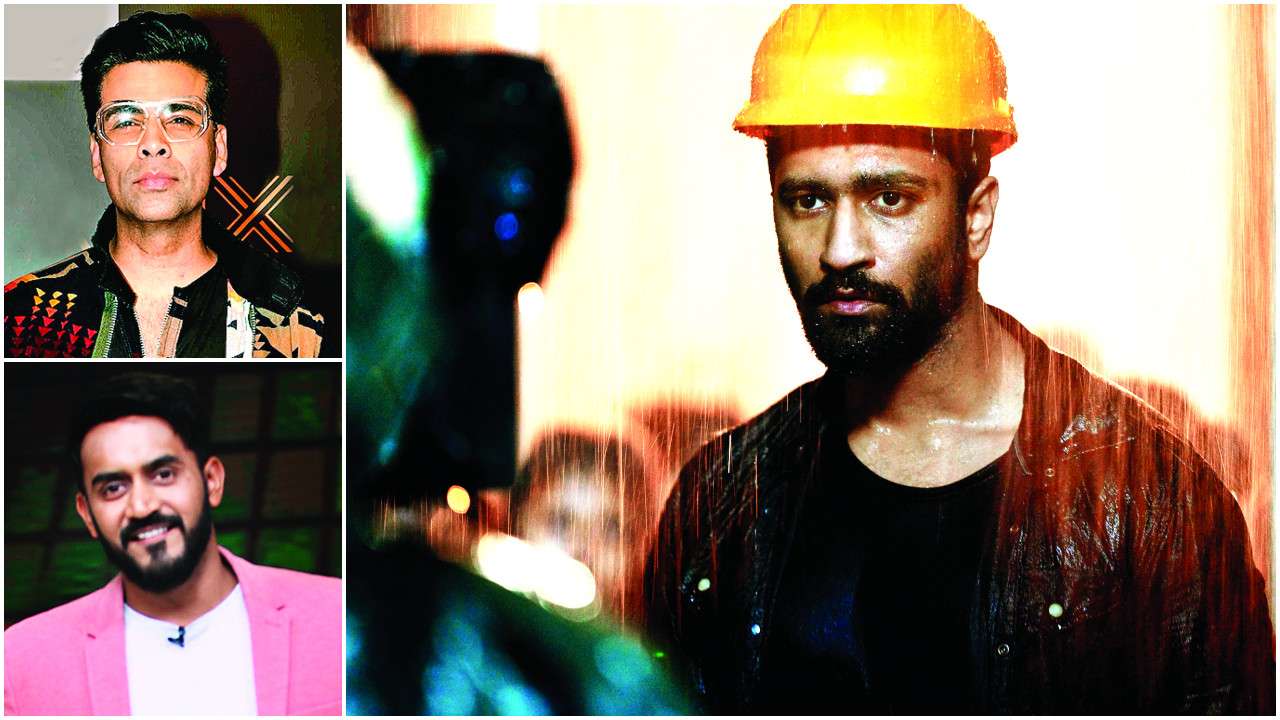
Karan Johar kick-starts horror franchise with Bhoot – Part One: The Haunted Ship starring Vicky Kaushal
8:22 AM

BOMBAY TIMES (June 10, 2019)
Over the last decade or so, Karan Johar has added several firsts to his banner, Dharma Productions, which was founded by his late father, Yash Johar. The company has backed family dramas, comedies, action entertainers and suspense thrillers while trying to strike a balance between conventional and unconventional spaces.
After flagging off Student Of The Year (a high-school franchise) and …Ki Dulhania (a romantic-comedy franchise with Varun Dhawan and Alia Bhatt), Karan will now back a horror franchise. The first film in the eerie series is titled BHOOT — Part One: The Haunted Ship, directed by debutant Bhanu Pratap Singh.
Karan was keen on the title BHOOT, which he felt was apt for the genre. Film buffs would recall that Ram Gopal Varma had made two films under the same title in the early 2000s. Though Karan and RGV share a history of indulging in a tussle of words on social media, it’s learnt that KJo reached out to the latter, requesting for the title for his new franchise. And, RGV instantly honoured his request.
Thanking his gesture, Karan told BT, “I made an unreasonable request to Ramu, asking him for his franchise title BHOOT and he graciously and magnanimously agreed to give it to us without even blinking an eyelid. All of us at Dharma are blown away by his generosity and are eternally grateful to him. We aspire to make sure the title is in the right hands of horror.”
BHOOT — Part One: The Haunted Ship marks director Shashank Khaitan’s debut as a producer. It’s also Vicky Kaushal’s second outing with the banner. The film, shot at some lesser-explored locations in Gujarat, has also been backed by Karan’s mother Hiroo Johar and Apoorva Mehta (CEO, Dharma Productions). The makers plan to release the film on November 15, 2019.
--------------------------
Hiren Kotwani (DNA; June 10, 2019)
Over the years, Karan Johar and his banner Dharma Productions have become synonymous with rom-coms and family entertainers. Now, the maverick filmmaker is set to create his first horror franchise with Bhoot – Part One: The Haunted Ship.
Starring Vicky Kaushal, the movie is helmed by debutant Bhanu Pratap Singh, who has earlier assisted Shashank Khaitan on Humpty Sharma Ki Dulhania (2014). This is Vicky’s second film with the banner and the first in this genre. Shashank is also producing the movie along with Karan, Hiroo Johar and Apoorva Mehta.
The idea for the script came from Bhanu, a horror enthusiast, who was also Shashank’s batchmate at a film school, before he assisted the latter on the Varun Dhawan-Alia Bhatt rom-com. Later, he started working on the concept and developed it with the Dhadak director, who suggested taking it to Dharma Productions. Bhanu, who was initially apprehensive since the production house hasn’t made any films in this genre after Kaal (2005), narrated the plot to KJo. Shashank tells us, “Karan loved it. Bhoot – Part One: The Haunted Ship is based on a true incident that took place in Bombay. The shooting is complete. The post-production is underway and the film will open in cinemas on November 15 this year.”
Based on a ship, as the title suggests, the movie also has a good dose of VFX, work on which is underway. The filmmaker adds, “The intent is to create a series. We’re looking at making more authentic films, even horror comedies. Bhanu and I have discussed a few ideas. It’s an exciting time to take the franchise ahead.”
The makers also approached Ram Gopal Varma as he had the rights to the title. After all, he had helmed the 2003 hit Bhoot. “It was extremely gracious of RGV to give the title to us,” Shashank concludes.
Revealed: Ram Gopal Varma's Bhoot made Ajay Devgn swear off elevators
8:06 AM

Himesh Mankad (MUMBAI MIRROR; May 8, 2019)
 Ajay Devgn may have set the cash registers ringing with his larger-than-life, macho turns on the big screen, but by his own admission, he scares easy. During a recent turn on The Kapil Sharma Show with his De De Pyar De co-stars Tabu and Rakul Preet Singh, the actor recounted a hairraising story from the sets of Ram Gopal Varma’s 2003 spook-fest Bhoot.
At the time of the incident, the film’s team was shooting on the 28th floor of a building and one day, while he was on his way to the spot, the elevator Ajay was riding in malfunctioned. “It crashed from the fourth floor to the basement and I was stuck in it for an hour and a half. After that, I only took the stairs to reach the location even though it was on the 28th floor,” the 50-year-old actor revealed, adding that he would climb up and down the stairs as many as four times a day during the month-long schedule. “The incident made me claustrophobic,” he added.
In the aftermath of the mishap, Ajay makes sure to take an elevator only if it has glass walls so that he is visible to the outside world. In another segment, Ajay shared that he decided to become an actor because of his father, veteran stunt director Veeru Devgan. “I wanted to explore other aspects of filmmaking like stunts, but my father was adamant to get me into acting,” he said.
Anushka Sharma's Pari to Vikram Bhatt's 1921: Here's why Bollywood horror films are not scary enough
8:10 AM

Dhaval Roy (DNA; April 17, 2018)
This year has seen two horror films hitting the marquee so far — Vikram Bhatt’s 1921 in January and Anushka Sharma’s Pari: Not a Fairy Tale in March. While the former was the fourth instalment in the 1920 franchise, the latter was given the onus of being the game changer for the genre, right from the time the teaser was released. As the film’s lead and producer Anushka Sharma dared the audience to check the movie out, spook fest lovers geared for a scare fest. The excitement for a Hollywood-like horror film was palpable. Pari released on March 2 and received mixed reactions. While Hollywood usually gets the horror formula right, the makers back home can’t seem to nail it.
THERE IS AN AUDIENCE
The success of Hollywood movies like Conjuring (2013), Insidious (2013), IT (2017) and others establishes the fact that we do like the jeepers creepers. However, we have our reservations when it comes to Indian horror movies. That’s no thanks to the decades of dilution of the genre, which makes such flicks tickle the funny bone rather than send chills down the spine. Much has already been said about cringe-worthy monsters, songs, and horrex (horror+sex — Hawa (2003), Ragini MMS (2011) and Ragini MMS 2 (2014) to name a few) that Indian fear files have been reduced to.
Ifrit-spawn Pari was the manna from Heaven (or Hell, as it were) that was meant to turn things around. So, what happened? Well, the film is just... different. It has the elements — the darkness, jumpscare, a stellar performance by Anushka, and a not-so-filmi treatment. But, the audience expected the film to be scarier. However, the film’s director Prosit Roy explains, “Pari is an atmospheric horror film. It’s not the conventional genre because we don’t see that kind in India.” He admits that the film was an artistic experiment. And, from the looks of it, people will take time to accept it. “It’s not going to happen overnight,” he says.
IT’S A TRICKY SITUATION
Fans of the horror genre hanker for the good stuff like Conjuring — closer home Ram Gopal Varma’s Raat (1992), and Bhoot (2003) — and anything lesser just doesn’t cut it for them. Vajir Singh, Editor, Box Office India magazine, agrees, “Since foreign film lovers don’t like Indian films, filmmakers are only left with audiences that expect song, romance and titillation with a few scary scenes thrown in. It’s a tricky situation because flicks that are made like Hollywood ones have a limited audience.” Central India distributor, Aditya Chowksey, concurs, “Offbeat films like Pizza (2013) don’t really work for the Indian audience yet, especially in smaller towns. They are more welcoming of Vikram Bhatt’s Raaz (2002) and the 1920 (2008) series or Bhushan Patel’s Alone (2015). If you make a movie for multiplex goers, it won’t work.”
STAR PRESENCE
Other than the chills, also usually missing in the genre is big names. There was Golmaal Again (2017) with Ajay Devgn and Tabu, but that was primarily a comedy. Bhool Bhulaiyaa (2007) starring Vidya Balan and Akshay Kumar was also horror comedy. Before Pari, leading names were perhaps last seen 15-odd years ago — Urmila Matondkar and Ajay Devgn in Bhoot. Vajir says, “When a big actor does something out of the box, it grabs attention. Look at the success of Bhoot or even Jaani Dushman (1979). It had a cast like Sunil Dutt, Rekha, Jeetendra, etc and Sanjeev Kumar playing a monster.” Aditya also mentions Ek Nanhi Munni Ladki Thi (1970), supposedly the first horror movie by Ramsay that starred big names of the time, Prithviraj Kapoor and Mumtaz. But the front line actors now stay away from these movies keeping the more-crass-than-creeps treatment in mind. Vajir emphasises, “I think if we want Bollywood horror to be as big as Hollywood, A-list actors must take up such films.”
Thankfully for Prosit, Anushka has always chosen character-driven roles and didn’t need much persuasion to come on board. The director-writer is confident that big actors would be open to horror films. He says, “It purely depends on the quality of the story. If it’s interesting, they would do it.” Vajir drives home this point by giving the instance of Sidharth Malhotra who told Box Office India that he’d like to star in a horror film if the content is good.
SOMEONE HAS TO START
Just like stars, if leading production houses backed such films, scary movies will cease to be a niche category. Like Vajir says, “Leaders are supposed to lead the way. If big players decide to take up this genre, we will see a change.” Prosit urges, “Someone has to start. We can’t always think of making things that are conventional. India has the tendency to make the same kind of stuff in this genre — there’s a ghost or a demon and every other element — comedy, romance, action. Ultimately, it does not seem like a horror film. That’s something that needs to be broken.”
Whether Pari will break that remains to be seen but we are hopeful. “I’ve heard of some upcoming horror projects,” Prosit says. “I hope the reasonable success of Pari pushes the envelope,” Aditya concludes.
Ram Gopal Varma reveals exclusive, interesting details about his memorable films
11:21 AM

The filmmaker takes us through almost three decades of movie magic
Roshmila Bhattacharya (MUMBAI MIRROR; May 6, 2017)
SARKAR 1, SARKAR RAJ, SARKAR 3 (2005, 2008, 2017)
Strangely during all the films I have done with Amitabh Bachchan over the years, including the Sarkar series, only once have we had a difference of opinion. It was over a scene in the original Sarkar, where he throws his son Vishnu out of the house. I wanted him to play it cold-bloodedly, without emotion, as if the son he was chucking out were an insect. But he thought that given that they were father and son, he show some anger. I argued that when you take a decision like this, it means you have given up all hope so there should be no reason to rage. He disagreed and finally we did the scene his way. But that night, around 11 pm, he called me to say, "Ramu, I've been thinking about this scene and I feel now that you were right. Let's reshoot it tomorrow."

I see Subhash Nagre aka Sarkar as a realistic Superman, who people can look up to and depend upon to solve their problems when the establishment fails them. For me, he is a graphic comic book character who does not age, who I conceived for Bachchan, whom I, as a film watcher, had studied over the years. It was a culmination of the cumulative effect he had on me since Zanjeer. As the principal protagonist, Sarkar is integral to the franchise and I can't imagine any other actor playing the role. Sarkar has become synonymous with Amitabh Bachchan, just like doodh and milk.

BHOOT (2003)
I love to scare people. As a child, I used to hide behind the door and say, "Boo!" Now, I make horror fantasies even though I don't believe in ghosts. Yet, one night, after wrapping up the shooting of Bhoot at around 2 am, I returned to my apartment, where I live alone and in my L-shaped bedroom, I was lying on the bed when suddenly I got the feeling that the ghost from the film, Manjeet Khosla, was standing behind the wall.
I kept staring at the wall, but couldn't muster the courage to get up and check. I tried to laugh off my irrational fears, but the eerie feeling wouldn't go away. I turned my back to the wall and tried to will myself to nod off. But sleep wouldn't and I found myself turning to look at the wall again, this time calling out softly, "Manjeet? Manjeet?" I was greeted by silence and chuckling over how foolishly I was behaving, I turned again and shut my eyes resolutely.
Moments later, I heard the sound of footsteps and felt someone get into the bed with me. The soft sigh of someone breathing creeped me out. I turned, to be confronted by... nothing!
This time, I jumped up and, rushing to the phone, placing a call to Barkha Madan, the actress playing Manjeet whose ghost haunts the apartment. Only after speaking with her was I reassured that neither she nor her bhoot had entered my apartment.

COMPANY (2002)
I chanced to meet a gentleman who was very close to the D-Company, not a criminal really but more of a business associate. In the course of our conversation, he told me that in the fight between Dawood Ibrahim and Chhota Rajan a number of people had got killed, yet the two guys still had so much love for each other. "Even today, if Dawood bhai calls, Chhota Rajan will stub out his cigarette instantly. They hate each other because they love each other so much," he told me. The last sentence caught my fancy and was the genesis of Company.
The premise of a mentor and his protege whose relationship slowly sours over ego issues is true of any company. The only difference is that in a normal company, a person gets fired if he doesn't do his job well or falls out of favour with the boss. In D-Company, they get fired, literally. The gentleman, who was my muse, was shot dead just months after I met him.

SATYA (1998)
I was sitting with someone when we got the news that Gulshan Kumar had been killed. I had met Gulshanji a couple of times and was shocked. The gentleman I was with knew him well and had spoken to him just that morning at 7 am. He mentioned that he had called him back an hour later. We have this habit of recounting details when a violent death occurs. And listening to him, a thought flashed through my mind. If Gulshanji woke up at 7 am, then when did his killer jump out of bed, I wondered. Before or after killing him, did he have breakfast? I know that these questions may sound strange, even funny, but they are relevant even though we only think of assassins when they kill or when they are killed. But between the two acts, they are people like any of us leading normal lives. They could be walking on the street, sitting beside you in the bus or the movie theatre and none the wiser. To see a guy like this in his world is what sowed the seeds of Satya.
The film made Manoj Bajpayee synonymous with Bhiku Mhatre. He had caught my attention in a small role in Shekhar Kapur's Bandit Queen after which I cast him in a brief appearance in Daud. I was impressed by his focus and intensity, both as an actor and a person, and ended up giving him this iconic role in Satya.

RANGEELA (1995)
I have five favourite films—The Exorcist, Mackenna's Gold, The Godfather, Dr Strangelove and The Sound of Music. Rangeela was my The Sound of Music where every character is lovable; it's the situations that create conflict. A R Rahman was new back then and to visually interpret his music on screen was a challenge.
I didn't think there was anything special about Aamir Khan (who played the lovable Munna) as an actor, but when I met him I was impressed with his dedication, focus and earnestness. I had not seen another actor who was more sincere, which is why I cast him as the street-smart orphan who makes a living selling movie tickets in black.
Why Urmila Matondkar? Well, I had gone to sign Madhuri Dixit for a film titled Drohi. She was not available, so we signed Urmila instead. I loved her spirit, her expressive face and her happy feet. I remember once when the choreographer couldn't make it to the set on time as he had missed his train, I told her to do the song herself. I was mesmerised by the way she danced and when Rangeela came up, she was my choice to play Mili, the movie extra who aspires to be a star and ends up with two men in love with her.

RAAT (1992)
Raat was the first film I wanted to make, even before Shiva. It was a really special film in terms of camerawork, the six-track stereophonic sound, the music and Revathy's performance. But back in the '90s, when our audience was still watching Ramsay horror flicks, it was perhaps a little too subtle and sophisticated for their liking, maybe even too cerebral.
Raat aficionados have grown over the last decade. Today, I have young girls aged 17 and 18 coming up and telling me that their favourite horror film is Raat, which they have seen on TV. When I hear that it surprises me. I wonder how the film on whose technicalities we lavished so much time and attention, can work on television? I don't know if I'd want to remake Raat, but I am working on another horror film. And today, I think I have finally understood the core of this genre.
I'll never do a film my kids can't watch-Ajay Devgn
8:03 AM

After Rascals and Bhoot, Ajay Devgn admits he won't sign an adult comedy or horror film; will abide by Censor's guidelines even if he doesn't agree with them
Sanyukta Iyer (MUMBAI MIRROR; August 21, 2015)
Ajay Devgn has over five films lined up in 2015-16. The actor will be seen in a funloving avtaar, in Milan Luthria's slice of life film, Baadshaho, where he romances Shruti Haasan and Lisa Haydon. He is also simultaneously working on two scripts, under his own banner. "One among them is my production for Kajol, which will go on floors in December. She will wrap up Dilwale by then too," Ajay told Mirror.
Meanwhile, the 46-year-old actor-producer has commenced working on the second instalment of Son of Sardaar. The original released in 2012. But the only similarity between the two films is their titles. Unlike the original action comedy, Sons of Sardaar will tell the story of the 21 Sikhs who fought to death in the 1897 Battle of Saragarhi.
Ajay insists that his selection of films highlights the fact that he's only interested in movies that can be watched with the family. "I had made a clear-cut statement after Rascals that I will never do a film like this again. Why do a film that I cannot show my children?" Ajay told Mirror, adding that he does not want to make difficult choices anymore.
"I have never had a problem with the Censors, but there are some things that I clearly don't agree with. Nonetheless, I follow everything to the T. There are particular guidelines about what a character can and cannot do on screen, but if he smokes, he smokes. You want a statutory warning, we will run the film with one," he points out.
Throwing light on the issue of the certification received for his latest release, Drishyam, he says that the film empowers women, has no illicit scenes and is a family entertainer, which was given a U/A. "The film has been widely watched in the South. That's the kind of films I will do. It may not be the highest grosser of the year, but it's a film that is well-received and has a decent opening," he says, adding that apart from adult comedies and dark satires, he will also reject horror films. "It's not just the Censor guidelines. Horror is a genre that is impossible to sell on satellite. Making them on a concise budget is another problem," he states. His 2003-supernatural thriller, Bhoot was an eye-opener for him. "After Bhoot, I decided against doing another horror film. It's too much trouble," he says.
Talking about his action drama, Shivaay, which is being produced under his banner, and will be filmed in Bulgaria, Ajay says making movies is a constant learning experience. "I am still learning to keep costs under control. Due to the songs and big action sequences, scripts of Golmaal and Singham could have grand budgets. I have learnt that with specific audiences, it's not about box-office returns, but the cost of production. As soon as you get into profits, you're a hit!"
Within the four walls of their house, Ajay and Kajol never discuss films. "There are so many other things that make for dinner table conversations that we never bring up the movies," he says. Referring to his daughter, Nysa,12 and son Yug, 5, Ajay says that today's kids make their own choices. "As parents, you have to support them. In our home, we don't involve them in the film industry or its matters," he smiles.
Barkha Madan: The nun who sold her movie dream
10:43 AM

Miss India finalist Barkha Madan, who played the bhoot in RGV's horror film, will be back in Indian theatres after 12 years with Surkhaab, a film she produced before turning into a nun.
Roshmilla Bhattacharya (MUMBAI MIRROR; May 1, 2015)
On November 4, 2012, actress Barkha Madan renounced the world. The decision wasn't prompted by financial lows, professional woes or heartbreak. Barkha, who now goes by the name Gyalten Samsen, was a Miss India finalist in 1984, the year that Sushmita Sen and Aishwarya Rai won big at the beauty pageant and went on to conquer the universe and the world.
After a successful stint as a model, Barkha herself stormed into Bollywood with Khiladiyon Ka Khiladi in 1996. She has fond memories of shopping with Rekha, watching Akshay Kumar rehearse his stunts for hours and smiling at a handsome 7-foot giant who turned out to be The Undertaker, the WWF champion Akshay knocks out.
The same year, she starred in the Indo-Dutch production, Driving Miss Palmen, before vanishing from the screen for seven years. She returning to spook in and as Ram Gopal Varma's Bhoot, and followed up with 20-odd TV shows. To the world, she'd found her calling. She herself admits that despite the highs and lows, the occasional proposition she was never desperate enough to accept, she enjoyed being an actress and was fascinated by the world of make-believe reality. But there was a nagging restlessness, niggling questions about whether this was her life's purpose.
As a sixth grader she'd visited a monastery in Sikkim where her army officer father was posted and had felt at home. In 2002, the feeling of home-coming returned while she was listening to the Dalai Lama in Dharamsala. Drawn by the happiness on his face, she asked Lama Zopa Rinpoche if she could make her a nun too.
Rinpoche laughed, "Why ? You fought with your boyfriend? Joining the monastic order isn't about escapism. You need to embrace Buddhist philosophy and reflect on why you want to walk the path of Divination."
Over the next decade, Barkha set up a production company and made two films, Soch Lo (2010) and Surkhaab (2012). "Everything was going well but I felt something was missing," she reminsces, explaining her reasons for going to a monastery in Kathmandu and asking to join the Buddhist monastic order.
Lama Zopa Rimpoche went for divination and returned to inform her that she would be ordained at 9 am the next day. "I made a call to my parents. They offered me their support. And borrowing a robe, I embraced my new life," says Barkha.
Today, the 41 year old's wardrobe is down to two sets of robes, some woollens to ward off the chill and a pair of flipflops. "My only worldly possessions are my cell phone and laptop. I live off my savings but I'm blissfully happy," says Barkha who claims to be first Indian nun from the non-Himalayan region.
Right now, she is offering prayers for the victims of the Nepal earthquake. Otherwise, she can be found meditating at Dharamsala or caring for HIV positive kids at the Tara Children's Project in Bodh Gaya. "Years ago, I had told the judges at a beauty pageant that if I won, I'd work with under-privileged children. I'm doing that now," she points out.
She will soon be promoting Surkhaab which releases in India a year-anda-half after after winning awards and accolades in the US and Canada where it opened in 2012. The film about illegal immigration and human trafficking, has her playing Jeet, a Judo gold medallist forced to flee her country. "It was shot in Toronto and Punjab in just 25 days with a skeletal 10-member unit on a shoe-string budget. I was the co-producer, the lead actress, and the chaiwallah," she laughs.
Does she see herself making another movie? "Not unless it's a nun's story," she retorts. What about her own story? Barkha insists other nuns have better stories to tell, pointing to her teacher-mentor Ven. Robina Courtin, a martial arts expert from England, fondly referred to as the Dalai Lama's bodyguard. "Her life's work with death row prisoners in the Kentucky State Penitentiary spun two documentarie, On the Road Home (1998) and Chasing Buddha (2000), and Vicki Mackenzie's book, Why Buddhism? (2003)," she says. "Hjetsunma Tenzin Palmo, another English born nun, was the subject of the documentary, Cave In The Snow (2002). She spent 12 years in an Himalayan Cave and eventually started a nunnery, Dongyu Gatsal Lin."
Barkha herself wants to start a nunnery in India. "If you want to make movies you go to a film school. If you want to become a doctor, you go to a medical school. But where does an aspiring nun go to?" she asks.
A look at scary, 'sexy' and downright hilarious horror films of Bollywood
8:09 AM
Shubha Shetty-Saha (MID-DAY; April 9, 2014)
Ghost films in Bollywood first tried to gain sympathy, then moved on to being downright hilarious and are now more practical and err… somewhat domesticated.
Ghosts that remember
Popular in films of the 1940s, 1950s and 1960s ( read: Mahal, Bees Saal Baad and the likes), these were heroines-in-white who would die and turn into ghosts, instead of being reborn.
Their only mission was to get back to the man they loved in their previous life and scare the hell out of him.
A prototype scene: In the middle of the night, only the hero can hear a soulful song in Lata Mangeshkar’s voice emanating from somewhere in the distance. He gets out of the house and the next moment, he finds himself in the middle of a thick jungle following a vision in white.
The apparition wears her long hair open, and is sometimes equipped with a burning candle. She also looks sad, really sad. The hero has to show that he is perplexed but is also in the mood to help her out of her misery. But then she disappears now and then and reappears on a swing or some such random place, to coolly continue with the next para of the sad song.
The foolish hero spends the night anxiously looking for the woman who’s here one minute and absent the next. Talk about some women not being able to make up their minds.
Bhatt films’ sexy ghosts

Mukesh Bhatt produced Raaz and Raaz 2, and then Vikram Bhatt carried the horror lineage forward with 1920, 1920 Evil Returns, Haunted, and other similar films. The Bhatts like their ghosts to belong to the scantily clad, sexy variety. Most of these horror and sex films worked well at the BO.
A prototype scene: The hero and heroine are embroiled in hot, intimate scenes with a lot of kisses thrown in and the “ ghost” is watching them from a distance.
The cult Ramsay movies

The Ramsays, who can be easily called the horror papas of Bollywood, gave us a series of successful films which might have not evoked fear but nevertheless managed to entertain big time with their generous doses of sex, masala and action. Ramsays weren’t sexists when it came to ghosts. Their ghosts were both male and female, whereas most other filmmakers preferred women ghosts.
Prototype scenes:
1. A semi-nude lady is taking a shower in a big, isolated house with all its doors thrown open, and the ghost is just about to strike her.
2. A group of youngsters or a couple in love get stranded in a jungle and knock on the door of a big, eerie-looking bungalow. Even as the background music reaches a deafening crescendo, an old, ugly housekeeper with a bad hair day opens the door. He has a menacing- looking lantern in his hand.
 The really scary ones
Say what you want about him, but no one understood ghosts better than Ram Gopal Verma. Films such as Raat and Bhoot only reiterate this. Remember that theatre scene in Raat or that truly scary one in Bhoot, when Urmila Matondkar catches Barkha Madam staring at her through the bedroom door when she wakes up? Brrr…. Give us more of these We would love to see more sublime versions of ghosts like the ones Dimple Kapadia and Hema Malini played in Gulzar’s film, Lekin.
Recent versions
In recent times, the ghost has become mild and kind with Amitabh Bachchan playing the benevolent Bhootnath. Ekta Kapoor’s Marathi- speaking ghosts in the films, Ragini MMS and Ragini MMS2, however, continue to be menacing and destructive.
Disappeared into thin air?
These girls played ghosts and then vanished from the film scene:
. Malini Sharma, who played the ghost in Raaz.
. Barkha Madan, who played the titular ghost in the film, Bhoot.
Ramsays weren’t sexists when it came to ghosts. Their ghosts were both male and female, whereas most other filmmakers preferred women ghosts
Ghost films in Bollywood first tried to gain sympathy, then moved on to being downright hilarious and are now more practical and err… somewhat domesticated.
Ghosts that remember
Popular in films of the 1940s, 1950s and 1960s ( read: Mahal, Bees Saal Baad and the likes), these were heroines-in-white who would die and turn into ghosts, instead of being reborn.
Their only mission was to get back to the man they loved in their previous life and scare the hell out of him.
A prototype scene: In the middle of the night, only the hero can hear a soulful song in Lata Mangeshkar’s voice emanating from somewhere in the distance. He gets out of the house and the next moment, he finds himself in the middle of a thick jungle following a vision in white.
The apparition wears her long hair open, and is sometimes equipped with a burning candle. She also looks sad, really sad. The hero has to show that he is perplexed but is also in the mood to help her out of her misery. But then she disappears now and then and reappears on a swing or some such random place, to coolly continue with the next para of the sad song.
The foolish hero spends the night anxiously looking for the woman who’s here one minute and absent the next. Talk about some women not being able to make up their minds.
Bhatt films’ sexy ghosts
Mukesh Bhatt produced Raaz and Raaz 2, and then Vikram Bhatt carried the horror lineage forward with 1920, 1920 Evil Returns, Haunted, and other similar films. The Bhatts like their ghosts to belong to the scantily clad, sexy variety. Most of these horror and sex films worked well at the BO.
A prototype scene: The hero and heroine are embroiled in hot, intimate scenes with a lot of kisses thrown in and the “ ghost” is watching them from a distance.
The cult Ramsay movies
The Ramsays, who can be easily called the horror papas of Bollywood, gave us a series of successful films which might have not evoked fear but nevertheless managed to entertain big time with their generous doses of sex, masala and action. Ramsays weren’t sexists when it came to ghosts. Their ghosts were both male and female, whereas most other filmmakers preferred women ghosts.
Prototype scenes:
1. A semi-nude lady is taking a shower in a big, isolated house with all its doors thrown open, and the ghost is just about to strike her.
2. A group of youngsters or a couple in love get stranded in a jungle and knock on the door of a big, eerie-looking bungalow. Even as the background music reaches a deafening crescendo, an old, ugly housekeeper with a bad hair day opens the door. He has a menacing- looking lantern in his hand.
 The really scary ones
 Say what you want about him, but no one understood ghosts better than Ram Gopal Verma. Films such as Raat and Bhoot only reiterate this. Remember that theatre scene in Raat or that truly scary one in Bhoot, when Urmila Matondkar catches Barkha Madam staring at her through the bedroom door when she wakes up? Brrr…. Give us more of these We would love to see more sublime versions of ghosts like the ones Dimple Kapadia and Hema Malini played in Gulzar’s film, Lekin.
Recent versions
In recent times, the ghost has become mild and kind with Amitabh Bachchan playing the benevolent Bhootnath. Ekta Kapoor’s Marathi- speaking ghosts in the films, Ragini MMS and Ragini MMS2, however, continue to be menacing and destructive.
Disappeared into thin air?
These girls played ghosts and then vanished from the film scene:
. Malini Sharma, who played the ghost in Raaz.
. Barkha Madan, who played the titular ghost in the film, Bhoot.
Ramsays weren’t sexists when it came to ghosts. Their ghosts were both male and female, whereas most other filmmakers preferred women ghosts
Subscribe to:
Posts (Atom)