Showing posts with label Bhavani Iyer interview. Show all posts
Showing posts with label Bhavani Iyer interview. Show all posts
It’s overwhelming to see that, even after 20 years, Black still touches people’s hearts-Sanjay Leela Bhansali
8:17 AM
Niharika Lal (BOMBAY TIMES; February 8, 2025)
From its characters and settings to the interplay of light and darkness, Black told a unique story with an exceptional cast. As the film marks 20 years, we reflect on the making of this cinematic masterpiece.
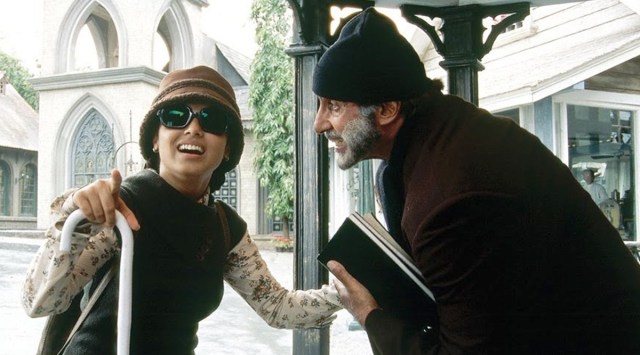
On the 20th anniversary of Black, director Sanjay Leela Bhansali says, "Black is a film that means a lot to me. I’m grateful for the love it has received from the audience, and for the incredible performances of Amitabh Bachchan, Rani Mukerji, Ayesha Kapur, and Shernaz Patel, along with all the talented technicians who made it so special. It’s overwhelming to see that, even after 20 years, Black still touches people’s hearts.”
The film's writer, Bhavani Iyer, revisits Black, a film that marked her screenwriting debut. Bhavani Iyer says, “Sanjay involved me in every part of the filmmaking process. On set, he'd ensure that I had a chair next to him. I couldn’t have asked for a better start in the film industry.”
Over the years, she wrote films like Lootera, Guzarish, Raazi, and Sam Bahadur, but when she started working on Black, she was still in her 20s, and says, “Sanjay never tried to manipulate my writing. There was never an attempt to do anything that was not true to the writing. And that spoiled me for life because that is what I look for in all my collaborations since I found it in that film. The way Sanjay stuck to the script is something that helped me understand how important writing is and how crucial the script is.”
'Sanjay wanted to explore a biopic based on the life of Helen Keller'
Bhavani Iyer made her screenwriting debut with Sanjay Leela Bhansali's Black. Narrating the story of how Black came about, she recalls, "I knew Vikramaditya Motwane; he had assisted Sanjay before. Sanjay had just finished Devdas, and he wanted to meet writers and explore different subjects. Sanjay spoke to me about two subjects he wanted to explore - one was a remake of Balika Vadhu, and the other was a biopic based on the life of Helen Keller. I found the Helen Keller idea very exciting. I had not watched too many films in my life - I was very young and in my 20s at the time. I had also read William Gibson’s play The Miracle Worker (about Helen Keller). That was the play Sanjay wanted to base the film on. My first meeting with him was on March 28, and by April 15, I had my first draft ready for him to read. Things escalated quickly, and by December that year, we were already shooting the film."
There were some issues with the rights, so the story was fictionalized. Bhavani says, "Sanjay involved me in every part of the filmmaking. On set, he'd ensure that I had a chair next to him. I could not have asked for a better start in the film industry."
'We wanted the teacher to be slightly unlikeable'
Bhavani Iyer shares that the characterizations were strongly defined in the first few days of writing.
She says, "Both Sanjay and I agreed with my suggestion that the teacher should be slightly unlikeable. He (Amitabh Bachchan's character, Debraj Sahai) is politically incorrect. He doesn't have a filter. He takes charge. I also felt that a teacher working with someone with special needs can't have too many filters, as they need to take charge of the pupil. The film is set during a time when there were not many schools for children with special needs. The teacher is in a phase of his life when he is retiring. What happens is that as we age, we don’t really care about the world or what people think. So, Debraj's character is at a stage where he doesn't care about anything but the job at hand - that kind of lends eccentricity to him. I also wanted him to be a poetry lover, quoting poetry. We kept exploring him through writing, and then Mr. Bachchan came in and gave him a completely different life altogether."
From the beginning, I was clear that there comes a point when the student becomes the teacher.
Bhavani recalls that she thought it would be interesting to tell the story as a relationship between a teacher and a student as it’s not a subject that has been explored much in our films. She says, “Sanjay also loved the idea. We decided to make the gender of the teacher male, as it would give us more opportunities to explore the teacher-student dynamic. That worked out beautifully. We felt that if we wanted to make the film in English, the family had to be anglo-Indian.”
However, she says that it could not have been just a story of a student and a teacher; it would have become too linear. From the beginning, she was clear that there comes a point when the student becomes the teacher.
She says, "The freedom of words that the teacher gave to Michelle - he needed to lose those words. I have seen people with Alzheimer's in my life, so I knew what it does. I knew what it can do to people, especially those with such a felicity for words. Whether it's a teacher or a writer, for them to lose words is devastating - I know that. So, I needed Michelle’s triumph of graduating to be bittersweet. There is a gasp of light when she recognizes that movement - when Debraj touches the graduation hat, which was once the dance of failure but now turns into the dance of victory. I feel that, many times, you just need the right teacher or the right push to realise what you're capable of.”
'Story had to be set in a surreal place'
Because of the snow, landscape, and the visual narrative that Sanjay Leela Bhansali wanted for the film, Shimla was chosen as the setting for the story. "The story had to be set in a place that is surreal and has an element of magic realism - like the scene where Michelle finds her teacher completely covered in snow," she recalls.
She says, "I think we benefitted in Black from some incredible casting and performances, with actors who brought much more to the characters than one could have imagined."
‘The title was Black because, right from the phonetics, we wanted to draw the audience into the world that is hers’
The film has a number of dialogues about darkness and light. Sharing her thought process behind it, Bhavani says, "There is a scene where Debraj locks Michelle in a room and the lights go off. Here she has the advantage, like he says - 'Without light, what's the use of sight?' Constantly, the idea was between lightness and darkness, and that was the thought because that’s the world Michelle inhabits. Even the title was Black because it needed that, right from the phonetics, to draw the audience into the world that is hers, which we wanted them to know and experience. Even in the visual setting, Sanjay did his best, and so did the DOP Ravi K. Chandran. Darkness and light were constantly endeavoured throughout the film - whether it was the white snow, the white corridors of the hospital, or the black walls of the house. The monochromatic theme was something we constantly endeavoured, whether it was in the visuals or clothes."
"Both Debraj and Michelle have qualities that I think are somewhat borrowed from my own life. The teacher that he is, is a lot like my dad - the teacher that my dad was. My dad was a very gentle person as opposed to Debraj. All that I know about my craft and the art of writing is what I learned from my father, and that is reflected in Michelle’s speech when she talks about how she grew from strength to strength, all thanks to her teacher," says Bhavani Iyer.
Talking about writing the character of Michelle, she says, "Michelle, to me, is someone whose handicap doesn't define her. She's not just a deaf and mute girl - she is a woman with a purpose, and she wants to achieve something, which, in her case, is graduation. It didn't matter to her that she had a handicap. She needs to achieve what she has set out to do."
She shares, "Shernaz (Patel) brought the mother's character the quiet strength, which is what we wanted. We didn't want the mother to be overbearing because the father was a tougher man, like some fathers who are not given to expressing love. He may love the child, but at this point, the child is an inconvenience, and he doesn't know any other way to resolve this other than sending her away. So, we needed the mother to be quiet and strong. Shernaz lent such gravitas to the character; you could see her strength, and you could see that she was unflinching and unshakeable."
Sabyasachi Mukherjee won the National Award in 2005 for Best Costume Designer for this film. “Black is a period film set in the 1960s. The plot necessitated my using a lot of monochromatic colours like grays, blacks, beige, browns, khakis, and indigo. I deliberately worked towards lending a definite colourlessness to the film,” he said during the release of the film in 2005.
Trivia
- Halfway through the schedule, the original set of Black was destroyed in a fire at Film City. To maintain continuity, the entire set was meticulously rebuilt with every detail carefully recreated.
- Almost everyone working on the film, spent a couple of months learning ASL (American Sign Language)
- The film won three National Awards. Amitabh Bachchan for Best Actor, Sabyasachi Mukherjee for costume and the Best Feature Film
Storytelling is the right way to cut through (hate politics)-Bhavani Iyer
8:05 AM

Nominated for Best Writing for Kaafir in the upcoming mid-day and Radio City Hitlist Web Awards, Bhavani Iyer discusses why Dia Mirza starrer is relevant in today's political climate
Mohar Basu (MID-DAY; March 3, 2020)
 At a time when India-Pakistan ties are fraught with tension, Kaafir is not an easy story to tell. But writer Bhavani Iyer was resolute in her decision to bring the true story — of Shehnaz who hailed from Pakistan-occupied Kashmir but was put behind bars in India after being suspected of being a militant — to the screen.
"I don't know if she has watched the show, but the Shehnaz I knew 14 years ago, left me moved," begins Iyer.
"Shenaz spoke about her horrors with such normalcy and heart, that I knew she had forgiven and moved on from what had happened with her," says Iyer of the woman who inspired Dia Mirza's character, Kainaaz, in the Zee5 offering. The sensitively told story has won her a nomination for Best Writing in the upcoming mid-day and Radio City Hitlist Web Awards.
"When the show released, I received love from across the border. Viewers called me to say that they liked the fact that Pakistani characters haven't been vilified," emphasises the writer. "When I was writing the show, I remember driving through Ludhiana, and the driver showed us a view of the border. It dawned on me that people on the other side are just the same."
While the material was powerful, Iyer says it was only enhanced by Mirza's mature performance. "We would talk for hours thinking of how to approach her character. The idea was to retain the character's fragility, without making her bechari. She said something beautiful to me; Dia said she wanted to be in my head and wanted to keep me in her heart."
Not many know that the show was originally conceived of as a movie. With the first season garnering appreciation, work on the second edition has begun. "Kaafir 2 has to reflect what's currently happening in the country, from an insider's perspective. My politics comes from an idealistic space. I grew up in a secular democracy. I am frightened for our future generations because we are bringing them on up hate. Storytelling is the right way to cut through the cacophony."
More About Kaafir
- Bhavani Iyer insisted on adding the court scene in which Vedant [Mohit Raina's character] narrates Kainaaz's journey — how she was taken to prison and raped for years; and ends it saying 'Imagine if she was an Indian.' Apparently, it was intended to evoke empathy since people from both sides of the border, who still await trials, have been branded militants basis suspicions.
- Iyer's favourite scene is the one where Raina's character comforts Kainaaz by embracing her. The chemistry brings the scene alive even with no dialogues to fall back on.
- Cast Your Vote For The Hitlist Web Awards
- Bhavani Iyer has been nominated in the Best Writing category for Zee5's Kaafir
The other nominees are:
- The Family Man (Raj-DK, Suman Kumar, Sumit Arora; Amazon Prime)
- Made in Heaven (Zoya Akhtar, Reema Kagti, Alankrita Shrivastava; Amazon Prime)
- Little Things S03 (Dhruv Sehgal, Nupur Pai, Garima Pura Patiyaalvi, Abhinandan Sridhar; Netflix)
- Delhi Crime (Richie Mehta; Netflix)
- Gullak (Nikhil Vijay; SonyLIV)
- Kaafir enjoys four nominations, including Best Series, Best Actor (Male), Best Actor (Female) and Best Writing.
- There are 14 categories that the public can vote in. Log on to www.hitlistwebawards.com to cast your vote.
- You can also vote via SMS. Send HITLIST <space> category name <space> your choice (a/b/c/d as on the website) to 57575.
- Voting lines close on March 8
It feels like Kashmir has adopted me-Bhavani Iyer
8:38 AM

After Raazi and Kaafir, writer Bhavani Iyer set to pen another web series based on the history of the Valley
Letty Mariam Abraham (MID-DAY; July 9, 2019)
She may be a woman of few words, but give her a pen and paper, and her stories will do the talking. Bhavani Iyer, who — with a repertoire that includes Black (2005), Guzaarish (2010) and Raazi (2018) — has fast sealed her place as one of the most promising screenwriters in the industry, is busy at work on her next web series that chronicles the history of Kashmir.
“The show is titled Srinagar. The first season will showcase the events between 1985 and 2000 while season two will chronicle [the time] from 1947 to 1971,” says Iyer, whose last work, Kaafir, too was set in the state. It easy to see that the Valley, with its trials and tribulations, holds a special place in her heart. “I’ve been there so many times, it feels like Kashmir has adopted me,” she smiles.
Directed by Onir, the latest series will go on floors next year. The research and material collated for her past offerings will come handy as she gives shape to her new project. “I have met people who have been part of the custodial system, legal system, the BSF and CRPF. Onir and I have done exhaustive research on the state. We have recorded different perspectives on the issues and how the locals are merely pawns in a political minefield that being created.”
Narrating a story of the Valley comes with its set of controversies, but Iyer has faith in her material. "I don’t intend to tell the story for the sake of sensationalising it. I want to chronicle it to give people all the perspectives on the subject. We sit here cocooned in our safety, unaware of the pain and angst that the Kashmiris carry within themselves. I met this young boy who said, ‘Aaj main school bus se utra, toh meri talashi huyi’ [I was searched when I got off the school bus]. For him, it is a rite of passage. Why is that the reality of 13-year-old, when we can change it? I ruffle a few feathers in the process, so be it.”
Subscribe to:
Posts (Atom)