Showing posts with label Bharosa. Show all posts
Showing posts with label Bharosa. Show all posts
Casting Guru Dutt: Why Kollywood courted Bollywood’s brooding romantic
8:27 AM

In The 1960S, Amid Flops And Personal Storms, The Actor Took A Step Back From Making Movies, Spurring South Indian Directors To Quickly Cast Him In Hindi Remakes Of Regional Hits
Vamanan (THE TIMES OF INDIA; June 21, 2025)
Apart from his short life span of 39 years, film-maker/actor Guru Dutt had this in common with the epochal Tamil poet Subrahmanya Bharati: Like the latter, he had recognition and apotheosis thrust upon him only after his death. Even as Bharati’s seminal lines of poetry are eternally etched in the Tamil consciousness, the songs of Dutt’s films project evergreen lyrical hues of great human significance. Who can forget the anthemic refrain in ‘Pyaasa’ penned for Dutt by the incomparable Sahir Ludhianvi, ‘Yeh duniya agar mil bhi jaaye tho kya hai’ (To what avail is personal victory in a world bereft of human values)!
More directly underscoring the Tamil literature connection of Dutt was his little-known fascination for the work of the prince-turned ascetic and poet, Ilango, and his urge to picturise his epic ‘Silappadhikaram’ with Waheeda Rehman playing the role of Madhavi, the other woman in the life of the epic’s protagonist Kovalan who suffered the tragic fate of decapitation for a crime he had not committed. But that was not to be because of Dutt’s untimely death in Oct 1964 either due to a deliberate or involuntary overdose of alcohol and sleeping pills.
Known as the grand master of romantic gloom and the alchemist who transformed commercial Hindi cinema’s pedestrian formulas through his individualism, artistry and vision, Dutt’s reputation skyrocketed in the decades after his demise, with Time magazine listing his ‘Pyaasa’(1958) among the hundred all-time great films of world cinema in 2005.
In the early 1960s, consequent on the resounding failure of his ambitious ‘Kaagaz Ke Phool’, India’s first cinemascope film in 1959, after the commercial and critical success of ‘Pyaasa’, Dutt became chary of directing films and preferred to essay roles rather than wield the megaphone, though there is speculation that he might have ghost directed some parts of his successful film ‘Sahib Bibi Aur Ghulam’ (1962) which he produced and played a significant role in.
It was at this point that South Indian film producers found it opportune to cast the famous but unassuming director-actor in their quickly made Hindi films based on proven regional language subjects. Guru Dutt too, tired of the tempests raging in his life, both because of his difficult relationship with his wife Geeta Dutt, as well as his growing attachment to Waheeda Rehman whom he had groomed as a heroine, found working in the efficient Kodambakkam studios to his liking.
The first South Indian Hindi film in which Guru Dutt played the male lead was ‘Bahurani’ (1963), which has a gutsy young wife standing up for her newly wed, somewhat mentally challenged husband, against her violent brother-in-law. The film had been earlier made in Telugu as ‘Ardhangi’ (1955) and in Tamil as ‘Pennin Perumai’ (1956). In the Tamil version, Gemini Ganesan had essayed the role played by Guru Dutt in the Hindi re-make. Guru Dutt was directed in the film by the veteran Telugu-Tamil filmmaker T Prakash Rao who had such hits as Sivaji Ganesan’s ‘Uthamaputhiram’ (1958) and MGR’s ‘Padagotti’ (1964) to his credit. The film, however, did not make waves.
N Vasudeva Menon, an AVM studio manager who had become a producer and studio owner himself, booked Guru Dutt for ‘Bharosa’ (1963), a remake of the Tamil ‘Thedi Vandha Selvam’ (1958), an ordinary film about a wronged hero with a golden heart. It was a role in which Guru Dutt was comfortable in, though the film did not have much to write home about.
The famous producer A L Srinivasan, known for his connections with Hindi film personalities and all-India film trade bodies, liked Dutt so much that he booked him for ‘Suhagan’ (1964), the Hindi remake of his own Tamil hit production, ‘Sarada’ (1962), which deals with a husband who can have physical relations with his wife only at the risk of dying. Director K S Gopalakrishnan had been fearful of directing a filmmaker of Dutt’s stature but the latter put him at ease.
More than ‘Suhagan’, it was the time Dutt spent with Gopalakrishnan in his village, Malliyam, near Mayiladuthurai, that proved unforgettable. Gopalakrishnan’s associate, the respected dramatist and writer Komal Swaminathan has recalled Dutt’s easy manner and friendliness in his memoirs. Dutt would spend hours together in the hot sun angling for fish in a village tank. At a time when prohibition was being firmly implemented in Tamil Nadu, Dutt enjoyed potfuls of country toddy with the relish of sipping his favourite Chivas Regal!
After all this merriment, some in place, some out of place, Dutt’s unexpected death came as a shock to the ‘Suhagan’ unit, and producer ALS had to release the film with the message, “I humbly dedicate this film to the everlasting memory of the late Shri Guru Dutt, my friend and your favourite”. Commercial hype apart, Guru Dutt has proved to be of the great favourites of world cinema.
(The writer is a Chennai-based journalist)
Sahir Ludhianvi's notes found at scrap shop
8:31 AM

MID-DAY (September 9, 2019)
A bunch of handwritten letters, diaries and black-and-white photographs of legendary Urdu poet-lyricist Sahir Ludhianvi were found at a scrap shop in Juhu. The priceless stuff has been bought by an NGO for just Rs 3,000, for preservation.
Mumbai-based Film Heritage Foundation, a not-for-profit NGO, found these items recently amid old newspapers and magazines at the shop, and now plans to preserve and exhibit "the archives".
"The diaries found have details of his daily routine, like where he would be going for song recordings, and other personal life happenings. The notes are related to his publishing house, Parchaian," said Shivendra Singh Dungarpur, founding-director of Film Heritage Foundation. "There are letters addressed to him from prominent people of the time, like music composer Ravi, his friend and poet Harbans. Some of the letters are in English, and some in Urdu," he said.
"Then there are his photographs, some with sisters and friends, and some of his home in Punjab. The foundation's experts are analysing the poems and finding out which are the ones that have not got published," he added.
"This is reminiscent of a scene from Guru Dutt's Pyaasa [1957] where the protagonist's poems and writings are found at a scrap shop," Dungarpur recollected. "He had written songs for the film, now considered a cult classic. Several situations in the film, whose protagonist played by Dutt too was a poet, were based on Sahir's life. Our team is always on the lookout for such film-related works. We once found original film reel of Guru Dutt's Bharosa and Sadhna's items in similar condition," he added.
Shocking: Sadhana memorabilia lands up at scrap dealer's
7:40 AM
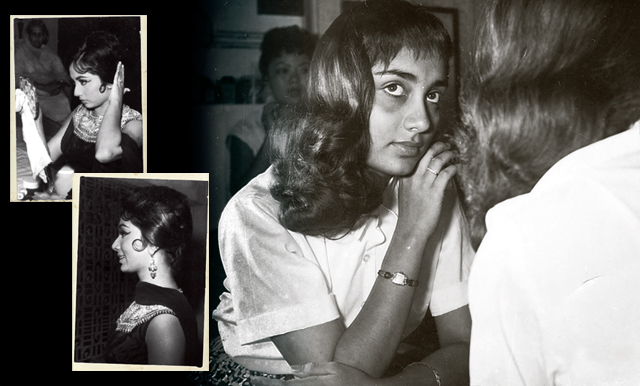
Genesis of the iconic ‘Sadhana cut’
The letters, notes and rare photographs that belonged to the late actress have now been acquired by filmmaker-archivist Shivendra Singh Dungarpur
Roshmila Bhattacharya (MUMBAI MIRROR; November 1, 2018)
Following her premature retirement from the big screen in the mid-70s, actress Sadhana, remembered for films like Love in Shimla, Hum Dono, Asli Naqli, Mere Mehboob, Mera Saaya, Woh Kaun Thi??, Rajkumar, Waqt and Arzoo, had turned into a virtual recluse. And after the demise of her filmmaker-husband R K Nayyar in 1995, the desi Greta Garbo had guarded her privacy even more fervently. Grappling with illness and property disputes, she passed away three years ago, on December 25, 2015. Since the couple had no children, one was clueless about what had happened to her personal effects till a scrap dealer approached filmmaker, restorer and archivist Shivendra Singh Dungarpur a few months ago with a few of her personal belongings.
A few years ago, the founder director of Film Heritage Foundation had connected with Sadhana for personal and film-related material, promising her that the foundation’s archives would conserve and preserve it in its original form using the best storage facilities. Additionally, they would also catalogue and digitise the material so that it would be available for public access down the decades.
Flashbacking to that meeting at her Juhu residence, Shivendra says it was brief and the actress was cagey, telling him that “someone was planning something” and she couldn’t part with any material. He left telling her to get in touch with him should she change her mind. She never called back.
“We did not connect after that but after she passed away, I did wonder what had happened to the memorabilia,” says Shivendra who was contacted a few month ago by a scrap dealer who wishes to remain annonymous. “He goes around with his thela picking up household discards and reselling them. He’d heard that I collect old stuff and asked if I was interested in buying old furniture. I wasn’t but when he told me ‘aur bahut samaan hai’ I called him over.”
To his shock, Shivendra discovered that the kabaadiwallah had rare, never-seen-before photographs of Sadhana, some dating back to her childhood days, of her parents, grandparents, family and friends. There was also pictures from her wedding with Nayyar on March 7, 1966. The couple had met on the sets of the 1960 romance Love in Shimla which had introduced producer Sashadhar Mukherjee’s son Joy and Sadhana (she was seen earlier in a Sindhi film, Abaana as Sheila Ramani’s younger sister) in Hindi cinema and was directed by Nayyar. That was also the first time when Sadhana sported a fringe on screen, inspired by Audrey Hepburn. It later became so synonymous with the ‘60s style icon that it came to be widely known as the ‘Sadhana Cut’.
“There are pictures of her getting the ‘Sadhana Cut’ and how it eventually turned out (see pics). There are around 1,500 photographs, along with her scrapbooks, notes and a few letters. I think before the new residents moved in, someone had instructed that her apartment be cleared. That’s how this scrap dealer got hold of all this invaluable stuff. We bought it from him around a month ago and now the Foundation is sorting and documenting them,” says Shivendra.
Mirror (Jan 5, 2015) had earlier reported how in May 2014, Shivendra had got an SoS call from Bipin, a scrap dealer in Goregaon, who had found the Original Cinema Negative (OCN) of a long forgotten 1963 film, Bharosa, directed by K Shankar and featuring Guru Dutt and Asha Parekh. For Shivendra who had seen the film when working on a script on a Guru Dutt biopic that never got made with Anurag Kashyap, it was quite a find. “We often have to work with dupe negatives because the OCN of several old films, including Pyaasa, is lost to us forever. Several labs have shut shop and thrown away the prints which is perhaps how this one landed up as scrap. Given where it was found, the negative was in pretty good condition. We’ve cleaned it up and now it’s a part of the Foundation,” Dungarpur had informed.
Sadhana’s career hit a roadblock after she was diagnosed with thyroid problems. She went to Boston for treatment and returned to the screen with commercially successful films like Intequam, Ek Phool Do Maali, Aap Aye Bahaar Ayee before her premature retirement and self imposed hibernation following the release of the 1974 murder mystery Geeta Mera Naam. The film was produced by Nayyar and not only had her in a double role but was also directed by her. She produced Pati Parmeshwar in 1989 with Nayyar but after that was rarely seen in public. “We will ensure that everything is preserved for posterity at the archives. I’m grateful these treasures came into our hands and weren’t destroyed,” Shivendra signs off.
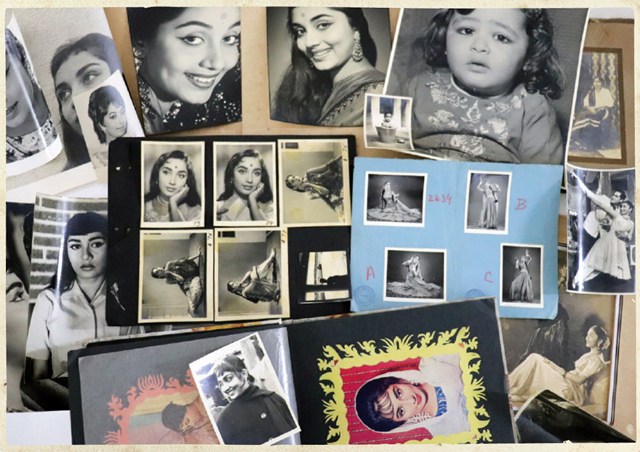
Rare pictures from Sadhana’s personal collection
Scrap dealer finds lost Guru Dutt film Bharosa
7:57 AM

Roshmilla Bhattacharya (MUMBAI MIRROR; January 5, 2014)
 Last May, filmmaker,
archiver and restorer, Shivendra Singh Dungarpur got an SOS call
from Bipin, a kabariwala (scrap dealer) in Goregaon. “I have
something, come have a look,“ he urged. Dungarpur rushed across and was
surprised with the Original Camera Negative (OCN) of a long-forgotten
film, Bharosa.
Directed by K Shankar, this was one of the two Southern productions Guru Dutt had acted in 1963 (the other being T Prakash Rao's Bahurani).
Bharosa was a trite, melodramatic tale of a rich man's son brought up as a menial by his guardian who splurges the money he's been given to make a doctor of his own son. It co-starred Asha Parekh as his gaon ki gori, Mehmood who went by the name Platform MPPS, 'Double Roti' Shubha Khote in a double role and Kanhialal as the wily friend-turned-fraudster. The film is miles away from the classics Guru Dutt produced and directed, like Pyaasa, Chaundvin Ka Chand and Kagaz Ke Phool. So not many were bothered when Bharosa was lost to subsequent cine aficionados. But for Dungarpur who had seen the film while working on the script of a Guru Dutt biopic with Anurag Kashyap a few years ago, it was quite a find. The biopic was never made and Bharosa too slipped away from Dungarpur's memory till Bipin's call.
“The OCN is the starting point of a film. Today, we often have to work with dupe negatives because the OCN of several old films, including Pyaasa, is lost to us. Several labs have shut shop and thrown away the negatives which is perhaps how this one landed up as scrap. Given where it was found, it was in pretty good condition. We've cleaned it up and now it's a part of the Foundation,“ says Dungarpur who set up a non-profit organisation, Film Heritage Foundation, last year. The organisation is dedicated to supporting the conservation, preservation and restoration of the moving image.
Starting February 22, the Foundation in collaboration with Martin Scorsese's Film Foundation, Cineteca di Bologna and L'Immagine Ritrovata will host a week-long school at Mumbai's Film Division. Through lectures and screening it will address issues related to film preservation and restoration and train participants in restoration practices. “For me our films are the cultural heritage many of us have grown up on. We can't let history get away from us,“ he asserts.

Subscribe to:
Posts (Atom)