Showing posts with label Bhansali Productions. Show all posts
Showing posts with label Bhansali Productions. Show all posts
Tuning up the band: Music labels bet on movie companies to hit the high notes
2:52 PM

Saregama & Universal’s investments in production houses aimed at a bigger play in entertainment industry: Analysts
Rajesh N Naidu (THE ECONOMIC TIMES; January 9, 2026)
Mumbai: Recent investments by music labels Saregama India and Universal Music in film producers Bhansali Productions and Excel Entertainment, respectively, point more to a larger play in the entertainment sector than consolidation of film production houses, industry experts told ET.
These investments are disparate both in structure, strategy and goals as opposed to the Adar Poonawala-Dharma Productions deal, and they have been triggered largely by the bearish business conditions in the music industry, they added.
"After a few years of bull run of over 20% compounded annual growth rate in revenue from streamers, YouTube and digital sources, labels today are seeing a bear phase as the industry consolidated, streamers merged or shut shop and free streaming is moving towards paid subscription," said a top executive at a leading industry player, on the condition of anonymity.
"Some of these labels seem to grow through reverse consolidation to build acquisition moats and create a robust pipeline. They may end up producing films," said the executive cited immediately above.
Another aspect that has triggered these investments is the fiercely competitive space of buying music rights in the open market.
"These investments ensure consistent availability of new content at a reasonable cost. In the past few years, competition intensity for music rights in the open market has become too high," said Vaibhav Muley, lead analyst, media and entertainment sector, Yes Securities.
Labels pay Rs. 10 crore-Rs. 33 crore per film if they buy music in the open market, shared analysts. A multi-year deal for music with a production house is almost 30-50% cheaper for labels, they pointed out.
Business Case
Also, these investments are effective from the standpoint of return on capital employed (RoCE) ratio-how effectively a company generates profits using its capital. Analysts shared that monetizing music across avenues provides RoCE of 30-40%, while films generate RoCE of 11%. This shows why buying a stake in production houses is a relatively less risky proposition than directly producing films.
Acquiring stake in production houses is also a win-win strategy, pointed out analysts.
"Today, labels have reasonably good cash on books. They are looking for low-cost avenues to buy music. Investment in production houses is one such route. Production houses get a minimum guarantee amount to start a film and labels in turn get music rights and ownership of films in proportion with their stakes," said an analyst, who declined to be named.
Furthermore, consolidation in the music label industry has prompted incumbents to look for adjacent diversifications.
"Labels are chasing growth. Acquiring labels have become expensive after consolidation (three labels shut shop). Then, there is subdued growth in revenue from streamers due to a shift in subscription mode. These deals reflect these realities," said the analyst cited immediately above.
Industry experts say the distinction between these investments and the Adar Poonawala-Dharma Productions deal.
"These investments do not amount to consolidation among production houses. They are different from Adar Poonawala-Dharma Productions, which is about equal partners. Whereas, after the investments, labels will function as 'strategic investors.' Along with owning music, they will own film rights in proportion with their stakes," explained Gaurav Dagaonkar, co-founder and chief executive officer of Hoopr, a leading platform for music licensing.
Analysts expect labels would integrate talent from their talent management division into the films produced by the production houses more effectively, right from the scripting stage, while also improving the monetization of music assets in these entities.
Saregama to invest Rs 325 crore in Bhansali Productions
9:26 AM

Javed Farooqui & Rajesh Naidu (THE ECONOMIC TIMES; December 17, 2025)
Saregama India has entered into a structured, long-term investment agreement with Bhansali Productions that gives it the option to take majority control of Sanjay Leela Bhansali’s film studio by 2030, while immediately securing rights of all future music created by the banner.
Under the deal, the Kolkata-headquartered music record label and content company will invest Rs. 325 crore in Bhansali Productions through compulsory convertible preference shares (CCPS), the companies said. It will subscribe to 9,960 CCPS of face value Rs. 10 each on or before February 14, 2026.
These preference shares will convert into equity in 2028, at which point Saregama’s stake will be between 28% and 49.9% of Bhansali Productions, depending on the conversion formula.
Following the conversion, Saregama will have the option, but not the obligation, to acquire additional shares to take its holding to 51% by 2030, giving it majority control of the studio.
Pricing for the additional shares will be determined through pre-agreed mechanisms linked to Bhansali Productions’ audited financials.
Alongside the equity investment, Saregama has entered into a music rights agreement under which it will acquire the rights to all future music created and produced by Bhansali Productions.
This provides immediate strategic value to Saregama, regardless of whether it ultimately exercises the option to become a majority owner, amid the ongoing chase for intellectual property in the entertainment industry.
The investment is expected to be earnings-per-share accretive for Saregama by FY27 and to improve margins across both its music and video segments.
“Bhansali Productions’ excellence in storytelling and content creation perfectly complements our leadership in music and entertainment,” said Avarna Jain, vice chairperson of Saregama India.
She said the partnership reflects the company’s strategy of aligning with leading creative talent while delivering long-term shareholder value.
For Saregama, the partnership strengthens two priority areas. It bolsters the video segment of its business and further consolidates its leadership in music licensing, with Bhansali Productions providing access to a steady pipeline of premium original music.
Under the partnership framework, Bhansali Productions will retain complete creative control, while Saregama will provide governance oversight and financial discipline. Bhansali Productions will also retain ownership of the intellectual property of all its films going forward.
Sanjay Leela Bhansali, founder of Bhansali Productions, said meaningful cinema requires time, trust and respect for the creative process. “In Saregama, we have found a partner that understands this philosophy. We share a deep respect for art, music and storytelling that is grounded in tradition and resonates across generations,” he said.
Aligned with its evolving content strategy, Saregama will gradually streamline its in-house film production activities over the next one to two years, focusing on strategic partnerships with marquee creators.
The company currently produces films through its in-house arm, Yoodlee Films.
In FY25, 16% of Saregama’s revenue came from video content, spanning films, digital and short-format programming. Its total revenue for the year stood at Rs. 1,171 crore.
For Bhansali Productions, the capital infusion will support a significant expansion of its content slate across formats, while allowing the studio to retain ownership of its film intellectual property.
The company has a pipeline of more than 10 feature films planned over the next three years. Upcoming projects include Love & War, directed by Sanjay Leela Bhansali and starring Ranbir Kapoor, Alia Bhatt and Vicky Kaushal, and Do Deewane Shehar Mein, a romantic drama directed by Ravi Udyawar and featuring Siddhant Chaturvedi and Mrunal Thakur.
“This is a landmark transaction, coming close on the heels of the Adar Poonawalla–Dharma Productions deal,” said Nitin Menon, managing partner at NV Capital, an investment firm focused on the media and entertainment industry. “Legacy creative brands like Bhansali Productions have strong recall value, and this reinforces the belief that high-quality IP continues to attract long-term capital.”
Over the years, associations have developed between leading film production houses and music labels. Recently, Universal Music partnered with Maddock Films to start a new music label, Mad4Music.
“Strategically, this acquisition makes sense. From the perspective of the industry, consolidation is not necessarily unhealthy,” said Tanuj Garg, partner at film production company Ellipsis Entertainment. “The deal, however, could result in increased concentration of capital among a few players,” he added.
“There is a need for more democratic models for mid-sized and independent producers who churn out equally, if not more, compelling content. This is becoming even more important,” Garg said.
ET had reported on December 2 that several Bollywood studios, including Bhansali Productions, were exploring fundraising amid market volatility driven by changing consumer behaviour, rapid OTT adoption and flat theatrical footfalls.
Despite this, M&A activity in the sector has been limited, making this only the third major Bollywood deal in the past five years.
Founded in 2003, Bhansali Productions has produced some of Indian cinema’s most successful films, including Devdas, Bajirao Mastani, Padmaavat and Gangubai Kathiawadi, as well as the Netflix series Heeramandi.
For FY25, the company reported revenue of Rs. 304 crore, Ebitda of Rs. 60 crore and profit after tax of Rs. 45 crore.
Kotak Investment Banking acted as the exclusive financial advisor to Bhansali Productions on the transaction.
YRF begins vaccine drive; FWICE adopts no-vaccine-no-shoot policy
8:40 AM
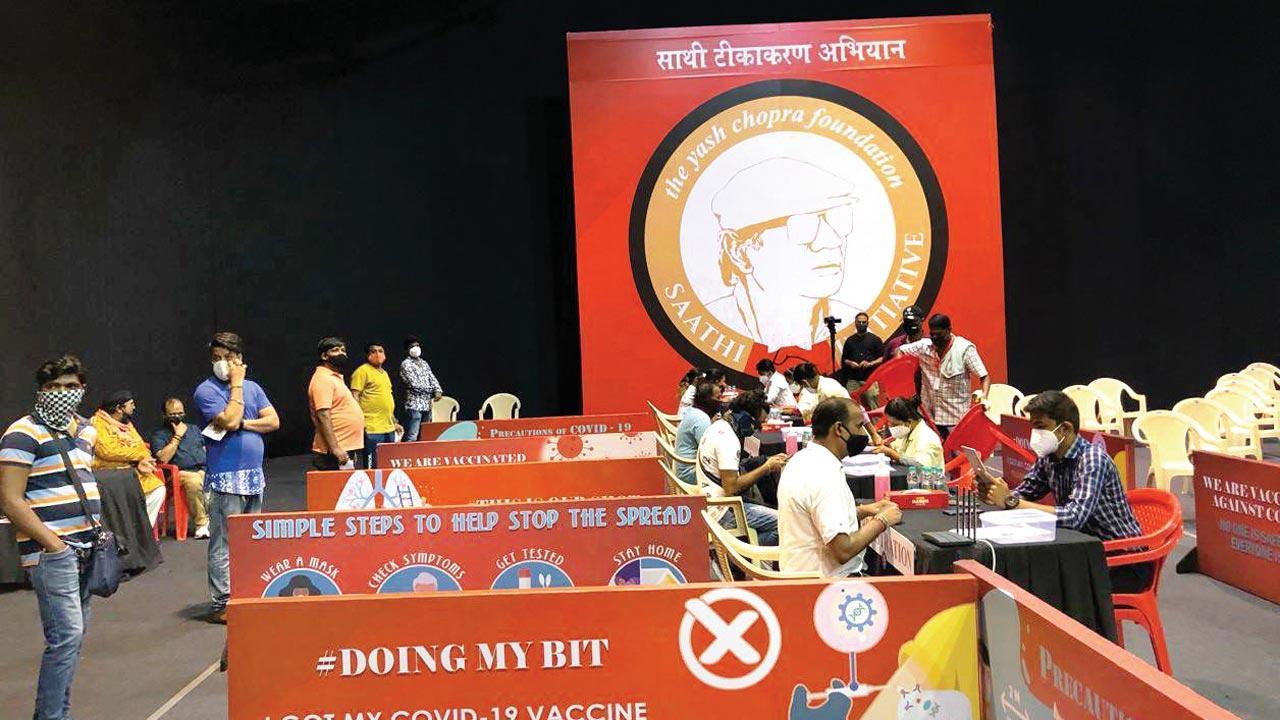
As YRF begins ambitious drive, film body introduces no-vaccine, no-work policy for its workers to tackle hesitancy
Mohar Basu, Uma Ramasubramanian (MID-DAY; June 9, 2021)
On Tuesday, filmmaker and Yash Raj Films’ (YRF) head honcho Aditya Chopra threw open the doors of his studio to kick off the vaccination drive, thus staying true to his word of inoculating 30,000 daily-wagers of the Federation of Western India Cine Employees (FWICE). Even as the first day saw close to 3,500 workers getting immunised, the drive has faced a setback in the form of anti-vaxxers in the industry.
With many harbouring misplaced fear and suspicions about the vaccine, the studio and FWICE find themselves bearing the additional responsibility of educating workers about its necessity. In a bid to encourage people to take the jab, FWICE has now adopted the no-vaccine-no-shoot policy where only those who have taken the first dose will be allowed on a set.
Pappu Lekhraj, who supplies the largest number of daily-wage artistes to Hindi film productions, reveals, “It has been a struggle on the part of the studio and FWICE to convince people to get inoculated. YRF is sponsoring the vaccination of workers and their families, while [the cine body] has announced that unless a worker takes the jab, he/she won’t be allowed back on set. Be it YRF or Bhansali Productions, there’s an emphasis on vaccinated workers.”
Going forward, several other production houses, including Excel Entertainment and Rohit Shetty Picturez, will follow the policy. Ashok Dubey, general secretary, FWICE, says, “Very few daily-wage artistes, workers and spot boys had filled the form [to take the shot]. But when the initiative kicked off, many others came forward. We have told them vaccination is compulsory, and that producers will call only those immunised for their shoots. So, out of the fear of losing jobs, people are now getting jabbed.”
YRF, one of the biggest studios of Bollywood, meanwhile is going full steam ahead on its multi-phase vaccination programme. Akshaye Widhani, senior vice president at the studio, said, “After inoculating all the employees at the studio and the crew members of our films, we have now started the vaccination drive for the Hindi film industry. This will result in the daily-wage earners returning to work and gaining financial stability. The drive will have to take place in phases, given the huge number of vaccines that are required to cover the industry.”
Bombay High Court directs Eros to pay Bhansali Productions Rs. 19 lakh in 3 weeks
8:20 AM

K A Y Dodhiya (HINDUSTAN TIMES; May 6, 2020)
Mumbai : The Bombay high court on Monday directed Eros International to pay outstanding dues to Bhansali Productions of ₹19.3 lakh for the film Goliyon Ki Raasleela Ram-leela but refused to restrain two foreign companies from exploiting the rights of the film after a merger was announced between Eros and two foreign companies.
Bhansali Productions and Eros International Media Limited had co-produced and released the movie in 2013 and there was an understanding between the two with regards to rights of the film. However, after one of the foreign companies started using the poster of the movie to highlight the merger, Bhansali Productions invoked the arbitration and conciliation clauses which restrained Eros International from selling, exploiting, licensing, distributing and renewing rights over the film. Bhansali also sought ₹19.39 lakh dues to be paid by Eros.
A single bench of justice B P Colabawalla while hearing the petition filed by Bhansali Productions through video conferencing on Monday was informed by senior counsel Zal Andhyarujina and advocates Nausher Kohli, Parag Khandhar and Nachiket Yagnik that Eros International limited was likely to merge with its parent company Eros International PLC and Hollywood’s STX Filmworks by June 30.
Advocates Akshay Patil and Vikrant Zunjarrao representing Eros International opposed the plea and said that there was no urgency to grant interim reliefs to Bhansali productions as Eros was to bound to pay the dues.
After hearing the submissions, justice Colabawalla said that as the respondent companies were situated in the British Isles and California, it would require a detailed hearing to decide on whether reliefs can be granted against entities lying beyond the court’s jurisdiction. He further said that as the court was hearing only extremely urgent matters there was no case for ad-interim reliefs. The court, however, directed Eros International to pay dues of ₹19,39,241 to Bhansali Production related to co-production arrangement in three weeks.
Subscribe to:
Posts (Atom)