Showing posts with label Basu Bhattacharya. Show all posts
Showing posts with label Basu Bhattacharya. Show all posts
I have challenged Shah Rukh Khan a little more than what others have done so far-Aanand L Rai
8:30 AM

Lasyapriya Sundaram (BOMBAY TIMES; December 11, 2018)
In his upcoming film Zero, director Aanand L Rai has moved away from his familiar world of films, which are set in the bylanes of small-town India, and often revolve around relationships. With the Shah Rukh Khan, Anushka Sharma and Katrina Kaif-starrer, the filmmaker tries to tell a love story that’s ably supported by CGI and VFX. For the first time ever, SRK will be seen playing a vertically challenged man on screen. In a candid chat with BT, Aanand talks about how this is his first collaboration with a movie star as big as Shah Rukh, how stories about love manage to find an audience easily and why it is important for him to love his actors. Excerpts…
 This is the first time you’re working with Shah Rukh Khan. Did you have any apprehensions about directing a movie star of his stature?
Shah Rukh Khan is the biggest star that I have worked with. The film went on floors after almost 11 months of talking, discussing and working on the script together. It took me that long to write the film. By the time we started shooting, we knew each other well. Director jaisa director main nahi tha aur woh actor jaise actor nahi the. Woh star hain, iss baat ko mujhe mehsoos hone nahi diya. While shooting, he submits to the director’s vision, and does whatever the director says. For example, if he feels that a certain scene requires him to show anger, but I want him to perform it differently, he will still do it. I learnt this very early on — an actor should ask all the questions on why he should be doing something before the shoot commences. Once he has agreed to the idea, while on set, he should ask how to do it and not wonder why. That’s the purest form of being an actor and Shah Rukh is like that. So, it’s important that I am careful and very sure about what I ask him to do, because he will simply deliver it (laughs!)
Were there no conflicts between Shah Rukh and you during the scripting stage?
There were no conflicts. From day one, my writer Himanshu Sharma, Shah Rukh and I knew that we were trying to attempt something new. Shah Rukh was particular about only one thing — that we share the same vision. He is a great partner when it comes to fulfilling your dreams. I can’t direct if I am not in love with my actors. There was no point during the making of the film where I felt that he is a star, and that he is asking me to do something which I am not keen on doing. I know that people expect such situations to arise. I also harboured those fears when we were about to say ‘yes’ to each other for the film. But I didn’t face any such situation with him. We have made what we wanted to make.
We’ve mostly seen Shah Rukh Khan in larger-than-life roles on screen, but in Zero, he is essaying the character of a vertically challenged man. Was it difficult to direct him in a never-seen-before avatar?
The interesting thing about Shah Rukh is that he can sit with me, look at Shah Rukh Khan (as a third person) and talk about him. While making the film, there was no conflict between him and me. The conflict was actually between us and (the other) Shah Rukh Khan. As an actor, he doesn’t say that I am playing the character. He always talks about the character as a third person. He has the ability to distance himself from the character and then deliver, which is not easy. This process was exciting for all of us.
What was his reaction to the character, after the VFX work was completed?
We had a test shoot. I wanted to see what changed as far as the lovability quotient is concerned, when the height of the character is reduced. We were also surprised with the results of the test shoot. The flow of emotion was different. An ‘I love you’ coming from a character of that height sounds very different from when a character, who is 5 feet 9 inches tall says it.
We are curious to know how the title Zero came about.
I was looking for a title, which would make the audience experience an incompleteness and a vacuum. However, it is not supposed to evoke pathos. At times, that sense of being incomplete also makes one feel light. Every character in the film is a little imperfect and that in itself has its own beauty. Flaws are beautiful and that’s where the film’s title came from. If these characters can be happy despite the challenges, then why can’t we be happy? Before weaving such characters in a commercial Hindi film, we tend to wonder if the audience will resonate with them. And often we end up deciding for the audience.
Recently, you pushed the boundaries and backed a fantasy/thriller film called Tumbbad. It was a rare attempt in a genre that remains hugely untapped in our industry...
Yes, we have spoiled the audiences’ taste. In our attempt to play safe, we tend to be non-creative. After a point, it becomes boring. In a relationship, we are often scared of explaining things. But that can’t be the relationship between an audience and a filmmaker. Either I will be successful or I will fail. But I am not scared. How will I be able to do something new if I am scared of doing it? All I need to do is be clear about my communication. My last venture, Tumbbad, might not have made a lot of money, but it made the audience curious and the 10th Tumbbad will make money. We should create a space for all kinds of films and a filmmaker should not underestimate the audience.
Shah Rukh Khan is undoubtedly the King of Romance. But does it get challenging for directors, when they have to keep reinventing him as a romantic hero?
He is not just the King of Romance, he is romance. He knows how to romance life. I have challenged him a little more than what others have done. I told him, ‘I am going to take away two feet from your height; the arms that you spread out will be shorter and now let me see how you romance on screen’.
Be it the Tanu Weds Manu franchise or Raanjhanaa, the films you have directed speak about relationships and essentially focus on love. Why do these themes interest you so much?
I think people want love, but they don’t understand it. We have also become so calculative that we don’t end up falling in love easily. Cinema reflects either what’s there in excess in society or something that is getting lost. Even today, people yearn for the kind of romance that they saw in Hrishikesh Mukherjee and Basu Bhattacharya’s films. The breezy romance at bus stops is a thing of the past now. Today, we have things like mobile phones, which keep us distracted.
Every director has a certain sensibility that is reflected in his work. Whether it’s the films you direct or produce, they have an earthiness about them. The stories often revolve around families living in small towns and reflect the homeliness that’s inherent in these places. With Zero, are you trying to break away from that stereotype?
I didn’t want to be known for making only a certain kind of cinema. I didn’t want to start believing in what people thought I could do. I shouldn’t be comfortable only telling stories about man-woman relationships set in small towns and middle class settings. I will stagnate as a creative person if I make the same kind of films. I am not saying that I am changing the world that my movies embody, but I am trying to broaden my horizon. I am the last person who should have done a film like Zero because it is high on VFX. It has been a horrifying journey for the VFX team. I have survived the journey only because they love me and I have exploited that love (laughs!).

I have had my #MeToo moments too-Sai Paranjpye
8:31 AM
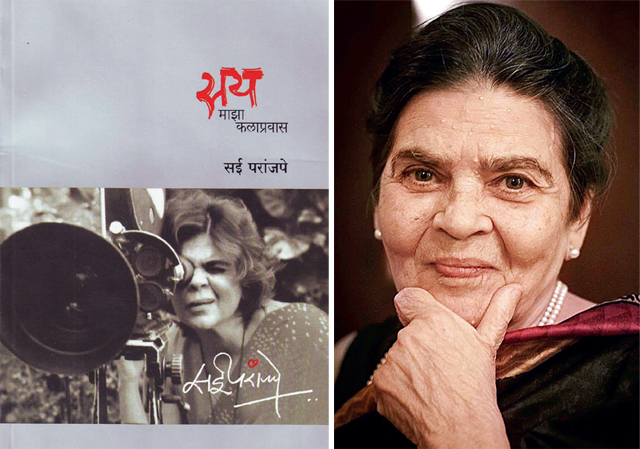
Cover of Paranjpye’s book, Say: Maza Kalapravas
Sai Paranjpye, while discussing her autobiography, expresses solidarity with women outing sex predators
Khalid Mohamed (MUMBAI MIRROR; October 30, 2018)
She’s in the throes of translating her best-selling autobiography Say: Maza Kalapravas from Marathi to English even as she shuttles between her Juhu apartment and her ancestral home in Pune.
Pinning the feisty octogenarian down for a conversation on topics ranging from the book in works to the #MeToo movement takes some doing. But once she’s in the chatmode, Sai Paranjpye right off recalls that when she was a teenager, a ‘roadside Romeo’ who had flashed her while she was cycling down Pune street, was hauled by her straight to the police station.
Next morning, she was advised not to register a formal complaint. It wouldn’t be proper for a young woman to even mention the offender’s private parts. That didn’t deter her though. If the man had dared to do the unspeakable, surely, she didn’t have to mind her language.
On the #MeToo movement, Paranjpye says, “It’s terrific that many women are coming forward to expose the offenders. But it shouldn’t just become the trend of the season, the momentum has to be sustained. Suspects or whatever the correct legal term is, have been reined in. Women can’t be bulldozed any longer. It’s been asserted loud and clear, ‘You can’t get away with it’.”
Next, her pause speaks. Am I merely interested in extracting quotable quotes on the #MeToo topic? Am I using her book as a journalistic ruse? Fair enough. Hence, I return to the translation regimen, only to be answered with a knowing chuckle, “Alright, I’ll take your word for it. The book’s my labour of love right now and it’s taking me forever. I’m still living in the past century. Since I’m not computer savvy, I write on clean white paper with a black ink pen. That led to a crick in the neck, spondylitis. After intensive physio therapy, I’m back to the grind.”
By the year-end, she should be done with the English translation. “If you have a catchy title, let me know,” she laughs companionably. Right.
Over time, the Padma Bhushan awardee has excelled in a variety of mediums, be it cinema, theatre, radio, documentaries, story books, and television. “If I may say so, I’m a pioneer of television,” she points out. “Unbeknownst to many, I was sent from Delhi to produce the inaugural programme, featuring the shehnai wizard Bismillah Khan and other artistes, for Mumbai Doordarshan.”
The autobiography, as its Marathi title indicates, focuses on her creative journey. “It’s not about my love life,” she remarks, adding frankly, “But you could say I’ve been catty. I’ve pointed out nasty instances in my career. Like Basu Bhattacharya (producer of Sparsh) took me for a ride. I’ve been blunt about Gul Anand (producer of Chashme Buddoor) who made tons of money, wringing the film’s success to the last drop.”
Never the sort to mince words, Paranjpye continues, “And I haven’t shied away from the Javed Akhtar story. He was writing the lyrics of Saaz. A recording had been scheduled with Suresh Wadkar and Kavita Krishnamurthy, but he took off without so much as a by-your-leave to Khandala. Overnight, I had to write the lyrics of the song ‘Baadal Ghumad Bhad Aaye’. And what do you know? Javed Akhtar won the National Award for the Saaz lyrics and didn’t have the courtesy to say a simple thank you.”
Vis-à-vis Nana Patekar, the lead actor of her film Disha, the filmmaker comments, “I’ve given him a piece of my mind in the book and beautifully so. At the B.R. dubbing studio, he was throwing one of his tantrums. I told him to leave and never come back. A few minutes later, he opened the studio’s door theatrically and had the nerve to say, ‘You’re saved because you’re a woman. Or else you wouldn’t still be here.’ Next morning, he called sweetly to ask about the timing of the dubbing session. I was as sweet, and the work was completed.”
The multiple award winning director and writer states that she can be fiercely self-critical. After graduating from the National School of Drama, she had staged a Marathi adaptation of Hamlet which was “expressionistic and stylised but I missed out on the soul of Shakespeare’s masterwork. I was roasted by the critics deservedly. However, I was shocked by the response to my adaptation of Neil Simon’s Last of the Red Hot Lovers, about a 50yish man who resolves to have flings with women. The audience roared with laughter but after the show, several people whose opinion I counted on, said, ‘This was not expected of you Sai. How can you bring up the topic of adulterous affairs?’”
At this point, I ask whether she has ever been subjected to sexual harassment. “Plenty of times,” she responds firmly. “There was a time, when men from all sorts of circles would try to kiss me and that’s putting it politely. I’d tell them to back off. Then there was this instance when a minister in the central cabinet offered to drop me home in his chauffeur-driven car, after an evening party hosted by my friend Saryu Doshi. During the drive, he passed me a chit saying, ‘I’d like to spend the night with you.’ With a deadpan face, I declined. On reaching my place as I was getting out from the car, he asked me meekly, ‘May I have the chit back?’ So, I’ve had my #MeToo moments too. No point revealing the minister’s name now, he’s dead and gone.”
Paranjpye surmises whether it’s yesterday or today, when sexual predators see that a woman is alone — single, married, separated or unaccompanied — they jump to the conclusion that she’s “available and fair game…it’s high time that such male chauvinists were shamed.”
And the parting shot is, “I am supremely glad about the #MeToo movement. Here’s wishing more power to the elbow of my soul sisters.”
Subscribe to:
Posts (Atom)