Showing posts with label B R Chopra. Show all posts
Showing posts with label B R Chopra. Show all posts
Blake Lively vs Justin Baldoni: Decoding the effect of a smear campaign on a celebrity's social currency
8:32 AM

In the wake of the Blake Lively-Justin Baldoni lawsuit and very public online smear campaign, we ask Bollywood publicists, managers, entertainment editors and trade gurus about just how much can a smear campaign affect a celebrity’s social currency
Mohar Basu (MID-DAY; January 12, 2025)
It all started with conspiracy theories as to why Hollywood actors and stars of the 2024 movies, It Ends with Us, Blake Lively and Justin Baldoni, were unable to get along during the shoot of the said movie. “Creative disagreement” was the popular term used for it, but what lay underneath was slander, and an effort to put down the other. Soon, social media was rife with conspiracy theories—some experts reading body language of the two stars—some just pondering on why they were both not seen together during promotions of the movie. It was declared: the two couldn’t stand each other.
There was some truth to the fire, as in the past two week, both Lively and Baldoni have filed lawsuits against each other. Lively’s account, where she accuses Baldoni of sexual harassment, was also reported in the New York Times by Megan Twohey (who has reported on the Harvey Weinstein case) with the headline: “We Can Bury Anyone: Inside A Hollywood Smear Machine”. What took centrestage: the use of social media and the Internet to create a narrative (true or not) of the other.
But how is Bollywood viewing this? A celebrity manager, on condition of anonymity, says the best way to attack a star is to attack their “image”. “They care for nothing as much as their image. And creative disagreements and celebrity fall-outs are rampant in this industry. For instance, Salman Khan walked out of Sanjay Leela Bhansali’s film after announcing it. Of course, that couldn’t have been pleasant. But what separates that from the Baldoni-Lively case is that neither party went out of their way to pull the other one down. A classic case of a Bollywood smear campaign is what happened to Kangana.”
Actress Kangana Ranaut has publicly admitted to being at the receiving end of the industry’s inability to stomach her. In 2021, she said, “Just last week, I lost more than five lakh followers on Instagram. They gang up on you, boycott you, and if that leaves you happy and content, they ruin your image and brand. That’s how they killed Sushant [Singh Rajput]. That’s how they harass outsiders who don’t need them for work. There are paid smear campaigns happening on Instagram as well… Many derogatory memes and fake information about me are spread. Instagram is also paid as my followers numbers automatically drop, fans who unfollow don’t even realize it... There is a proper investment of troll army, creative budget to make memes, to write lies to spread smear campaigns, movie mafia + political mafia + jaded actors who are rejected lovers, you are jealous of even a fruit bowl...”
These observations were following an incident when Ranaut posted a picture of herself having breakfast, and got trolled.
A former publicist of Ranaut’s, who worked with her for a year, told us, “This whole impression that Kangana is difficult and a loose cannon, has been created. She is very professional and believes in doing her work and going home. She has a certain political leaning and believes in it strongly, but who isn’t leaning towards the establishment today. Why should she be vilified? Then it all boils down to—is she good at her work? Oh yes, she is. It’s a good question to ask then—why is she not getting films? Some part of the answer is that she has managed to offend her directors. She has wanted creative control and I personally believe, directors allow men the creative control, when women ask for it, there’s an issue. There has been a systematic smear campaign on Kangana—where videos of her using a fake horse have been leaked when every actor does that for period films. Money has been spent on bringing her down. If one wishes to study a smear campaign, they should go through Kangana’s career post 2015.”
The problem happens when a one-off dispute shifts from professional disagreements to personal attacks, with media outlets amplifying unverified claims from anonymous insiders. This pattern is a textbook example of how celebrity feuds are orchestrated and sustained in the digital age. Earlier this week, a slanderous article on Triptii Dimri appeared on a website, which claimed that she was removed from Aashiqui 3 because makers weren’t comfortable with her bold avatar in Animal. In Triptii’s case, the story may be planted by professional rivals who want to cost her an opportunity/or envious of the fact that she is currently shooting for Vishal Bhardwaj’s film with Shahid Kapoor.
But it could be a reach to say this only happens to the women in the industry. An industry veteran pointed out that in 2014, Aamir Khan met Mumbai Police to complain about “false and malicious messages” that were being circulated in social networking sites Facebook, Twitter and WhatsApp to damage his image and reputation of his issue-based show Satyamev Jayate.
“Aamir Khan complained to us about some objectionable messages getting circulated (against him),” a police official had told the press then.
But how do the smear campaigns work, and more importantly, do they succeed in today’s media landscape? Let’s take a closer look at Bollywood’s modus operandi.
Tushar Joshi, entertainment editor of India Today, tells us, “These smear campaigns are age-old in the industry. Sometimes they are direct and sometimes they are proxy. But what is going on in Hollywood is something actors in Bollywood have faced. These campaigns happen via publicists, production houses, actors and colleagues and friends who have agendas different from their rivals. Maybe emails, voice calls haven’t been made public. They might have been exchanged in private to sway the minds of the opinion makers. The only difference is most of what happens in Bollywood happens behind closed doors. With the Baldoni-Lively case out in the open now, new norms are being set.”
Smear campaigns are rarely explicit. They are carefully orchestrated efforts that exploit the vulnerabilities of digital ecosystems. A lot of the battle has moved to Redditt.
In an email interview, the Reddit account, Bollywood, tells us, “We frequently get requests to post leaks and we do so. So far, we haven’t got commercial deals but it’s only a matter of time until we get there. We list it under unverified goss. We have noticed a lot of gossip on Kartik Aaryan, Akshay Kumar, Ranbir Kapoor, Ranveer Singh and the things that we get told are juicy. Clearly, someone wants to feed these stories to the public. The tabloids have stopped carrying gossip, so we have to. A post can look organic, but it’s often the first step in a much-larger campaign.”
A Bollywood publicist tells us, “Earlier, the approach was subtle. Journalists were given insider tidbits—sometimes, stories were planted by mentioning them in passing. The goal is to create a seed of doubt in their audience’s mind. But now, it has become all about money. Influencers with followers ranging from 5,000 to 50,000 are often paid to post seemingly neutral content that’s actually part of a coordinated campaign. A simple Instagram story about a '“troubling blind item' can snowball into a full-blown scandal.”
“Smear campaigns work because they tap into our collective love for drama. Controversy sells, and people are quick to believe what aligns with their existing biases. It’s classic voyeurism,” says a Bollywood podcaster. But at the same time, a smear campaign has little correlation to a film. There is plenty of hate against Ranbir Kapoor but his film, Animal, made nearly Rs 1,000 crores.
Veteran director Anurag Kashyap had said before that a smear campaign might work for a weekend, but it can’t sustain itself if the audience connects with the work of an actor. At the end of the day, content is king.
In the end, none of the bitterness matters, says trade analyst Taran Adarsh. “The goal is that a film must work. Smear campaigns pique curiosity and fuels the news cycle. But the audience wants a movie, they want to be entertained. Often films have gone through political controversies and personal issues and have powered through because the film is good. Also none of this affects an actor’s brand value. It is a he said/she said story until someone goes to the cinema hall and says ‘oh what a film’. I have to quote a story here. B R Chopra and Madhubala went into a famous trial over a film. She was replaced by Vyjayanthimala and the film did very well despite this controversy. Collections remained unaffected. I had asked Chopra sa’ab, ‘Aapko laga nahi negativity aajayegi’ and he had said, ‘Kaam karma hota hai. Acha kaam kariye and the audience will reward you’. The interpersonal dynamics may be shaken, but cinema will last forever.”

Shankar-Jaikishen used to visit Gaylord all the time and they had a table reserved here-Divij Lamba
10:09 AM
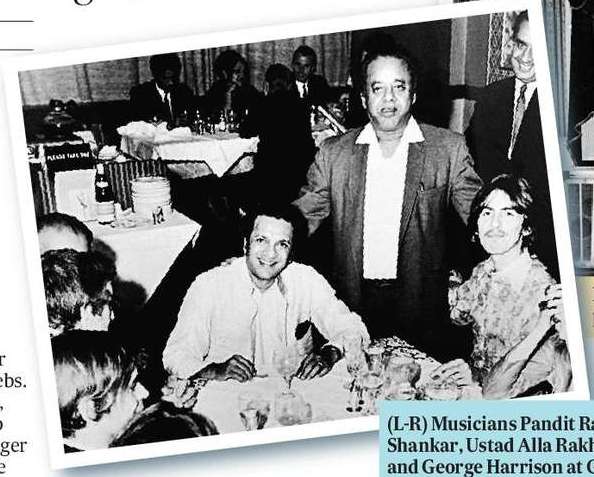
(L-R) Musicians Pandit Ravi Shankar, Ustad Alla Rakha Khan and George Harrison at Gaylord
The city’s iconic eatery serves up rich history and memories to today’s power-dining frat
Ismat Tahseen (HINDUSTAN TIMES; May 4, 2025)
Mumbai is on the list of the Best Food Cities in the World for good reason. And one establishment in the city that holds the torch out to this culinary heritage is Gaylord, which opened in 1956. The flagship dining house in Churchgate embodies a rich history, having been the flavour of international and Indian celebs. Bollywood veterans B R Chopra, Raj Kapoor, Rishi Kapoor, Dilip Kumar, Rajesh Khanna and singer Lata Mangeshkar had their fave delicacies here, so did the iconic musicians Pandit Ravi Shankar and The Beatles!
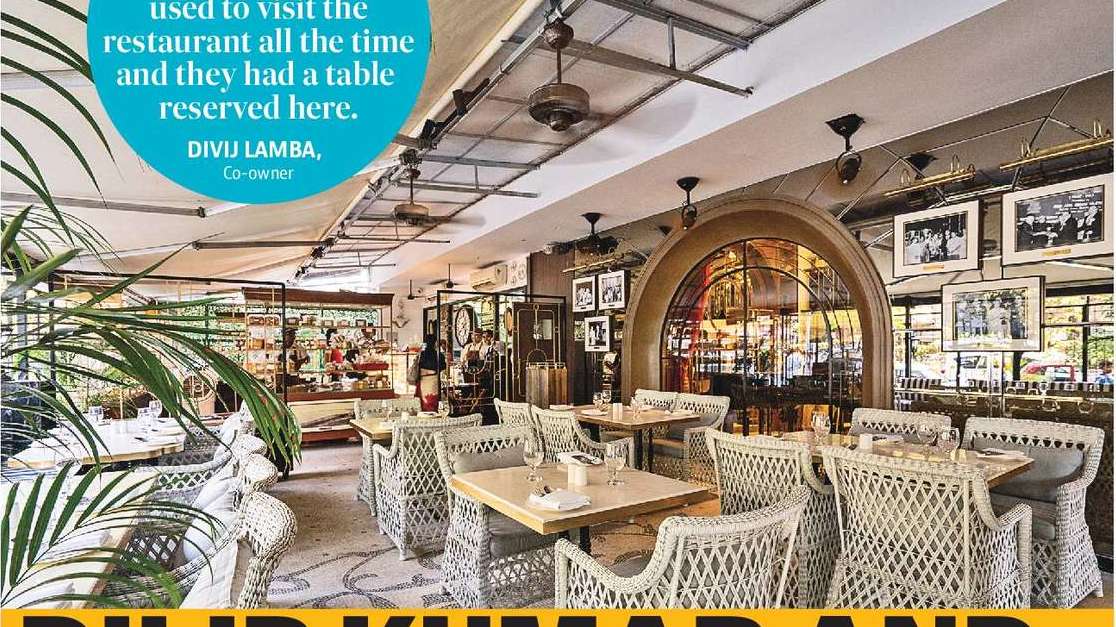
After it’s first-ever extended closing, Gaylord has reopened. It’s a case of old-meets-new, as co-owner, Divij Lamba, calls the decor, “a love letter to our past”.
‘For cricketers, this was the post-match destination’
Divij goes back in time as he shares how his great-grandfather, Pishori Lal Lamba launched Gaylord in collaboration with Iqbal Ghai (both Delhi-based entrepreneurs who established the Kwality restaurant chain in 1947).
Divij and his brother Dhruv grew up hearing stories of the who’s who dined at Gaylord. He says, “Celebrities were regulars here, so were a lot of cricketers. They made it their post-match destination as CCI Club almost opens into Gaylord. Veteran composer duo Shankar-Jaikishen also used to visit all the time and they had a table reserved here.”
The transformation sees Gaylord’s iconic alfresco-style seating now exuding a warm and contemporary Parisian vibe along with red couches on its mezzanine floor. But the makeover apart, Gaylord also holds on to its past. “We’ve made sure that history is not lost; the decor still takes people to another age,” adds Divij as he points to a collection of 155 photos around — sitar maestro Pandit Ravi Shankar with George Harrison. French designer Christian Louboutin had also visited.
‘The past is the real treasure’
Of course, the food undeniably does the talking, too. Divij adds, “We’ve ensured that the faves — Chicken à la Kiev and Lobster Thermidor are back. So is the signature butter chicken, given the North-Indian lineage of the restaurant.” The revamped space has plans to host cultural nights from live grand piano recitals, to live music events and specially curated high tea parties.
Today, as the brothers helm the business, Divij admits, “There is this sense of responsibility to carry forth our legacy. We’ve tried not to change the DNA of the place as that is what Gaylord is known for. The idea is to maintain the past, as that is the real treasure.”
How did it get its name?
Gaylord is a combination of both the partner’s names ‘Ghai’ & ‘Lamba’. Lamba had posted an advertisement asking for suggestions and one of the reader suggested the name ‘Gaylord’. They liked it as it had both partners initials.
20 Years of Baghban: I was not convinced because I had to portray a mum to four elderly boys-Hema Malini
8:10 AM
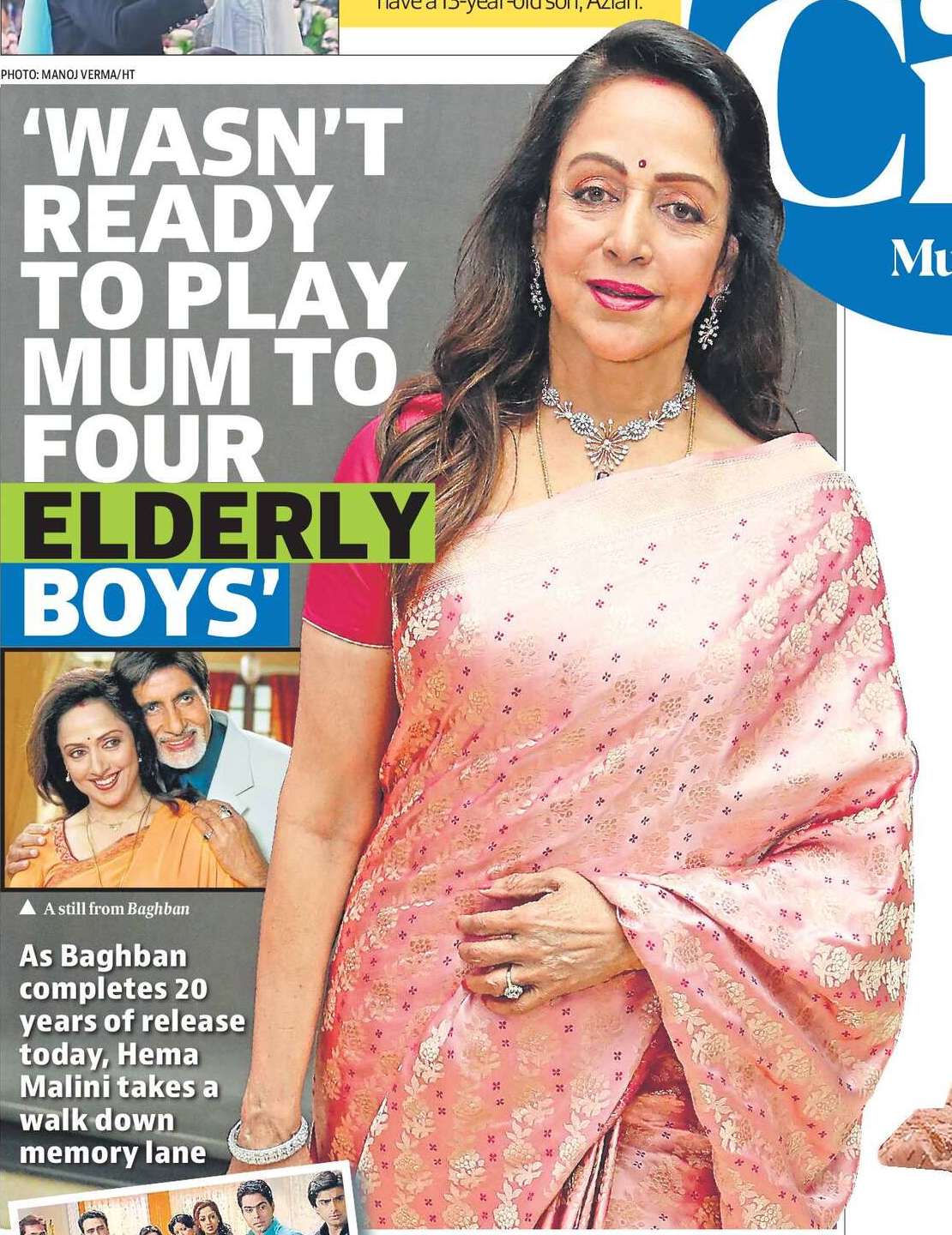
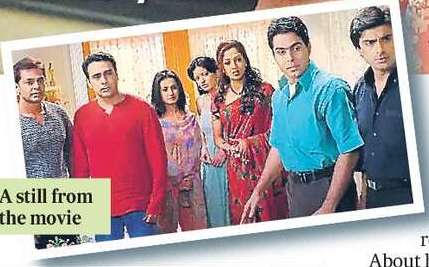
As Baghban completes 20 years of release today, Hema Malini takes a walk down memory lane
Rishabh Suri (HINDUSTAN TIMES; October 3, 2023)
Baghban, a poignant narrative portraying the abandonment of ageing parents by their children, resonated deeply with moviegoers back in 2003 and continues to leave a lasting impact.
In this cinematic gem, which turns 20 today, actor Hema Malini played the leading role opposite actor Amitabh Bachchan.
She tells us that she was initially unsure about accepting the role: “I was not doing anything. That’s when Ravi Chopra, the director, came to me and narrated this subject. I was not convinced because I had to portray a mum to four elderly boys. Then my mother said, ‘If Amitabh Bachchan is doing it, then you can also do it’.”
Malini, 74, says she was reassured that she wouldn’t be made to appear as “an old woman with white hair” and would be presented in a way that reflected her real-life persona.
About her co-star Bachchan, with whom she had worked in several films, including Sholay (1975) and Satte Pe Satta (1982), she says, “When Amit ji used to enter the set, he would bring so much life; all the workers used to say, ‘Arre Amit ji aa gaye’.”
Recalling the romantic scenes she shot with him, especially the song Main Yahan Tu Wahan, Malini says, “It was B R Chopra sahab’s (producer) dream to make this film. He was watching all the scenes from day one. He gave me a narration before the shoot started.”
The actor shares that she learned of the film’s success when her daughter, actor Esha Deol Takhtani, was working alongside Bachchan’s son, Abhishek, in Dus. “They would keep telling me picture hit ho gayi hai. Mujhe lagta tha mazaak kar rahe hain, but it turned out to be a fact,” she smiles.
DIVYA RECALLS FIRST FILM WITH AMITABH BACHCHAN
Divya Dutta, who played Reena Malhotra, one of the daughters-in-law, who was part of the plan to split the elderly couple, says, “It was my first film with Mr Bachchan, who is the reason why I got into films. I used to say a very bright ‘good morning’ to him every day. Those gradually became less bright. Saying those nasty lines to someone I adored was not going down well with me. One day, he said, ‘You know you are not being nice to me; my fans won’t like it’; I said, ‘Sir, yeh ek role hi toh hai’. And without saying anything further, he taught me a lesson that I need to dissociate myself from my character.”
I took Pamela to B R Chopra’s daughter’s wedding, where Yash Chopra and she met for the first time-Simi Garewal
8:19 AM
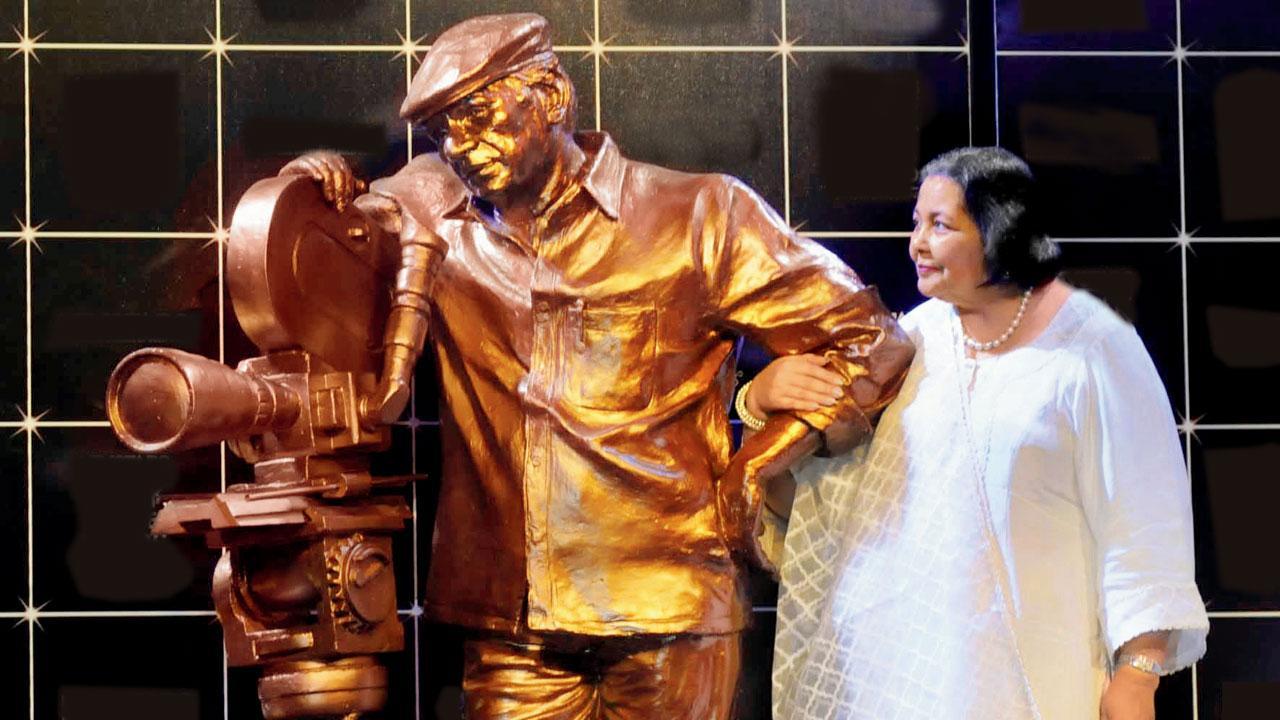
Cousin-actor Simi Garewal reminisces about spending her childhood with the singer-producer who became the 'bedrock' of the Chopra family
Simi Garewal (MID-DAY; April 21, 2023)
Although she was my maternal cousin, Pamela [Chopra] was like my own sister. We shared rooms when she visited us four to five months in a year. It was as if my mother [Darshi Garewal] had adopted her as the third daughter. Pam was a movie buff who knew more about cinema than I did. She taught me Bharatnatyam. She was a warm, vibrant, creative, and charming person who would [often] accompany me on shoots.
I took her to B R Chopra’s daughter’s wedding, where Yash and she met for the first time. She [felt] that he was paying more attention to Hema Malini, but I had caught Yash sneaking a glance at Pam several times. A few months later, B R Chopra and his wife [met] my mother [for a marriage alliance] between Yash and Pam. Her father, Mohinder Singh, who was in the army, was initially hesitant as the Chopras were wealthy [in comparison]. But my mother assured that she would take care of everything. She took care of her like her own daughter.
Strangely, after her marriage with Yash, she started distancing herself from us, which hurt all of us deeply as we couldn’t understand what happened. Though we would go for Aditya [Chopra] and Uday’s [Chopra] birthdays, which eventually stopped. When [we met at] Yash ji’s funeral, Pam was warm. We never got a chance to find out what happened, [even when] we spoke, laughed, and joked around. We never dove into what happened.
Pamela was Yash ji’s muse, friend, philosopher, and the guiding light of Yash Raj Films in the initial years of their marriage. She was a creative force, musically inclined and his sounding board. She later became busy with the family. Pamela was the gentle, positive, practical influence in Yash ji and their children’s lives. She ensured that they were grounded, balanced, and well-mannered. Pamela was the bedrock of their family.
As told to Upala KBR
Praveen Kumar Sobti of Mahabharat passes away; co-stars Puneet Issar and Nitish Bharadwaj remember him
7:47 AM

Avijit Ghosh (THE TIMES OF INDIA; February 9, 2022)
New Delhi: Olympian Praveen Kumar, who hurled his way to two gold medals in discus at the Asian Games and later drew instant recognition nationwide playing Bheem in ‘Mahabharat’ on television, passed away on Monday following a cardiac arrest at his Ashok Vihar residence. He was 74.
Built like a fort and an imposing six feet, six inches in height, Praveen Kumar Sobti had the power, coordination and body-size to excel in both discuss and hammer events. “If he had received the kind of training and other facilities available today, an Olympic medal would have been within his grasp,” Olympian and Asian Games gold medalist shot-putter Bahadur Singh told TOI.
When his stellar athletics career was on the wane in the 1980s, Bollywood stepped in. Ravi Tandon’s ‘Raksha’ (1982) marked his celluloid debut. He acted in about 50 films, notably ‘Meri Awaaz Suno’, ‘Khudgarz’ and ‘Shahenshah’. ‘Mahabharat’ (1988) changed his life and Bheem became one of the most-loved characters of the serial.
-----------------------------------------
Puneet Issar, who played Duryodhan, talks about their friendship over the years
Tanvi Trivedi (BOMBAY TIMES; February 9, 2022)
Actor and four-times Asian Games medallist, Praveen Kumar Sobti, who played the iconic role of Bheem in Mahabharat, passed away yesterday at his Delhi residence.
Puneet Issar, who played the role of Duryodhan in Mahabharat, recalled how Praveen Kumar Sobti was Praveen paaji for him. Sharing an interesting story about how Kumar was cast as Bheem, Issar said, “B R Chopra, the producer of Mahabharat, wanted me to play the role of Bheem. But I had made up my mind that I would play Duryodhan. My physique and wrestler body suited the role of Bheem, so Chopra sir felt that I should be Bheem. But I was adamant to play Duryodhan and it became a task to find someone even stronger than Duryodhan to be cast in the show. Then I suggested Praveen Kumar’s name because he was an international athlete, 6 feet 8 inches tall, much taller than me. Praveenji agreed and the rest is history.”
Recounting the rapport they shared, Issar said, “I always called or met him when I visited Delhi. He had a great sense of humour. We had fight scenes in Mahabharat and looking at the promos, I remember how my daughter got terrified of Praveen ji bashing me up. He then came home and spoke to my daughter and made her feel comfortable. He was constantly cracking jokes and though we were enemies in reel life, we were like brothers in real life. In the past few years, he stayed at home and enjoyed his life peacefully.”
Issar also shared how the last scene in Mahabharat, where he had to fight Bheem, was one of the most remembered scenes from the show. He said, “I had to keep saying, ‘My body is now even stronger Bheem, come on, hit me’. And Bheem had to fight with me. It was one of the most challenging scenes we performed in our lives.”
HE WAS A MAN FILLED WITH GRATITUDE FOR LIFE: NITISH BHARADWAJ
Nitish Bharadwaj, who played Krishna in Mahabharata , says Praveen Kumar “was a man filled with gratitude for life. After he acted in Mahabharat and a few Bollywood films, he became a recluse and decided to live peacefully in Delhi. He was quite content with life. He was a man filled with a great sense of humour and never spoke bad about anyone. He suited the character of Bheem perfectly. When you thought of Bheem, only Praveen’s persona came to mind. No wonder he was known as the Gadadhari Bheem of Mahabharat.”
The kind of cinema B R Chopra, Raj Kapoor, Guru Dutt used to make is coming back, thanks to OTT-Raj Babbar
8:12 AM

Titas Chowdhury (HINDUSTAN TIMES; January 4, 2021)
After 28 years in politics, actor Raj Babbar has now decided to recommence his career as an actor. In November last year, the former Member of Parliament, made his comeback with the web series Dil Bekaraar that marked his debut in the digital space.
“After my term ended, I thought of resuming acting. Fortunately, Dil Bekaraar came my way. Now, I’m being offered many films and web series,” he says, adding he featured in small roles in his friends’ films while busy with politics.
Like everyone else, Babbar, 69, has been caught by the OTT bug and wants to be a part of more web shows. “During the lockdown, I watched a few good shows and some amazing performances by actors from India as well as the world. That, subconsciously, had an effect on me. OTT platforms are a win-win situation for actors as well as filmmakers and writers. The medium completely belongs to them and we, actors, can do wonders now that we can showcase so many nuances,” he elaborates.
But what has truly captured his attention is the return of good content. “I grew up watching films made by filmmakers Guru Dutt, Satyajit Ray, Raj Kapoor, Ritwik Ghatak, Mehboob Khan, V Shantaram, and B R Chopra. I feel the kind of cinema these stalwarts used to make is coming back, thanks to OTT,” he says.
Quiz Babbar about the young lot of actors and he says, “They’re energetic and brilliant. They work hard and have the power to grasp the audience’s attention. They’re aware of the current atmosphere and so, they become prepared.”
Why don’t we have National Awards for television?-Sudhanshu Pandey
7:58 AM
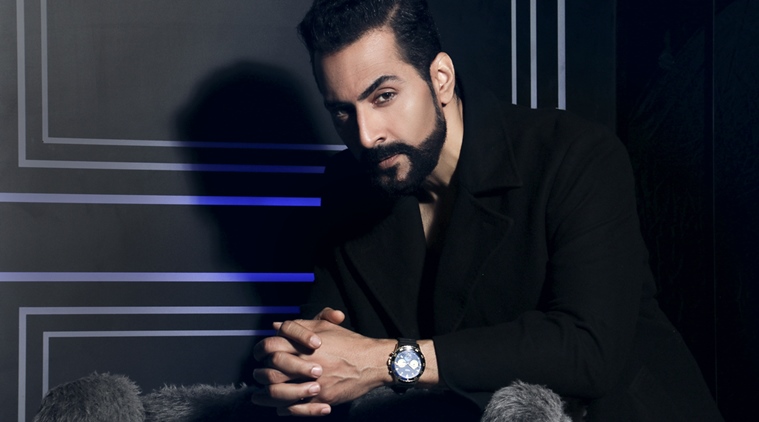
The actor plans to start a campaign to garner support and urge the authorities to institute National Awards for the Indian TV industry
Roshni Olivera (BOMBAY TIMES; October 19, 2021)
Indian television has grown by leaps and bounds over the past two decades and is one of the biggest entertainment industries today. In recent years, many award functions have been organised to honour members of the fraternity. But Sudhanshu Pandey has a bigger dream for the small screen and he now wants to work in the direction of fulfilling it. He strongly feels that there should be National Awards for television too, just like films. To take this thought ahead, he plans to launch a campaign to garner support from various quarters, and eventually, approach government officials.
The actor says, “This has been on my mind for a while now and some time ago, I decided to work on it. I have shot a couple of videos, and I hope to spread awareness about this initiative — ‘National Awards For Indian Television’. Today, social media can be a very effective tool to put your ideas across.”
Sudhanshu says, “I’ve been discussing this with people from the industry, and I am sure they are going to support me in it.” Ask him about the inception of this idea, and he says, “I started my career with television in 1998 when I did a show for B R Chopra. Sometime later, I got into films and continued with that and also did web shows. TV happened to me again last year, when producer Rajan Shahi, who’s a friend, offered me Anupamaa, saying he could not see any other actor in that role. That’s when it all began.”
It was during the first lockdown that this thought came to him. “We shot for Anupamaa for a week in March 2020, and the lockdown was announced. During the lockdown, I watched many television shows and got a good understanding of the industry. I realised how television is the most powerful, impactful and influential industry today. In June 2020, we started shooting for our show again, and I have been shooting non-stop since then. The response and the appreciation that I have got for my role is unbelievable. That’s the reach of TV,” says Sudhanshu, further emphasising the need to motivate TV actors, technicians and everyone associated with the medium, so that they keep churning a lot more and better content.
He says, “Television has not got the recognition that it deserves. It’s the only industry that runs 24/7 and 365 days a year. Throughout the pandemic, too, except for a few months, work didn’t stop here. People across all channels, production houses worked relentlessly to provide viewers their daily dose of entertainment. I think their work deserves to be considered for the National Awards. It’s a dream that I have seen, but I want to fulfil it for all of us.”
Geeta Dutt believed that the bungalow was haunted, says Lalitha Lajmi on Guru Dutt's wife in new book
8:37 AM

Waheeda Rehman, Guru Dutt`s love and muse, cut off from him after the Berlin Film Festival screening of Sahib Bibi aur Ghulam. Dutt, who was married to singer Geeta Dutt, is said to have drunk alcohol on the entire flight back home
In a new biography, which explores the man and the myth that was Guru Dutt, the actor's sister recounts how his wife Geeta blamed their Pali Hill home for all that was going wrong in their relationship
MID-DAY (January 10, 2021)
Berlin, 1963
Sahib Bibi Aur Ghulam was India’s official entry at the 13th Berlin International Film Festival. On 26 June 1963, its lead actors, Guru Dutt and Waheeda Rehman, attended the festival along with the film’s director, Abrar Alvi. The screening took place the next day but the film failed to create any flutter as the international audience could not relate to the overt melodrama and the very Indian theme. This, despite the fact that the film had been trimmed specially for the festival. There were hardly twenty-five people in the theatre and their interest in the film could not be sustained. The film was outrightly rejected.
Guru Dutt walked out of his own screening.
On this very same trip, Waheeda Rehman — Guru Dutt’s protégé, and the one and only lead actress in his films for a substantial part of his career — conclusively yet gracefully conveyed the end of her relationship with Guru Dutt.
‘Yes. The last time I saw him must have been in Berlin,’ said Waheeda Rehman. Things had started to unravel towards the close of their last shoot together for Sahib Bibi Aur Ghulam. Guru Dutt’s younger sister, the eminent artist Lalitha Lajmi, remembers, ‘Waheeda and Guru Dutt had almost parted. She used to invite us both sometimes for dinner and my brother knew she was friendly with me. I heard Guru Dutt went with a bouquet of flowers to her home and the doors were not opened to him. Perhaps it was after this incident I had visited him and for the first time he told me not to keep in touch with her any more.’
The very next day, Guru Dutt left Berlin.
Legendary filmmaker B R Chopra recalled, ‘That man, Guru Dutt, drank all the way back from Berlin to Bombay while keeping all to himself in a corner seat. We knew all about Waheeda having told him, point-blank that she had made up her mind about him and that was it. She also discreetly left Guru Dutt to find his own way back. Guru Dutt was clearly heading towards turning into a mental and physical wreck…I instinctively knew that it was the beginning of the end.’
Guru Dutt used up all the sleeping pills that he had carried with him to Berlin. He didn’t sleep for the next four nights. ‘He said to me, “I think I will go mad”’, recalled Bimal Mitra, the writer of Sahib Biwi Aur Ghulam and undoubtedly a giant in the literary world from Bengal.
Bombay, 1963
Back in Bombay, his wife Geeta Dutt—the glorious singer who had broken playback singing traditions to bring a fresh naturalness to Indian film songs—had started blaming their bungalow for all their woes. They shared only a decade old but widely celebrated story—the star singer and the struggling filmmaker having found love in tinseltown. Deep down she believed that their relationship had developed an irreparable rift only after they shifted to this bungalow in the very posh locality of Pali Hill.
Lalitha Lajmi, who witnessed the relationship from the early days of courtship till the end, further recalls, ‘She believed that the bungalow was haunted. There was a particular tree in the house and she said there’s a ghost who lives in that tree, who is bringing bad omen and ruining their marriage. She also had something against a Buddha statue that was kept in their huge drawing room.’ According to Lalitha, it was Geeta who had suggested that they must leave.
This prospect was heartbreaking for Guru Dutt.
It had been his dream house—but never the home he had always longed for. Guru Dutt had twice attempted to kill himself in this house and survived both attempts.
Once, after surviving a suicide attempt, a close friend asked Guru Dutt, ‘Why should you have done it? You have fame, you have wealth, you have the adoration of the masses. You possess all that most people crave for! Why are you so dissatisfied with life?’
Guru Dutt replied, ‘I am not dissatisfied with life, I am dissatisfied within myself. True, I have all that people crave for. Still I don’t have that which most people possess—a nook where one can repair [retire] to after the day’s task is done, where one can find some peace and forget one’s cares. If only I could get that, life would be worth living!’
From a house that had been home to the birth of so many great stories on celluloid, it now only birthed insomnia for Guru Dutt. So despite living in one of the most beautiful bungalows in Bombay’s prime real estate, Guru Dutt would leave the house early every morning and reach his studio with sleep-deprived eyes. The studio wouldn’t be open at that hour and silence hung all around it. Guru Dutt’s man Friday, Ratan, would open the lock of the small chamber—a seven feet by seven feet room with a precious small bed. This is where Guru Dutt would lie down quietly and finally find sleep.
‘I always wanted to be happy in my household. My house is the most beautiful among all the buildings in Pali Hill. Sitting in that house, it does not look like you are in Bombay. That garden, that ambience—where else can I find it? Despite this, I could not stay in that house for much longer,’ once shared Guru Dutt.
Away from his luxurious and palatial bungalow, this small room was where he would find peace and sleep.
And then, on the morning of his birthday — ten days after his return from Berlin — he called in workers and told them to demolish his Pali Hill bungalow
‘I remember it was his birthday. He loved that house and he was heartbroken when it was demolished,’ recalls his sister Lalitha Lajmi.
‘But what is the real reason for demolishing the bungalow? Bimal Mitra asked him. That bungalow was…?’ ‘Because of Geeta,’ Guru said in a low voice.
‘What does that even mean?’ Mitra asked Guru took a puff of his cigarette, and gently explained, ‘Ghar na hone ki takleef se, ghar hone ki takleef aur bhayankar hoti hai.’ (The pain of having a home sometimes can outweigh the pain of not having one.)
It seems like sharp reminder of the scene from their film Sahib Bibi Aur Ghulam where Guru Dutt, playing a middle-aged architect, goes back to the haveli and asks the workers to pull it down. His life and cinema kept merging with each other like that.
About a year later, the last shot he gave was for the film Baharen Phir Bhi Aayengi. Playing a reporter, he hands over his resignation letter to his editor and says, ‘I am leaving.’
Excerpted with permission from Guru Dutt: An Unfinished Story by Yasser Usman, published by Simon & Schuster India
Inheritance cannot be called nepotism-Javed Akhtar
7:59 AM

Nishad Neelambaran (HINDUSTAN TIMES; September 17, 2020)
Veteran lyricist Javed Akhtar spent most of his time in the Coronavirus lockdown at his Khandala home, and is in love with its picturesque location. “Within an hour-and-a-half from my house here [in Mumbai] you are on a hill station with clouds coming into your room, and complete calm,” says the Padma Bhushan awardee.
Ask if there will be added pressure to come up with quality scripts and lyrics owing to the time everyone has had during the lockdown, and Akhtar, 75, says, “The pressure has always been there, corona or no corona (laughs). People are not willing to take anything mediocre.”
In recent months, Bollywood has been making the headlines for various reasons. Talking about the hot topic of nepotism, Akhtar says, “Inheritance cannot be called nepotism. In the film industry, nepotism is not possible because ultimately, the person who is buying the ticket cannot be rigged. Maybe somebody born in a film family has a foot in the door, but that’s about all.” As for drug abuse allegations, he says, “I’ve not seen drugs. I have heard young people tend to use drugs, but that is not just in the film industry, it is the malice of society.”
Akhtar, awarded the Richard Dawkins Award earlier this year, says he has not encountered favouritism in the music fraternity. “B R Chopra had Sahir (Ludhianvi; lyricist), Yash Chopra also worked with Sahir for long. When you work with each other, your communication is perfectly honed,” he adds.
Govinda’s son Yashvardhan Ahuja meets with a car accident, escapes with minor injuries
8:41 AM

The car that rammed into his four-wheeler reportedly belonged to the Chopra (Yash Raj) family
Renuka Vyavahare (BOMBAY TIMES; June 26, 2020)
 Govinda’s son Yashvardhan Ahuja met with an accident in Juhu on Wednesday. The incident took place around 8.30 pm, when a car that was on its way to pick up late filmmaker B R Chopra’s grandson Rishabh Chopra, rammed into Yash’s car from the side. The Chopra family car was driven by their driver, who was the sole occupant of the vehicle during the accident. Yash, who was on his way to meet a friend, was also alone in his car. While he suffered injuries on his left hand, the driver is said to be safe.
Govinda told us, “I rushed to the spot as soon as Yash called us. We informed the cops immediately and they reached in no time. Some people, who saw it happen, told me that the other driver had jumped the signal, leading to the accident. Aaj kal aisa zamana aa gaya hai ke even if you are right, you need proof to prove yourself. So, I have the witnesses talking about it on camera. The airbags turned out to be the saviours! When we reached Juhu police station, Rishabh Chopra and Akshay, who I suppose is a production manager with Yash Raj Films (YRF), were there. They apologized for what had happened. Mujhe koi shadyantra (conspiracy) nahi laga isme, aur unhone mere aate hi maafi maang li, toh maine unko maaf kar diya. They also said that they will take care of the damages caused.”
The actor added, “It was a Chopra (Yash Raj) family car. I was taken aback that they haven’t called me so far. Maybe they will call later.”
Meanwhile, Yash, who is nursing his injuries, assured us that he is doing fine. He said, “Rishabh has been calling to check on me. With the roads being relatively empty, people tend to speed off and that is what happened with the other driver. Had I not applied the brakes, it could have been worse. We need to be careful.”
A remake of 1980 disaster-thriller The Burning Train on the cards
8:00 AM

The 1980 disaster-thriller to be remade 40 years later with a star-studded cast and the promise of mind-boggling VFX
Avinash Lohana (MUMBAI MIRROR; March 11, 2020)
After Juno Chopra’s contemporary adapatation of B R Chopra’s 1978 romcom Pati Patni Aur Woh with Kartik Aaryan, Bhumi Pednekar and Ananya Panday, and Jackky Bhagnani’s upcoming Coolie No. 1 remake, with Varun Dhawan and Sara Ali Khan taking over from Govinda and Karisma Kapoor, the two makers have now joined hands for another reboot. This time it is the 1980 disaster-thriller, The Burning Train, which was directed by Juno’s dad Ravi and produced by his grandfather B R Chopra. The film revolved around a newly-launched train, Super Express, that claims to be the fastest in India, but catches fire on its inaugural run from Delhi to Mumbai after a bomb blast. The film had a star-studded cast, an R D Burman score that hit the right notes and Hollywood-styled special effects.
Confirming the news Jackky informs that The Burning Train is a film he grew up watching. “I’m sure many of us did. It’s classic Bollywood and I’m thrilled to be working with my friend Juno to recreate the magic that Ravi Chopra sir had 40 years ago. It has its heart at the right place and we are all set to give it our all,” he asserts.
The film will go on floors in the second half of the year, and Jackky promises, like the original will be a multi-starrer. “We will be finalising the cast soon. The modern adaptation will be set in a train itself and will have a new twist,” adds the actor-turned-producer.
The original had featured Dharmendra, Vinod Khanna, Jeetendra, Hema Malini, Parveen Babi, Neetu Singh, Danny Denzongpa and Vinod Mehra with an equally impressive supporting cast comprising Navin Nischol, Iftekhar, Jagdish Raj, Simi Garewal, Ranjeet, Asha Sachdev and Kushboo among others.
The 1980 film is also among Juno’s all-time favourites and he assures that like in the original, the VFX will play an important part in the remake too. “I remember my dad had gone to Los Angeles for the VFX, which back then, was way ahead of its time. I was blown away by his vision and I am excited to make my own version of the film. Currently, we are on the verge of signing the director,” informs the maker who fondly remembers watching the film with his father.
One look at Iftekhar and the cop saluted him, letting us off, the penalty forgotten-Hina
8:18 AM

Roshmila Bhattacharya (MUMBAI MIRROR; March 5, 2020)
For millennials, the name Iftekhar may not ring a bell, but for me he was the ‘inspector uncle’ of my growing up years at the movies. While Sayedna Iftekhar Ahmed Sharif may well have played a smuggler, Mulk Raj Daavar, in Deewar, and the notorious Black Cobra masquerading as Inspector Bhupinder Singh in Rishi Kapoor and Neetu Singh’s romantic thriller Khel Khel Mein, in my memories, he’s always on the right side of the law. I remember him as Zanjeer’s Police Commissioner Singh who takes Amitabh Bachchan’s Vijay to task for getting “personal” with criminals and Don’s DSP D’Silva whose brainwave it is to pick up another Bachchanesque Vijay, this one a simpleton slumdweller, and pass him off as a mafia boss who was gunned down during a chase. He wore the vardi with distinguished panache, bringing dignity to his many cop roles in Hindi films, and according to his wife, Hina, was even accepted as one of them by the cops.
Hina ji recalled that once they were stopped by a havildar when they mistakenly drove into a ‘No Entry’ lane. “But one look at Iftekhar and the cop saluted him, letting us off, the penalty forgotten,” she had laughed when I met her decades ago.
Interestingly, despite looking so convincing in a uniform, Iftekhar saab himself never aspired to join the force. He started off in his father’s firm in Kanpur, disinterestedly waded through some more office jobs, before he was spotted singing at a function in Kolkata by composer Kamal Dasgupta who not only recorded two songs with him for a private album, but even recommended him for an acting role in the 1944 film, Taqrar, which flagged off a career in the movies that continued for half-a-century.
Three years later, communal riots uprooted him from the City of Joy and brought him to Mumbai while the Partition separated him from his family who migrated to Pakistan. A period of struggle followed, during which both Iftekhar saab and his wife were too proud to ask for money, even from their own families. The roles kept coming, be it that of a gardener in Patanga, an Air Force officer in Sangam, a doctor in Cha Cha Cha or a public prosecutor in Shaheed. And then there was a string of police inspector roles, in films like Shree 420, Guide, and Teesri Manzil. But it was the cop turn in Ittefaq in ’69 that marked a turning point in his career.
Ashok Kumar had recommended Iftekhar saab, who he had known since his Bombay Talkies days, to his producer-friend B R Chopra, for the suspense thriller directed by his brother Yash. Though he was a decade older, Dadamoni and Iftekhar saab were inseparable and would jabber away in French. In fact, it was his buddy, a Lucknow School of Arts alumnus, who got him hooked to painting when Dadamoni was ailing and laid up in bed, to distract him. “One day a beautiful painting of a horse arrived from Dadamoni with a note, saying, ‘To my guru who put the brush in my hand for the first time,’” flashbacked Hina ji. In ’64, Iftekhar saab had painted the title credits for Kishore Kumar’s Door Gagan Ki Chhaon Mein.
He was an honest man and a conscientious actor whose heart broke when his daughter Saeeda was diagnosed with cancer. “For five years he watched Saeeda… the tension and depression killed him. At night he would cry silently into his pillow,” Hina ji sighed.
Six days after his daughter passed away, on February 7, 1995, Iftekhar saab was rushed to the hospital. He recovered enough to bring in his 75th birthday on February 22, but the next day, suffered a paralytic stroke. On March 4, he took his last curtain call, dreaming of the kebabs and paaya his Hina would cook for him. He had met her when she was 16 and had broken off his engagement to marry the pretty Jewish girl who had come into his building in Kolkata and entered his life following a Japanese air raid. Once they were married, they were never apart. Till his daughter called him away… For me, there will never be a better ‘inspector uncle’.
I won’t give up on my dream of making a biopic on Madhubala-Madhur Bhushan
7:56 AM

Madhur Bhushan, Madhubala’s youngest sibling, gives us an insight into the iconic star’s life and talks about her passion project – a biopic on her sister
Neha Maheshwri (BOMBAY TIMES; March 3, 2020)
 Paeans have been written about her ethereal beauty and stardom, and odes dedicated to her spirit and passion for life. And yet, destiny was such that her beautiful life was laced with tragedy. At 36, after a nine-year battle with illness, she succumbed to death. Days after her 52nd death anniversary (February 23), Madhur Bhushan (originally Zahida), reminisces moments from her sister’s far too short life, and talks about why Madhubala’s story needs to be told.
She says, “Though she is remembered for her classic beauty, there was so much more to her than her beauty. I want to do something for her before I die. She continues to rule millions of hearts and her story needs to be told.”
However, Madhur’s dream of making this biopic hit a roadblock after her other siblings raised an objection over it. Reportedly, filmmaker Imtiaz Ali who had procured the rights from her for the biopic earlier, recently terminated the contract because of the same reason. But Madhur is not ready to give up on it, yet. “As of now, the biopic has come to a halt because my sisters have objected to it. I find it strange that they don’t want this to materialise…humne uska (Madhubala) namak khaaya hai. Usne apne behnon ko paala hain,” she says, adding, “With the help of my spiritual guru, Arvind Kumar Malviya, who’s idea this was, I want to make this biopic.” Madhur also plans to write a biography on her sister and title it ‘Nine Years of Madhubala’.
‘SHE ALWAYS TOLD OUR DAD, ‘ABBA, MUJHE FILMON MEIN JAANA HAI’
‘It was written in her fate...becoming an actress,’ says Madhur, recounting the turn of events that made a nine-year-old Mumtaz Jehan Begum Dehlavi land in Bollywood. From Baby Mumtaz to Madhubala, her journey could only be described as that of a dance of destiny. She made her acting debut as a child artiste at the age of nine with Basant (1942) and her first appearance as a lead actress was at 13, when she starred opposite Raj Kapoor in Neel Kamal (1947). It wasn’t long before, she became a star and a sensation. Madhur continues, “Madhu aapa was a cute little girl. She would sing, and dance in front of the mirror. She always told our dad (Ataullah Khan), ‘Abba, mujhe filmon mein jaana hai’. However, our father was averse to it because of his conservative background and the belief that girls should not join the industry. But life had plans of its own. Our father lost his job, and eventually, we had to move to Mumbai to survive. At one point, he relented to her wishes and started doing the rounds of studios with her. However, he never dreamt that she would become such a big star.”
With Mahal (1949), she caught the imagination of Bollywood. She became a star, overnight. She was around 16 then. So, did things change at home with this newfound stardom? “Never,” Madhur is quick to point out, adding, “We often felt, ‘Oh my God, she is so beautiful. How can we sit next to her?’ She would put us at ease by saying things like, ‘Main toh actress hoon na, isliye log mujhe mudd mudd kar dekhte hain. Tum actress bann jaoge toh tumhe bhi log mudkar mudkar dekhenge’. She never made us feel any less. She was such a loving daughter and an equally good sister. Unfortunate are those people who ill-treated her or left her to be by herself.”
‘SHE NEVER FELT THAT SHE WAS A STAR AND SHE DIDN’T BEHAVE LIKE ONE’
To the outside world she was an enigma, a mystery. People even said that she was a recluse, but what was the eternal beauty like in real life? Madhur gets nostalgic while taking us on a trip down memory lane. “Hum logon ke saath toh bohot hi masti karti thi — kabhi baal kaat diya, kabhi kuchh kar diya. She loved to have ice-cream and enjoyed listening to music. She would even go to theatres to watch movies wearing a burkha. If you would have met her, aapko aisa lagta hi nahi ki yeh actress hain. She never felt that she was a star and she didn’t behave like one. She wouldn’t wear any make-up; she didn’t need to because she was so pretty. She would only dress in whites and tie her hair up in a simple bun when not shooting. Madhu aapa didn’t need to get dolled up, as my father didn’t allow her to attend parties. He had told her, ‘Maine izzat bohot mushkil se kamaayi hai, Madhu. Court cases jeeta hoon tum bachhiyon ki izzat ke liye. Mere baad koi tum par unlgi nahi utha sakta saying that they were dhandhewali chokris and their father exploited them.’ My sister always abided by him. She was a gharelu ladki,” says Madhur.
‘IT WAS VERY EASY TO LINK HER WITH MEN BECAUSE SHE WAS SO BEAUTIFUL’
With beauty and fame came rumours of her linkups, controversies and heartbreaks. Following a courtship of nine years with Dilip Kumar, the couple endured an ugly breakup and Madhubala finally married Kishore Kumar in 1960. Madhur says, “People have written about her affair with Kamal Amrohi. Baahar jaane ko milta nahin toh affair kaise hoga? Woh toh Dilip Kumar sahab ke saath itni films mein kaam kiya, waise mulaqaat hui aur pyaar ho gaya. She worked with Kishore Kumar sahab in Chalti Ka Naam Gaadi (1958) and Half Ticket (1962), toh pyaar hua. It was very easy to link her with men because she was so beautiful. Prem Nath wanted to marry her, but she told him that our father wouldn’t allow it, because we were Pathans. She was not the kind to have frivolous relationships.”

THE LEGENDARY ROMANCE WITH DILIP KUMAR
However, the highlight of her love life remains her relationship with Dilip Kumar, which made headlines then and continues to pique eveyone’s interest to date.
Most believed that the two of them would tie the knot, but sadly, it was not to be. Was it a misunderstanding, a clash of egos or love gone sour? In the Bollywood thespian, Dilip Kumar’s autobiography, which was published in 2014, it has been stated that things soured between them during the making of Mughal-E-Azam. He stated, “I sensed, Asif (filmmaker) was seriously trying to mend the situation for her when matters began to sour between us, thanks to her father’s attempt to make the proposed marriage a business venture.”
Talking about their bitter-sweet love saga, Madhur recalls, “Dilip sahab and Madhu aapa were shooting for Naya Daur (1957, Vyjayanthimala was cast in her place ultimately). The makers had scheduled an outdoor shoot (the location was where a previous shoot was attacked by dacoits), and our father was not willing to allow her to shoot at that location. He feared for my sister’s safety. He asked them to zero in on an alternate location, but B R Chopra (producer) sahab didn’t budge. That’s when Dilip sahab got involved. His only mistake was that he stood by the producer. Finally, B R Chopra filed a case against my father, which went on for four months, jiske dauraan we heard people say ulti-seedhi cheezein about my father. They called him a dictator and that he wanted to dominate my sister. Finally, the case was resolved, and later, Dilip sahab came home and told Madhu aapa to complete the film, and post that, they could get married. But my sister wanted him to apologise to our father. He flatly refused. We have nothing against him. Had he apologised to my father, aapa would have been Mrs Dilip Kumar. She had immense gratitude for our father, and she couldn’t just let it go.”
‘IMAGINE A 27-YEAR-OLD GIRL BEING TOLD THAT SHE HAD JUST TWO YEARS TO LIVE. WE WERE ALL IN SHOCK!’
It was in 1960, while shooting for a film in South, that Madhubala spat blood. She flew to London the next day, along with her husband, Kishore Kumar. “We were not aware that she had a hole in her heart. When the doctor said that she had a hole in her heat and the operation won’t be successful, we were all in shock! Imagine a young girl of 27 being told that she had just two years to live. She consulted several doctors in India and they confirmed her worst fears. She was advised to take a break, but she had films lined up. She completed a song and a few scenes in Mughal-E-Azam (1960) in that condition. It took about nine years to complete the film and that was the phase when she was suffering. In all those years, she rarely met anybody from the industry, barring Geeta Dutt and Waheeda Rehman. She didn’t want anyone to see her in that state. I was with her through the last few years of her life. I would sleep in the same bed with her.”
‘SHE LOVED THE SONG RULA KE GAYA SAPNA MERA. SHE FELT THAT IT ENCAPSULATED HER LIFE’
It was a life too beautiful, cut too short. Madhur reveals, “You know…She loved the song Rula Ke Gaya Sapna Mera (Jewel Thief, 1967). She felt that it encapsulated her life. She would wait every day for the doctors to tell her that they had discovered a cure for her. She wanted to live. I believe that love heals. Yes, we can’t change destiny, but if she had received more love from the people who she loved so much, then I think she would have had more strength to fight her battle for life, longer.”
Did Madhubala get a chance to interact with Dilip Kumar during the last days of her life? Madhur says, “He once went to see her at the hospital. She sent him a message through someone that she wanted to see him, and he came over to see her. This was before his marriage. Later, he came for the funeral. He immediately flew down from Madras (where he was shooting) when learnt that Madhubala was very critical. But he was late by two hours...she was buried by then.”

‘I WON’T GIVE UP ON MY DREAM TO MAKE A BIOPIC ON HER’
Though she is remembered for her classic beauty, Madhur says that there was so much more to Madhubala than her beauty. She believes that the story of her undying zest for life, fierce loyalty towards her family and quiet courage in matters of the heart, needs to be told to a nation that hailed her the Venus of Bollywood. However, Madhur’s dream has not taken off because her other siblings are not willing to give their consent. But she is not ready to give up on it, yet. She says, “With the help of my spiritual guru, Arvind Kumar Malviya, I am keen to make the biopic, as it was his idea.” Along with her guru, she also plans to set up an old-age home and a school for young girls in Jodhpur. “Madhu aapa would always tell my father, ‘Abba, jab hamare paas bahut paisa aayega na, toh hum log school banaayenge chhoti ladkiyon ke liye.’ She didn’t get formal education herself and this was her dream.

Respecting people’s sentiments, we’ve edited out the lines from Pati Patni Aur Woh-Juno Chopra
7:44 AM

Producer Juno Chopra confirms dialogue trivialising marital rape has been cut from the Pati Patni Aur Woh adaptation respecting people’s sentiments; is working on three original scripts
Avinash Lohana (MUMBAI MIRROR; November 22, 2019)
 After collaborating with Junglee Pictures on the romcom, Bareilly Ki Barfi, and adapting his grandfather B R Chopra’s 1969 suspense-thriller Ittefaq, Kapil aka Juno Chopra is gearing up for his next production, a modern-day adaptation of the 1978 Pati Patni Aur Woh, again from the family banner. Kartik Aaryan steps in for Sanjeev Kumar as the philandering husband, Bhumi Pednekar takes over from Vidya Sinha as the biwi and Ananya Panday steps into Ranjeeta Kaur’s stilettoes as the alluring secretary. The film opens on December 6 and while the trailer has been widely appreciated, a certain dialogue trivialising marital rape has not gone down well with some sections. Now, we’ve learnt that the offending portion has been snipped. “Both my grandfather and my dad (Ravi Chopra) made socially relevant films and while I haven’t made one yet, I believe in doing the right thing. Respecting people’s sentiments, we’ve edited out the lines.”
Another controversy cropped up when Taapsee Pannu was replaced by Bhumi without her being informed despite having blocked her dates. Juno keeps it short, “Kartik, Ananya and Bhumi are the only three I saw for this film. I’m thankful that I got them without having to go to anybody.”
Juno informs that the idea of adapting this film, a humorous take on extra-marital affairs, came from Akshay Kumar. “He pointed out that Pati Patni Aur Woh is still relevant. Karan Johar, too, has always loved the title. That’s how the idea took birth,” he says. Considering Akshay’s interest, why didn’t he cast him? “I’d work with him in a heartbeat, and Akshay’s always been warm, but in this case, he only shared an idea,” Juno reasons, adding that Kartik and he are gym buddies and when he offered him the role of Chintu Tyagi, he was game.
His favourite from the original is the song, “Thande Thande Paani Se Nahana Chahiye”. His mother (Renu Chopra) recently told him that when Sanjeev Kumar learnt he’d have to sing in the shower, he went on a diet. “Fifteen days later, when he didn’t weigh any less, my grandfather suggested they give him a bigger kaccha (shorts),” Juno laughs, refusing to divulge if the song will feature in the new film.
So, which Chopra classic will he revisit next? Juno admits his grandfather and father have left him a bank of movies, but he now wants to make something original. “I have three films under development—a coming-of-age film, a slice-of-life drama, and a road trip subject. We are in the process of casting,” he informs, adding that Bhoothnath 3 is also in the scripting stage. “I’d love to work with Nitesh (Tiwari, director of Bhoothnath Returns) again, he’s a superb director and one of the most down-to-earth persons I’ve met.”
After going through a financial low following his father’s demise, Juno says they are slowly limping back, with the support of everyone, from Shah Rukh Khan to Bhushan Kumar. “At the moment, I’m concentrating on setting up my company and clearing my father’s dues. Once that is in order, I will definitely direct,” Juno signs off.
Pati Patni Aur Woh shares nothing with the original other than its title and logline-Mudassar Aziz
8:13 AM

Sharing fresh still from Pati Patni Aur Woh, the director explains how Kartik Aaryan-Bhumi Pednekar-Ananya Panday starrer is different from 1978 original
Mohar Basu (MID-DAY; October 16, 2019)
 Kartik Aaryan, Bhumi Pednekar and Ananya Panday unveiled the first look of Pati Patni Aur Woh on Tuesday. While the film was initially touted to be a remake of the Sanjeev Kumar, Vidya Sinha and Ranjeeta starrer by the same name, director Mudassar Aziz believes his offering is markedly different from the original as relationships have undergone a sea change in the four decades that separates the two movies. "Modern-day relationships are based on different value systems. Hence, we turned things around on the concept level itself and re-wrote the plot. Our film shares nothing with the original other than its title and logline. It is a humble tribute to B R saab [Chopra, director of the original]," says the director.
With Kumar's character getting fascinated with his new secretary, the 1978 film offered a comic take on infidelity. The director too has adopted a playful tone for his story. "This film, in a light-hearted manner, analyses what makes people stray," reflects Aziz, adding that he has tweaked the characters to make them more relevant. "We created a brand new character for Kartik. Bhumi's 'Patni' is nowhere close to what Vidya ji played in the original and Ananya is the surprise package."
Remembering Ashok Kumar aka Dadamoni, the man with a delightful chuckle
8:11 AM
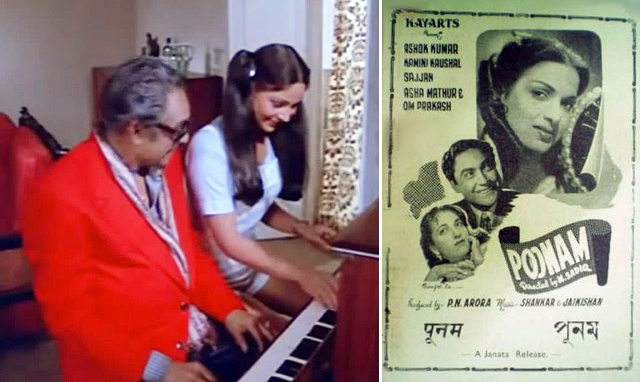
Dadamoni, Rati Agnihotri in a still from Shaukeen; poster of Poonam (below)
Roshmila Bhattacharya (MUMBAI MIRROR; October 11, 2018)
I met him for the first time as a wide-eyed 22-year-old trainee journalist. And even as I was stuttering over the “Sir”, he cut in to say gently, “Call me Dadamoni.” With that one word he steadied my skittish nerves and I made a friend for life. Since our birthdays were a day apart, Ashok Kumar who’d have turned 107 on October 13, would always insist that he was younger than me which, going by the twinkle in his eyes and his Puckish humour, he was.
Rati Agnihotri, the giggly PYT of Basu Chatterjee’s Shaukeen whom the three old men — Ashok Kumar, Utpal Dutt and AK Hangal — compete with each other to impress, agrees with me, saying his chuckle was the most delightful sound she’d heard. “And the hilarious anecdotes Kishore da (Kishore Kumar) and Dadamoni would narrate had us clutching our sides with uncontrollable laughter. He was tailor-made for that role, except he wasn’t lecherous, he was one of the nicest persons I’ve met,” asserts the actress.
Another co-star, Kamini Kaushal, flashbacks to one of her earlier films, Poonam, which had Dadamoni as the much older hero, mesmerised by her singing. She narrates how she’d met him for the first time when he’d come to her college, Kinnaird in Lahore, to attend a cultural programme organised for the war relief fund as the chief guest. “I was a final year honours student in English literature, spirited, fun-loving and uninhibited. After my solo dance performance, I was standing in the row right behind him, and to catch his attention, I stealthily pulled his hair from behind,” the nonagenarian actress shares.
Kamini ji adds that when they started working together in Poonam, she asked him if he remembered her from that incident, and he nodded with a laugh, “Of course I do, you naughty girl.” That set the tone of their relationship. “I was a kid and he was years older, but we were buddies,” she smiles fondly at the memory.
For Rati, Dadamoni was someone she could talk to about anything and everything. “He was learned and honest. Given how young and inexperienced I was then, his anecdotes from his life’s journey were like Aesop’s Fables for me,” she asserts.
Rati goes on to recall how during the shooting of a song for Tawaif, she had admitted to him that the 18-hour workdays, 24x7, for months on end, were taking their toll, leaving her drained and susceptible to infections. Dadamoni who had studied homeopathy, immediately prescribed some little white pills which her parents got from a pharmacy in Princess Street. “They worked miracles,” the actress marvels years later.
That wasn’t the end of his lessons. During the shooting of B R Chopra’s social drama, there were times when Rati would get a little anxious because this character with her body language and colourful vocabulary, was very out of character for the young girl. “I would nervously ask Dadamoni how to do a particular scene Chopra uncle had briefed me on. He would tell me reassuringly, ‘Beta, tum jaise kar rahi ho, sahi hai.’ This gave me the confidence to play the role naturally, without trying to force myself to become someone I wasn’t,” she says.
Today, when I look back to our conversations, I realise I got my share of Aesop’s Fables too, between chuckles, which still echo in my ears.
Ater Ittefaq, I’ll never be scared of not having money again-Kapil Chopra
8:05 AM

Kapil Chopra, with brother Abhay, on tumultuous times, suspense thrillers with alternate endings, and the promises tomorrow holds
Avinash Lohana (MUMBAI MIRROR; October 30, 2017)
Sitting comfortably in a living room crowded with mementoes and memories, BR Chopra’s grandsons and Ravi Chopra’s sons, Kapil aka Juno and Abhay Chopra, revive childhood memories, discuss epic battles and tell us why Ittefaq happened. Excerpts from the interview…
What do you remember of the original Ittefaq?
KAPIL: I saw it as a kid on DVD and I remember Nanda running in a blue saree (laughs). I’d loved the concept even then and the fact that it was a songless thriller.
ABHAY: Yeah, it was way ahead of its time, reminded me of Alfred Hitchcock and was such a departure from Yash uncle’s later films.
The film was produced by your granddad, B R Chopra, directed by his brother, Yash Chopra, and your father, Ravi Chopra, was an AD on it. Quite the family plot, right?
ABHAY: In the scene where the chandelier falls, dad was the one holding it and cueing the action.
KAPIL: Yash uncle and dad were more friends than chacha-bhatija. They had a bachelor pad in town and were mad about convertibles. Yash uncle visited dad regularly when he was ill, when all Yash uncle wanted to know was when dad will get back to making movies.
Did you ever imagine yourself in any other profession?
ABHAY: I was always fond of films but loving cinema as a filmmaker grew with time. It’s a tough business and you have to really love it, to want to do it. Our parents never forced it on us.
KAPIL: I did a course in marketing in the US and on my return, assisted Karan (Johar) on Kabhi Khushi Kabhie Gham. Associate director Nikkhil Advani was a taskmaster, but nobody wanted to go home. (Laughs) I even skipped a friend’s wedding because I didn’t want to leave the office even though we were actually not doing much.
Tell us about your grandfather?
ABHAY: When I was studying in film school, I’d send mom my scripts. She would read them out to him and he’d send them back with valid comments.
KAPIL: He really spoilt us and regaled us with stories like how he got Rs 6 lakh to shoot an episode of Mahabharat when it actually cost Rs 8 lakh. When dad pointed out that they were losing Rs 2 lakh on every episode he told him, “Just do this well, phir humari pidhiyan khayengi.” It’s true, Mahabharat is still earning us money and was our saviour in bad times. My grandfather taught us never to run after money but focus on content that would make us proud.
Your association with Shah Rukh Khan grew through Bhoothnath and its sequel and now he has co-produced Ittefaq.
KAPIL: He’s been a pillar of support, when dad was really ill, he came home and offered to help. We owe him a lot. Ittefaq would not have been made without Shah Rukh.
Who else helped you weather the tumultuous times?
ABHAY: Mom (Renu Chopra), she’s very strong…
KAPIL: And always positive. I get stressed out easily but Abhay always calms me down, saying, “Don’t worry, we’ll figure it out.” In these last four years, we’ve grown as a family. When I didn’t want to burden mom, I shared my problems with my brother.
Is the financial crunch behind you now?
KAPIL: We are limping back. But after this, I’ll never be scared of not having money again.
What support did you receive from Aditya Chopra?
KAPIL: Adi was very supportive during Bareilly Ki Barfi. And we began shooting Ittefaq at his studio and wrapped it there with the song “Raat Baaki.” The studio was booked solid but Adi worked it out saying he’d love for us to return.
In these days of social media how will you keep the suspense under wraps?
KAPIL: We have shot alternate endings and except for the cast, director and the producers, nobody knows what the actual ending is. We are running the ‘No spoiler campaign’ requesting people to keep the secret.
BR Chopra’s repertoire includes fi lms like Nikaah which is relevant today in the wake of the Supreme Court judgement on triple talaq and Insaf Ka Tarazu given the #Metoo campaign. Any more remakes in store?
ABHAY: We are blessed to have a library of films but even Ittefaq is not a copy. As long as you find a new way to tell an old story, it’s fine.
KAPIL: Karan (Johar) and I were recently discussing a remake of Pati Patni Aur Woh. We’d like to do more remakes and adaptations, but also put out original content. In January, we roll with a road trip film which Nitin Kakkar will direct. Fawad Khan had given the nod to it earlier but now we are looking for another actor.
Javed Akhtar plays narrator in Bareilly Ki Barfi
7:53 AM

MUMBAI MIRROR (August 10, 2017)
Like in his 2016 wrestling-drama, Dangal, in which the story is narrated by protagonist Geeta Phogat’s cousin, Omkar’s (Apaarshakti Khurrana), writer-director Nitish Tiwari thought of taking a similar approach when penning the story of Bareilly Ki Barfi for his filmmaker-wife Ashwiny Iyer Tiwari. The Junglee Pictures and B R Chopra production is co-written by Nitesh and Shreyas Jain and set in the small town of Uttar Pradesh.
“We wanted a narrator who is not just a voiceover but a key character through the film. Someone who is an integral part of the paagal Mishra family,” points out Ashwiny who roped in fivetime National Award-winning lyricist Javed Akhtar as the sutradhar in the Ayushmann Khurrana, Rajkummar Rao and Kriti Sanon romcom.
She adds, “In any small town where houses are closely stuck, everybody is a part of the family and knows exactly what’s happening in whose house. So the sutradhar in our film is a neighbour who has been a witness to the Mishras interesting journey.”’
Ashwiny informs that it was creative producer, the late BR Chopra’s grandson Kapil aka Juno Chopra, who was instrumental in bringing the Padma Shri on board. “When dad (late filmmaker Ravi Chopra) was directing Baghban, he asked Javed sir to help with the climax and even after all these years, it’s the most poetic finale. Fifteen years later, I got Javed sir on board again and life has come a full circle,” says Kapil.
The August 18 release features Rajkummar as a shy salesman, Pritam, who turns into a stud Romeo to break starry-eyed Bitti’s (read Kriti) heart so Ayushmann, as Chirag, can woo her. The plan backfires when not just Bitti but her entire family grows fond of Vidrohi and a glowering Chirag is sidelined.
“The narrator had to be someone who enriches the story with dollops of humour with his understanding of language, intonations and expressions. Who better than Javed sir,” Juno signs off with a smile.
Without any struggle I had landed my big break-Salma Aagha
7:39 AM

Roshmila Bhattacharya (MUMBAI MIRROR; May 26, 2015)
Her maternal grandmother, Anwar Begum, had acted in Heer Ranjha with her grandfather Jugal Kishore Mehra in 1932 and her mother, Nasreen, with K L Saigal in AR Kardaar's Shahjehan in 1946. But surprisingly, light-eyed beauty Salma Aagha was more interested in a career in singing rather than acting. She was in the recording studio for a song rehearsal with Naushad for Chanakya Aur Chandragupta when producer B R Chopra walked in, took one look at her and said, "Yeh meri Nilofer hai!"
His composer-friend tried telling him that Salma was there as a singer, but Chopra was adamant about casting her as the female lead in his upcoming social-drama, Nikaah, and asked her to meet him the next day. He was a good friend of her grandfather's who had been with All India Radio before he entered films like Chopra, who was a journalist. So she went along and he once again reiterated that she was playing the lead in his film.
"That was it! Without any struggle I had landed my big break and I didn't even realise it then," laughs Salma recalling her entry into Bollywood over three decades later.
She was a complete novice but Chopra was the patient mentor-director, explaining every technical detail minutely to her, and Salma put her heart into her performance. So much so that after one particular scene she was so distraught that she just wouldn't stop crying even after the camera stopped rolling.
"Raj Babbar who played my second husband in the film and who has remained a good friend since, reprimanded me saying, 'Why do you take things to heart? It will make you ill.' But I continued crying," she laughs.
Chanakya Aur Chandragupta never got made but Nikaah, earlier titled Talaq, Talaq, Talaq, based on the Sharia laws of divorce and its misuse, opened in 1982. Made on a modest budget of Rs 19 lakh, it was a superhit.
"It was the story of every second home. I work for two NGOs, I've come across many instances of men messing up and women having to pay for their mistakes," says the film's singer-actress who was an overnight sensation.
Salma points out that many singers since have come up with remixed versions of Dil ke armaan aansoun mein bah gaye, even she is coming up with one with my daughter Sasha.
"But none of these versions have been as successful as the original, not because these singers aren't good but because my voice was unique at the time," she reasons.
She adds that many, including the film's composer Ravi, had tried to dissuade Choprasaab from using her voice, insisting he go in for another playback singer. But he was adamant. He not only got her to sing Dil ke armaan but also another solo, Faza bhi hai jawaan jawaan, a duet with Mahendra Kapoor, Dil ki yeh aarzoo thi koi dilruba mile and Chehra chhupa liya hai kisine hijab mein with Mahendra Kapoor and Asha Bhosle. "Dil ke armaan released before the film and was an instant hit. But I didn't know then that this fairly simple song would be evergreen," she admits.
After the film opened she'd visit theatres incognito to gauge people's reactions. And she was overwhelmed when, as she'd heard, she saw people streaming into the darkened auditorium just before Dil ke armaan came on screen. "When it started playing there would be shower of coins and after it was over, all those who had stepped in for a dekko would go away and the doors would shut quietly," she smiles.
Salma didn't win the Filmfare best actress award despite being nominated but she did return home with the black lady after being adjudged the best playback singer (female) for Dil ke armaan. She admits that with Lata Mangeshkar and Asha Bhosle also in contention, she didn't think she stood a chance of winning and was happily talking to someone when suddenly she heard her name being announced.
"The auditorium was packed and everyone was looking at me. For a moment my heart stopped beating. Then I stood up and walked to the stage to collect my first Bollywood award," she smiles.
Both dubbing studios under BR Chopra banner shut down
7:45 AM

Asira Tarannum (MID-DAY; August 27, 2014)
A few months ago, we had heard that Bhoothnath Returns was an attempt to revive the BR Chopra banner but now it has emerged that both its dubbing studios have been shut down. The studios — one of which was set up in 1971 and the other in 1983 — were apparently shut down after the recording for Bhoothnath Returns was over and now their staff is also said to have left.
 An insider reveals that the studio staff was
asked to leave one by one. “Now only an electrician is working here and
everyone else has already left. The studio’s equipment too has been
sold; there was a beautiful lift in there and that too has been sold.
For the outside world, the studio is under renovation but we know that
the studio has been shut. Why will the staff be asked to leave if the
studio was just under renovation? The staff strength was 20- 22 people
but now they are no longer working here,” says the source.
An insider reveals that the studio staff was
asked to leave one by one. “Now only an electrician is working here and
everyone else has already left. The studio’s equipment too has been
sold; there was a beautiful lift in there and that too has been sold.
For the outside world, the studio is under renovation but we know that
the studio has been shut. Why will the staff be asked to leave if the
studio was just under renovation? The staff strength was 20- 22 people
but now they are no longer working here,” says the source.Turns out that it was around last year that people working in the studio first got a whiff of things to come. Interestingly, some people seem to have got their salaries while some others are apparently struggling to get it. B N Tiwari, President, Sound Artist Association, who worked at one of the studios, says, “Yes, Bhoothnath Returns was the last film the studio did and the studio has shut down now. It is appalling to see such big studios shut down. I won recognition only thanks to these dubbing studios. I left in 1996 and then my wife, who is Asia’s first woman sound recordist, left sometime in 2008. It was a dream studio, but now it stands shattered.”
Another source says that the younger Chopras thought it was better to shut down the studios owing to the many litigations it is currently facing. “The owners plan to put them for sale,” says the source.
When contacted, Abhay Chopra, Ravi Chopra’s son who owns the dubbing studio, said that the studios have been shut down temporarily. “They have been shut down for renovations and upgrading,” was his reply.
Subscribe to:
Posts (Atom)