Showing posts with label Assi. Show all posts
Showing posts with label Assi. Show all posts
Today, people discuss box office more than cinema-Kumud Mishra
9:47 AM

Kanksha Vasavada (BOMBAY TIMES; June 13, 2026)
Kumud Mishra has already carved a niche for himself across theatre, films, and OTT platforms, but the actor continues to explore new creative avenues. Making his Gujarati cinema debut with Dhabkaaro, he delivered a brief yet impactful performance, reaffirming his belief that “agar script achchi hai, toh medium ya language se koi farak nahi padta.” Kumud, who was in Vadodara for the play Dhumrapaan, talks about theatre, choosing scripts carefully, and more.
‘Theatre still values stories and craft over numbers’
Kumud believes the priorities of both creators and audiences have shifted. He says, “Today, every art form is judged by the number of people watching it. A few years ago, after watching a film, conversations revolved around cinema itself — whether the film was good, how the story was, the making, the production, and so on. But now, the discussion is only about how much money it will make or how it will perform at the box office, all in terms of crores. Unfortunately, even audiences today seem more focused on discussing everything around the work rather than the craft itself, which is sad.”
He adds, “However, theatre still has that unique space where discussions around the genre, the story, the challenges, and the creative process keep it exciting for me. Of course, there are economic considerations too, but our focus remains on creating plays that audiences genuinely enjoy while also being creatively fulfilling for us. I also enjoy the fact that new directors and actors continue to join the group.”
‘Theatre mein aap bina ghabraye fail ho sakte hain’
Working extensively across OTT platforms and films today, Kumud has continued to remain deeply rooted in theatre. He says, “I never left theatre, nor did I ever feel like leaving it. If you feel like you are holding on to something, it stops working—but theatre was never like that for me. It is a necessity in my life. It was there long before films, OTT, or any such ambitions even crossed my mind. Theatre has given me everything I have today as an actor, and it still offers me the freedom to experiment fearlessly. Theatre mein aap bina ghabraye fail ho sakte hain. The focus is on experimenting with the content, not on the money attached to it.”
‘I read scripts in one sitting before saying yes’
Asked about how he chooses projects, he says, “The truth is that mujhe bohot saara kaam offer hota nahi hai. Jo kuch hota hai, uss mein se I select. When I read a script, I finish it in one sitting and can clearly visualise that world unfolding before my eyes. Even if it’s a script for a web show, say, 300–400 pages, I will still read the entire thing. People may find it amusing, but I see it as part of my job. There can be other reasons as well, such as the desire to collaborate with a particular filmmaker, but the script remains the most important factor.”
Talking about adapting to characters, Kumud says, “I don’t merely portray the characters I’m given—I become them. Whether it’s a billionaire or a policeman, they are all real people to me. I don’t imitate them; I step into their lives. What truly makes a character stand out is their place within the story and the way they respond to the situations around them. I have always believed that an actor should look the part. So, I underwent a physical transformation for my character in Assi. The role required me to appear leaner. In theatre, that is not much of an issue because wahan aap 40 saal ke hoke bhi 17 saal ke ladke ka character kar sakte ho, and vice versa. But in films, you cannot betray the audience, which is why casting becomes extremely important.”
‘Hope to do more Gujarati films’
Talking about Dhabkaaro, he shares, “Abhishek (director) is a dear friend, and I also loved the script. Some scripts are so good that you simply want to be associated with them in any way possible. I also enjoyed the way this industry functions. It felt like being part of a family. Everyone worked with a lot of focus and dedication, which was touching. Also, while we have always seen (Devan) Bhojani doing comedy, seeing him playing such an intense character was quite an experience. We interacted a lot and had great fun.”
He adds, “I wish I had the opportunity to learn and speak more Gujarati, because as artistes, we always feel the need to fully understand a language and its nuances. I hope people appreciate my work and I get more opportunities to work in Gujarati films.”
‘Barodians are warm and welcoming’
Talking about Vadodara, he says, “My experience in Gujarat has always been wonderful. I’ve visited Ahmedabad several times, and we also perform regularly in Vadodara. This time in Vadodara, it was a unique experience because we were performing at a new venue, for an audience that was entirely new to us. Vadodara has long been known as a vibrant and thriving centre for the arts. I first visited the city many years ago when my brother was working there. He loved the city so much that he eventually bought a home there, which later became my base as well. The people are incredibly warm and welcoming, making you feel instantly at home, as though you’ve known them forever.”
The fact that you said Assi and Dhurandhar in the same breath is good enough-Anubhav Sinha
3:01 PM
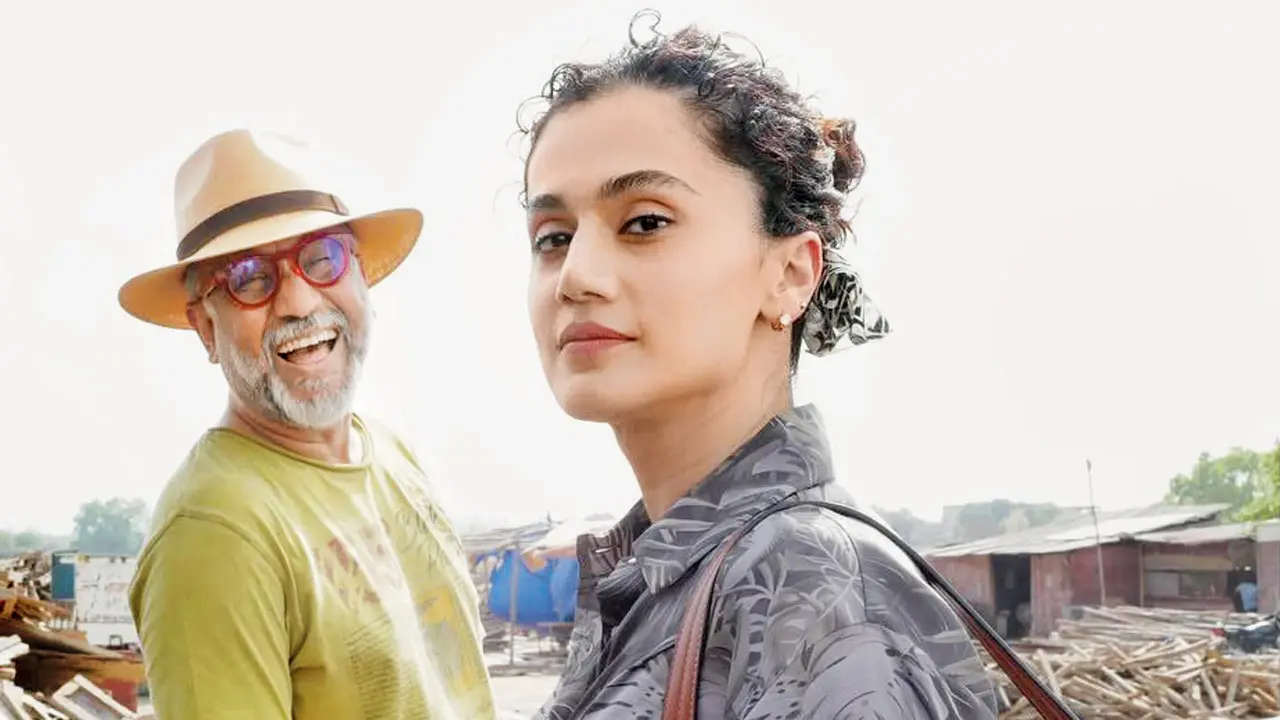
As Assi drops online, filmmaker Anubhav Sinha gets candid about its box office reception, making unpopular choices, and why he believes films like The Kerala Story and The Kashmir Files have a right to exist
Priyanka Sharma (MID-DAY; May 3, 2026)
Stationed at a city hotel, filmmaker Anubhav Sinha is busy recording long media interactions about his latest film, Assi. If one didn’t know better, the director’s enthusiasm would give the impression the film is about to release. But the Taapsee Pannu-starrer released two months ago, and began its streaming run last week. For Sinha, though, it feels like a re-release.
“The film dropped on Zee5 on Thursday night (April 17). Friday was a little quiet. So, I thought maybe OTT release is like this. But, Friday night onwards, it became viral — whether it was Instagram Reels or Whatsapps or DMs from filmmakers, friends, bichhde hue dost Mathura aur Jaipur se. So, for me, it’s feeling like a re-release,” he smiles.
Still, two months is a long time for a maker to observe the reactions that a film received during its theatrical run, agrees Sinha. “Largely, things that are said about the film are in appreciation. There are a slim percentage of people who find Kumud’s [Mishra] character, Kartik, to be an outsider to the story. But that’s all that I have heard as a critique. The other observation is that the film is very disturbing, which it was intended to be,” he says.
It feels the right time to register a feedback that one felt while watching the movie that works both as an investigation and an introspection centred around the rape of a school teacher (played by Kani Kusruti) in the capital. The feminist intent notwithstanding, the execution in parts feel preachy, we share with Sinha. The director replies, “I respect this observation and if I looked at the film from that viewpoint and it’s not absolutely unfounded.”
Sinha, consistently, has been among the voices in the industry who remain open to dialogue and dissent. So, we ask him how he views Pannu’s widely-discussed Instagram post, before Assi’s release, where she appealed to the audience to be louder in their support for films that aren’t cut from the cloth of mainstream. “You deserve good cinema only when you value it,” reads a sentence from her post. Doesn’t it put an unfair amount of responsibility on the audience, which is an outsider to the rooms that decide what gets made in the industry?
“The responsibility of the audience is directly proportional to the expectation of the audience. So, Tapsee is probably coming from a place where she very regularly hears that good cinema is not made. Even though, I don’t agree much with this because how do I assume my cinema is good? People will decide that. But Tapsee was probably trying to talk about real cinema, real stories. So, if the audience has expectations and demands from cinema, then it becomes your responsibility as well [to support it] because making such films is an unpopular choice. People have no idea what it takes to get these films off the ground,” he says.
But another argument arises that the audience merely reacts to the visual assets of a film or to a star, if it’s a star-fronted feature. If a filmmaker fails to ignite excitement among the viewers, the onus shouldn’t fall on them to still pay to watch a film, howsoever well-intentioned it is. Sinha agrees that the responsibility lies more on the industry to churn out diverse stories on a regular basis, even if it fails at times, in an attempt to reach out to the audience and eventually condition it to give a chance to “unpopular films”.
How does one restore the balance that an Assi and Lapataa Ladies can co-exist with a Dhurandhar and a Pathaan [2023]? “Yes, the balance has become very lopsided. But the fact that you said Assi and Dhurandhar in the same breath is good enough. Around 13 lakh people went to see Assi in the theatres. If I draw an analogy, 40–50 thousand people sit in a stadium to watch a match. Now, three crore people went to Dhurandhar, but its stakes and ambition were different. Assi’s ambition was not that three crore people should go to see me,” he argues.
But Sinha is a producer as well and the commercial ambition of Assi will have a number attached to it. “It should have done much better than what it did for it to fall into that [success] category. But that’s one of the later metrics that I look at. In the real world, it seems that the math of a film is very urgent. But it takes a backseat, not only for the filmmaker but for the whole team, including the stars and the studio. Years later, it doesn’t matter how much money did Satya [1998], Chandni [1989] or Lamhe [1991] make. On an urgent basis, Lamhe was a flop. But today, it is a hit.”
What remain urgent are Sinha’s stories. So, we mention our recent conversation with filmmaker Mahesh Bhatt, who said that stories on screen are being weaponised to push people away from each other.
“As an audience, you can choose one story over the other but all of them have the right to exist. The Kerala Story [2023] has a right to exist, and so does The Kashmir Files [2022],” Sinha says.
So, where does an artiste’s responsibility lie? “Artistes will make their own choices and then history will place them on shelves. It’s not my job to place another artiste on a shelf or myself on another shelf. We are making films, and today there is a knee-jerk response. Twenty years later, when a smart girl writes a massive article about what happened in this era in India, we will all be judged much later. If you are fortunate, you will be judged, otherwise you will most likely be ignored by history.”
The enemy within: Changing face of rape on screen
10:45 AM

No torn blouses, leering villains and revenge sagas. Some filmmakers are moving beyond tropes to confront the ordinariness of sexual offenders and systems that enable everyday harm
Shruti Sonal (THE TIMES OF INDIA; April 26, 2026)
For decades, Indian cinema has had a rape script with three roles. A lecherous villain, a woman violated, and a hero who arrived just in time to avenge her. That template is cracking with a new crop of films and shows where the perpetrator grows up listening to poetry about women’s empowerment, speaks English, and belongs to your family.
‘Chiraiya’, a new web series that has ruffled feathers in India’s ever-growing manosphere, puts a face to that. In a reputed joint family in Lucknow, a sari-clad Kamlesh — the elder bahu — asks a question that old cinema never had to answer. “As women, we’ve been taught to never cross the rekha like Sita, and we’d be safe. But what if we aren’t safe inside the rekha itself?”
Her question follows an event that rarely makes it to popular culture: her sister-in-law being subjected to marital rape, an act not yet criminalized in India.
The show’s afterlife online has seen one of the rape scenes turned into a meme in incel circles online, where it is used to argue that ‘modern women’ are okay with increasing their ‘body count’ before marriage but quick to label sex within marriage as rape.
Beyond these rage-bait debates, however, the show is emblematic of how a string of recent shows and films are tackling rape, moving beyond helpless victims, macho male saviours, and neat definitions of justice. They are taking on ‘hushed’ issues like marital rape, and also examining systemic failures, legal hurdles, and the everyday-ness of perpetrators — a far cry from voyeuristic tropes, torn blouses, and villains laughing as women beg ‘bhagwan ke liye mujhe chod do’.
When the villain looks like us
‘Chiraiya’ director Shashant Shah says moving beyond villains was a “conscientious” decision, as is placing the story of rape in a liberal, middle-class family. Arun, who commits marital rape on multiple occasions, is shown as an English-speaking younger son of a progressive father, who writes evocative poetry about women’s empowerment — but fails to stand up for his bahu.
“We wanted to show education has nothing to do with how women are getting treated, and it’s not something that happens in lower-strata societies,” he adds.
Assamese short film ‘Xoudaamini’ takes a similar approach. It begins where most films tend to end — with an intercaste couple eloping and marrying. But instead of a happy ending, the marriage unravels when the husband, in a drunken state, forces himself on his wife.
Priyanka Sohoria, the film’s director, says the story was born out of personal experiences of women in her family. In ‘Xoudaamini’, the woman leaves home after the incident, along with her son.
“After watching it, many women reached out to me and said they had gone through something similar, but couldn’t leave,” Sohoria adds. “That’s why such stories are important — to show other possibilities.” Released on YouTube for free, the short film has amassed nearly three lakh views.
The National Award-winning Malayalam film ‘Aattam’, too, avoids depicting the act itself, and instead focuses on what follows within a ‘liberal’ theatre group. The accused, a colleague, is defended by peers, while the survivor faces questions in a space she once considered safe.
This move away from stereotyped villains towards familiar, everyday perpetrators has implications beyond cinema, says Nikunj Kulshreshtha, assistant professor at Jindal Global Law School.
In a study of 4,485 Hindi films between 1980 and 2022, he analyzed markers commonly associated with rape victims, such as whether the victim was educated, her relation with the perpetrator, whether she struggled physically, and her dressing.
“I found that these films were not only pushing the image of an ideal rape victim, but also the ideal offender,” says Nikunj, pointing to the long-standing depiction of rapists as visibly deviant men with criminal pasts or addictions.
“Such depictions impact how the judiciary views offenders, and often damage the credibility of victim narratives, as a lot of people have difficulties in believing that a boy from a good family could be a potential sexual offender,” he adds.
Takes more than a hero
Along with the changing depiction of victims, the hero too is being reimagined. In older films such as ‘Shahenshah’, ‘Damini’, and ‘Insaf Ka Tarazu’, rape often functioned as a plot device to trigger a male protagonist-led revenge arc. While such narratives persist in some recent blockbusters like ‘Dhurandhar 2’ and ‘Maharaja’, a growing number of filmmakers are moving away from it.
In Anubhav Sinha’s ‘Assi’, a courtroom drama centred around a gang rape where Taapsee Pannu plays a fierce lawyer, there are no dramatic victory speeches or cathartic endings. Instead, there’s a call for reflection, with the movie title alluding to the NCRB data of over 80 rapes happening every day in the country.
“I was not interested in creating a hero, or making this incident the podium the hero stands on. I also didn’t want to blame a single perpetrator, or even the police or the judiciary in isolation,” Sinha says. “Maybe the onus rests on us. There’s a lot left to be desired in the way we raise our boys. On the other hand, from a young age, we ask girls to keep quiet and ignore small acts of harassment.”
‘Chiraiya’ too resists a cliched saviour saga to focus on imperfect allies and female solidarity. At its centre is Kamlesh, who initially struggles to recognise marital rape but gradually educates herself and stands by her sister-in-law, acknowledging that women often pass on and perpetuate patriarchal norms, too.
“I wanted to focus on this aspect of sisterhood because even today, a lot of women feel that they don’t have anybody to go to when something like this happens to them,” Shah says.
Unlearning the everyday
More recent narratives are also widening the lens. Oscar-nominated crime drama ‘Santosh’ examines caste bias and corruption in the investigation of a Dalit woman’s rape and murder, while the sequel to the successful ‘Dhurandhar’ briefly touches on sexual violence against men — as a way of exerting masculinity and power — often ignored in mainstream depictions.
“It’s more about looking inward. I’m fighting with my own misogyny every day,” says Sinha, recalling how he grew up in a household where he would get his plate of food before his sister.
Unlearning such “small” acts, he argues, is crucial in battling ‘rape culture’. “We have to understand that it’s not a group of men gleefully fantasizing about rape. It’s the normalization of sexual objectification. Rape is probably the by-product of that…both on and off the screen.”
OTT platforms only want box office hits-Taapsee Pannu
11:02 AM

Taapsee Pannu, who champions the rights of women onscreen, talks about choosing the right films in an industry that strictly banks on box-office numbers
Sonal Kalra (HINDUSTAN TIMES; February 28, 2026)
Bold, fearless, bindaas: few in the industry can be summed up like this. Actor Taapsee Pannu embodies these traits both off and on the screen. She talks about what works and how she functions, with her recent film Assi spotlighting the sensitive subject of rape. Excerpts from her chat on The Right Angle with Sonal Kalra:
With big-scale films like Dhurandhar, how do you get the conviction to bring an ‘uncomfortable watch’ about rape to theatres?
If people like to watch violence on screen, let’s not demarcate it as ‘this violence is okay, but this violence is not’. We all enjoy big films, but all types of cinema have their own palate.
If one decides to only watch a certain kind of films, our cinema will start looking like a template. Then we as an industry will not be able to produce the kind of variety we are capable of.
There is also a notion people have about a film being okay to watch on OTT, but not in theatres. But the reality is that OTTs also don’t want films that are not big-scale event-based. Their mandates clearly state that they only want films that are box office successes. Soon, there will be a time when movies like Assi will not be released even on OTT platforms.
Does it worry you that the industry prides itself on saying you are only ‘as good as your last hit’?
A decade ago, it was believed that women-led stories didn’t have space in theatres. Then came Vidya Balan and Kangana Ranaut-led films, changing the definition of ‘mainstream’. The industry was flourishing before Covid, when a film like Saand Ki Aankh (2019), in which Bhumi Pednekar and I played 60-year-old daadis, ended up earning Rs. 21 crore. There was that time, too.
Change is the only constant. I am going to be optimistic about the future. My only insecurity as an actor is that if that (mentality) continues, I will have to change the kind of films I take up. I would have to either disassociate totally or change my path and the kind of films and roles I do, which will be slightly painful for me.
When will your fans get to see you in a comedy role like Khel Khel Mein?
I am waiting for a good comedy. I don’t want to be the object of comedy; I want to perform. Mudassar Aziz (director) personally knew me and what kind of comedy I could pull off. People who know me don’t associate me with something so serious (Assi). I am really hoping that after Khel Khel Mein, I find my footing as a bankable actor and find the right script. It takes a while. We don’t have that many comedy films where women can enjoy doing comedy and not be the object of comedy. It’s a rare sighting.
There is a fight between producers and actors: producers say that if an actor leaves a film, they should be compensated; actors feel that they are not compensated when a film is shelved or postponed, or if they are replaced. What is your view?
If both sides decide to spend money on recces and block dates without signing any papers purely on trust, then in what capacity can one try to go and fight for it? It happens all the time.
I have wasted months trying to make a project happen. It happened when a filmmaker, who was a friend of mine, told me that our project had been indefinitely pushed because the investors pulled out, just two weeks before it went on floors.
For an actress, it’s extremely harsh because we don’t get paid as much. There is a limited time of the year that is good to shoot in. And three months of my peak shooting time got wasted like this because we had not signed any papers. We can only feel guilty about it, but we won’t have the authority to seek compensation. That’s how the business works.
Have you ever lost out on work because of being a bindaas, outspoken person?
I might have, but I don’t get this information firsthand. What I do get to hear is, ‘The hero doesn’t want you to be in the film.’ Heroes decide the heroine in a film, unless you have a director who is the biggest star who asks for a particular person. When Raju (Rajkumar Hirani, director) sir wanted me in Dunki (2023), I was in the film. It might just be a big shock for everybody because I am not in the quintessential circuit of those films, or Shah Rukh (Khan, actor) sir’s regular pair on screen. The director was sure he wanted me.
The other thing I sometimes hear is that I am a little too difficult to work with. But I fail to understand that. Anyone who looks at my filmography, directors who worked with me have repeatedly cast me, and that cannot happen with someone who’s difficult to work with. Nobody wants trouble again and again in their films.
If the people who have not worked with me say that I am not a very social person, I cannot go out of my way to show them how I am. I let my work do the talking. It’s the harder route, but I am saner that way.
Mid-sized films have the highest chance of good ROI-Anubhav Sinha
10:01 AM

Dropping his earlier proposal of limited theatrical release for mid-budget movies, ‘Assi’ director Anubhav Sinha asserts high-concept films will find their rightful screens and audience
Mohar Basu (MID-DAY; February 22, 2026)
During the release of Anek (2022), filmmaker Anubhav Sinha had proposed that small films could adopt a model of limited theatrical release, followed by a quick OTT première. He believed the approach would give small movies the chance to co-exist alongside big-screen spectacles. However, now, days after his latest offering Assi has arrived in cinemas, the director admits he has had a change of heart.
“I’m saying the exact opposite today. The future is this size [of films]. Mid-size, medium budget, and high-concept films have the highest chance of a good ROI [return on investment],” he tells mid-day.
In the past eight years, Sinha has championed mid-budget movies, delivering thoughtful stories in Mulk (2018), Thappad (2020), and Bheed (2023). “That’s the only cinema I know as a maker,” he smiles.
Even as tentpole movies dominate theatres today, the director remains clear that filmmakers should continue to make rightly budgeted, content-driven movies and they will find their audience. “I love Rajkumar Hirani and Rohit Shetty films as a viewer. But as a filmmaker, this is all I want. So, I will fight for my and my peers’ right to make films we believe in.”
Is making such films in today’s ecosystem difficult? Sinha admits it’s tough, probably tougher for others than him.
“[You have to] make a good film and recover the money. I make my films frugally. But it’s not easy for everybody. There will be six more directors who want to make such films; they are running around with their scripts. But they won’t get funded. I’m too senior and I’ve seen more than reasonable success. [So] I get to do this.”
(Crisp) Movie Review: ASSI by FENIL SETA
3:46 PM

Assi begins on a shocking note that grips the viewers instantly. The makers inform at the very beginning that a rape is reported in the country every 20 minutes. This information is reminded to the viewer after every 20 minutes into the runtime and it further packs a punch. The courtroom scenes are the most memorable. At the same time, director Anubhav Sinha focuses on what the survivor goes through and the female members of the rapists' families, further enhancing the impact. Despite so many plusses, the film sadly slips at several plusses. In some scenes, the film has been executed in a 'film festival' style. Anubhav should have ideally helmed it like Mulk or Taapsee's Pink – films which were legal dramas, were not masala entertainers as such and yet, had mainstream appeal. Secondly, for some reason, a lot of prominence is given to the character of Kartik (Kumud Mishra), which distracts the viewers from the principal story. Even the cop character's track doesn't pack the intended punch. Speaking of performances, Taapsee Pannu returns to the zone that she owns and is too good, as always. Kani Kusruti plays a very difficult character and comes out with flying colours. Mohd Zeeshan Ayyub gets to play a lovable, unconventional character and he essays it with panache. Kumud Mishra is okay. Satyajit Sharma (Navratan; defence lawyer), Rajendra Sethi (senior cop), Jatin Goswami (Sanjay; cop), Revathy (Vasudha; judge), Manoj Pahwa (rapist's father), the actor playing ASI Vanita and others lend able support. Naseeruddin Shah, Supriya Pathak and Seema Pahwa are impressive in special appearances. All in all, Assi is definitely worth a watch, but could have been a classic had the direction been consistent.
My rating - *** out of 5!
My rating - *** out of 5!
Every time Gaurav Solanki and I went to write a scene, we were trying to think like a woman-Anubhav Sinha
8:57 AM

Mohar Basu (MID-DAY; February 17, 2026)
In its first 10 seconds, the trailer of Assi tells you a chilling statistic — that there are 80 reported rape cases in India every day. “That’s one every 20 minutes. By the time you finish this interview, one more would have happened,” director Anubhav Sinha told us, when we met him to discuss his upcoming film that sees Taapsee Pannu as a lawyer, who takes up the case of a sexual assault survivor, essayed by Kani Kusruti.
With Assi, Sinha aims to show how rape culture is rooted in patriarchy. More importantly, he wants to examine our society’s generational failure. “Mothers tell their daughters at 13 that this [sexual violence] may happen, and this is how you deal with it. But men don’t tell their sons about gender equality. We don’t tell them that you might be attracted to another person’s body, but you can’t snatch it,” he rued.
The director teamed up with Gaurav Solanki to write the social drama. Yet, they entered the writing process at a disadvantage. “Every time Gaurav and I went to write a scene, we were trying to think like a woman. That was the toughest part for me. I was watching a lot of films about women to understand women, to feel like one.”
Reuniting with Pannu after Thappad (2020) was a deliberate choice. The director knew she’d front the film for the right reasons. “I meet a lot of actors who want to be in my movies because they think they should want to be in a movie like that. That doesn’t work for me. You will see Taapsee’s honesty in her eyes. She walks the talk.”
Taapsee Pannu's honesty towards her work is terrific-Kumud Mishra
9:53 AM

Priyanka Sharma (MID-DAY; February 16, 2026)
Actor Kumud Mishra speaks about stepping out of his comfort zone for Anubhav Sinha’s next directorial venture, Assi, a role he initially resisted but ultimately embraced.
There won’t be an Anubhav Sinha project that Mishra would want to refuse. Yet the director never takes their equation for granted, always sending him the script and asking which part he would like to play. With Assi, Mishra picked a role for himself, but Sinha had other plans.
“But he had something else in his mind for me. He gave me a character that I felt was not for me at all. I thought it belonged to someone else. But he said, ‘Aap karenge aur uske liye aapko tayyar hona hoga’.”
Though he agreed, Mishra was apprehensive. “Every character has a look. Your physique should be closer to that of the character. So, I didn’t feel I was ready for this role,” the actor told mid-day. With only two months to prepare, he had to lose weight.
“First I said yes but then I got scared if I would be able to pull it off. I feel in this film, I worked harder on losing weight than on acting,” he laughs.
Reuniting with Taapsee Pannu was a joy. “Her honesty towards her work is terrific. When you have worked with someone several times, you develop a comfort factor and surety that you will be able to create something good.”
Subscribe to:
Posts (Atom)