Showing posts with label Ashutosh Rana. Show all posts
Showing posts with label Ashutosh Rana. Show all posts
Renuka Shahane to direct husband Ashutosh Rana for the first time
9:29 AM

Akash Bhatnagar (HINDUSTAN TIMES; May 28, 2026)
Celebrity couple Ashutosh Rana and Renuka Shahane recently celebrated 25 years of marriage. But beyond the milestone, the duo is now bringing their enduring off-screen chemistry into a new creative collaboration.
Speaking exclusively to us, Renuka, who has carved a space for herself both in front of and behind the camera, reveals that she is set to helm a short film this year starring her actor-husband for the first time.
“There are always jitters when you direct, but this time it’s more special as Rana ji is playing the lead. It’s the first time he is in front of the camera and I am behind it, and it can go either way. Just because you are great partners doesn’t mean it will translate on screen too. But it was better than I had imagined. As a director-actor duo, we make a great team,” shares the actor-director.
Talking further about Ashutosh as a professional, Renuka shares, “He’s a dream actor to work with; he is so open and trusting. He completely surrenders to your vision. He’s like clay, open to being moulded and doesn’t come with preconceived notions as an actor.”
She quips, “Maybe with others he might be a little strict, but with me he was exceptionally kind and forgiving.” Renuka adds that she would also love to collaborate with her husband on screen someday, but with “someone else directing the project”.
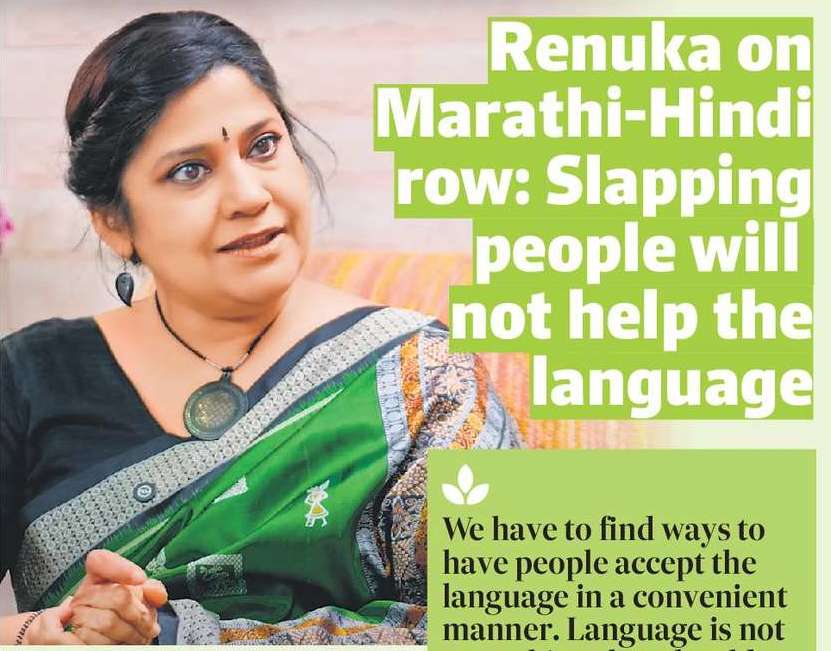
Renuka Shahane on Marathi-Hindi row: "Slapping people will not help the language"
2:49 PM
HINDUSTAN TIMES (July 19, 2025)
Actor Renuka Shahane has weighed in on the ongoing language debate in Maharashtra, urging people to respect local languages and cultures while firmly opposing any form of aggression in the name of linguistic pride. The 58-year-old, who hails from Maharashtra, shared her thoughts on the tensions that have emerged between Hindi and Marathi speakers in the state.
“If you’ve been living in a place for a long time, it’s good to understand the local language and culture, and be respectful of it. I don’t like people who don’t feel the necessity to be accommodating of the local language and culture,” Renuka said on the podcast InControversial.
However, she added that she’s against any kind of violence. “I don’t like the fact that people can be rude about it. Going into a place where Marathi is not spoken and slapping two-three people won’t help the language in any way. We have to find ways to have people accept the language in a convenient manner. Language is not something that should be forced.”
Renuka’s husband, actor Ashutosh Rana (58), who hails from Madhya Pradesh, also addressed the issue recently. “Bhasha samwaad ka vishay hoti hai, vivaad ka nahin. Bharat samwaad mein vishwas rakhta hai, vivaad mein nahin,” he told ANI, emphasizing that language should be a tool for dialogue, not controversy. Renuka and Ashutosh’s comments come amid tensions in Maharashtra around language identity.
The debate reignited recently after the state government announced — and then rolled back — a decision to make Hindi a compulsory third language in schools. Since then, several confrontations have been reported where individuals, allegedly linked to the Maharashtra Navnirman Sena, have clashed with people for not speaking in Marathi.
Siddharth Anand said that I was his lucky mascot and wanted me in Fighter-Ashutosh Rana
7:58 AM

Choosing not to read the book that inspired the series, Ashutosh discusses how he built his retired journalist character in Murder In Mahim
Letty Mariam Abraham (MID-DAY; May 21, 2024)
Sitting in a comfortable room of a five-star, Ashutosh Rana, dressed in black kurta, jeans and a stole, looks ready to tackle any question coming his way. Having been in the industry for over two decades, there is no role the actor cannot do. Yet, you would find Rana doing odd roles that don’t exactly do justice to his talent. Murder In Mahim then comes as a fitting addition to his resume. In the JioCinema series, based on Jerry Pinto’s book of the same name, also starring Vijay Raaz, Rana displays his inner strength as an artiste as he portrays an ex-journalist in pursuit of a serial killer. Edited excerpts from the interview.
How do you choose a role from the plethora of offers that come your way?
I don’t look at the length of the role; I look at the character’s importance in the subject. If the character wasn’t there, would the story move forward? I had two releases, Ranneeti: Balakot & Beyond and Murder In Mahim, where I play two distinct characters. In Ranneeti, I play a suave and overpowering ISI Chief. In Murder In Mahim, my character Peter Fernandes [modelled on the author] is subdued, but he has tremendous [inner] strength. In one, you get to see power, in the other, strength. I have never played such a low-key character. When I play Peter, I notice the character’s body language, the walk, the way he talks and looks. If a character forces me to break my mould and not carry my traits forward, it’s a win-win.
Apart from the script, how much of the character’s creation is your own doing?
Pick any character and you can never know all its traits. We can write a character’s main traits, you have to explore the rest as an actor. Before knowing a character, you have to know yourself well first; you have to know how you’d react to a situation and then change the reaction to suit your character. This is an on-going process and I take it quite spiritually.
Tell us more about Peter Fernandes.
He was a journalist, but took early retirement because he was fed up with where journalism was heading. However, when his son, who attended a gay parade, is a person of interest in the killings of the LGBTQiA+ people, he goes back into investigative mode. He has to fight against powerful people to prove his son’s innocence.
Did you read the book or meet the author?
Whenever a story is [adapted], I try not to watch [or read] the original unless I am done with my act. Else it will impact my performance, it will limit my imagination. After finishing the show, I read the book, and interestingly, the series is shot exactly how the book describes the story. I had not met the author but my mother-in-law is his good friend. Through her I learnt that Jerry is happy that I played the character.
You say that you look at your character’s importance when choosing projects. But so often, talented actors are wasted in films, like you were in Fighter.
It’s a pain an actor has to go through. Sometimes, you have to do it out of respect and affection for someone. I have done films with Siddharth [Anand] like War (2019) and Pathaan (2023). He didn’t ask me, he simply said that I was his lucky mascot and wanted me in his film. He said that I have two key scenes, and I have to portray everything in those scenes, instead of adding four extra scenes to establish the father-daughter relationship between [Deepika Padukone’s] character and me. Sometimes, it hurts, because while we may imagine a story in a certain way, it doesn’t pan out accordingly. The only problem is when other filmmakers feel that since I have done a special appearance in Siddharth’s film, I’ll do it for everyone. It’s a risk, but you have to find a way around it. The other problem of saying no is that you have to wait a long time to find your next role.
Ashutosh Rana remembers Sangharsh: "Every actor wishes for one such movie"
9:15 AM

On HT City’s 25th birthday, we turn the clock back to 1999, when Ashutosh Rana gave Bollywood the villain it needed through Sangharsh
Mimansa Shekhar (HINDUSTAN TIMES; February 24, 2024)
It has been 25 years since Sangharsh (1999) hit the screens and actor Ashutosh Rana won acclaim for his portrayal of the twisted antagonist, Lajja Shankar Pandey. To this day, he deems the psychological thriller one of the highest points of his filmography.
“Very few things in life have such a long journey. Every actor wishes for at least one such movie. Generations have passed. If a film stays in your memory for this long, it’s a blessing for any actor,” he tells us.
Recalling how he thought filmmaker Mahesh Bhatt, who co-wrote the film with Girish Dhamija, initially signed someone else to play the role, the actor says, “I was shooting in Hyderabad. I left it and came running to Mumbai to meet him. I asked him how he could sign someone else. Either he should take my audition and then reject me, or just say I didn’t do justice to [my role of a sadistic killer in] Dushman (1998).”
To Rana’s surprise, it was all just a practical joke. “Bhatt sir laughed and said since he hadn’t met me in a long time, he was playing around. Because if he hadn’t, I would’ve never come. This role was written for me,” he asserts.
Rana, who played a religious fanatic in director Tanuja Chandra’s Sangharsh, admits that it was not a mainstream film at the time. But he’s glad that over the course of 25 years, the genre has gained acceptance and popularity. “To have that conviction of taking the risk back then is worth applause today,” he shared, calling it “one of the finest films.”
At the time of the film’s release, his character became a massive hit among audiences, particularly for its dreadful cry. “The look and mannerisms were a collective design by Bhatt sir, Chandra and me. Bhatt sir wanted a signature something for the character. I thought for Lajja Shankar, every spirit is evil who comes in his way. I did it [the cry] without any rehearsal. It had such an impact,” the 56-year-old reveals.
With so many years gone by, there’s one thing Rana would tell his 25-year-old self. “It’ll be magnetic to meet that version of myself today. Uss Ashutosh ka josh aur iss Ashutosh ka hosh. If I ask him for his energy and tell him to take my experience, it will be an out of the world combination. Then both of us will be at our best,” he ends.
Nitin Desai cremated amidst his opulent sets with police honours
8:25 AM

Umesh K Parida (THE TIMES OF INDIA; August 5, 2023)
Navi Mumbai: Art director Nitin Desai was cremated on Friday evening amidst the sprawling and opulent sets he created at his studio in Karjat in deference to his last wishes.
Politicians Vinod Tawde and Kirit Somaiya attended the funeral at N D Studios along with film personalities Aamir Khan, Ashutosh Gowarikar, Sanjay Leela Bhansali, Ashutosh Rana, Mukesh Rishi, Mahesh Manjrekar, Sonali Kulkarni and Aadesh Bandekar. Aamir Khan led the movie fraternity in paying tributes before the cremation close to the helipad inside the premises. He said, “I cannot believe such an incident happened.”
Tawde personally monitored the funeral arrangements, which included a police gun salute in the presence of Raigad SP Somnath Gharge. One of Desai’s assistants (from 1999-2002) turned politician, Jitesh Kamath, recalled Desai’s dream to raise ground-plus-four storey sets on the 52-acre studio campus.
Jitesh Kamath said, “There was a time when at least one set at any of the studios in Mumbai including Film City would be booked in Desai’s name. He had dreamt of something big and hence set up this studio to fulfil his wish.”
A close friend, Eknath Kadam, said, “ND Studio has catered to over 150 actors. I spent time with Desai during the early days.”
A local, Prashant Deshmukh, recalled, “Desai during his peak provided jobs to one member of each family of the nearby Hatnoli village. The N D Studios land was purchased in a phased manner.”
The N D Studios in February this year hosted the marriage ceremony of Desai’s daughter. His wife, three children and son-in-law were among others present at the funeral.

Desai’s wife, daughter, son and son-in-law
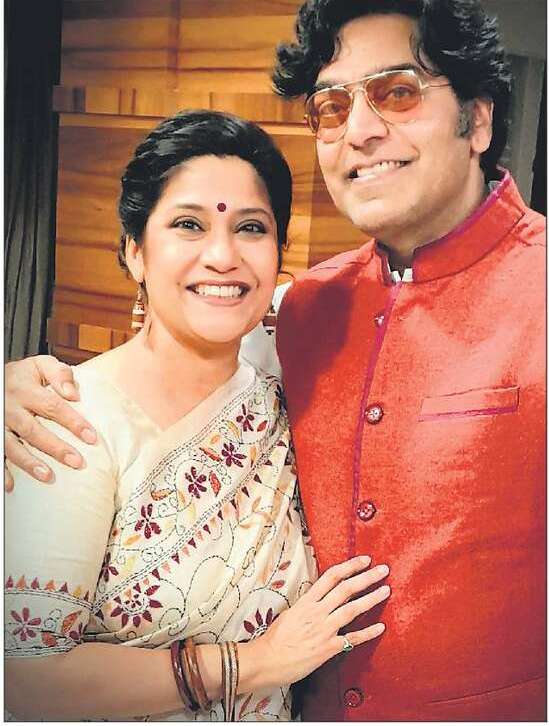
Ashutosh Rana and I would love to work together but we should have roles that we’d like to play-Renuka Shahane
8:30 AM
Ashish Kumar Singh (HINDUSTAN TIMES; January 23, 2023)
Actors Renuka Shahane and Ashutosh Rana have been married for over 20 years, and fans have been waiting to see them together on screen ever since. Shahane tells us that she would love to share the frame with her husband, but only if it’s a meaningful role: “We would love to work together, but both of us should have roles that we’d like to play.”
The 56-year-old, who was recently seen in Govinda Naam Mera, shares, “The roles have to be mindful of the fact that we are husband and wife in real life. As long as people say, ‘It was great to see them on the screen together’, I don’t mind taking up edgy stuff too.”
The Tribhanga (2021) director continues that Rana, 55, who has cemented his position in the industry with movies like Dushman (1998), Sangharsh (1999), Raaz (2002) and Simmba (2018), among others, is picky when it comes to projects. She says, “He is a powerful actor and opts to play only weighty characters. He likes to go for roles that he has not done before. I think, for any actor, that is a basic criterion.”
When asked if the two take each other’s advice while choosing projects, she confesses, “We depend on each other quite a lot, and we discuss things constantly to decide what to do and what not to.”
Shahane, who is also active in Marathi cinema, agrees that the industry still has a long way to go. “There was a time when films such as Me Shivajiraje Bhosale Boltoy (2009) and Sairat (2016) were thought to be better than their Hindi counterparts,” she says.
The actor adds, “There have been exceptional Marathi films that have broken that barrier, but it is not as big an industry compared to Telugu, Tamil or Malayalam cinema. Telugu and Tamil movies can compete with the Hindi film industry, but Marathi cinema cannot really do that, yet.”
My first film Patthar Ke Phool was with Sippy Films, and now, my OTT debut is with them-Raveena Tandon
8:55 AM

Glimpses of the cast were depicted using projection mapping
As she forays into web with Aranyak, Raveena launches trailer with a special visual experience in Lonavala
Uma Ramasubramanian (MID-DAY; November 24, 2021)
Imagine 25 people in the heart of a forest plunged into darkness. Somewhere not too far away, eerie music begins to play. As if on cue, the trees around start lighting up, one by one. Sounds like the opening scene of a thriller? Here’s the twist though — the 25 people are journalists, and the forest, in reality, the lawns of the Hilton Shillim Estate in Lonavala.
On Monday, Netflix India launched the trailer of Aranyak, which marks the OTT debut of Raveena Tandon, in a special event. It won’t be wrong to say that the makers brought the fictional town of Sironah — in which the series is set — alive in Lonavala. Before we had a dekko at the two-minute trailer, we experienced the spooky universe of the crime thriller. Glimpses of the cast and the trailer were projected on the trees around, using 100-feet projection mapping, as the play of light created imagery of a dense forest around, all set to a spine-chilling score. We weren’t the only ones impressed by the experience — Tandon, who came on stage soon after, summed it up: “Earlier, we used to have mahurats. Today, when I saw this, I was overwhelmed.”
The actor, who was joined by Ashutosh Rana, Meghna Malik, director Vinay Waikul and producer Rohan Sippy, said she felt like a debutant all over again. “My first film Patthar Ke Phool [1991] was with Sippy Films, and now, my OTT debut is with them. Life has come full circle. Since 1991, I’ve been in front of you. I hope [this] will mark [the beginning of] another 30 years of you tolerating me,” she laughed.
At odds with their supernatural thriller, the mood was light-hearted as Sippy joked, “I have aged 60 years. But she still looks like she did in 1991.”
Tanya Bami, series head, Netflix India described Aranyak as a “propulsive thriller”, adding that every woman will identify with Tandon’s character.
I asked makers why they didn’t consider me for titular role in Chhatrasal-Ashutosh Rana
8:10 AM
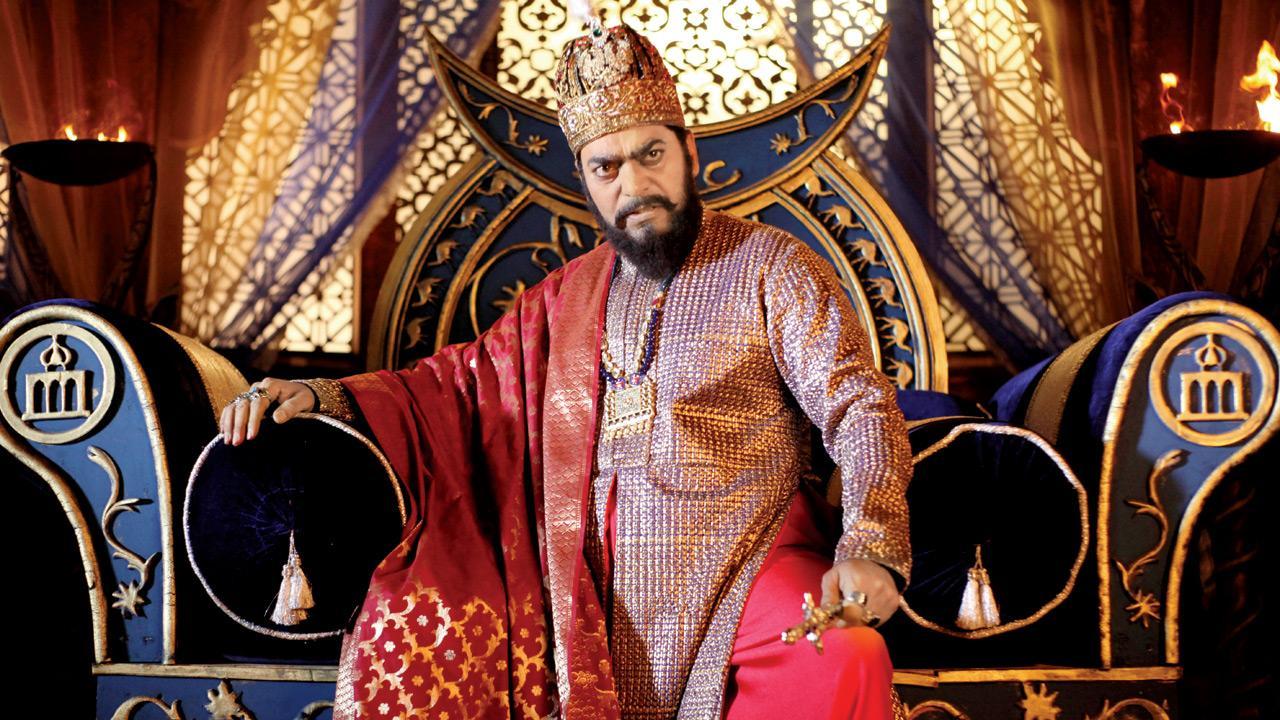
As he plays Aurangzeb in Chhatrasal, Ashutosh Rana says he wished to portray Bundeli king whose heroic stories he grew up on
Letty Mariam Abraham (MID-DAY; August 17, 2021)
We’ve often seen him as the tormenting antagonist on screen, but having a conversation with the man who makes acting look like child’s play was a first. On hearing Ashutosh Rana’s passion for his craft and the work he puts in to portray a character, it made us wonder why we don’t see him more often on screen. For now though, the actor is only too happy to tell the story of Maharaja of Bundelkhand with MX Player’s Chhatrasal. Rana talks about his love for history, and portraying Aurangzeb despite being a “bhakt” of the King of Bundelkhand.
Edited excerpts from the interview.
This is your first web series. Did you have any inhibitions before making your debut?
Not in the least. I hail from Bundelkhand, and if a series is being made on the King of Bundelkhand, it was my desire to be part of that narrative. It was a moment of pride and joy for me. Some things that you love come to you much later in life. After this series, I am sure I will be offered more historical projects.
We hear that you had wished to play the titular role?
Of course. I am a bhakt of Maharaja Chhatrasal Bundela, so I asked the makers why they didn’t consider me for that part. In turn, they asked me, who would then play Aurangzeb? On hearing this, I fell silent. In his lifetime, [the King of Bundelkhand] ruled for 44 years and won 56 wars. He then challenged Aurangzeb, and freed Bundelkhand from [his grip]. A hero emerges when he wins against a villain who is bigger and more powerful than him. That’s what Maharaja Chhatrasal accomplished all his life. It would’ve been a delight to play such a phenomenal character, but it is equally amazing to play Aurangzeb.
How did you desist from portraying Aurangzeb as all black?
There are few rulers with his combination of traits. While he was a powerful ruler, he had a Sufi style to him. Though he lived in a palace, he lived as a fakir in it. Despite it all, he has been the most powerful ruler of the Mughal empire. Without moving from the throne of Delhi, he controlled almost all of India. We didn’t explore the humane side of him in this series.
Why do you think there weren’t any shows made about Maharaja Chhatrasal until now?
This was mainly due to the language barrier. Bundelkhandi is a language that is mainly spoken in Uttar Pradesh and Madhya Pradesh, and is not a popular [dialect beyond that region]. That said, his name is not lost in history because several Hindi poets have written about his bravery. I had read the works of Kavi Bhushan. His feats are recorded in history, but since we didn’t learn about him in our history textbooks, we believe he didn’t exist. We may know the name of our father, grandfather and at times even our great-grandfather, but can we name the generation before that? That doesn’t mean they didn’t exist.
As an actor, do you have a line that you would never cross?
I cannot take my or someone else’s clothes off on screen. In Dushman [1998], I played a rapist. But my character Gokul Pandit did not touch Naina or Sonia [Kajol’s characters]. If I’m able to convey the fear of rape without touching, I have achieved the goal. Aesthetics is key even to showcase some of the most horrific acts. Instead of being wild on screen, I strive to create a wild imagination, which is more [impactful]. That is why people still remember me from Dushman and Sangharsh [1999]. I play negative characters, but with a positive attitude.
Ashutosh Rana, who played senior RAW officer in Hrithik Roshan’s War, to reprise role in Shah Rukh Khan-starrer Pathan?
8:22 AM

Upala KBR (MID-DAY; August 4, 2021)
Siddharth Anand’s Pathan sees Shah Rukh Khan as a Research & Analysis Wing (RAW) officer, with Dimple Kapadia’s character heading India’s foreign intelligence agency. Now, a new recruit has been added to the RAW roster. Word is that Ashutosh Rana plays a senior officer in the espionage thriller that also stars Deepika Padukone and John Abraham.
His casting is yet another move by producer Aditya Chopra to further the idea of a crossover between the spy thrillers coming out of his stable. “Ashutosh played RAW joint secretary Colonel Sunil Luthra in Hrithik Roshan’s War [2019]. It was Adi and Siddharth’s idea to have the actor reprise his role in Pathan. The actor shot some important sequences with Shah Rukh and Dimple at Yash Raj Studios in Andheri, a few days ago. It is heard that Dimple and Ashutosh’s characters will mastermind the mission that will see the protagonist lock horns with John, who plays the baddie,” reveals a trade source.
With the big-ticket project, Chopra intends to position Kapadia and Rana’s characters as senior intelligence officers who will feature in his future productions in the espionage franchise. The troika will be complete when the producer finds a suitable actor to play the role of Salman Khan’s on-screen boss in Tiger 3, another spy drama from the Yash Raj Films banner. Late playwright-actor Girish Karnad had essayed the role of RAW chief, Dr Shenoy, in Ek Tha Tiger (2012) and Tiger Zinda Hai (2017).

My fever lasted a long time and that was worrying the doctors-Renuka Shahane
8:09 AM

Kavita Awaasthi (HINDUSTAN TIMES; April 28, 2021)
“It will take all of us some time to come back to feeling totally normal,” says Renuka Shahane, who recently tested positive along with her entire family. She is glad that all of them are recovering well.
“I was worried about my 81-year-old mum, who tested positive as she was staying with us. (Ashutosh) Rana ji (husband-actor) returned from a shoot and got a fever and immediately we got him tested. He was admitted to the hospital later and we all got tested but our results came three days later. The first few days were really bad. My fever lasted a long time and that was worrying the doctors but as my oxygen levels were good, so we felt confident that things would get better,” she shares.
Shahane has been avoiding watching forwarded videos and the news on Coronavirus as she gets emotional due to her “vulnerable” condition. She is disheartened to see so many whatsapp forwards, which call the pandemic “a conspiracy theory”.
“Oh, please! It exits and is curable but the infection rate is so high that before you know it, you’ve infected 50 other people. The doctors and health workers have been working non-stop and they need a break. People don’t understand or think for others, at all. It is scary when you get Coronavirus as we haven’t understood it properly yet. We should err on the side of caution rather than be overconfident and say, ‘kuch nahin hoga’. Look at the situation we are in today. The rising cases and situations at hospitals are heart-breaking,” she says.
People look at me as the youngest newcomer-Kunal Kemmu
8:14 AM

Kunal Kemmu on Kalyug, his first lead role, completing 15 years
Rishabh Suri (HINDUSTAN TIMES; December 9, 2020)
Starting off as a child artist and progressing to doing films as an adult, Kunal Kemmu, with a successful stint in showbiz, is glad to be an actor. Completing 15 years since Kalyug released, he says, “I always say that the way my career has been going, people look at me as the youngest newcomer, someone who keeps debuting every other or two years! I am still excited about the stuff that I am doing,” he says.
The 37-year-old had done films such as Sir (1993) and Hum Hain Raahi Pyaar Ke (1993) as a kid, and then Kalyug came along. Calling acting as an adult a “completely different experience”, Kemmu says, “When I was doing this as a child, it was just a hobby, I wanted to see myself on the 70 mm screen and enjoy with my family and friends. I don’t think I was passionate about it. Kalyug had a lot more riding on it, because that was when I realized what it means to be a hero in a Hindi film.”
He goes on to talk about the pressure that accompanied the experience. “If it does well, you are going to benefit, and if it doesn’t, then [you will bear the brunt]. Besides that, it was also completely different being on a set and interacting with the technicians. Also, in the film, I was chasing Ashutosh Rana, who I had worked with as a child actor! To get used to that dynamic took a bit of time. I have the fondest memories of the film. I am very happy it turned out to be my first one, and still gets talked about so much, and is still relevant when it comes to songs,” gushes Kemmu.
Image: Meezaan Jafri, Paresh Rawal, Shilpa Shetty take off to Manali to resume Hungama 2 shoot
7:54 AM

The Hungama sequel to resume filming this week
Himesh Mankad (MUMBAI MIRROR; October 5, 2020)
On Sunday, Meezaan air-dashed to Manali to resume shooting for the Hungama sequel being directed by Priyadarshan. The team will be shooting in the hills for 12 days. Scenes include the madcap climax featuring the entire cast comprising Shilpa Shetty, Paresh Rawal, Rajpal Yadav, Manoj Joshi, Ashutosh Rana and Pranitha Subhash. “It’s going to be a lot of fun,” the asserts actor, adding, “I’ve never been to Manali before. Besides the climax, we’ll also be shooting two songs at a remote location.”
Meezaan goes on to inform that after the Himachal schedule, the team will reunite for a two-day shoot in Mumbai, before calling it a wrap. With cinema halls slowly opening up across India, he is hopeful of a theatrical release. “Comedy is a universal and evergreen genre, meant to be enjoyed collectively. Our film is meant to be consumed on the big screen,” he shares.
The film also features Johnny Lever in a pivotal role, and the actor has already wrapped up shooting for his part during the Ooty schedule. Ask Meezaan about how it feels to be surrounded by so many actors known for their comic timing, and he confesses it’s intimidating and he is in awe of them. “I was scared on the first day of the shoot as the scene was with Paresh sir, Manoj sir and Ashutosh sir, but they were all really supportive.”
The actor considers himself fortunate to get back to a film set in the midst of a pandemic and promises to be cautious during the shoot. “The entire cast and crew have already been tested twice, and before we took off for Manali, another Covid test was taken. We took off on a charter flight and it is as if the whole team is being quarantined together,” he laughs, adding that while he is wary of comparisons with the 2003 original fronted by Akshaye Khanna and Paresh Rawal, he is confident that the sequel won’t disappoint.
“The story has nothing to do with the first film, but the majority of the cast is the same. Priyan sir has made over 100 movies and I know even this one is going to be amazing. So I’m not worried at all,” he signs off.
There is no cause for celebration this year-Renuka Shahane
8:30 AM

The actor says that this year, she’ll not be able to make it to her mother’s place on Gudi Padwa
Kavita Awaasthi (HINDUSTAN TIMES; March 25, 2020)
“This year, the plan was to go to my mum’s place on Gudi Padwa as she was planning to prepare a traditional Marathi lunch, which is rare for me, and I was looking forward to it. But it won’t happen,” says Renuka Shahane, who feels she might not get the batasa (sugar candy), neem and mango leaves and garlands for the puja. “There is no cause for celebration this year. Moreover, I don’t celebrate festivals in public, so the manner in which we celebrate Gudi Padwa will remain the same. We will do the gudi puja and I will make shrikhand at home. We will all be together and that will be a moment to cherish,” she shares.
With the Coronavirus pandemic, Shahane feels blessed that none of her family members had travelled abroad, so there was no reason to be concerned. She says, “But one can’t be selfish. We should also look at the repercussions globally, and in our country. The lockdown has to be taken seriously as we can’t take things lightly. The ones with privilege should try and help the ones who are the most affected by the pandemic — at least those around us. The pandemic will affect us all for a very long time as it is a war-like situation with the amount of casualties. The world is so connected and that is the main reason why the virus spreads so fast.”
The actor adds, “One will have to rethink many things including much-needed changes in our lifestyle, how we are treating Mother Earth and other species on this planet.”
She is enjoying having her husband (Ashutosh Rana, actor) at home 24x7 but reveals that her life hasn’t changed much as she has asked her staff to stay at home. “I am used to them taking leaves on Ganeshostav and summer holidays, so this phase isn’t new to me. I am used to doing the housework. But what is surprising is that people are cribbing about spending time with family. I’m shocked to hear that because don’t we all want to spend time with family? Some people are so strange,” she says.
Aditya Chopra, Karan Johar and Rohit Shetty are like ‘chaar dhaam’-Ashutosh Rana
7:25 AM

Kavita Awaasthi (HINDUSTAN TIMES; October 24, 2019)
Being part of a film that does stupendous business at the box office is a joy. Every actor wants his or her film to be seen by the most number of people and superhits are possible when a film is watched multiple times,” says actor Ashutosh Rana, talking about the success of the Hrithik Roshan-Tiger Shroff-starrer War, which also features him.
Ashutosh proved his mettle way back with Dushman (1999) and Sangharsh (2000). And the movies he has done of late have also given his career a boost. Last year, for instance, he was seen in Simmba, Dhadak and Mulk, besides Sonchiriya this year. The actor feels being part of a film like War has a huge impact on one’s career. “Aditya Chopra’s production house, Karan Johar’s production house and Rohit Shetty are like the chaar dhaam’. As in Hindu religion, even if you visit many famous temples, doing the chaar dhaam yatra is a must. Similarly, being an actor, after having worked with them I feel I am completely a part of the film industry. I have worked with so many other talented filmmakers but having these diggaj (stalwart) filmmakers in my filmography takes it to another level,” he says.
After shooting for Vicky Kaushal-starrer Bhoot, he is now working on Guneet Mongia’s next, Priyadarshan’s Hungama 2, another film with Aditya Chopra’s production house, a Telugu web show, a Kannada film and a web series based on the Mughal emperor Aurangzeb. Ashutosh is known for his impeccable command over Hindi and says talking in Urdu while playing a historical character was a pleasure for him. “Hum bhaasha ke anugrahi hai, pujari hai. So, whenever I speak in Hindi, Urdu, English, Tamil or Telugu, I try to use the language in a pure form and not use Hindi while speaking English or vice versa. Urdu and Hindi have been spoken in India for years and essentially, we speak Hindustani zubaan. It wasn’t tough to talk in Urdu for the show as the language was not as chaste as it might have been in that era. That’s because the show is set in 1700s but the audience watching it is from 2019, so we have kept that in mind,” he shares.
My character in Sonchiriya has been the strongest-Bhumi Pednekar
8:27 AM
 Chaya Unnikrishnan (DNA; February 7, 2019)
Last year, Bhumi Pednekar was missing in action on the big screen, though she was seen in Lust Stories, an anthology of four short films on a digital platform. But 2019 will see the talented performer having a couple of releases starting with Sonchiriya. The film, which is set in the ravines of Chambal, has the Toilet: Ek Prem Katha actress play a feisty character alongside Sushant Singh Rajput. The 29-year-old, who has been essaying strong women characters ever since her debut in Dum Laga Ke Haisha (2015), considers her rustic avatar to be the most challenging till date. Here, she talks about her unique prep for the role and more. Excerpts...
From an overweight girl in Dum Laga Ke Haisha to being completely deglam in Sonchiriya, you have no qualms experimenting with your look. Don’t you feel apprehensive about how it will be received?
Honestly, no. When I play a character, I am completely disconnected from Bhumi, the person. I become the character. In Sonchiriya, the transformation was worked upon extensively right from the discolouration on my face to pigmentation due to sun exposure, the roughness of the skin texture, etc. I had to stop grooming myself for a couple of months. No going to the parlour, no manicure, waxing, skin or hair treatment. The only make-up was to get tan and darkness around the face. In fact, when I would drape the sari and have freckles on my face, I would become a different person. Recently, when I had to don that look for the promotions, I thought I appeared beautiful.
What prompted you to take up the film?
Abhishek Chaubey (director) has been on my bucket list. I have seen all his films, and especially loved Ishqiya (2010). But I was blown away by Udta Punjab (2016). So when I got a call from him, I was surprised. There was a gut feeling that I wanted to be a part of this phenomenal story of courage and spirit. It’s a humane story that comes from a region known for its lawlessness and harshness. The actioner is set ’70s during the Emergency period. It’s more than 40 years ago, but still relevant. That’s what stayed back with me after the narration. A lot of things that the director Abhsihek Chaubey has tried to comment on still exist; be it the caste divide, status war or the atrocities that women face. It’s the sheer consequence of revenge. Sonchiriya is an action-packed revenge drama. There’s so much happening in the movie that you start feeling for the characters.
What kind of prep did you have to do for the role?
In my first meeting with Chaubey sir, he told me categorically that in order to be a part of this film, I had to be physically, mentally and emotionally strong. He gave us that kind of training, too. We learnt the Bundelkhandi dialect. Ram Diwakar, who plays an important character in the film, trained us as he is from Chambal. We became so fluent in the language that we conversed in it on the sets even with the crew. As compared to other films, my physical training for this was different. I designed my workout around my character’s daily chores. I represent a girl, who does a lot of physical labour. Women there walk several kilometers to get water and carry 8-10 litres on their head, at times, with children on their back. To make myself stronger, I used to walk around Aram Nagar, barefoot, with some kind of weight on my back, either aate ki bori or chawal ki bori.
To what extent did this help while shooting?
We conditioned ourselves to such an extent that we felt we belonged to the region. So much so that even being pricked by thorns or the insects scurrying around didn’t get a reaction from us. The film is full of action, so we also trained in gun work, but it was all raw. Also, this is the first time I am doing action. The director spoke to us extensively about the character. Since it’s in the ’70s, it’s before modernisation took place. Women lived such a suppressed life, they did not know what the options were. My character shows a lot of strength and courage, but it is a reaction to the circumstances she is in. Women inherently are extremely strong, but their strength is only shown when they go through some dire situation.
As we can see in the trailer, the characters speak a lot in Bundelkhandi. Won’t this be a hindrance as many viewers cannot understand the language?
Not really. The beauty of cinema is that it’s an audio-visual medium. The audio has a strong visual supporting it. The language won’t be tough, it’s not alien from Hindi. A few minutes into the film and you’ll understand it. Chambal is a huge character in the movie and we had to make it as authentic to the area as possible. The language is not a hindrance in any way, it only uplifts the film.
How was it working with Sushant Singh Rajput?
Sushant is a passionate actor and so am I. We bonded on those grounds. He is a fit guy and did a lot of prep to get into the layers of the character. Sushant, Manoj sir (Bajpayee), Ranvir Shorey, Ashutosh sir (Rana) and I had a blast shooting for it. We used to improvise and help each other, there was never any kind of insecurity or ego battle. The entire cast needed to be synchronised for the film to be what it is.
Of all the characters you have played so far, which has been the strongest?
I honestly cannot pick one, but what I have done in Sonchiriya is most different. I did not know what life in 1970 was like and the entire process made me realise that such a big section is still living under suppression. They are still trying to find their freedom. This has been my strongest character.
What more can an actor ask for but characters of varied temperaments?-Ashutosh Rana
8:02 AM

Applauded for his act in Simmba, Ashutosh Rana on juggling masala films with middle-of-the-road cinema
Shaheen Parkar (MID-DAY; January 21, 2019)
Ashutosh Rana finds himself in an interesting phase of his career — after playing a pivotal role in Rohit shetty’s over-the-top universe of Simmba, the actor will be seen in Abhishek Chaubey’s Sonchiriya, a gritty dacoit drama. “What more can an actor ask for but characters of varied temperaments? Commercial cinema is getting real, so it is a good time for artistes like me,” says Rana.
Ever since Sonchiriya’s trailer released, there has been curiosity about his role, with fans wondering if Rana is back to doing what he does best — exploring a grey character. “It’s an interesting character with different shades to it,” he says in measured words, careful to not divulge too many details.
“Abhishek is known for his raw dramas. Plus, when you have co-stars like Manoj Bajpayee, the finest actor of our times, and youngsters like Sushant Singh Rajput and Bhumi Pednekar who are known for their acting prowess, things work out for the good.”
Apart from Simmba, Rana was also seen in Anubhav Sinha’s Mulk and Shashank Khaitan’s Dhadak last year. “I am fortunate that I have always received appreciation from the audience and critics. It is difficult to earn respect. there have been high expectations from me as an actor right from my Dushman (1998) and Sangharsh (1999) days.”
Quiz him why he is not seen more often in Bollywood, and he is quick to point out that projects in the South have kept him busy. “I have done Kannada, Telugu, Tamil and Marathi films,” says Rana, who has just wrapped up another Telugu offering, Vishwamitra. “Language does not matter to me. As long as it is a meaty role, I am game for it. After over two decades in Bollywood, there’s no point doing something for the sake of doing.”
Even when he is not honouring his South film commitments, one will rarely spot the actor hobnobbing at social dos. “I am not in the party and paparazzi scene. If I am not working, I am busy writing,” says the actor, who released the Hindi satire, Maun Muskan Ki Maar, last year.
#MeToo: Should actors give an official consent before shooting intimate scenes?
8:43 AM

Rachana Dubey (BOMBAY TIMES; October 25, 2018)
With the #MeToo movement gaining prominence in India, many of our filmmakers and actors have woken up to the need for a safer working environment. Recently, actor Dalip Tahil took a written and visual consent from his female co-star before shooting a rape scene for a web show. Reportedly, Emraan Hashmi, too, has insisted on including a sexual harassment clause in his contracts, as well as that of his film’s crew.
The heightened sense of awareness around women’s safety on film sets has also sparked new conversations in Bollywood. Filmmakers have decided to modify the way Hindi films are made and how women are treated on the sets. Directors like Konkona Sen Sharma, Alankrita Shrivastava, Gauri Shinde, Kiran Rao, Zoya Akhtar, Reema Kagti, Meghna Gulzar, Shonali Bose, Nitya Mehra, Nandita Das and Ruchi Narain recently formed a collective to take a stand against sexual harassment. Their male counterparts have also pledged support to the cause. As the #MeToo storm rages on, BT reached out to filmmakers and actors to gauge the measures they want to take while shooting scenes (especially ones that are intimate), and understand, whether a recorded consent by people involved in the shoot is the need of the hour. Here’s what they had to say:
We have to find ways and means of building a safe and secure environment. Over the years, we have been conditioned to work in a patriarchal set-up. The change in mindset will come with some sort of regulatory mechanism in place. So, it is important to have checks and controls. We shouldn’t be flippant about it and have a knee-jerk reaction. We need to have a clearly documented way forward. First, we need to understand what constitutes harassment, violation and how to escalate any instance or address a grievance.

It is a process of education, because for too many years, men have had it easy. We have to build a framework in the next few months. Hollywood does that, because they shoot scenes that are explicit in nature. Workshops are held to train actors to shoot a scene in the nude. I think we need to understand from other industries as to how they address these issues. Also, it does not apply only to the world of cinema, but it is about ensuring that all working environments are safe. – Hansal Mehta, filmmaker (directed films like Omerta)

I have shot such scenes before. It is done like a job and with a lot of mutual respect. I am anyway very sensitive about these things. My actors talk to me about it the moment they experience any discomfort, as that’s the kind of equation we share. My actors generally know everything regarding their role in the film and how things are going to be depicted. But if actors want a recorded consent for themselves, I wouldn’t mind it. We must respect the personal boundaries that we all have. – Leena Yadav, filmmaker (directed films like Parched…)

I feel that a central code of conduct must be put into place with regards to certain representation of women in films and their involvement in films, especially in case of scripts with such sensitive scenes. Collectively, it helps when a centrally accepted rule is put into place instead of sporadic selfthought actions, as that creates a sense of disorganisation, which only beats the purpose. – Yami Gautam, actress

From Satyameva Jayate, I have chosen a path where I will not have such scenes in my films. Having said that, it’s very important that everyone acts professionally and responsibly about these things. Everyone should know what they are signing up for. There should be no confusion. Even in the past, when I have shot intimate scenes, it has been with the artiste’s consent, and were shot aesthetically. I have stuck to what everyone was comfortable with. It’s better to make it clear in the script and if someone wants it written in black and white in their contracts too, it’s fine. It’s better if they know and agree to abide by what they are consenting to. – Milap Milan Zaveri, filmmaker (directed films like Satyameva Jayate)

I can understand the fear that Dalip Tahil must have felt and hence, he did what he did, but I will not do that with an actor. In fact, I would not even do such a scene if I don’t trust my co-actor. I don’t believe in written and video proofs, because I have a great rapport with my co-actors — male and female. For me, acting is a process of understanding life and it’s sacred. So, I wouldn’t do anything to make it look or feel incorrect to me or to anyone else. I will perform all my scenes as an artistic representation of what has been written in the script, and not for any other purpose, whatsoever. – Adil Hussain, actor

Personally, I will take legal counselling and follow guidelines set by the studio and the production house in this regard. Eventually, what has come out of this is that, like there are guidelines in corporate structures, there will be some in films, too. The #MeToo campaign has made everyone aware and more sensitive. I am sure everyone was in sync with what Dalip Tahil did. Everyone needs to be aware of what is being done and we must follow all the necessary steps to ensure work goes on smoothly with everyone’s consent. – Suresh Triveni, filmmaker (directed Tumhari Sulu)
 I have never felt the need to shoot anyone’s consent so far. I mean, I started out in the movies with a film like Dushman that had some really challenging scenes. With the #MeToo campaign, you need to be careful. If someone feels the need to take some precaution like Dalip has taken, I don’t see any harm in that. He’s only taking precaution. Shooting any scene requires mutual trust. Every actor knows every scene they have to shoot in absolute details. We go as per the script and the demand of our characters. Sahejta barkarar rakhna zaroori hai and for that, to make yourself feel secure, it’s perfectly alright to seek your co-star’s consent in writing or on camera. – Ashutosh Rana, actor
 The thought of shooting a consent before and after a rape scene or an intimate one, never occurred to actors of my generation. We were more worried about giving the right shots and the right expressions. Rape scenes are played up on expressions and camera angles. It’s unnecessary to ask a co-star for her feedback and her consent, because when we are narrated scripts, everything is mentioned in it. If it’s required and actors are comfortable, they will do it. There are so many people around on a set; how can anyone go beyond a set parameter for shooting a scene? I just think that in today’s scenario in particular, an actor, male or female, should complain immediately if he/she is feeling uneasy about doing a scene. It’s more important to have a safe environment in the work space, which includes film sets. No scene is shot without an actor’s consent anyway. – Prem Chopra, actor

 What Dalip Tahil did only goes on to show that everyone is wary of what is happening today. It stems from the fact that some people are using the #MeToo campaign for wrong reasons. There’s a reason why so many influencers have come forth and said that the campaign should be used in the right direction and should not involve any personal agendas. We should not let the campaign lose steam. At the same time, there is a lot of speculation among the actors and they’re just trying to be safe than being sorry later. The industry is at the cusp of change — it will go through corrections, changes and dents. Eventually, policies that will come out of these will be in everyone’s interest. No actor will then feel scared about any situation or filming any scene. Social campaigns are for social change and that takes a while. Instances like Dalip Tahil’s throw us off a bit, but this is part of the push and pull that happens in the process of a social change. – Abhinay Deo, filmmaker (directed films like Blackmail, Delhi Belly)
What Dalip is doing makes sense, but all these areas are covered contractually. And why not? Maybe this is a way to go about it. Whenever we shoot an intimate scene, first and foremost we ensure that the actors are comfortable. It’s also done in a closed environment where there are fewer number of unit hands, except for the DOP, the director and maybe the sound person. I discuss all my scenes threadbare with my actors and go ahead with the shoot only when they are comfortable. – Sriram Raghavan, filmmaker (directed films like AndhaDhun)
– With inputs by Lasyapriya Sundaram and Renuka Vyavahare

Working with Janhvi Kapoor and Ishaan Khatter helped me sharpen my skills-Ashutosh Rana
7:55 AM

Ashutosh Rana on the virtues of working with new talent and his upcoming films
Sanyukta Iyer (MUMBAI MIRROR; June 18, 2018)
Aushtosh Rana, who rose to fame with villainous turns in Dushman (1998) and Sangharsh (1999), is back in the race. Over the next two years, the actor will be seen in significant roles in Rohit Shetty’s Simmba, Tigmanshu Dhulia’s Milan Talkies and Anubhav Sinha’s Mulk. In his next release, Dhadak, he plays debutante Janhvi Kapoor’s upper-class, narrow-minded landlord father.
“I share a great relationship with Karan Johar’s production house and (director) Shashank Khaitan who has strived to explore my full potential as an actor. My character in Dhadak is magnetic, viewers will be drawn into his psyche,” he says from Hyderabad, where he’s shooting with Ranveer Singh for the cop-caper, Simmba.
Dhadak comes four years after Shashank directed Ashutosh in Humpty Sharma Ki Dulhania in which he played Alia Bhatt’s disapproving Punjabi father. “When you’re working with actors like Varun Dhawan and Alia you need to be on your toes, they rejuvenate you. And while Janhvi and Ishaan are young, you cannot be laidback around them either. They have mastered the skill of being in front of the camera. For someone experienced and considered a good actor, they never let me feel relaxed. They have shown me that age doesn’t matter, edge does. Working with Janhvi and Ishaan helped me sharpen my skills, it’s a great way to not grow old as an actor,” he says.
Ashutosh, who has also worked in Tamil, Telugu, Marathi and Kannada films, admits that the new-age audience is receptive to unique content and will enjoy seeing him alongside Manoj Bajpayee and Sushant Singh Rajput in Abhishek Chaubey’s dacoit-drama Son Chiriya. “Honey Trehan (casting director) and Abhishek called me last year and narrated the most brilliant story I’ve ever heard. It’s a character as special as the one in Dushman and Sangharsh,” he promises.
The 50-year-old actor admits that goodwill goes a long way at the movies, recalling how Tigmanshu rang him up 16 years after Haasil to offer him Milan Talkies. Likewise, Anubhav Sinha, with whom he had filmed a TV show, Shikast, in 1994. “He told me he was making Mulk and I had to be a part of it,” Ashutosh beams.
It was Mahesh Bhatt, who wrote Dushman and Sangharsh, who had first identified his potential and took him on for the TV show Swabhimaan. “In the first scene he wrote for me, he gave an 11-minute sequence where Rohit Roy and Chanda Ruparel sat quietly while I performed a 10-page scene. It was a three-camera set-up and a great start to my career,” he reminisces.
The National School of Drama alumnus has wrapped up Ismail Durbar’s Tigdum And Chicken Curry. He will be portraying four different characters – a Kathiawadi Gujarati who owns islands, a Mumbaikar living in a Worli chawl, a Nawab who speaks chaste Urdu, and a wannabe don who has ended up being the Nawab’s translator.
Ashutosh thanks his actress-wife Renuka Shahane for her constant support saying he’s fortunate to be her husband. “If I ever hit a low, she helps me forget it immediately,” he signs off with a smile.
Mud-slinging matches on social media can affect people emotionally-Renuka Shahane
8:05 AM

Neha Maheshwri (BOMBAY TIMES; March 5, 2018)
Be it the ever-smiling anchor of Surabhi or Salman Khan’s demure bhabhi from Hum Aapke Hain Koun..!, everyone remembers Renuka Shahane as the girl next door with the brightest grin ever. At the same time, anyone active on Twitter in recent times has come across her socially-relevant posts and knows that she has no qualms in voicing her opinions, even if it is at the cost of sounding politically-incorrect. As this hands-on mom is all set for her Bollywood comeback after a long hiatus with the upcoming film 3 Storeys, we catch up with the actress on motherhood, social media and more. Excerpts...
In a career spanning 25 years, you have done just a handful of films in Bollywood. What kept you away from the big screen?
After Hum Aapke Hain Koun…! (HAHK), I was getting roles similar to that of Pooja (her character in the film) and that is what kept me away. Since I am from theatre, doing something routine on screen did not seem challenging. Besides, I was getting exciting roles on TV, which is a time-consuming medium. Also, I delivered my firstborn in 2002, a year after my marriage. By then, I had reached a saturation point. I was working round the clock and I needed to take time off to be with my children. In fact, I still don’t think that they are independent enough for me to get back to work. However, I have been active in Marathi cinema and TV and I am happy to keep in touch with the Marathispeaking audience. Now, interesting things are happening in the cinema space, too. I think 3 Storeys will prove that I could do other roles apart from playing a pyaari bhabhi (laughs!). It’s a leap of faith for the makers to cast me. Who would have thought of casting me as Flory Mendonca? Today, A-list actors are playing a variety of roles and they could have approached anybody for this part.
You shared a video on sensitizing boys about menstruation last year. This year, Pad Man highlighted a similar topic. Do you think Indian cinema is headed in the right direction?
Yes, I do, because when a superstar like Akshay Kumar educates the masses about menstrual hygiene, it is important. People look up to Bollywood so much that when a male superstar says something like this, changes start happening in our society. Such topics are no longer restricted to only those who are involved in women’s causes. I am just hoping for that day when we do not have to wrap our sanitary pads in black polythene bags, like it is some national secret or a bomb (laughs!). Also, the kind of value women have in films these days and the roles they are getting to play… it is a massive change. Both men and women, who are sensitive to such topics, are making films with a humanistic approach. They are trying to lend that kind of realness and sensitivity to their films. Today, even married actresses command their fan following with films riding on their shoulders. Forget marriage, even childbirth is not detrimental to their careers. That is a massive change.
Your Twitter handle says ‘Mommy without a pause! At other times, writer, director and actor’. But for years now, your focus has been raising your children.
Totally. I am a hands-on mother. I have been their anchor since their birth. It’s been nine years since I took a sabbatical. Playing mom to my boys is what I do for most part and I love it. There is no regret at all, as this is what I have always wanted. I cannot tell you how much I have learnt about myself and the world as a mother. If I were working, I would be yearning to spend some quality time with them, but now I have all the time for them. Even I had that advantage when I was growing up. My mother did not work till I turned nine. It is a personal choice, and I wanted to give the same kind of security to my children. But to each his own. I am not good at multitasking, while there are others who thrive on that. They like to manage several things at a time, get up, fill lunch boxes, go to work, come back home, look after their homework and cook. I think that choice should be respected. Along with that, the choices that men make should also be respected. They should also have the choice of taking a back seat and spending quality time with their children. A family should decide who is inclined to doing what. In my case, it looks patriarchal because my husband is working and I am staying at home. But that is my dream. I didn’t want to become an actress. I wanted children and I am living that dream. When people say that it has been a setback in my career, probably it has as an artiste, but not as a human being.
People call you a social media crusader. Is it easier for you to express yourself today?
Oh yes! I would say so because otherwise, where would you speak up? Social media gives me that kind of space and it makes my fans aware of how I am as a human being. It has been great. Especially when college kids meet me now, the first thing they talk about is, ‘We read your posts. You’ve done a good job in expressing your views and opinions, which is what we feel, but can’t express openly.’ Social media has helped me connect with young people, who might not be familiar with my work. This platform is democratic. There are extreme views and abusive trolls as well. At the same time, there are people who try to make some sense and perhaps, speak on behalf of those who might not be able to put their own thoughts into words. So many people tell me that, ‘Ye jo aapne kaha, this is exactly how I feel, but I could not write.’ So, it is that sense of being a representative.
When you are trolled, does it affect you deeply?
Initially, I would be shocked as I had never faced hatred of this kind, but soon I realised it was all orchestrated and not personal. Earlier, I would spend hours discussing topics and sometimes it worked and many of the trolls turned around and apologized. I have always maintained that I have no issues with people having a different point of view, but I have a problem with the way they say it. I respect your opinion, so why can’t you respect mine? Mudslinging matches on social media can affect people emotionally. Rana ji (husband Ashutosh Rana) would come home and ask me, ‘Were you on Twitter today? You look like a mess’, and I would say, ‘Yes, I had a very long battle (laughs!)’. In fact, people in the industry express shock and tell me that did not know I have this side to me.
You were trolled for your post on Salman Khan, in connection to his comment on rape and the black buck case. Later, you cleared your stand by saying that you are not anti-Salman. Did you ever regret posting anything?
I wanted to clear my stand as people often misrepresent facts. Somebody took up what I said related to the judiciary and then put it out of context, which said that ‘Salman’s bhabhi slaps him in a post’. That is ridiculous and we should not encourage this nonsense. There are nuances in what I have written and anybody reading that should know it is not anti-Salman, but my posts are questions that the judiciary needs to ask itself. I cleared my stand but it was not a way to say sorry for what I had written. Today, I would not have done it as I have also changed on social media. Earlier, I would have tried to clarify that my purpose is not to hurt people. I have every right to talk about what is going on around me, even if it is about people from my industry. If associations go kaput because of that, they do. One just has to face the consequences because this is something I stand for and I don’t mind saying it.

While the audience hasn’t increased over the years, the remuneration of stars has-Renuka Shahane
8:02 AM

The actor-director on her obsession with human nature and how it inspired her script about three women across generations
Kunal Guha (MUMBAI MIRROR; October 9, 2016)
When Renuka Shahane directed her first film Rita (2009), which was adapted from her writer and journalist mother Shanta Gokhale’s book Rita Welinker, she thought she’d “direct a film every two years”. That, however, did not happen. Instead, Shahane had to wait seven years for her next opportunity. Now, the script for her female-centric drama, Tribhanga, has been selected for NFDC’s Film Bazaar for production collaborations with makers across the globe.
Speaking of her upcoming project, she reflects on its evolution. “When I first wrote it, it was just to check if my writing skills had gotten rusted,” she says with her trademark smile. To put her work to test, she submitted it to the Sundance Mumbai Mantra Script Lab in 2013. “When I went to the script lab, I had no idea about the grammar of scriptwriting. My mentor, Malia Scotch Marmo (writer of Steven Spielberg’s Hook, 1991) was happy with my characterisation but felt that I needed to learn the basics of screenplay writing, especially how the story needs to be told.” Shahane also credits Marmo for introducing her to “the universality of the subject”. “She told me that people will respond if the story was told with conviction.”
Tribhanga is about three women from different generations and is inspired by the asymmetric Odissi pose, which has breaks in three places — neck, waist and knees — “and yet it is a sensual form”. “The three characters (in Tribhanga) are like the three breaks and yet they are all joined,” she says of the story which is partly in English (70 percent) and Marathi (30 percent). “The breakup is because that is how we speak.”
Shahane feels this is a great time for Marathi cinema. “You can really delve into the story and experiment with form. The Marathi cinema-goers have a liberal taste due their exposure to theatre and reading Marathi literature,” she adds. But despite this renaissance in regional cinema, Shahane reckons that there are still many challenges for a filmmaker today. “A disadvantage is the budget. This just means certain subjects are difficult to pitch or sell. Also, while the audience hasn’t increased over the years, the remuneration of stars has.” She holds one-time producers responsible for the whopping fees that actors charge. “They put in a lot of money to work with their favourite stars, often paying them more than what they’d make otherwise, and then the stars expect the same amount every time,” says Shahne who has a tentative cast on paper and shares that “it is the first thing a producer asks about a project”. “I’d like Rekhaji to play Anuradha,” she says of the character in her script who is a dancer and actress and shares a dysfunctional relationship with her mother Nayantara, who is in a coma.
The actress-turned-filmmaker’s desire to work behind the camera manifested early and she assisted Vijaya Mehta in the TV series Lifeline (1988) and even directed an episode for Zee TV’s Rishtey (1998). “I’d turn up early on the sets of Hum Aapke Hain Koun to understand how Sooraj-ji (Barjatya) would plan the day’s breakdown with his assistants. When I told him that I wanted to direct and planned to join FTII to learn the craft, he told me, ‘Ma’am, I don’t know the magnification of lenses, but there is a competent DOP for that. And if you are able to translate your vision to your team, you can direct’.” But her plans of wielding the megaphone were stalled after her marriage to actor Ashutosh Rana. “I had worked in TV for so long I needed a break and when I had kids (Shoryaman in 2002, Satyendra in 2004), I wanted to be there for them. We live in a nuclear family and I didn’t want my kids to be raised by maids,” she says, adding that her husband insisted she continue with the profession and even urged her to write. “Ranaji was the first to suggest that I should write and direct,” she says, adding, “And in 2004, after Shwaas released, a lot of exciting things were happening in Marathi cinema. I wanted work on a subject which dealt with human relationships as my interest lies in human nature and the various possibilities in interpersonal and intrapersonal relationships.” In 2006, Shahane wrote her first screenplay centered on child abuse. While it received a nod from husband and mother, it still remains on paper. “I will make that film one day for sure,” she smiles.
Subscribe to:
Posts (Atom)