Showing posts with label Ashutosh Gowariker interview. Show all posts
Showing posts with label Ashutosh Gowariker interview. Show all posts
Shah Rukh Khan, Aamir, Hrithik Roshan experiment within boundaries of mainstream entertainment-Ashutosh Gowariker
8:09 AM
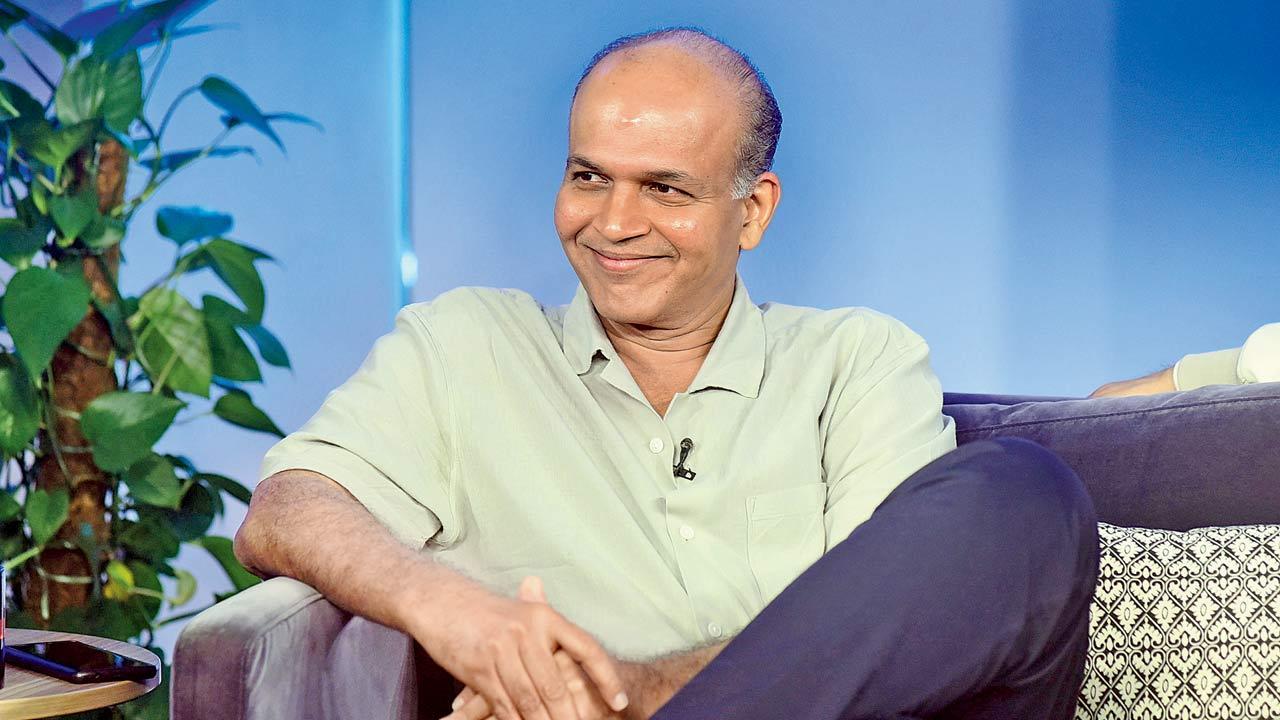
With this year marking 20 years since he launched his film production stable with Swades, filmmaker Ashutosh Gowariker discusses exploring other avenues, including the web space, television shows, and documentaries
Priyanka Sharma (MID-DAY; December 17, 2024)
It may have been 20 years since the release of the cult classic, Swades, but, filmmaker Ashutosh Gowariker feels it was only yesterday that he launched his production house with the Shah Rukh Khan-starrer. Arguably, Gowariker’s perception may not be completely flawed, given that the patriotic offering that holds a mirror to society, has been kept alive in the minds of people several years after it left cinema halls.
The filmmaker understands why Swades—a film that deals with the themes of class and caste divide—has lived far beyond its years. “It gives us the status quo; the point zero. It [shows us] where we need to hit reset. When people tell me that Swades continues to be appreciated, it makes me happy and sad. I am happy that the work is being appreciated, but sad because it implies that nothing has changed. I don’t know if matters have become worse. The divide between urban and rural [India] has increased. We look at the technological [advancement] in cities and think we are progressing. But, it is a mirage. Of course, the heartland also has all the amenities. But have we progressed in our way of thinking? I don’t think so. The change is still happening. And more work needs to be done on that front,” he explains.
Meanwhile, Gowariker has a lot of work on his plate too. As his production house crosses the milestone mark, he is eager to turn his attention to new ventures. Sure, venturing into web shows may seem to be the most natural progression in this day and age, but the filmmaker is also keen to explore other avenues.
“We want to also make television shows, documentaries and audiobooks. We want to cover the entire entertainment gamut. We are developing stories in the OTT space, which is a great addition to our business, because my films are long, and if I have a long story to tell, I can do so in the form of a web series.”
However, fans of the filmmaker who have been eager to watch his opulent productions play out on the big screen need not be disappointed. “I have finished my [movie] script. We are currently casting for it,” says the director, who last helmed the 2019 historical, Panipat.
Ask him if he intends to reunite with his friends and collaborators, including Shah Rukh, Aamir Khan and Hrithik Roshan, all of whom Gowariker has delivered memorable films with, and he says, “[Only] if I have the right script.”
He adds, “The theme has to come to me first. [I will approach them] if they suit the part. All three of them have one common trait—the willingness to experiment within the set boundaries of mainstream entertainment. That is why Dangal, Dear Zindagi and Super 30 [were successful]. They are willing to put themselves out of their comfort zone for a film, but, it needs to have the structure of a mainstream movie.”
With Lagaan, our mainstream cinema got a global platform with the Oscar nomination-Ashutosh Gowariker
8:31 AM

Monika Rawal Kukreja (HINDUSTAN TIMES; June 15, 2021)
Of all the recognition Lagaan won, the Oscar nomination — the third film from India to do so after Mother India (1957) and Salaam Bombay! (1988) — remains the most memorable. Though it didn’t win the award, director Ashutosh Gowariker admits there was “renewed interest in song and dance”. He tells us, “When making Lagaan, I wanted it to cross over in India to all states. The day we got to know it’s being liked in single screen theatres in Delhi and Mumbai...we started getting news from France, South Africa, we knew the film is crossing over on its own; that was a bigger joy.”
Talking about the Oscar nomination, he notes, "... the film was speaking. So, yes, mainstream Indian cinema came on a global platform, in the new era.”
If Gowariker, 57, was making Lagaan today, would he have compromised on its 3.42-hour run time? He says, “My approach in scripting would have be different, but it’s not a two-hour film. I feel a film should be told in a required duration and with the genre it’s promising.”
While actor Aamir Khan felt he didn’t prepare much for his character, Gowariker says he was somewhere sure that Khan would just do it right. “Each time we did narrations, I knew Aamir is getting the character; he knows it. Also, he had done auditions with many actors, so he was taking that all in. The only thing I’ve been sad about is that he couldn’t work on his [Avadhi] diction,” the filmmaker admits.
Acting has always been my pehla nasha-Ashutosh Gowariker
7:25 AM

Abhimanyu Mathur (BOMBAY TIMES; March 22, 2021)

In 2016, Gowariker returned to acting after almost two decades in the National Award-winning Marathi film Ventilator. The filmmaker said he was reluctant to do the film, but was won over by director Rajesh Mapuskar’s persistence. He said, “When Rajesh contacted me with the script, I thought he wanted me to produce it. He said he wanted me to play the lead. I tried for six months to shoo him away, but he was persistent. Eventually, I realised the passion he had. I was not a big Marathi film star, but I saw the earnestness in him. Thank heavens I said yes. It’s such an honour to be a part of a National Award-winning film.”
Over the decades, Ashutosh is known for his historical epics, like Jodhaa Akbar, Mohenjo Daro and the recent Panipat. During the session, when asked if he wanted to take it up a notch higher by making a film in the mythological fiction genre for the big screen, he said, “Demigods and myths don’t need epics anymore. They already exist in our cinema. In cinema, our hero is supposed to be compassionate and fight evil. All those qualities are already there in our heroes. Stars like Mr Amitabh Bachchan, Rajinikanth, Mohanlal and Chiranjeevi are demigods, and the characters they have played have become mythical. But, if I have to create an epic on screen, I need to devote three to five years of my life. At this time, I have too many stories to explore, and I can’t take out that much time.”
His film Jodhaa Akbar ran into controversy when it released, with several organisations raising objections to the portrayal of Jodhabai in the movie. Speaking about outrage and reactions that usually follow when historical characters are depicted in films, the filmmaker said, “When I am writing a historical, I try to do my due diligence. I weigh my facts, and I discuss with historians and archaeologists, and I create the story based on that. There will always be reservations when it comes to depictions of history. Everyone has interpretations. You have to make movies on what you feel about.”
I like to tell untold stories-Ashutosh Gowariker
8:24 AM

Director Ashutosh Gowariker opens up on why he chooses the subjects he does and on being influenced by the women in his life
Anjali Shetty (HINDUSTAN TIMES; December 6, 2019)
Director Ashutosh Gowariker says he doesn’t let controversies affect him. His only thought is, “Why are people not patient?” He shares that he embraces the questions as people ask it out of concern. The Jodhaa Akbar (2008) director, says, “It is a given that there will be questions when you make a historical film. If I was a descendant of a great warrior, I would want to know what is being written about or presented about my family member. However, at the same time, people should wait and be patient. I like to go on the front foot and explain that everything is okay.”
Gowariker’s films have always had music as an integral and interactive part of the narration and the director admits to be involved in it. “It is important for a composer to know the story. I don’t want a song to just stand out on its own. It also needs to take the scene ahead and be a dramatic extension of the scene. So, the involvement helps the music director or it can be out of place,” he says.
On choosing the subject of Panipat, his forthcoming film, Ashutosh shares, “Pune and Kolhapur have been important associations, the latter being my home town. One has been a part of the Chhatratpati and the Peshwas rule. But never did I think of making a film on that. Yes, I may meet somebody who will say, ‘why don’t you make a film on Chhatrapati Shivaji Maharaj’. And I will do it. But no one told me to make a film on Sadashiv Rao Bhau. Somewhere I like to tell untold stories, to see if there is a learning curve or knowledge to impart from it. In this story, what happens is inevitable, and that astonishes me. I thought, if I am so intrigued by it, then I should tell the story.”
From Jodhaa (Jodhaa Akbar, 2008) and Chaani (Mohenjo Daro, 2010) to Parvatibai (Panipat), the women characters have always been strong, independent and fearless. And, he believes it has been a part of his films by default. “It could be because of the influences of my mom (Kishori), sister Ashlesha who is a lawyer and my wife, Sunita. It is something I may have drawn from them. Hence my existing women protagonists are always rooted, supportive and strong. And not in the simplistic way of ‘behind every successful man there is a woman’, but in a more complex manner with discussions, arguments and being straight forward.”
We feel good about the emotion of being united, but are we really united?-Ashutosh Gowariker
7:58 AM

Madhureeta Mukherjee (BOMBAY TIMES; December 5, 2019)
With every film, he walks down a tough path and makes tough choices. He goes back in time, blows the dust off the thick pages of history, revisits untold stories and then, creates a cinematic spectacle of it. But every subject, however challenging, has a driving force. Like for the upcoming historical war drama Panipat, what intrigued Ashutosh Gowariker was that the Marathas were defeated in the battle, but “there was a certain spirit in that entire journey, which can’t be ignored.” Yes, his films have often been mired in controversy, but it is his unbridled passion and honest intent towards the story at hand that’s helped him battle the outside forces. Finally, he believes what matters is that a film must go down in history and stand the test of time. Excerpts from a conversation with the nuanced storyteller…
Your films are clearly driven by a certain deeprooted belief, for instance Jodhaa Akbar (2008) threw light on the subject of religious harmony, and Swades (2004) brought about the feeling of nationalism. What is the inspiration behind making a film based on the Third Battle of Panipat, one of the most significant battles of the 18th century?
The idea came from the fact that back then, we were not united, and centuries later, today, we are still asking ourselves, ‘Are we united?’ This battle happened in the 18th century, but it is relevant even in today’s times. We feel oneness and feel good about the emotion of being united. We get united when there is a cricket match against neighbouring countries, but honestly, are we really united? Panipat was the battle that we lost, but what exactly happened then and why did we lose? When I started probing, I realised that there is a huge story here. The Peshwas travelled 1,000 km up north (from Pune) to stop the invaders. They were not going to Panipat, but then a cat-and-mouse chase happened along the Yamuna river, they went up north via Mathura, Agra and other cities and finally to Delhi. And then, while they were going to Punjab, they were intercepted, and the battle happened. So, what was this journey all about and how were they going to amass such a huge army? Whenever we look at a story of defeat, we are not as interested in it. When do we want to see a cricket match that we have lost? We like talking about our victories. Hence, this story intrigued me because even if we were defeated, there was a certain spirit in that entire battle and the journey, which can’t be ignored. My motivation came from that place; I wanted to capture that spirit. I wanted the audience to get a cinematic version of the most important battle of the 18th century.
There are so many layers to such an epic story and so many characters. The dynamics of that era was also complex — that is a lot to incorporate in one movie...
Yes, a huge number of characters are involved in the story. They were the movers and shakers of those times. Also, it consisted of people from all backgrounds — Hindus, Muslims, people from different castes, farmers and others. So, who gave support and who did not, was all an outcome of the political situation and the geographical location of who was placed in which territory. The relationships amongst the kingdoms were fragile and depended on many such factors. I have explored that, too, in the film.
While the audience is often divided over the way history is portrayed in cinema, I am sure that if you interact with various historians on a particular subject, you, too, would face a dilemma. Does your film take views from various experts in the field, or have you derived and relied on information and facts from a single source?
I have yet to come across two historians who agree on something. They write an account, analyse each other’s work and disagree on several things. Here, I am just a filmmaker, trying to show a historical story on screen. I am not creating another account from another perspective. I feel the need to draw my information from the earliest account that is available to us. In this case, my reference point was historian T S Shejwalkar, who wrote the book, Panipat 1761. He wrote specifically about this battle. I have created my screenplay from the way it has been narrated in his book. There is another Pune-based historian, Pandurang Balkawade. I took him on board officially for the film, for inputs on various matters.
Your choice of casting is always well-thought-through, like Hrithik Roshan and Aishwarya Rai Bachchan for Jodhaa Akbar — they both looked gorgeous and regal. How did you zero in on the cast of Panipat — Arjun as Sadashivrao Bhau, Sanjay Dutt as Ahmad Shah Abdali and Kriti as Parvatibai?
They were absolutely my first choice, and this is the first time I got my first choice of cast (laughs!). When you get your first choice, it cuts down your waiting period, because when you don’t get an actor you want, you have to pitch it to someone else, and then, it’s a long wait for many months. For Sadashivrao Bhau, I wanted someone with a big built and someone who can make you believe that he has great force and strength. I zeroed in on Kriti as she looked so Maharashtrian and is such a detailed actress. Sanjay Dutt is someone who has gone into another league, and sometimes, just his presence is enough. You put him in a specific look and make him stand there – you feel this is the character. It was great that all three of them consented right away when I offered them this film. I always think that as a writer or director, I can create only 50% of a character, it is the blend of my character sketch and the persona of the actor that finally comes alive on screen.
Lagaan (2001) changed the course of your career. After that, has there always been immense pressure to raise the bar higher and higher?
I have not thought about a previous film as a burden. I’d like to think that every new film that I do comes with challenges of its own. I have to de-strap myself from other trappings and approach every film with new vigour. If I have the attitude of having been there and done that, I think I might lose a certain charm of making every film with a fresh approach. In Jodhaa Akbar, I shot two battles, but Panipat demands something else. Unless I detach myself from my previous work, I can’t move on to take on the next challenge.
How often do you go back and view your films scene by scene? How critical are you of your work?
I am very critical of my work and I like to keep revisiting my films. If I look at my film after five years and feel embarrassed about it, that means the film hasn’t stood the test of time. I think a good film is one that stands the test of time.
You have given us some fine and unforgettable films like Lagaan, Swades and Jodhaa Akbar, but when an ambitious film like Mohenjo Daro (2016) goes unappreciated, and the audience does not connect with your vision, does it throw you off? What do you tell yourself?
I tell myself, ‘What were you thinking??? (Laughs!). When a film does not work, there could be many, many reasons for it. Everyone could cite a different reason, but the truth is, in this case, it was the script. Everything emanates from the script — every decision you make, and every character motivation comes from it. If the audience has not engaged with the film, it is because the script failed to engage them. There are so many times we see a film that has been made shoddily, but it turns out to be a big hit. The reason is, technique was unimportant in that film, the audience connected with the storytelling and felt for the characters. For me, Mohenjo Daro is still a nice film where we created a different world, but the script could have been emotionally more powerful and that is what it lacked.
So, you do believe in the audience’s opinion, point of view and feedback, and take it seriously as a filmmaker?
For me, the audience is always right. It is also because I am always right. When I watch a film as an audience, I am ruthless. The filmmaker must have spent 200 days shooting it and a lot of money in putting it together, but if the film does not work for me, I will say that I didn’t like it. If I can react like that, even the audience has the right to do it. They are not concerned about my hardships, or how many days of hunger I went through, all they want to know is, film acchi hai ki nahin.
Talking about battles, your films have had their own share of battles. You have got flak from some quarters for apparent misrepresentation of facts in Jodhaa Akbar and then again, in Mohenjo Daro. It is always a tightrope walk when you are making a film based on historical facts, right?
Let’s look at Sir Richard Attenborough’s film Gandhi (made in 1982). Sir Ben Kingsley, who played the titular role, resembles Mahatma Gandhi in no way. But we have no trouble with that because of the way it is addressed and the way the story is narrated. After a point, we start believing that he is the Mahatma. If you compare him with the pictures of Gandhi, it’s not slightly different, it is starkly different. Another example is the film Sanju (2018). It did not matter to us that Paresh Rawal was playing Dutt saab, because Raju (director Rajkumar Hirani) was capturing the essence of Dutt saab through Paresh Rawal and the essence of Sanjay Dutt through Ranbir Kapoor. In a historical film, too, I feel that you have to capture the essence of that period and recreate it in the most authentic way possible.
How much leeway does a filmmaker give himself for creative interpretation in a film based on history?
Every filmmaker has his own censor, his own degree of variants of what he wants to show, where he wants to jump, and where he wants to be more stringent with facts. These are the choices that you have to make while writing the screenplay. For me, authenticity and realism are very important. Yes, I have some drama in my films, like I will have a scene like ‘namak kum hai’ in Jodhaa Abkar, which is not part of history. Those embellishments are important as that will keep the audience entertained, but authenticity still remains important.
Responding to various trolls post the trailer launch of Panipat, Arjun said, “It is unfair to crack jokes on historical characters, on martyrs. We should not forget the sacrifice that these men made.” How do you react to these trolls?
I believe that trolling is an art form. I feel that the trolls are thrown artistically at you; they use choicest of words and abuses, and draw sharpest of parallels with something or the other. Trolling is like a full-time job, and so, we have to take it in our stride. I wonder how some people can have so much venom, anger and hatred in them, and they purge all that through their trolls.
Reportedly, the Afghan Embassy to India, in a letter to the MEA (Ministry of External Affairs), expressed concerns over the contents of your movie with regards to the portrayal of Ahmad Shah Abdali, who led the Afghan army in the Battle of Panipat. Have they reached out to you and what is your response to it?
I think that Abdali was a great military strategist, and he is the father of the nation for Afghanistan. But this period in history is also the same time when he invaded India eight times, and when this particular battle of Panipat happened, it was his fifth invasion. If I have to show the story of why this battle happened, then I can’t escape from the fact that he was invading India at that point. So, it is not about maligning or trying to show someone in a bad light, but what I have shown is based on facts.
You were seen after long in front of the camera in 2016 for the Marathi film, Ventilator. What made you go back to acting, which was once a career option for you?
I don’t have the energy to pursue acting now. If a director comes to me and tells me that there is a part that he wants me to play, I will do it, provided I am available during that time. I have some time after this film, so if something comes my way, it will be great. It is not that acting is easy; for me, it is therapeutic.
Historical romance, period drama, epic war film… what next? Can we expect anything like a contemporary story, with characters from the period we are currently living in?
I don’t know what is next, but do I think of a story where my hero is dressed in jeans? Yes, I think in that zone, too (laughs!). It is just that sometimes you get a theme which is so great in terms of its period setting that it takes precedence over everything else. Otherwise, why would I make a Panipat after Mohenjo Daro? I had no fears. If you get motivated by the theme, then your reasons for making the new film is different. I think everything is a mix of your effort, hard-work and your luck. You need dollops of luck. After Mohenjo Daro, for me to get this kind of cast, was great. In that sense, I must say that I have been fortunate.

In terms of loss of lives, the third battle of Panipat was next to battle at Kurukshetra-Ashutosh Gowariker
8:02 AM

Ashutosh Gowariker gives five reasons for basing his next film on the third battle of Panipat
Roshmila Bhattacharya (MUMBAI MIRROR; December 3, 2019)
There were three battles at Panipat, but, as Ashutosh Gowariker points out, we tend to address them collectively, as one. The filmmaker’s upcoming historical showcases the third battle in an engaging way, with songs, romance, drama and action, and Arjun Kapoor locking horns with Sanjay Dutt. In Ashutosh’s words, “when you have an audio-visual medium to reach out with, it takes you beyond school books”. Three years of research has gone into the project, and here’s why he believes this battle deserved a cinematic spectacle:
1. The most inspiring thing about the third Battle of Panipat was that an army of 40,000 left Pune to travel up North, covering a distance of 1,000 km to stop an invading Afghan army of a lakh. Nowhere in the world, be it in Europe or South-East Asia, has an army travelled such a distance. Most of the battles were at sea or on borders.
2. My protagonist Sadashivrao Bhau was a Maratha general, a man of brute strength and military acumen. He was bullish and an on-the-spot decision maker. Of course, he was a great warrior, but he was also a compassionate man who knew how to treat the enemy when a battle was won. He single handedly led this entire expedition, amassing support from various kings en route, so the Marathas could show their strength to the Afghan king Ahmad Shah Abdali.
3. My antagonist, Ahmad Shah Abdali, was also a strong military strategist. Whenever an outsider invaded India, he had to cross five rivers on the way and upon returning. This needed a certain expertise because each time, he had to build a bridge over the rivers. That Abdali led eight invasions showed his mastery. A chase happened between the two armies along the Yamuna river which is important to this battle.
4. What made this battle unique was that it was fought in a single day. It started in the morning of January 14, 1761, at Panipat and ended at sunset. The loss of lives on both sides was a lakh. In this it was next to the battle at Kurukshetra, the difference being that the Mahabharata is mythology while the third Battle of Panipat happened 200-300 years ago and changed perceptions across India.
5. Had we been more united, this invasion may never have happened. But the Marathas fought with such intensity, that Abdali never returned to Hindustan. So, even though the battle was lost, it was a victory of different kind because the invasions stopped.

I can't let fear of comparison keep me from making my film-Ashutosh Gowariker
9:14 AM

Ashutosh Gowariker discusses the upcoming historical, Panipat, and the obvious comparisons between Ranveer Singh and his male leads
Abhishek Mande Bhot (MID-DAY; December 1, 2019)
The last time Ashutosh Gowariker made a historical epic, the world was a very different place. Facebook was far from being the government-toppling behemoth it is today, YouTube was three years old and Instagram wasn't even an embryo. Netflix had delivered its billionth DVD the previous year and Barack Obama's biggest concern was that he wasn't going to be able to keep his BlackBerry after he became President. Let's take a moment to review that. Netflix. was. a. DVD. rental. company. So when Jodhaa Akbar released in 2008, it released... it didn't drop.
It had been eight years since Gowariker was nominated for the Academy Awards but somehow, at the time, it seemed like it was just the previous year. He had since made just one movie, Swades (2004) and Jodhaa Akbar was a hotly anticipated film from an Oscar-nominated director. The sheen of accolades seemed to last longer back then, somehow. Even if Jodhaa Akbar had been a mediocre film, the Oscar-nominated tag suspended between two olive branches, would've been sufficient to carry it through. It gave Gowariker the liberty to indulge himself. Jodhaa Akbar ran for three hours and 20 minutes. He'd justified it back then saying the genre and the scale required that kind of runtime. Gowariker's next, Panipat, that marks his return to the genre runs at two hours and 45 minutes.
And so it is that on what passes off as winter morning in Mumbai, sun filtering through the tree canopies in a quiet Khar lane we find ourselves waiting for the man who's about to have yet another go at the box office. If the dismal performances of his last three films, What's Your Raashee? (2009), Khelein Hum Jee Jaan Sey (2010) and Mohenjo Daro (2016), have affected him, Gowariker doesn't show it. He has the calm of a boxer before a bout, having shut out anything that could potentially distract him from his game.
But that hasn't meant he isn't aware of the changing world around him. "The fact is that audience viewing habits have evolved," he says, "And your approach to storytelling has to undergo a change too. The narrative pace has to be quicker and the script tighter. You can't insist on showing someone offering three salaams in an emperor's court, even though that was the prevailing norm, because the audience doesn't necessarily want to get that deeply involved in the tale. Skip cinematic manners to keep your audience engaged."
As a result, much of Gowariker's scripting process has undergone a change, especially with Panipat. He says, "At the script stage, how all the incidents are interwoven becomes important. There are so many characters involved in the story; you have to take a conscious decision, which ones to show and who to drop."
You would've thought that this kind of environment would be detrimental to historical epics. Yet, India has seen more movies in the genre than ever before. This year alone saw the release of Manikarnika and Kesari. The last year opened with Padmavat. Even though it wasn't rooted in history, 2017 was the year of the epic film Baahubali 2, while 2015 saw the release of its precursor, Baahubali: The Beginning. The year 2015 was also the last time that the Maratha pride was on full display in Sanjay Leela Bhansali's Bajirao Mastani. Next year will see the release of the Ajay Devgn-starrer Tanaji and Akshay Kumar-starrer Prithviraj. There's a lot of period drama going around. For perspective, when Jodhaa Akbar hit the screens in 2008, comparisons were made to Mughal-e-Azam, a movie that released almost 50 years ago.
"The reason why we're getting to see more historical epics is because producers are willing to back these projects and actors are willing to act in them. Without these two, there's no way a movie can be made," Gowariker says matter-of-factly. It also helps that actors are now more open to experimenting. Panipat stars Arjun Kapoor as Sadashiv Rao, a nephew of Bajirao Peshwa and the commander-in-chief of the Maratha army. Sanjay Dutt plays Ahmad Shah Abdali, the Afghan emperor who invades the Maratha empire. Neither has a period film in their filmography. With Panipat, both the actors step into some very big shoes—that of Ranveer Singh. The maverick superstar has played both, a Peshwa (Bajirao) and a Muslim invader (Khilji), and comparisons between him, Kapoor and Dutt are bound to be drawn. "I can't let the fear of comparisons keep me from making my film," Gowariker says. "Even Arjun, when he was offered the role, didn't say, 'Oh, Ranveer has done something similar so let me avoid it'. He was inspired by the story, the character, and agreed immediately." As for Dutt, "When I asked him why he'd never done a period film, he said no one had asked him," Gowariker says doing a little Dutt impersonation.
There's no denying that even in the three-minute trailer Dutt's Abdali is reminiscent of Singh's Khilji, a portrayal that is considered by some as being problematic in the way it reduced the ruler to a meat-eating, sex-crazed, philistine. Some have called the portrayal Islamophobic. A reviewer called it a movie that "puts together every single stereotype of Muslims in India". Gowariker says that there was a conscious effort to make sure Dutt's Abdali didn't come across as being that. "I had kept that in mind while scripting. Panipat is about Maratha valour; it is about a protector and an invader and not about religion."
The battle of Panipat ended with a crushing Maratha defeat. According to Trimbak Shejwalkar's authoritative book on the subject, that also served as the bedrock of Gowariker's research, about one lakh Maratha soldiers and non-combatants were killed during and after the battle. But what sets it apart from movies such as Manikarnika, Kesari or even Padmavat is that this wasn't a last stand situation. At the time of the battle, the Marathas were a dominant force and, if anything, the battle was a clashing of two extremely powerful empires. It's also something should free the film from the toxic machismo of Akshay Kumar in Kesari and Ajay Devgn in the upcoming Tanhaji. In that, the casting of the easy-going Arjun Kapoor doesn't seem altogether off, despite the many memes.
It's also perfectly likely that Dutt's scowl and Kapoor's narrow range of expressions would be the movie's, how shall we put it, Waterloo, but something in the trailer suggests that Panipat is a dignified tale that celebrates valour and not victory. In this chest-beating moment of our country's history, Panipat could come as a welcome relief.
As we walk out of the building, we learn that the half dozen policemen guarding the entrance have been deployed to protect Gowariker from a fringe Maratha group threatening stir against the film. Gowariker isn't fazed. The right-wing tin-pot Karni Sena had threatened a similar stir during the release of Jodhaa Akbar. Eleven years have passed. Some things don't change.
1 lakh
Number of Maratha soldiers and non-combatants killed during and after the Third Battle of Panipat


I’m very nervous. Soon I will have no nails left-Ashutosh Gowariker
8:09 AM

Ashutosh Gowariker on his plans to explore the story of Prince Siddhartha’s journey to becoming Buddha, where he erred with Mohenjo Daro and why he felt the need to go to battle with Panipat
Roshmila Bhattacharya (MUMBAI MIRROR; November 19, 2019)
 Just three weeks before he unveils his next period extravaganza, Panipat , Ashutosh Gowariker looks amazingly calm and not battle weary as you’d imagine. The voice is soft as he takes you into the war zone. Excerpts:
You choose subjects that challenge you as a filmmaker, from Lagaan and Jodhaa Akbar to Mohenjo Daro and now Panipat. What makes you want to create big screen spectacles?
I love history, and within that, the theme is important, be it religious tolerance (Jodhaa Akbar) or the concept of unity (Lagaan). I also love to create different worlds and learn what were the smallest sparks that fired these big events.
And just how difficult is it creating these worlds?
It’s very difficult and is all in the prep, which is why I make one film in three years. The research doesn’t end with the script, but blossoms through different departments—from art to action, from costumes to hair and make-up. And since every department needs time, the key is patience and singular focus. In this, I’m not alone. Along with my crew of like-minded people, I need committed actors who’ll shave their head and stay in that look for six-eight months. Building that commitment is like building an army in itself.
We’ve read about the battle of Panipat in history books but in modern times, how do you plan to whip up interest and bring people to the theatres?
Yes, we have read about the battle but how many know that there were three battles of Panipat, and the third, which we are bringing to the screen, was the most inspiring? For the first time in history, anywhere in the world, an army travelled 1,000 kilometres to stop an invader. Since film is an audio-visual medium, it’ll take you beyond textbooks. And while I like to be authentic in my depiction, I also like to tell a story in an entertaining way. I can’t think of making a film without songs; elements like music keep the audience engaged.
You’ve always cast against type but what made you opt for Sanjay Dutt, Arjun Kapoor and Kriti Sanon who had never done a historical film before Panipat?
According to descriptions, Sadashiv Rao Bhau was a large man, a warrior with brute strength. Arjun fitted the bill. Also, he was free then to give me the commitment I wanted. And having seen his Ishaqzaade, 2 States and Finding Fanny, I knew him as a natural, understated performer. Kriti is beautiful, and having played the girl-next-door in all films, I thought it would be nice to see her in regality as Parvati Bai.
Sanjay and I go back a long way, having been co-actors on Naam. When I asked him why he’d never done a historical before, he said simply that no one had asked him. So, I did. He’s my Afghan invader, Ahmad Shah Abdali. All three were my first choices. Along with them, I have an interesting ensemble cast in Mohnish Bahl (Nana Saheb Peshwa), Padmini Kolhapure (Gopika Bai) and Zeenat Aman ji (Sakina Begum).
In India we’re quick to compare, pass judgements. So, as soon as your trailer came out, similarities between Arjun’s Sadashiv Rao Bhau and Ranveer’s Bajirao and Sanjay’s Abdali and Ranveer’s Khilji from Padmaavat were noted.
That’s understandable because the last film that comes out, stays in our recent memory. So, Jodhaa Akbar was immediately compared to Mughal-E-Azam, Bajirao Mastani to Jodhaa Akbar and Padmaavat to Baahubali. That’s nothing to be worried about.
Also, we are still in the era of the Peshwas in Panipat, which revolves around Bajirao’s next generation—his son, Nana Saheb Peshwa, his brother Chimaji Appa’s son Sadashiv Rao Bhau and his second son with Mastani, Shamsher Bahadur. So, the costumes and their palace, remain the same but the story is very different.
You give three years to a film like Mohenjo Daro (below), then, it’s torn apart. Where do you get the strength to enter another battlefield?
The norm of this business is that failure is singularly yours while success is to be shared. So, I never blame anyone. I analyse what went wrong, make mental notes and try not to repeat the mistakes in the next film.
What mistakes did you make with Mohenjo Daro? Was it the special effects?
Mohenjo Daro was pre-history, there were no references, so we wrote a story and built a world around it, from scratch, hoping the audience would identify with it. They didn’t, despite all our Herculean efforts. I’ve noted that the audience forgives bad performances and VFX if the script connects with them. That did not happen in this case. Maybe I could have done it a little differently in terms of emotions.
During Mohenjo Daro you were also dragged to court on plagiarism charges.
I’d never copy anyone’s script, in fact, I’d never take anything from anyone that doesn’t belong to me. I am very straight so when such court cases happen, I feel sad, but I have to still fight them.
Would you want to revisit Mohenjo Daro?
Not at the moment, and even if I did, I’d want to go to Harappa this time, as it became a bigger trading centre after Mohenjo Daro. A civilisation was named after it. But after Mohenjo Daro, Jodhaa Akbar and Lagaan, I’m done with pre-history, medieval, Mughal India and the British era. I haven’t explored Ancient India yet. I’d want to make a film on Buddha, on how Prince Siddhartha became Buddha. What happened to bring the change, the answers he found…
Do you see any changes in you from when you were an actor?
As a person, my knowledge about our country and its neighbours since our histories are connected, has been enriched by my own films. But as a maker, I start on a zero when I start a new project. The challenges are so different each time that I’m scared on the first day of shoot, and for every day after that, worried if I’m doing the scene right.
Lagaan was the turning point for both Aamir Khan and you. What do you recall of the film?
When I moved to direction, the attempt was to do something new and different. That’s what led to Pehla Nasha with Deepak Tijori, followed by Baazi, which was an attempt to change Aamir’s image from a chocolate hero to an action hero. Lagaan was a step further, on a bigger scale.
Back then, no one believed a cricket film, revolving around villagers who spoke in Avadhi, set in British India, would work. But both of us were excited about entering this world. Lagaan was a period drama and a sports film, it made a social statement, had songs and was a love story. Even I have not made a multi-genre film like this since. It went to the Oscars, the Olympics of cinema. We made it to the last five, after which it’s unfair to choose. But a choice had to be made, that doesn’t devalue the rest. We lost the cherry, but we ate the cake.
It was a brave step for Aamir too, not just to act in it but to also produce the film.
Oh yes, it was. But Aamir was always trying to do different things while remaining mainstream. Even when he had started, Raakh came on the heels of Qayamat Se Qayamat Tak and Lagaan with Dil Chahta Hai. But yes, Lagaan gave us the confidence and the eyeballs to take more leaps. I went on to make the nationalistic Swades, followed by Jodhaa Akbar. And along with the audience, the trade was interested in my next.
After Mohenjo Daro, it couldn’t have been easy finding backers for Panipat?
For a project to be greenlit, you need actors willing to work with you and funders who’ll back you. I was fortunate to get both. Also, I have a pillar in Sunita. She’d also come out of Mohenjo Daro and had she told me not to make Panipat, I wouldn’t have. My wife has a natural business acumen, she understands numbers and finds solutions to problems which are huge. We also found a collaborative partner in Rohit Shelatkar, who has been harvesting this dream for a while.
Panipat will be followed by Tanhaji: The Unsung Warrior. Our audience seems to be more amiable to this genre...
Jodhaa Akbar changed things.
So, would you say our audience has evolved?
I don’t think the audience has changed. I, too, grew up watching Amar Akbar Anthony and Rajnigandha, Don, Gol Maal with films of Mrinal Sen and Satyajit Ray, as also Hollywood flicks. What has changed is access. Earlier, Rajnigandha would play in three theatres, today, it would play in multiplexes, do Rs 100 crore business. What has evolved is the distribution and exhibition, which is the bridge between filmmakers and the audience.
 We have digital platforms...
Yes, but web writing is difficult as you have to engage an audience and get them to binge through 10 episodes of an hour each. I don’t have that skill, I’ve to perfect cinema first.
Are you open to more acting roles after Ventilator (left)?
Acting is a difficult job, but it was calming and liberating for me to stand in front of a camera and not have to worry about the colour of the curtains behind me. I’d love to do roles which interest me. But right now, I’m in the battlefield.
And yet you seem so calm…
Oh no, I’m very nervous. Soon I will have no nails left.

I wanted to make a film on religious tolerance and I wanted to tell that story through Jodha & Akbar-Ashutosh Gowariker
8:08 AM

Ashutosh Gowariker talks about his magnum opus that released on this day ten years ago, and why the recent Padmaavat controversy should not stop filmmakers from wanting to make historicals
Roshni Olivera (BOMBAY TIMES; February 15, 2018)
When Jodhaa Akbar released on this day in 2008, it was termed a modern masterpiece that would be remembered for years to come. Rightly so. Ten years after the historical hit the screens, it is still talked about for its visual treatment — the opulence, breathtaking battle sequences and the romance between the lead pair Aishwarya Rai Bachchan and Hrithik Roshan that lit up the screen. The man behind it all, filmmaker Ashutosh Gowariker, has reasons to be proud. A decade later, the filmmaker still gets emotional while talking about his historical romance, and in a chat with Bombay Times, he reminisces the days of filming his dream project. He also shares his thoughts on the challenges of making a historical and why the recent Padmaavat controversy should not dissuade makers from telling a story that they want to. Excerpts from a chat with Ashutosh Gowariker...

It’s my first historical; before that I had made a period film, Lagaan (2001). I knew the challenges were many — it would be compared to some great historicals of the 1960s and there would be other comparisons as well. But I wanted to make a film with religious tolerance as the theme, and I wanted to tell that story through Jodha and Akbar. Even after all these years, the film is very important to me. What is exhilarating is that it is still appealing to the audiences — the newer audiences as well — not just in India, but overseas, too. Even now every year, it gets invited to film festivals and is showcased in their special sections.
You made a beautiful film which was 3 hours 40 minutes long, but eventually, you had to trim it down to 3 hours 20 minutes. How difficult was that given how passionately you felt about the subject?
Well, I must admit that it was tough (laughs). When it is a dramatic story, there is so much drama, so many different character graphs, and other character arcs that need to be justified. In a film like this especially, you have a lot of mannerisms of that era, where a person visiting the emperor would bow down and salute thrice. That needed to be shown, because if you don’t show it, then you haven’t entered that world. All these nuances added to the film’s length, and the scissors fell on the character of Birbal. There were two scenes of Birbal, which went out of the film and later, we included them in the DVD as the deleted scenes. The final film was 3 hour 20 minutes... I’m not very proud of the length, but at least I could bring it down to that.
With so many years having passed, would you have done it any differently now? Would you give the film a tighter edit?
No, it would have been the same.
Jodhaa Akbar saw protests in 2008 and over the years, protests of such nature seem to have become the order of the day. With the recent Padmaavat controversy, do you think filmmakers like you will be dissuaded from making historicals?
Not at all. It doesn’t have to be a historical; I might make a contemporary film and have a social issue that I want to discuss and raise questions about. That can get into controversy too. Controversy is not just limited to historicals. Anything which is issue-driven can face this. I feel filmmakers and writers should go out and make what they believe in. Otherwise, we will cease to be creative. Any art or cinema needs to grow. A thought needs to be taken ahead. The thought is the biggest thing. Thinking minds mulling over society, mulling over life are the ones who are able to create images or words in literature. For art, literature or cinema to grow, we need to have the freedom to tell what we want to.
Talking about historicals, they are not easy to make. What was the most difficult part about making Jodhaa Akbar?
When you delve into history, you will find that only some facts are written in books. You then have to fill in the blanks. When you are filling those blanks, there is a huge responsibility, because you have to imagine it with great care and try and see how you can tell the story, while setting it in that time period. Also, when it’s history, everyone wants to know exactly what happened. If you make a mistake, you will get criticised. These are the challenges, but it’s all in the preparation. With every film I make, I do as much preparation as I can to fine-tune the details. In the case of Jodhaa Akbar, the credit goes to the entire team that came together to create something that has found universal appeal.
Were Hrithik Roshan and Aishwarya Rai Bachchan your first choices to play Akbar and Jodhaa?
Absolutely! I feel very fortunate that I thought of them and was able to cast them for it. I remember that Dhoom 2 had released then, and everyone knew how they worked well on screen. It gave us an additional thrust and confidence. For audiences, it was interesting to see them as Jodha and Akbar. For me, Hrithik is the new-age emperor. Aishwarya too, now holds the tag of Jodha. We have seen her play so many parts, but never a princess. Here she plays both, a princess and an empress.

The reluctant comeback: Ashutosh Gowariker talks about returning to acting after 18 years with Ventilator
10:27 AM

The role of Raja Kamerkar in Rajesh Mapuskar's Ventilator is making the director hungry for more
Anju Maskeri (MID-DAY; October 23, 2016)
'On the first day of reading the script of Ventilator, I was a bundle of nerves, because I had completely lost touch with memorising lines,' says Ashutosh Gowariker. 'But nobody else knows this,' he adds with a laugh. The pounding heartbeat and butterflies in the tummy were natural. After all, the 52-year-old filmmaker was returning to the silver screen as an actor after 18 years. His last major role was as Imran in the 1994 Kundan Shah directed, Shah Rukh Khan-starrer Kabhi Haan Kabhi Na. This, Gowariker followed up with an episode in the hit television series CID in 1999. And now, he’s set to make his comeback with Marathi film, Ventilator. Produced by actor Priyanka Chopra and directed by Rajesh Mapuskar of Ferrari Ki Sawari fame, the film premieres at the Mumbai Film Festival on November 4.
So, when we meet Gowariker and Mapuskar on a sunny Tuesday afternoon at Juhu’s Novotel, it happens to be the day when the film’s trailer has just released. 'Look, Boman Irani has tweeted it,' says a visibly thrilled Mapuskar as he plays the trailer on his phone for us. Gowariker, dressed in a crisp white shirt and jeans, appears excited, but is wary of the word comeback. 'When you say comeback, it means the person has a lot of desire to come back. But, I never wanted to get back to acting, although it is my first love and I began my career with it,' he says. Gowariker’s acting career boasts of roles in Ketan Mehta’s 1985 drama, Holi, Naam (1986), Gunj (1989) and Salim Langde Pe Mat Ro (1989).
Yet, when Mapuskar approached the Lagaan maker, Gowariker gently pushed him away, despite liking the script. 'Initially, I thought it was to produce, but when he said he wanted me as an actor, I was taken aback. At that time I was still wrapping up Mohenjo Daro and it would take me another four months to finish, hoping this would have him packing off,' he says. But, Mapuskar wasn’t one to let go without a fight. 'I only had Ashutosh in mind for the role. And I was ready to do whatever it takes to convince him. I wanted an actor with no baggage, but someone tall, with a personality,' says the 44-year-old.
After five months, much to Gowariker’s surprise, Mapuskar returned. Gowariker says the thought of getting distracted from direction kept him away. Mapuskar says Gowariker even insisted on an audition hoping that he’d be rejected. However, what sealed the deal was a phone call from Priyanka Chopra, who had featured in Gowariker’s 2009 fiction What’s Your Raashee? 'She said, ‘Hey, you know, I’m producing the film that Rajesh is talking about. I know you’re still thinkin’ about it. Come on, let’s do this,’' says Gowariker, aping Chopra’s twang.
Gowariker plays filmmaker Raja Kamerkar and the story revolves around an ailing senior member of his family who is being put on the ventilator just days before the Ganpati festival. 'It is about how the family reconnects and rediscovers each other in a time of tragedy.' The journey of a filmmaker who loses touch with his family after attaining fame as a top-notch director is something Gowariker related to. That, however, he admits didn’t make the role any easier to play. 'Acting is tough. You need to be in a different kind of mental space. Which is why I insisted on having readings with the cast before shooting so that on the first day on the sets I wouldn’t be caught on the wrong foot,' he says.
Ventilator’s cast includes Boman Irani Sukanya Kulkarni, Usha Nadkarni and Rahul Solapurkar among others. It has 116 Marathi actors. 'But, Rajesh is adept at capturing emotions and relationships, bringing them all in one space. He enjoys that, as is evident in Ferrari Ki Sawari,' says Gowariker, who never interfered with the script. 'At most, my contribution was the intensity of the take, which is a very actor-director job.'
The film also happens to be Mapuskar’s debut with Marathi cinema. 'Before Shwaas (2004), which got nominated for the Oscars, the Marathi film industry itself was on a ventilator. Then a spate of films like Valu, Timepass, Fandry, Dundyadaari, Lai Bhaari and Sairat paved the way for filmmakers like me.' Gowariker, on his part, is back to working on a couple of scripts as a filmmaker after his last outing, the Hrithik Roshan-Pooja Hegde-starrer Mohenjo Daro tanked at the box office. 'I still love direction. However, today, when I look back, I thank my stars that I said yes to Ventilator. But, now that I have done this, I look forward to more experimental roles,' he smiles.

Ashutosh Gowariker robustly defends Mohenjo Daro; breaks silence on box office debacle
8:56 AM

Director Ashutosh Gowariker robustly defends pre and post release barbs against Hrithik Roshan-starrer 'Mohenjo Daro'
Ajay Brahmatmaj (MID-DAY; August 25, 2016)
Ashutosh Gowariker has had brickbats coming his way since his historical project, 'Mohenjo Daro', hit theatres earlier this month. The reaction was more or less expected, considering a cold response to the trailer of the Hrithik Roshan-starrer. But, the director is taking the criticism in his stride and promises to "fix" the "wrongs" in future.
Addressing mass communication students at a seminar as part of the 7th Jagran Film Festival in Bhopal, Gowariker said, "Many critics and viewers have pointed out that the costumes are not from that era (2016 BC) and the dialect was not right. But, I urge people not to pay heed to such details. We prepared everything having consulted with archaeologists and have tried to keep it as real as possible."
He added that despite the barrage of criticism, he and his team are happy with how the film shaped up. "Everyone worked really hard and we'd hoped that the audience will appreciate our efforts.. My main motive was to bring on celluloid the beauty and charm of a period left unexplored. This is a matter of national identity which hasn't been showcased in cinema before. I collected information from archaeologists, but wrote the screenplay keeping in mind the human element, blending fact with fiction," he explained.
Gowariker went on to add that he always tries to keep a film's story relatable to today's audience lest it be labelled a documentary. "While writing a historical film, I ensure that it has contemporary relevance. The one thing about Mohenjo Daro's theme was how a beautiful culture and civilisation was wiped out by a man-made disaster. The villain (played by Kabir Bedi) erects a dam which causes massive floods in the region. Even today, the whole world is talking about global warming, but no one is doing anything about it. I want to show the common link between 2016 BC and 2016 AD. I also wanted to set a love story with a backdrop of a culture and civilisation relatively unknown," he waxed eloquent.
The filmmaker finally admitted that a film's failure sends him into introspection mode and saddens him too. The filmmaker's last directorial venture, Khelein Hum Jee Jaan Sey (2010), was a period drama based on the 1930 Chittagong uprising, and was panned by critics and the audience alike.
"When I make period films, people ask why I don't move out of that genre. When I try my hand at normal films like What's Your Raashee (2009), people say I should concentrate on period films only. I don't want to blame the audience; I did that earlier in my career, but over the years, I have realised that the audience is always right. I try to internalise their feedback. I want to figure out what went wrong and why so that I can fix it in future," he said.

Ashutosh Gowariker talks about the many faces of Rajesh Vivek who passed away recently
8:02 AM

Subhash K Jha (DNA; January 18, 2016)
I am indeed very sad and shocked to hear about the untimely passing away of Rajesh Vivekji. He was a powerful actor, who used his physicality, voice and face with extreme intensity to portray an emotion! That was his hall mark. I said it to him often, that he had many more characters inside him, waiting to be extracted. He would laugh with joy on hearing this, but I always meant it. I made five films with him. He had made an impression on me in Junoon and Joshilay. And hence many years later, he was in my mind for the character of Guran even while writing Lagaan. He had played serious roles, but I wanted him to portray a character that is behaving seriously but coming across funny. He too loved the character and did it very well! Guran became lovable! Rajeshji then went on to do five films with me — Nivaaran in Swades, Chugtai Khan in Jodhaa Akbar, Detective Bhautesh Joshi in What’s Your Raashee? and Blacksmith Siraj in Khelein Hum Jee Jaan Sey. Throughout these films, I marveled at his sheer energy and madness mixed with his artistry and craft of acting, his creative inputs towards his character and his spirit to perform. He always revealed much more of the character than has been written in the script, which I think is a rare talent.
Awards or Festivals — anything that celebrates cinema — should be upheld - Ashutosh Gowariker
7:54 AM

Chhaya Momaya (DNA; January 10, 2015)
With a string of memorable films like Swades, Lagaan
and Jodhaa Akbar behind him, filmmaker Ashutosh Gowariker has recreated
and reimagined a different canvas each time — sometimes taking the
audience into the lap of a gilded era in history or making them revisit
old-world values. His deep and profound interest in history and
geography reflects in the well-researched and eloquently documented
world he creates with his own inimitable twist. From being a small
screen actor to an avant-garde filmmaker — it’s been quite a journey for
this movie mogul.
Not many know that he started his career as an actor, making his debut in 1984 in director Ketan Mehta’s Holi. After that, he acted in several television serials like Circus and C.I.D. (1998) and films like Chamatkar (1992), and Kabhi Haan Kabhi Naa (1993).
The 1993 movie, Pehla Nasha marked Gowariker’s directorial debut. In 2001, he wrote and directed the Lagaan and the rest is history. He also became a voting member for the Oscar in 2005.
He’s of the firm belief that films must entertain but also leave something behind with the audience. In a refreshing tête-à-tête, at his private den, he talks about straddling the worlds of acting and cinema, the importance of his film’s commercial success and his much-awaited historical work — Mohenjo Daro.
He also talks about his non-filmi roots, steering clear of campism in Bollywood, key learnings in the film business over the years, the importance of awards and sharing his work and life with wife Sunita...
What’s the root of your artistic expression?
The root cause I would say — is my parents! They exposed me to all the forms of the entertainment business, be it movies and theatre, the performing arts like Hindustani classical concerts and academic excursions like art exhibitions and museums. I never had an ambition or even an aspiration as a child to get into the movie business. But in retrospect, I feel that all these experiences became my foundation. My father introduced me to books that gave me an exposure to Marathi and English literature. Hindi literature came in much later for me. So all of these experiences and learnings have somewhere helped me. I was not typically a good history student, as you may believe me to be, contrary to my movies. But history does interest me now. In school, my favourite subject was geography, so maybe, I had some connection there.
However, I had no connection to movies. My father was a police officer for many many years and then he decided to get into a business and that could only be done by quitting his job and so he got into the export business of chemicals. My mom has been doing the toughest job in the world and that is — taking care of the house and bringing us up (my younger sister Ashlesha and I).
I often hear friends saying after seeing a bad movie, or reading a bad book, that it’s been a waste of time. I do not feel that, because for me, even that bad experience is teaching me something — like, what not to do, which helps a lot. So I have now become like a sponge — I absorb everything, whatever that comes my way.
When I became an actor I would observe the directors that I worked under and made mental notes of what I would do if the scene had to be handled in a particular way. So, I learnt while on the job — I am a Director by Observation.
What gives me satisfaction in creativity? When the work that has been created has a recall value. For me, what’s important is that after you have seen a movie — when you go back home, does that image come back to you? Or something that you observe, do those thoughts come back to you? Do they provoke any thought process in you? I feel that’s very important in my film-making process. The movie should stay with you, it should come back to you, you should always be able to revisit it, discover new things when you see it again. That’s why I take a lot of time to make movies, because my research takes me a couple of years, depending on the kind of film. For Swades, it took me two years, for Jodhaa Akbar it took three years, and similarly for Mohenjo Daro.
How much is a film’s commercial success important to you?
Very important! I feel that the main intention of making any movie should be to reach a maximum audience. That ensures appreciation and box office recoveries. Especially in my movies, the cost of production is so high that it is very important that the returns are there. At least, your co-producer or the person who is putting in the money gets his money back. On a creative level, for the entire team, the commercial success is very important because you know you have slogged, you have worked on a movie for more than a year. Appreciation comes in two ways — you get good reviews and you have a section of the audience that really loves your film. But that necessarily might not translate into numbers. You may get an award for it, which is like getting a pat on the back. Real success is to get box office success as well as a pat on the back! That’s a very unusual combination to have. There are a very few films which enjoy both box office success and critical acclaim. But I would say, my last two films did not work so well. It is also the kind of subjects you choose to tell stories, which you know when you are doing them that this is going to be commercially successful. For example, if you make a good love story and it’s done appealingly with the right cast and music, it will work, but if you are making a biopic, which is not a very popular genre then you are already into a risky space. My last film which was about Surjya Sen, who led the Chittagong Uprising of 1930 — it did not appeal to the audience. I felt very strongly that I must tell this untold story and fortunately, I got the money to make it because the team believed in it — Ajay and Sanjeev Bijli of PVR said yes, then Abhishek said yes, Deepika said yes, and hence the film got made. Otherwise, if it is just the commercial success then they would not have said yes to a movie like this. So, sometimes you get the audience’s appreciation, sometimes you don’t, but that does not demean the film. I am still proud of the film, whether it is Khelein Hum Jee Jaan Sey or What’s Your Raashee.
You are known to make long movies and the cost of production goes high, Is it fair today when Hollywood says you make 45-minute movies to capture the audiences as lot of people are watching movies on the net. Also, they do not have the time to go and sit in a theatre. What’s your take on that ?
The length of a movie is very much governed by the genre you choose. If you choose a drama then you will land up needing more screen time. For example, Gone With The Wind. Lagaan is a drama — it is also a sports film, but primarily, it is a drama. Jodhaa Akbar is romance, but it is also a drama. So, you need screen time to create those different worlds! But let’s say you are making a thriller, then you have to tell the story within two hours. If you take any of Mr Hitchcock’s films, none of them are three-hour-long because most of them are murder mysteries, and hence clock well under 90-120 minutes. The Hobbit or Lord of the Rings — they are all three-hour-long films, and that too without songs. However, this time with Mohenjo Daro, I am keeping it tight.
Do critics matter and how much?
Yes, critics matter. For me, there are two kinds of criticisms — one is the reviewer and the second is the critic. A reviewer watches a film, he is in a certain state of mind and within 20 minutes, he writes his review. A critic is someone, who sees the movie, studies it and is in no hurry to write the review. He/she studies it, analyses it and comes up with a critique in say after a week or a span of 10 days. He has mulled over it. A critic is not swayed by the box office success or failure of the film and he treats it like a work of art. A reviewer goes by his instinct and his/her mood that day. I accept both. The review has to come out on Friday. The critic take his own time, maybe on a Sunday and says, ‘you know I saw that movie, I don’t know why it’s not garnering so much of box office collection? It’s a good movie.’ So I’m saying that both matter and I accept both. It is a state of mind. I still know so many people who saw Swades when it came out and they hated it. And the same people have re-reviewed the film after a year and said, ‘I don’t know what frame of mind was I in when I saw the movie.’
How have you dealt with campism in Bollywood over the years?
I have never seen campism. I feel a camp is one that groups together and does not allow another group of people to make movies. I would qualify a camp as that. We don’t have those camps. We have groups of like-minded people who feel like we’ve done a movie, we’ve enjoyed its success and let’s make another one. That particular group has grown in their own world of cinema, doing their thing.
Do awards matter much to you?
Awards ceremonies are always criticised for lacking veracity and consistency. Awards or Festivals — anything that celebrates cinema — should be upheld! Now every award or festival is governed by six to seven like-minded people who come together and decide what is good for their awards or festival. Based on their choices they give the awards. Every jury is different and hence their choices will be different. You may win an award in one award ceremony and you may not win for the same in another. When I make a movie which does not win an award or even a nomination, I don’t treat it as being ignored or being unsuccessful. I just feel that this particular jury didn’t feel the film fit for those categories. It doesn’t demean the movie because I feel that the movie has been made and one is proud of it already. The other advantage of awards is for the crew — technicians! When a film becomes successful, the actor and the actress get more movies and advertisements and make a lot of money. But the crew’s recognition comes with the award, which is very important for them.
You and Sunita work in tandem — something most spouses are not known to do. How do you manage that?
We do have our share of fights, lot of fights. When I say fights, it’s like what I want is 100 elephants and she is going to give me 50 so I’m going to have a fight for it. So when I fight for 50 more, it starts with me trying to convince artistically, then it moves to requesting, then pleading and finally cajoling. It goes through several different layers to get that done. So we have a nice synergy. Of course, there are a lot of things she has rejected also. Ultimately, it is she who knows how to make that that film in the allocated and pre-decided budget. What I like about her, is that she has tremendous respect for the money that is being spent. It is a sense of responsibility that we have taken this money from the co-producer to put into a movie, then we have to make sure that that money gets spent well in the right place, it should be seen on screen. She takes care of all those important decisions.
What is the inspiration for Mohenjo Daro?
One of the questions that always interests me about different worlds is — how that world must have been or how people lived during the British Raj? What was a village made of at that time? What is the co-relation between the villagers and the raja-maharajas and the British. So that interest made me come up with Lagaan. Then, how would a Hindu princess live with a Mughal emperor? And she’s been forced into it. We know that the emperor allowed her to keep her religion, and also build a temple for her — so what happened here? That interested me. So it helped me imagine the story on what must have happened. Similarly, I have always wondered how the Indus Valley Civilisation was? Who were the people? What must have been that world? This was the most advanced at that time compared to other civilisations like the Egyptian and Mesopotamian. How was it like? Our school paragraphs only talk about their drainage system. What were their manners and morals? Likes? Dislikes? Ambitions? What kind of homes they lived in? And what was the life they led? It’s something very intriguing. And to discover that I wrote a story. Once again, I have imagined responsibly.
How are you so calm despite it being a mega-scale project?
Be it a zardozi artist or a carpet maker, they need to go on with the same speed, knit by knit, thread by thread, with patience and perseverance to complete that carpet within three months. For me it’s the same thing. Because when you create something like this then you have to be at it, bring in all the crew members and their expertise, get in all their suggestions how they want to do. How the cinematographer wants to light up a scene or how a costume designer wants to dress the characters. Bringing all the different inputs and creating an environment, where everyone is collaborating creatively needs time. So you go into the rhythm and keep building… working at it like a zardozi artist.
Making Everest was like climbing Everest for me-Ashutosh Gowariker
8:19 AM

Priya Gupta (BOMBAY TIMES; October 6, 2014)
 Ashutosh Gowariker, 50, is
meticulous, patient and perseverant. He started his glamour career with
television from where he moved on to becoming a film director. He will
debut as a TV producer with the upcoming fictional show Everest coming
soon on Star Plus. His films in the past have always related to History
in some way be it Lagaan or Jodhaa Akbar. With Everest, interestingly,
he has covered Geography before he moves back to history with his magnum
opus, Mohenjo-daro.
Ashutosh Gowariker, 50, is
meticulous, patient and perseverant. He started his glamour career with
television from where he moved on to becoming a film director. He will
debut as a TV producer with the upcoming fictional show Everest coming
soon on Star Plus. His films in the past have always related to History
in some way be it Lagaan or Jodhaa Akbar. With Everest, interestingly,
he has covered Geography before he moves back to history with his magnum
opus, Mohenjo-daro.The story metaphorically: Every individual has a personal Everest (highest point in the Himalayas) to conquer in life for which they are willing to go any distance.
A word of caution: The story in no way suggests that every father in India is like that. Ashutosh Gowariker is the producer and writer of Everest. In all his work earlier, he has always refrained from being preachy and likes to communicate his message in a gentle and subtle way. That will remain in this story too, which is centred around the story of this daughter Anjali Singh Rawat with her father whose dream she wants to achieve. Excerpts from a conversation with Ashutosh Gowariker:
What excited you to produce television?
I started my career with television and my first taste with popularity, as you can call it, was with a serial called Kachchi Dhoop that had me with the actress Bhagyashree. I am now the writer and a producer of this show with Glenn and Ankush as the directors. They have been my assistants on my first two films and have a very good understanding of television. All this time I didn't have a story to tell on the television format that is very different from a film. In a film, you have two halves, you have a first and second half and you have a hook at the end of the first half for the people to come back in the second half, the story is finite and it ends. In television, you need to have a hook at the end of every episode, otherwise the audience will not come back. And that is very tough. It needs immense talent for that kind of story narration. People like a show when they are engaged and that is if it is great writing. For this story, I needed a television format, which a film couldn't have done and decided to make it as my first TV production given that it was a story that I liked and was a space that I wanted to get into. This will be the first-of-its-kind of show with a sports related aspiration, involving an emotional drama.
What made you write a story like Everest?
I wanted to tell a story about mountaineering as a sport, but I found it limiting in a particular way, as it is just a sport. You always wonder why does a person climb a mountain? What does he get when he reaches the top? It's just inner satisfaction. How do you portray that inner satisfaction on screen? So, to portray that dramatic high of inner satisfaction, we have combined it with a drama and the story of a girl, who decides to fulfill her father's dream that her father felt only a son could have done. So, how will she fulfill his dream? His dream could have been anything, I made it climbing the Everest. Everest is, thus a metaphor, to say that while you will come across hurdles and obstacles in your life, you need to get past them to achieve what you have to and want to. Somewhere in our lives we all have our own targets and ambitions. They are difficult tasks and therefore we call them Himalayan tasks.
We know that while some fathers may consider a daughter equal to a son and some even more than a son, for many fathers, a daughter is clearly less than a son. Did you write Everest out of any personal experience?
I haven't experienced this difference in my immediate life, but I know that it exists. It is a completely fictional story and I have not based it on any one at all. I somewhere felt the need to gently hit upon this topic as I know it will touch a chord. But I didn't want to tell them, I just want my audience to experience it and hence the journey of this girl wanting to achieve this Himalayan task for her father. There are different kinds of writers. Some borrow from the tragedies of their life to sell them to people, some have the ability to take it from the lives and situations they see and create characters out of that. I'm the latter.
Are you interested in mountaineering yourself as a sport?
I am a sportsperson, though not interested in mountaineering. Making Everest helped me understand mountaineering too. We shot the snow scenes 12000 feet at a temperature of minus 6 degrees above Uttarkashi at the Dokrani Glacier. The only way to reach there was for the entire crew to trek up for five days on foot.
What's the kind of preparation you needed to do to shoot outdoors in such difficult conditions?
The entire crew needed to go through altitude and health tests, so that we could test the physical strength required by them for shooting in such conditions.This show had to be completely written and shot within the snow period. We all stayed in tents, obviously without any heaters, permanently at minus 6 degrees temperature for 30 days. The crew consisted of about 100 people, none of whom had aspirations of mountaineering. They were doing just their regular production jobs, be it of makeup or costumes or whatever else. When I am putting them through this kind of ordeal, I needed to give them some kind of comfort by way of tents, good sleeping conditions, a proper toilet, etc. It was like building a complex in the glacier. We took cooks from here I and had about 100 sherpas (porters), who would transport food and other stuff to us there from Uttarakhand. We had doctors and a medical tent on set and you had to be well-clad all the time.
Has this been the toughest geography you have worked in?
Yes, it was very tough and tiring. But since we had a lot of preparation, both mental and physical, no one fell sick, thankfully.
Is there an Everest you want to conquer in your life?
I am born and brought up in Bandra. My father was in the police force till the age of 55 when he took retirement to start his own business. I was never inclined towards acting. I had neither any aspirations nor ambitions towards it. I was a very average student getting 70% and was quite content with it till I entered Mithibai College, where I got involved in all kinds of extra-curricular activities, including theatre. I started enjoying acting and got spotted by Ketan Mehta for a role in his film Holi. I then acted on television and then got into film direction. For me, every film of mine has been very challenging and was about me conquering my own Everest. I would say that even making Everest was like climbing Everest for me.
Your films have always had the presence of a very strong woman, be it Gauri who was the first person to support Bhuvan in Lagaan or Geeta in Swades or Jodhaa in Jodhaa Akbar and now Anjali in Everest. Is that by coincidence or there is a presence of a strong woman in your own life?
I am most attached to my wife Sunita and my younger sister Ashlesha, who are very strong women and strong influencers in my life. Even though Ashlesha is younger to me, she is very protective about me and will make sure that I am making the correct decisions. We have grown up with me drawing from her always. She is the more sensible one between us and I will take her approval for all my decisions. Sunita, because of her complete support to me. I started producing only when she said yes and I rely on her to helm my affairs. She is very strong in her business sense. So, she holds the strings of money be it at home or on a film. So, it's only when she said yes, that we produced our first film Swades. I might want 500 elephants in Jodhaa Akbar, but she may give me 100. She is able to balance my ambition with the right economic backing. They are both strong. While my sister likes my sense of humour, my wife likes my inno vativeness. And I do know that both of them like me for my simplicity.
Do you feel a level of anxiety before Everest?
Be it before a film or TV, the anxiety is the same. In a film, your anxiety can be that the person will leave the theatre in the intermission. On TV, the fear is that the person could change the channel in 10 minutes. I may be strong and my own emotional anchor but the fear of rejection is always there.
I am thrilled to be back with Hrithik after Jodhaa Akbar-Ashutosh Gowariker
4:08 PM

Ashutosh Gowariker talks about his film based on the Indus Valley Civilisation
Upala KBR (DNA; June 7, 2014)
Post Jodhaa Akbar, Ashutosh Gowariker and Hrithik Roshan have teamed up for another period film, Mohenjo Daro, which is based on one of the major cities of the Indus Valley civilisation and which lies in Pakistan. Ashutosh is currently completing his TV series (fiction) Everest which he is producing after which he will begin his epic film. A chat with the filmmaker on Mohenjo-Daro.
Why did you choose the subject of Mohenjo Daro as the backdrop of your story?
The Indus Valley civilisation has fascinated me since my school days when we read about it in history. Though I made other films Mohenjo Daro always remained at the back of my mind. After Jodhaa Akbar I started reading on the subject in detail and as I researched more I realised that there is so little one knows about this period. Though a lot of romanticisation of these times have been done still we don’t know much and yet there is constant talk about it as a forgotten world I could bring that to my film with a romantic touch. So I wrote a love story spread across those times. Though it is essentially a love story the core of the story is Mohenjo Daro — seen through the eyes of the lovers.
Why Hrithik as the hero?
I want to say that I am thrilled to be back with Hrithik after Jodhaa Akbar. We had worked together four years ago. I wrote my first draft of Mohenjo Daro three years ago and I thought of him as my hero. I am glad Hrithik and I are working together on this. He will single-handedly bring great value to my film and enhance it tremendously with his presence.
Such a film requires research.
I have done that. I have read all the books of archaeologists who worked at those sites and met some of them. I have been to the Harappan city Dholavira, in India. It’s one of the cities of the Indus Valley civilisation that still exists today.
It’s rumoured that you have approached various actresses from Anushka Sharma, Priyanka Chopra, Kareena Kapoor, Katrina Kaif and Anushka Sharma as the female lead opposite Hrithik.
We have not approached any actress as yet but we will be shortlisting someone soon within the next 10 days.
Making history again
Hrithik says, “It’s very rare to come across a vision that challenges every aspect of the norm. That defies your ability of the physical and mental. A film that is truly about spirit. Add to that an epic love story set in ancient India. The Indus Valley Civilisation is very centric to India. But more than anything I am truly excited to once again be working with Ashutosh. I think the right words would be... ‘We’re BACK!’”
Hrithik Roshan fell in love with Mohenjo Daro's story-Ashutosh Gowariker
3:38 PM

Ankur Pathak (MUMBAI MIRROR; June 7, 2014)

But setting the stage for the historical romance has not been easy for Gowariker. He gave the first narration to Hrithik Roshan back in 2011 and the actor was instantly convinced about the project. "He fell in love with the story."
However, Hrithik had various previous commitments, which he needed to complete before he could dedicate himself to a mammoth project like Mohenjo Daro. "He had a major chunk of dates allotted to Karan Johar's Shhuddhi. However, since he decided to opt out of it, we decided to begin work on my film," Gowariker says. But how does he plan to tell a tale that is both, ambitious and ambiguous in nature? "While the plot will follow the discovery of Mohenjo Daro and the culture and the vibe of the ancient civilisation, it will largely centre on a love story," the director says, adding, "I've met as many as seven archaeologists who have been closely involved in documenting the discovery of the Indus Valley Civilisation. I have also visited the archaeological site of Dholavira in Kutch (Gujarat) for a recce. I'm soon going to visit Mohenjo Daro as well. But since the film is set in a certain period, we will have to recreate the whole site in a film studio. We are presently working on the logistics."
So far, Gowariker is the solo producer of the film but negotiations are underway with a major studio. Did the debacle of the Abhishek Bachchan-Deepika Padukone starrer, Khelein Hum Jee Jaan Sey, affect his box-office standing? "No. Some films you make with a lot of passion and integrity, but they fail. What can you do about it? I'm very proud of Khelein Hum Jee Jaan Sey and given a chance, I wouldn't have made it differently. As far as taking risks is concerned, Mohenjo Daro will probably be my most risky film till date. If you let the boxoffice numbers cloud your cinematic vision, then you will never be able to make the film you truly want to make," said the filmmaker.
Subscribe to:
Posts (Atom)