Showing posts with label Arif Ali interview. Show all posts
Showing posts with label Arif Ali interview. Show all posts
The family is very fond of Arif; I am the slightly off one. And the ladies love him-Imtiaz Ali
8:59 AM
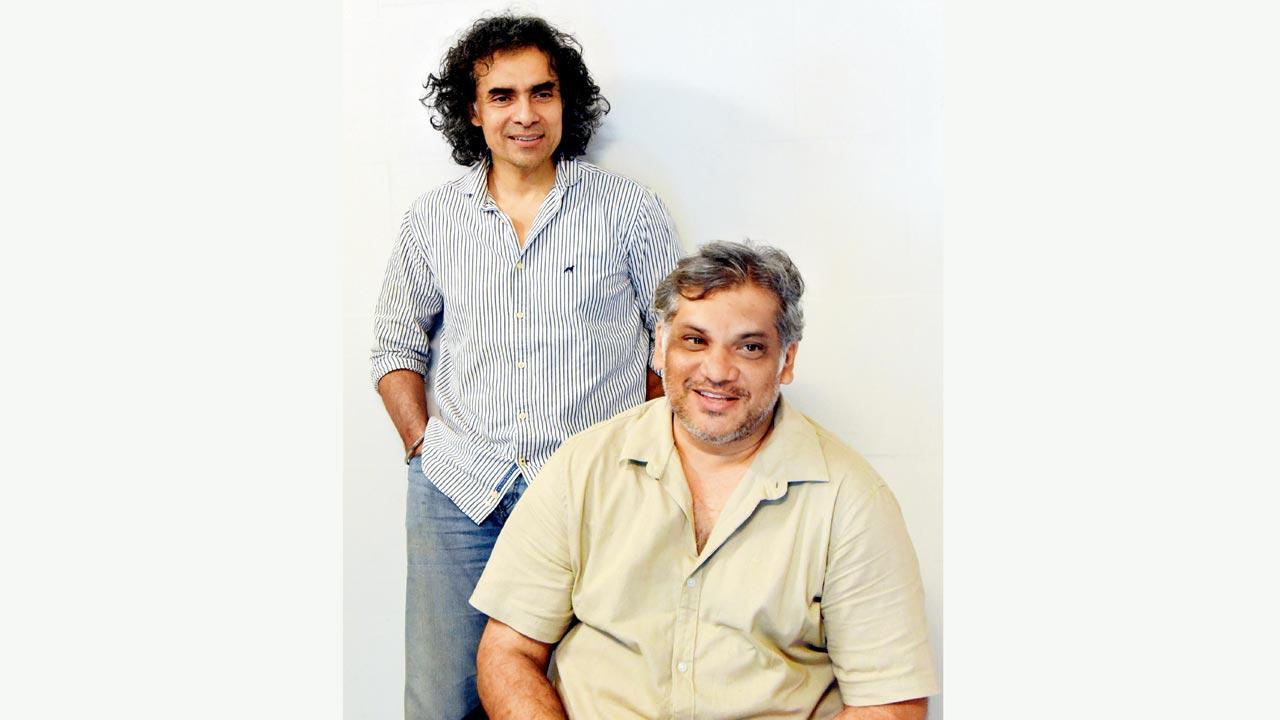
Imtiaz and Arif Ali, who are back on OTT with the second season of thriller She, talk about their bond made of mutual acceptance, admiration and adaptability
Aastha Atray Banan (MID-DAY; June 19, 2022)
“We have similar food tastes,” says director Arif Ali of his elder brother, writer and director Imtiaz Ali. Somehow, the conversation that has to be about the second season of Netflix thriller She, which Imtiaz has created and written, and Arif has directed, has become about the cuisine that Mumbai is home to and isn’t. “We share the same opinion—the North has better food, but we need to find a few places and then be happy within that,” says Arif. Surprisingly, this attitude is also reflected in the rest of the conversation, which is about the brothers believing in the same philosophy—do the best you can, and then just put it out in the universe.
When it comes to She, a story about a woman constable who goes undercover as a sex worker to bust a kingpin no one has seen, the two seem to be in sync as well. The second season is about the lead, Bhumi, played by actress Aaditi Pohankar, coming into her own, realising the power of her sexuality, and how she can use it to gain control over others. “That’s what I find most fascinating about the second season—the fact that she uses it now like a weapon,” says Imtiaz.
The two brothers often look at each other before they answer questions, almost taking unspoken permission, a courtesy that may have helped them through the making of the show. “Imtiaz pays attention to the details, while I am more macro. He has written certain things the way he sees them… there is a comma, or a full stop, because of a reason. And he wants it a certain way. We have had to change some scenes, because he didn’t think they were true to what he wanted. And I am okay with that—at the end of the day, it’s his vision.”
Imtiaz gets it, but says that as showrunner, he was responsible for the final product, unlike a project where he may have just written a script and handed it off. We remind him of the time when we pointed out discrepancies in Homi Adajania’s Cocktail, which he wrote. The film didn’t share his vision. “Yes, but with Arif I can say anything, and know that I am not being judged. I can’t impress him, and I can’t fool him. He knows it all. So when I am signing off on something, it has to be absolutely right. A scene, a moment, a dialogue… is all there for a reason. Or else let’s chop it off completely.”
Arif laughs when we ask if he wants to give his elder brother some “feedback” on his process. “There are times where what he may have written, could be different. He spent two hours on one scene, I spent many on the recce, and the preparation. I thought that maybe this could be different. But sometimes, he is obstinate about it. And it [the scene] eventually got cut on the editing table!”
But the brothers show no signs of discontent or disagreement. They talk about spending a lot of time together growing up. “We were the constants in each other’s lives. He got married first, so he had a TV and a home, and we used to spend evenings watching movies. We have similar likes and dislikes,” says Arif, who is the natural extrovert between the two.
“Oh, he is very popular and genial, and gets along with people. He is the one who is interested in people being together. The family is very fond of him—I am the slightly off one. And the ladies love him,” says Imtiaz, who we have discovered through interviews over the years is the natural introvert, who talks only because he has to. “I am not popular with the ladies the way he is,” Arif interjects.
Is the mutual love of and from women, the reason they could get into the mind of Bhumi, a lower middle class Marathi girl shunned by her husband because he saw her as cold, manly, asexual, who is now grappling with the nuances of her own sexuality? “I don’t think we disagreed about any way in which we showed her. We were clear she was coming into herself. But it wasn’t to be woke. I am socially responsible in the way that I don’t want my movies to make audiences take the wrong steps, but at the end of the day, it’s a story.” Arif adds, “Yes, I’m glad we are talking about all the issues that are important to women and us, but for us this was a character, and the character will have an organic journey.”
Maybe Bhumi is just looking for the “self”, a trait common to many of Imtiaz’s characters—Dev in Tamasha, Veera in Highway or Aditya in Jab We Met. “Ya, maybe. I am not looking for my ‘self’ at all, but my characters seem to be. There has to be some deeper psychological reason for that.”
At the end of the day, the brothers can put aside work, hang and talk about other things. “But we do talk about work as well; work is life.” Do they care how critics and audiences will react to She? Arif takes this one—“You can never know what audiences want. But we knew what we wanted, and we made that product. Now, it’s out of our hands.”
This year, I came close to selling my car as I had no money-Arif Ali
9:04 AM

Priya Gupta (BOMBAY TIMES; July 3, 2014)
Arif Ali, 39, is the younger brother of the romantic filmmaker Imtiaz Ali. He is curious, experimental and secure. He believes in family and human beings and is not in a hurry to do things. To him, quality of life is more important than material things. Over an hourlong conversation ahead of his upcoming romantic film Lekar Hum Deewana Dil, he talks to Bombay Times about his beautiful mother, his insightful brother Imtiaz Ali and his dream of re-uniting with his wife and children. Excerpts:
You have debuted as a director at 39. How did you become a director?
We come from Jamshedpur where there are really no good colleges, so you have to move out after Class XII. Imtiaz had already moved to Delhi and by the time I finished school, he had come to Mumbai and was studying at XIC (Xavier Institute of Communications) and then was working at Zee.
My parents were happy to send me as Imtiaz was already here and I did my Eco Honours at St. Xavier's College. My friend's dad Shridhar Kshirsagar was making this television serial called Khandaan and needed Hindi writers who could translate from English. Since my Hindi was good, he called me to Bangalore for a couple of months while I was still in first year of college. He gave me my first air ticket to go to Bangalore. Prior to that, I had travelled only second class, and many a times even ticketless, from Jamshedpur to Mumbai and back. Invariably, we would be too many boys and just a few girls so even if we got a berth, we would give it to the girls. Ultimately, during the three years that I was in St Xavier's College, I travelled only without a berth. We would spread newspapers on the floor and sleep on it. All the chaiwallas in the train had become my friends and knew my taste. Travelling in AC was neither affordable nor considered macho. So you can imagine how I would have felt traveling by air first time, staying in a nice hotel, that too in a city like Bangalore that was considered so cool. Imtiaz had been working as the Rs 1,500 flunkey, who would deliver tapes in Zee TV. He was always in the office 24x7 surviving on his tea and a packet of Bourbon biscuits. But by the time I was in second year of college, he had left and I took up the flunkey job at Zee alongside studying. Post completing my graduation, I took up a job at Cinevista, where I wrote for a detective show and then wrote Sanjivani, after which I started independently producing and directing TV shows. I then joined UTV full-time as creative director for about five years, where I did a gamut of stuff before I left them in 2009 to pursue making my own film. To sustain my family, I needed to keep writing for TV. Imtiaz and I had decided that he would not help me and I thank him for that. Being an elder brother, there is a natural tendency to help, but he had learnt by swimming in the water himself and he allowed me to do that. When I was doing TV at UTV, Vikas Bahl (Director of Queen) was in the films division and he used to like my writing a lot. He asked me to write a film for him and while that film did not happen, I later wrote Lekar Hum Deewana Dil and the first person I sent it to was Vikas. He loved it and said, `I think you should direct this film.' Vikas quit UTV and I continued doing TV till I met Dinoo Vijan, whom I knew due to Imtiaz doing Love Aaj Kal. Dinoo loved the script and decided to produce it.
Your relationship with your older brother Imtiaz Ali?
I call him bhaiya. We are best friends and grew up together. He has broken my head twice and I got stitches when we were younger. I would try to hit him back but physically , he would overpower me. He was very popular in Jamshedpur. Our schools were next to each other and in a small town like Jamshedpur, everyone knows everybody . He was good at everything, be it studies, sports, speaking and drama. He was very agile and could jump over the fence at once. He would not practise, but would still walk out with medals in sports. And on top of that, he was good-looking. In my school, there were girls only in Class XI and XII and even though they were my seniors, they would come to me and be nice to me. And I would feel kicked till one day when I realised that all that attention was because they wanted to be introduced to my brother. I was envious of him. But when he moved to Delhi, I realised the void in my life and really missed him. That is when we became best friends. He is very intelligent, aware and insightful about people. He has always taken himself seriously and that is a good thing as it's a sign of confidence. He is more self-absorbed than I am and unlike him, I am a bit of a fool and a tubelight in a way. But meri tubelight jalti hai ultimately, and woh bhi brightly. He has always been giving relationship advice to everyone from the time he was 18. There would be his friends queuing outside his house to take his advice and there was this joke that anyone who took advice from him would land up in a broken relationship and yet everyone wanted it. He would tell me also, 'You are a duffer and should do this.' Fortunately, I didn't listen to him. I love him the way he is and we can talk about everything. The only thing I would like to change about him is that at times he can be obstinate and headstrong and he may even regret it later. But that's him. Even though I am most attached to my mother, she is most attached to Imtiaz. She is beautiful and he has got his looks from her.
Why did you choose to make a youth love story?
I vibe with 20-year-olds very well. Even my tastes in life are that of a 20-yearold. For instance, the colour of my car is electric blue, I listen to their kind of music. As against fine dining, I like eating out at canteens, I like using trains abroad and will go everywhere with my backpack. I love sports and whenever I can play, I do that. I feel I am still 20 mentally .
How different are Imtiaz and you?
We both love our kids and our parents. Our parents are conventional but have given us a lot of freedom and encouragement. We are both extremely loyal. He is very grounded. He lives frugally and does not have a fancy car or apartment and is interested only in making films. Imtiaz is sufi and has always done his own thing and is a little aloof. I have always been the most dependable guy in the family who a relative will call if they come to Mumbai. With Imtiaz, either they will not call him or he will find a way to put them on to me. The only thing my mother likes me more for, over Imtiaz, is that she knows I will take her calls and, if busy, return her call immediately. With Imtiaz he may not call her back even in a week and may totally forget about it also. I am much more responsible than him, take fewer risks and feel that I have to work harder than him to achieve the same thing as he has a natural flair and intelligence. I do things slowly but surely. Imtiaz is mentally much older than I am though I have a stronger sense of responsibility.
Which was the toughest part of your journey?
I was 30 when I got married to Atiya Hussain who I have known from Jamshedpur since we were kids. She is an economist and a journalist and for the past one year is working in Geneva with the World Trade Centre where she lives with my two kids Nafisa (7) and Zafar (5) along with her parents who live there. She had to take up this job as, after the film happened, it took a financial toll as you don't really get paid for your first film. In the last one year, while making this film, I came close to breaking down as after my family left, I once went to the bank and realised that after paying off my EMIs, I was left with only Rs 400 and had no cash to withdraw. I had no idea where I would pay my driver from. I came close to selling my car and actually put it out on sale. I cut down my expenses drastically wherever possible. I saw my kids after 11 months, two months back. On the flight, I was overtaken by the anxiety as to how they would react to me and wondered what if we don't feel connected to each other. I reached there, changed quickly and went to their school that was a five-minute walk. They were playing. Usually, I would spot my child immediately but it took me some time, but I managed to spot Zafar. He came forward, hugged me and spoke to his friends in French and I said, 'Wow.' They didn't come and stick to me though they acknowledged me, but then slowly they kept coming back again and again and finally we had a really amazing time.
Atiya may need to work there for another one year, but eventually I am looking forward for them to return to India. A lot depends on how my first film is accepted. It just takes one film to change your life. Inshallah! I hope so.

Subscribe to:
Posts (Atom)