Showing posts with label Anurag Kashyap interview. Show all posts
Showing posts with label Anurag Kashyap interview. Show all posts
Today, cinema is marked by fear, propaganda and a loss of truth-Anurag Kashyap
9:49 AM
V Nichita (BOMBAY TIMES; April 16, 2026)
When filmmaker Anurag Kashyap sat down for an unfiltered fireside chat with writer and moderator Suman Kumar at the Bengaluru Art Weekend, what emerged was not a polished masterclass, but a candid, stark conversation on propaganda in cinema, creative frustration, and why Anurag has stepped away from directing — for now. Opening the discussion on propaganda in films today, Kashyap didn’t dismiss the debate, he reframed it. Excerpts from the conversation:
‘Caution culture has fundamentally altered filmmaking’
“If a film is propaganda, then the film opposing it is also counter-propaganda. Films that present facts as facts are simply not being made. The ones that hold a mirror are seen as too troubling,” he states. For him, the larger concern isn’t propaganda itself, but the disappearance of honest storytelling. “Today, when you write a script, the first person to read it isn’t the producer or actor — it’s a lawyer who flags what’s ‘problematic’. That culture of caution has fundamentally altered filmmaking,” he believes.
‘I would never cast myself’
Anurag Kashyap the actor, he admits, is very different from Anurag Kashyap the director. “Every time I act, I think, ‘What did I get myself into?’ The director in me would never cast me,” he says. So why take up acting roles? “I’m not making films right now — I need a source of income. Therefore, if someone I trust offers me something, I say yes,” he says simply.
‘I’ve put filmmaking on the back burner is because I’m unable to make honest films’
Today, Anurag points out, “Films are getting dumped, they are not even making it to OTT platforms. As a filmmaker, I find that there is no point. If you make a film only to watch it yourself at home, what’s the point?” For now, he’s choosing to step back. “The reason I’ve put filmmaking on the back burner is that I’m unable to make honest films. I’d rather write and be ready for a time when I can make films safely,” he says.
‘I want to make audiences uncomfortable’
Anurag’s cinema has often leaned into moral ambiguity — and he embraces that instinct. “I cannot write a character who is absolutely moral. There’s some degree of immorality in all of us. I like to make people uncomfortable, even if it’s just a little.”
Reflecting on audience reactions to morally complex characters, he added: “If you feel sympathy for someone with no redeeming qualities, instead of judging them, judge yourself. That’s what art does — it makes you look inward,” he says.
‘Finish your writing before you judge it’
On writing, Anurag kept his advice simple and practical. “When you start writing, finish the script. Don’t read what you’ve written until you’re done. Overthinking is the biggest creative block. If you keep rereading, you’ll never finish. I still write with a pen and don’t revisit it until the end,” he says.
He also cautioned against chasing market-friendly ideas. “A lot of people get stuck trying to find an idea that will ‘work’. If the need to make a film outweighs the need to be called a filmmaker, it becomes easier. I exorcise myself through writing,” he says.
‘Hunger drives everything in life’
Drawing from his own journey, Anurag’s advice to aspiring creators is, “It’s not difficult if you want to write, act, or make films. The real challenge lies in expectations. If you want to be a superstar, then timing, luck, networking — everything comes into play. But hunger is what drives you. When you’re hungry, you find food; it’s the same in any field.”
‘Animation in India is still boxed as children’s content’
Commenting on the lack of adult animation in India, Anurag states that it remains a major limitation. “The fact that we call it ‘cartoon’ automatically reduces it to children’s content.” He pointed out that even globally successful animation often fails to find theatrical space in India. “It travels the world but doesn’t release here. The next five years are going to be very dangerous for Indian animation. With AI entering the space, creative risks may shrink further,” he states.
‘The Kannada film industry is not in a very great state of affairs right now’
Anurag acknowledges both the breakthroughs and the struggles he sees in the Kannada industry. “It’s not a very great state of affairs out here,” he said, noting that while big hits emerge, smaller films continue to face funding and distribution challenges.
“Projects get funded only if certain stars are attached,” he points out. This, he believes, impacts originality. “People start imitating success and lose their own voice,” he says. Yet, he remains hopeful about filmmakers who continue to stay true to their vision.
--------------------------------------
I love Bengaluru. It’s extremely peaceful. People are non-intrusive — they give you space. Returning to Mumbai now feels ‘very weird’
- Anurag Kashyap on his love for Bengaluru
It’s no longer possible to make films like Gangs Of Wasseypur fearlessly today-Anurag Kashyap
2:24 PM

Yemen S (BOMBAY TIMES; February 6, 2026)
Filmmaker and actor Anurag Kashyap says his biggest fear today is not being able to make the kind of cinema he truly believes in. Speaking at the 17th Bengaluru International Film Festival (BIFFES) 2026 during the Fearless Filmmaking session on Saturday, Anurag said films such as Gangs Of Wasseypur and Mukkabaaz would not be made in the current climate.
“Gangs Of Wasseypur or Mukkabaaz would not have been made today because of the themes I chose to tell those stories with. And even if they were released, they would be heavily censored,” he said.
Anurag also noted that several honest filmmakers are attempting to find ways around censorship. “India is still better, and that gives me hope. If filmmakers can make cinema in Russia and China, we can too,” he said in conversation with critic and writer Baradwaj Rangan. “Movies that spark important conversations will be made in India at some point. We just need to wait,” he said.
‘The OTT format has destroyed the way cinema is experienced’
Cinema, Anurag said, has always been meant for the big screen. However, with the rise of OTT platforms and the convenience they offer, audiences are increasingly consuming films on smaller devices. “When I made Nishaanchi, I envisioned it entirely for the big screen. But times have changed. People now watch films at their convenience. The format has destroyed the way cinema is experienced,” he said.
Emphasizing the importance of the theatrical experience, he added, “The joy of cinema is watching it on a big screen. You can’t watch Mera Naam Joker or Sholay on a phone. These films are made for the theatre, and it’s a disgrace if they’re watched otherwise.”
‘Reaction to Toxic trailer was blown out of proportion due to social media’s controlled narrative’
Responding to the backlash around the trailer of the upcoming Kannada film Toxic, Kashyap said he enjoyed it and felt the reaction on social media was exaggerated.
“When a woman is in control of her sexuality and enjoys it on screen, it becomes a problem. But when male actors do the same, no one says anything,” he said, adding, “Social media controls the narrative, and this was blown out of proportion.”
I’ve seen my films discarded by exhibitors my whole career-Anurag Kashyap
8:18 AM

Rishabh Suri (HINDUSTAN TIMES; November 17, 2025)
Anurag Kashyap’s directorial Nishaanchi, starring Aishvary Thackeray, Vedica Pinto, and Monika Panwar, released in theatres in September. The result was not impressive, with low box office collections. It had ended on a cliffhanger, promising a second instalment. Now, two months later, Nishaanchi 2 has quietly been dropped on a streaming platform.
We reach out to Anurag about this decision, and he says, “It was my suggestion, and our collective decision between producers and us.”
The filmmaker attributes it to the underwhelming support from viewers. “Had the audience turned up for part 1, there is no way the second part would not have been released in cinemas. And since most of the reaction was that the film felt incomplete, it was decided to let them have the complete experience.”
A story about twin brothers and how they end up taking different paths in life, the direct-to-OTT release of the second film got zero promotions.
Anurag explains, “No marketing could be done because of the theatre-OTT rule… theatres don’t allow even promoting the film or dropping it anywhere for eight weeks, and OTT has to do their part of the deal. That’s another thing that theatres themselves don’t adhere to. They will cancel shows and throw the film out if it doesn’t open, not allowing the word of mouth to build up. That’s how they treat non-tent-pole films. It’s pretty one-sided, and I’ve seen my films being discarded my whole career by exhibitors themselves. We were lucky that we had a studio, which has a streaming platform as well, producing and backing our film.”
I don’t enjoy acting. I don’t want to have an acting career-Anurag Kashyap
3:30 PM

Upala KBR (MID-DAY; October 31, 2025)
Behind the camera is arguably Anurag Kashyap’s favourite place in the world. That said, of late, we’ve seen him facing the camera just as much. The filmmaker featured in four releases last year, and will soon be seen in three more — the Tamil action thriller One 2 One, Telugu drama Dacoit: A Love Story, and the Kannada sports drama 8. It looks like the acting bug has bitten him.
“I don’t enjoy acting. I don’t want to have an acting career or be known as a star-actor,” states Kashyap, insisting that filmmaking will always be his true love. “I love making and writing films. The process of filmmaking is in my blood. I am making movies non-stop and I want to continue making them. In my free time, I am also writing,” says Kashyap, whose directorial venture Nishaanchi released in September.
Earlier this year, the director had announced that he had shifted to Bengaluru as he found the Hindi film industry “toxic”. How is Bengaluru treating him? Fabulously, he says. “[When in Mumbai], I was in depression for some time. The transition happened during Kennedy [2023], and I came out of it. Leaving Mumbai changed me a lot.”
He can feel a tangible change, he says. “Bengaluru is beautiful because I am not surrounded by film people or the same conversations that bore me. Here, the conversations are about cinema and not about box-office business. Nobody discusses films, music, and literature anymore [in Mumbai]. The cultural space in Bengaluru is beautiful. I keep acting in South movies and keep looking at scripts to direct. After I complete my acting assignments, we’ll see what happens in 2026.”
Sushant Singh Rajput agreed to play the lead; we had made an announcement too-Anurag Kashyap
9:28 AM

Having found his Nishaanchi hero after a long wait of over eight years, Anurag Kashyap shares that he advised Aaishvary Thackeray against doing other films until his launch with the crime drama
Upala KBR (MID-DAY; September 17, 2025)
If the universe had listened to Anurag Kashyap’s wish, Nishaanchi would have been released eight years ago with late Sushant Singh Rajput in the lead. But each film has its destiny, and the upcoming crime drama was destined for Aaishvary Thackeray.
The filmmaker recalls, “Sushant Singh Rajput agreed to play the lead, and we had made an announcement too. But then he changed his mind as he signed two big commercial films — Drive [2019] and Dil Bechara [2020]. After that, I met other actors and they all wanted to do bigger movies. Then I decided to wait for a newcomer, who would be good enough to pull off this role.”
Kashyap’s eight-year wait paid off. Today, he is launching Thackeray and Vedika Pinto with Nishaanchi, which tells the story of twins Babloo and Dabloo who have contrasting life values. “If I hadn’t found Aaishvary, I’d still be sitting on this script,” says the director, adding that the debutant’s showreel left him impressed.
“In his showreel, Aaishvary did the most difficult monologues, including one of Manoj Bajpayee’s from Shool [1999]. When I cast Aaishvary and Vedika, I told their parents that if they’re doing this film, they cannot be doing anything else. They kept getting offers, but they said no to everything and trusted me. It’s difficult to mount a film like Nishaanchi if the newcomers take up another project and that doesn’t turn out to be good enough. It’s like what Aditya Chopra did with Ahaan Panday.”
As soon as Nishaanchi’s trailer dropped online, Kashyap’s fans compared it to Gangs Of Wasseypur (2012). The filmmaker says the crime drama is his attempt to go beyond the 2012 offering.
“After Wasseypur, everybody kept offering me the same thing. I wanted to step away from that. There’s more to North India than Wasseypur and gaalis. With Nishaanchi, I made a family drama with seeti-maar dialogues, like a Deewar [1975] or Trishul [1978], rather than a gangster film.”
Once upon a time in Banaras: The Kashyap siblings and their earliest engagements with cinema
11:26 PM
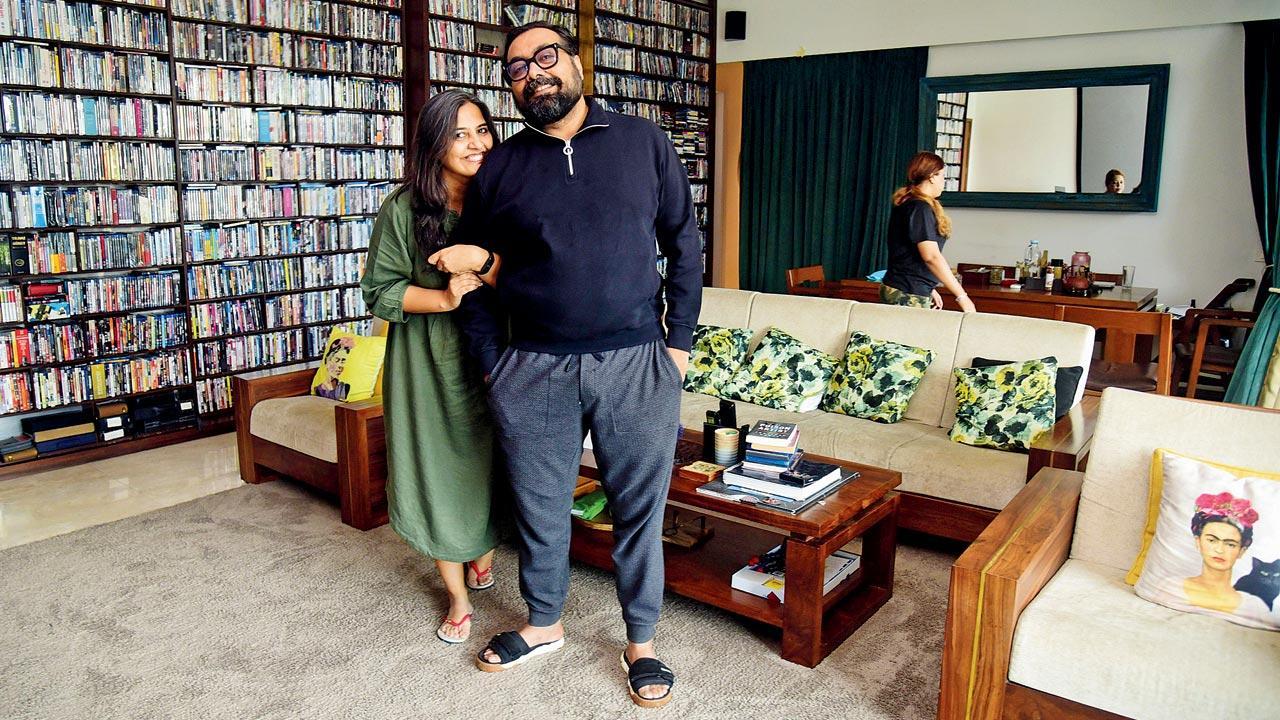
How do three of a family all become filmmakers? Kashyap siblings Anurag and Anubhuti didn’t watch movies when growing up. They played Cinema Cinema, and making up stories was their favourite pastime
Heena Khandelwal (MID-DAY; October 30, 2022)
When most children their age would play ghar-ghar, the Kashyap siblings played cinema-cinema. “Carrom board coins would become my audience, and board games would turn into a make-shift auditorium. Sometimes I would cut out film posters [to make it more realistic],” recalls Anurag Kashyap, the eldest of three siblings, over a phone call.
What about the plot? “A magazine called Sarita carried a review section called Chanchal Chaya. I would read the review, make up the story and they [Anubhuti and Abhinav] would think that I watched all the films,” he laughs. “He would create random stories… ones with shock value,” adds Anubhuti, the youngest of three siblings.
“He would also draw and turn them into comics and novellas. These would be circulated among all the cousins during the summer vacations.” “One was titled Mr Huge Ho Gaye Fuse,” pipes in her eldest brother. “I had also created a character called Wonder Man. This was back in the 80s, much before Marvel.”
All three siblings—writer, director and actor Abhinav is the middle child—had very little exposure to cinema, partly because their father, an engineer with the Uttar Pradesh energy department, would be posted in remote areas. As a result, the trio grew up in Obra and Anpara, small thermal power colonies near Banaras. Also, cinema was considered a bad influence.
“Besides an occasional Amitabh Bachchan movie on screen,” shares Anurag, “we watched most films on VCR, with pirated cassettes. In fact, the version of Mr India [1987] that we saw was without the climax.”
Anubhuti was the first among them to explore her creative side; she co-wrote a play in college and acted in it. “It also travelled to some festivals, but that was it,” she says, adding that her options for adulthood were simple: Either study and make a career for yourself, or get married.
“None of us actually aimed at getting into movies,” she says. “An MBA seemed like a good option [for me].” After graduation, Anubhuti worked in the corporate sector in Pune and Mumbai for a few years.
Meanwhile, Anurag enrolled in a zoology course at Hansraj College in Delhi, but was exposed to world cinema at a film festival. He moved to Mumbai and was soon writing scripts for television serials and films. “I was young and arrogant,” he recalls, “and turned down a lot of work that came my way, thinking this was not what I wanted to be known for.” But Abhinav, who was in Mumbai to prepare for an MBA degree, saw it as a great opportunity and became a mainstream scriptwriter.
However, it took several years for Anubhuti to quit her job. “I had reached that point where I knew that if I didn’t realign [with my creative side], it wouldn’t happen later,” she says. “So I took a sabbatical. Anurag [who was wrapping up No Smoking in 2007] recognized my talent much before I did. He subtly nudged and manipulated me into joining films.”
Anubhuti joined the team of researchers working on Bombay Velvet, which released much later in 2015. “It involved watching many films,” she laughs. Around the same time, scriptwriter Raj Kumar Gupta was making his directorial debut with Aamir (2008), and was looking for an assistant director. Anubhuti came on board. Later, she assisted Anurag on Dev.D (2009) and Gangs Of Wasseypur (2012).
“All the people who worked with me and went on to become directors—such as Neeraj Ghaywan and Vasan Bala—stayed with me only because of Anubhuti,” says Anurag. “I am chaotic, but she would handle me as well as them.”
After Gangs Of Wasseypur, Anubhuti stopped assisting and moved in the direction of short films. “The first was Let Stalk, my take on stalking, which never saw the light of day,” she says. “Then I wrote and directed Moi Marjaani [about a single mother and her encounter with love].”
It took almost a decade for Anubhuti to stake her claim to the spotlight. It came with the Ayushmann Khurrana-starrer Doctor G, which released earlier this month. The movie revolves around a male medical student stuck in the Gynaecology department.
“The script came to me in 2016, but the following three years saw a lot of ups and downs in the production company Junglee. We were just about to start shooting when the pandemic happened,” she says. Anubhuti also directed the web-series Afsos (2020).
Has Anurag been a support system in Bollywood? “He would have, had he known,” she confesses. “But I never shared any of it [struggles] with him.”
“We are the kind of siblings who hug each other a lot, but never really talk,” says Anurag. “Actually, it is not easy to talk with me around,” interjects Anubhuti, mentioning that during conversations, she is more of a listener than a talker. “I am the one who talks a lot,” explains Anurag. “She is usually worried about me, and wants updates about my life.”
Their style of cinema also differs from each other. While Anurag’s work is best described as dark, Anubhuti’s lens sees shades of grey; Abhinav makes mainstream potboilers. “Anubhuti is far from the cancel culture,” says Anurag. “She sees everyone as a work in progress, and believes everything is forgivable.” Similarly, their personalities are different too.
“While I grew up on world cinema,” says Anurag, “Anubhuti feeds off on real experiences. I have mad energy, while Anubhuti is calm.” “I am also very lazy,” interjects Anubhuti, adding that Anurag can write endlessly, but she needs a lot of pushing. “I am very independent, but I’m also happy doing nothing and I have no hurry in life.”
In an industry where nepotism is brought up every Friday, the Kashyap siblings wanted nothing to do with each other. “I have produced a lot of films,” says Anurag. “Anubhuti could have made a film [with me] long ago, but she wanted to make it on her own. Even Abhinav chartered his own path; he is very enterprising. The credit goes to our parents. We were all told that once we complete our education, we would have to make our own living. And we did.”
I remember Shah Rukh Khan feeding me. He only knew how to make omelette-Anurag Kashyap
8:39 AM

Sit With Hitlist: Maverick director Anurag Kashyap traces his journey in the movies -- from a wannabe actor in college to now -- via funny, never-heard-before anecdotes
Mayank Shekhar (MID-DAY; June 12, 2020)
 The first time ever that filmmaker Imtiaz Ali saw what a portfolio looked like — an album with photos of a person, in multiple looks and poses — was that of an actor called Anurag Kashyap. Back then, Ali was in college in Delhi, helping out a local TV serial crew, when Kashyap approached him with his portfolio.
"It was 1992. Imtiaz was in [Delhi's] Hindu College. I had just discovered theatre, and was told that you need to get pictures clicked, if you want work. I did, after collecting Rs 3000, which was a big sum then. And I started doing a lot of acting on stage, and I did some films," the candid Kashyap recalls.
Ever since Ali told me about that portfolio (in jest, during an interview), I've been meaning to ask Kashyap about it. Besides, he is before me on the screen — this conversation being held over a video-conferencing app. And the last time I saw him on screen was as an actor in the recent, cutesy Zee5 release, Ghoomketu, where he played a cop. Kashyap shuts his eyes with his palm, feigning embarrassment at the mention!
 "Also, what Imtiaz did not tell you was one of the first films that I did as the lead-actor, he was my co-star. The only copy of the film is with Zee, where it had premiered on January 26, 1994. We don't talk about it. Imtiaz will kill me. If you ever pull out a copy from the Zee library, he will come after you too!"
"The good thing about being a bad actor is you know how to extract great performances," Kashyap tells me later. Which in his case, I'm told, notoriously involves hardly ever saying "action" or "cut" on set. Often, no lines for actors to mug up, let alone extensive rehearsals, before shoot. It's a process only the best can survive.
Ali, of course, played the '93 Bombay bomb blast accused Yakub Memon in Kashyap's first release, Black Friday (2007). He played a bigger role in his life, if you consider that Kashyap used to shack up at Ali's place while the latter was doing a post-grad course at Mumbai's Xavier Institute of Communications (XIC).
This is also how Kashyap first met his key associate, Vikramaditya Motwane, with whom he later founded the production company, Phantom, where they did a string of films together. Kashyap also produced Motwane's directorial debut, Udaan (2010). Likewise, Motwane was the show-runner for the Netflix global series Sacred Games (2018), which Kashyap directed both seasons of.
He reminisces, "I couldn't get into XIC, and was living in Imtiaz's room. Aarti Bajaj, my first wife and permanent editor for both mine and Imtiaz's films, was a year junior. Vikramaditya Motwane was Aarti's classmate. That's how we knew each other. But we really became friends during the shoot of [Deepa Mehta's] Water. Vikram was an assistant, and I was writing dialogues. The shoot got stalled [due to protests], and we spent a lot of time in Banaras. Thereafter, I kept meeting him because he was first assistant director (AD) to Vishal Bhardwaj in his first film called Barf, before Maqbool — that never got made."
In fact, if it wasn't for spotting Motwane — somewhere in the back, in a baseball hat — in a picture from the 'mahurat shot' of Kashyap's directorial debut Paanch, that he had posted on Twitter, I wouldn't have known that the two went that far back together. No, it wasn't the film's anniversary being celebrated on social-media. Can't be. That movie never released.
 Kashyap says, "Yeah, that was sometime around 2000. Vikram was one of the sound designers on Paanch. And because I was scared of shooting songs, and he had been Sanjay Leela Bhansali's assistant, I asked him to direct the songs. He had two credits in the film — sound designer, and director of songs. It was a first for many people —Bosco-Caesar as choreographer, Natty [Natarajan Subramanian] as cameraman, Wasiq Khan as art director, Aarti Bajaj as editor. Abbas Tyrewala was the lyricist in the film and Vishal Bhardwaj did the music. Both of them, Vikram, I and others, used to hang out together. Then, there was Sriram Raghavan, Shivam Nair and a whole lot of others — part of another gang. Even Tigmanshu Dhulia, Irrfan and others were all close to my brother [Abhinav]. That was the third gang. I was the centre-point, everywhere. And then I had another friends' circle, with Anand Surapur [who directed Fakir Of Venice, Farhan Akhtar's acting debut], Zoya Akhtar and the lot. When I wrote a script, I had way too many boards to bounce off. And that's what we did!
"I was a huge fan of Sriram Raghavan's Raman Raghav [a docu-drama on a serial killer that Kashyap remade in 2016]. And I used to write with Shiva Nair. They gave me credit on their [script] Ranga Billa, although I was happy to work without credit. Likewise, I rewrote a script of Shiv Subramaniam, Auto Narayan, because I had a take on it. But they also gave me credit. Then a strange thing happened, with a script I wrote officially, for the first time, called Nagarajan — with Kamal Swaroop (Om Darbadar) as director. For that film, I found an actor I was a fan of from Delhi stage, called Manoj Bajpayee. I put the film together. But it never happened. Nobody was showing faith in Manoj. He was going through a hard time and doing Ram Gopal Varma's Daud, which is when Ramu ji said he wanted to make a film [Satya] with Manoj. And asked if he knew of a writer for it. Without having seen any of my written works, Manoj took me to Ram Gopal Varma."
The rest, as they say — if you casually scroll up the 'gangs'/cast of characters again — is history. Of post-millennial, part indie, part commercial, wholly entertaining Hindi cinema. Charge of the bright brigade, if you will. The new subversive Bollywood, arguably. It helps that Kashyap was not just at the centre of several spokes (and that he continues to be).
But that he's also a liberal raconteur: "Oh, one of my favourite stories is about Mahesh Bhatt. He happened to me, right before Ram Gopal Varma. He got me to write films. And Mukesh Bhatt [his brother, and producer] was very miserly with money. I was struggling for rent. Pooja Bhatt was the nicest and kindest; I would tell her to talk to her dad."
"Then I just walked up to [Mahesh] Bhatt saab once and said that I'd rather be a carpenter than work in his office. With his brother [Mukesh] around, he didn't say a word. When I was leaving, he came down, said, 'Don't ever change.' And he put Rs 10,000 in my hand. That was big money in 1994-1995."
Years later, at a post-screening event in a film-festival abroad, Kashyap was narrating the first part of the story above. He heard a voice from the audience: "Aur Mahesh Bhatt ne paise diye the. Woh bhool gaye?" "Bhatt saab was sitting in the crowd. I got so emotional. I have had funny incidents like these."
"I remember [the media maven] Amit Khanna trying to hold me back to work on TV serials, where there was so much money. Naseeruddin Shah also cast me in a play, Androcles And The Lion. I walked out of everything to do [Varma's] Satya. It was instinctive. I had to write that film."
My favourite Kashyap story is about a prominent '90s film-critic who was chatting with Ram Gopal Varma on the sets of Shool. Gazing at a young Kashyap, who had written the film, and mainly to haze him, he asked Varma if his bratty assistant even knew what the word 'shool' meant. Kashyap stuck out his three fingers, "That's tri-shool." Staring at him still, he left his middle-finger pointed up: "And this is shool!"
He repeats the punch-line/move, laughs, continues: "There was a time when Mukul Anand was making Trimurti (1995). I wanted to work with him as an assistant. I would call his house land-line. Every call was a rupee gone. And he was always busy. Third time I said, 'Subhash Ghai bol raha hoon. Unko bolna kal se set pe aane ki zarurat nahin hai [This is producer Subhash Ghai, tell him not to show up on the sets from tomorrow],' and hung up. Now when somebody trolls me on social media, I just remember my time!"
There is then the moment he randomly landed up at Shah Rukh Khan's bungalow Mannat (he mistakenly calls it Jannat) on Bandstand: "I was hungry and I walked into his house, using our college connection [both went to Hansraj in Delhi]. I remember him feeding me. He only knew how to make omelette."
And then, there are the more famous spats, with those clichéd kickers, 'Anurag Kashyap ko gussa kyun aata hai': "Karan Johar gave an interview calling me a psychopath. Till then we had not met. I called him a fat kid, who still thinks he is in school. Remember we had this fight in mid-day. I also said something about Anil Kapoor in the interview that became a headline. But people always knew I was childlike."
Of course much about public exchanges have changed since the late 2000s, where the audience is now equally a participant — altering and shaping opinions on public figures, based on beliefs, rather than any first-hand knowledge. Despite lack of the latter, one opinion is as good as the other.
Kashyap vividly remembers, "I bought my first laptop, and discovered the Internet. What's the first thing you do then? Google yourself. I landed on a page where people were talking about me and my films with incorrect information. I was also going through a phase when everybody was saying things that I am not. I told them this is not true. These people were like, who told you? I said I am Anurag Kashyap! They said, why don't you start talking? I said fine, I'll talk, assuming 20 people will read."
That website was called Passion For Cinema (PFC). If you'll excuse the exaggeration, it was Bombay/Versova's very own Cahiers du Cinema, with diverse/off-stream voices expressing themselves as critics/bloggers, before filmmakers.
Kashyap cites, "Chaitanya Tamhane [Court], Anand Gandhi [Ship of Theseus], Dibakar Banerjee, even before his first movie… There was [composer] Sneha Khanwalkar, Kartik Krishnan, who runs Filter Copy… So many names. Vasan Bala [Mard Ko Dard Nahin Hota] and Neeraj Ghaywan [Masaan] quit their jobs. Suddenly many of these people started working with me. We were raising money. My office-space became a kind of dharamshala. People stayed and lived there — all we could provide was food."
This alternate eco-system might be Kashyap's far more dramatic contribution to films, than merely his movies alone. He's perhaps a film buff/activist, first. And this has always been the case. He's gone to the extent of rescuing actor Rajpal Yadav from Andheri railway station, since he was returning to his hometown, having given up. That's when, Kashyap says, he first met the nondescript Nawazuddin Siddiqui, standing next to Yadav.
At a data/practical level, consider the ensemble cast of Gangs Of Wasseypur (GOW; 2012), which looks now like the first batch of national school of lead-actors, for films and web-series — besides Nawaz, Manoj Bajpayee, Rajkummar Rao, Pankaj Tripathi, Richa Chadha, Huma Qureshi, even Jaideep Ahlawat, who killed it in the deathly dark Paatal Lok. Or, why not Vicky Kaushal, since he assisted Kashyap in GoW!
Also, over years, he's allowed unfettered access to young/untested/fresh writing-directing talents, having actively produced their films, lent his name/heft for no benefit to himself; or generally egged on peers and past associates alike. "Who am I? Someone like Martin Scorsese still makes time for that," Kashyap reasons. Speaking of which, and exploring the film-buff side still — in a very PFC fan-boy sort of way — Kashyap equally lights up when you ask about his Alice/Anurag In Wonderland moments, meeting his own greats.
Like Scorsese, for instance who, after having watched GOW, invited him to be on the jury of the Marrakech film festival. Before Scorsese walked in, Kashyap was smoking outside with the Oscar winning Italian director Paulo Sorrentino, without knowing it was Sorrentino! Both were nervously puffing away.
"When Scorsese sat down on his table — me, [German-Turkish star-director] Fatih Akin, [French sensation] Marion Cotillard, [Italian star] Golshifteh Farahani…We were all equals, looking up to him. We were also there, because of him!"
Or this other time, Kashyap was in the same room as Francis Ford Coppola, "Sophia Coppola, his daughter, was with him. He is old. I kept staring at him for so long that he made me sit on his lap and said, now talk to me!"
These are of course perks of having your works travel among audiences/aesthetes abroad, as Kashyap's (both as producer and director) have, especially at the movie Mecca, Cannes. Plus a global streaming giant like Netflix helps reach around 200 countries simultaneously.
Since Netflix began commissioning Indian content only three-four years ago, Kashyap has already directed two shorts (in the self-explanatory Lust Stories, Ghost Stories), directed-produced two seasons of a show (the underworld saga Sacred Games), produced a zombie mini-series (Ghoul), and directed a feature (Choked).
While the Netflix model evidently allows him to go out of the box (office), as it were, there is also the mainstream audience that can't be altogether alienated. I know at least one friend who did not understand Kashyap's short film in Ghost Stories at all. While the others were gently scratching their heads, it went totally over hers. It was the same look on theatrical audiences with Kashyap's No Smoking (2007). Where does he stand on the art for self-expression versus art for mass-communication debate?
"No film is ever made with the intention of people not getting it. I just don't like to over-explain. So, I try to leave hints here and there. With Ghost Stories, I thought absolutely everybody will get it. The idea behind that was of a woman dealing with her own trauma. Then Zoya [Akhtar] pointed out that I could have confused people by putting the kid in there. No Smoking taught me how not to make Choked. Both are magic realism."
Choked is about kitchen and bathroom plumbing, choking with money/cash! It's also the first Indian filmic commentary on the 2016 demonetisation. Screenshots of related scenes from the film are already doing the rounds as memes on the Internet. Which is the default pop-culture response to most of Kashyap's films.
For instance, the tagline Emotional Atyachar in Dev D (2009). Where does that come from? "There was a line in the song Pardesi, that went, 'Ikke ho gaye, agge yaar'. Sounded like atyachar to me, which is what I kept humming, when 'emotional' hit my head at night, so I called [composer] Amit Trivedi to write it down. The brass band elements came from Kamal Swaroop's Om Darbadar and Emir Kasturica's The Underground. I told Amit and [lyricist] Amitabh Bhattacharya, "Band ko record karna hai. Emotional atyachar gaana hai. Baaki, you guys figure out."
What about the running/chase sequence in Black Friday (2007)? "There were too many arrests to be shown in Black Friday, so we just compressed them with a chase, where we could see the world these characters [blast-accused] came from." How about 'Tumse naa ho payega' from GOW? "That was all in Tigmanshu Dhulia's delivery!" And what about… Okay, this could leap across pages. Will stop now. Deserves a series.

Cinema halls will co exist with online streaming platforms-Anurag Kashyap
8:20 AM

Shamayita C (BOMBAY TIMES; February 8, 2020)
Anurag Kashyap was recently in Kolkata to inaugurate a film festival. In a chat before the event, the filmmaker spoke about his take on film festivals, his love-hate relationship with social media and more. Excerpts:
You have mentioned that film festivals played an important role in you becoming a filmmaker...
True. I used to go to these festivals and watch all sorts of films. I wanted to be part of filmmaking business only after watching these films. Sirf Bollywood dekhte toh I could never have become a filmmaker. Films screened at these festivals help you grow. They broaden your perspective.
Writer, director, actor, producer — which role suits you the best?
Writer-director. I think I am most comfortable as a writer and a director.
Which one is your favourite Anurag Kashyap film?
I don’t know (laughs). I always say, ‘That’s going to be the next one’ (laughs).
You share a very interesting relationship with social media. Your take.
I think, social media is a curse (laughs). Initially, it was very empowering. It gave voice to people. But when some people learnt to speak up, others decided to manipulate social media. Now, there is so much of data that is being misused. Information is being controlled and lies are being spread. Once, after I retweeted something, I realised it was fake news and I fell for that. So, you have to extra careful. Else, you cannot differentiate between the real and the unreal.
In this era of online streaming platforms, how do you see the future of movie halls, especially single-screen theatres?
Cinema halls will co-exist with online streaming platforms. While people will continue watching intimate films online, they will go to the theatre for other films. For song-and-dance movies, the audience still prefers to go to cinema halls. The content of Indian cinema needs to improve. Only a strong content can make a film work. Now, people across the world watch our films. So, they can compare. Their expectation is much higher. It doesn’t matter if it is for big or small screen, I will continue making films.
My audience was always watching my films illegally-Anurag Kashyap
8:28 AM

Monika Rawal Kukreja (HINDUSTAN TIMES; February 5, 2020)
With the kind of cinematic sensibilities he possesses — dark, deep and deranged — it doesn’t take much for Anurag Kashyap to stand out from his contemporaries. Take, for instance, his films Black Friday (2007), Dev D (2009), Gulaal (2009), Gangs of Wasseypur (2012), Raman Raghav 2.0 (2016) — the filmmaker has always explored a world that’s not too easy to relate to. In a candid conversation, the filmmaker talks about experimenting with the horror genre, collaborating with fellow filmmakers and more.
You’ve made some really dark films in the past. In what sense was Ghost Stories a different experience?
Ghost Stories gave me an opportunity to make horror that I always wanted to make. It was hard for me to explain to anyone how I look at horror, because the kind of horror that I really like are [films such as] The Witch (2015), Hereditary (2018), the more psychological ones. I love the genre now and after this anthology, I have a reference point that this is how I want to approach things.
Do you feel restricted when you’re teaming up with three different filmmakers? Is it tough to reach a consensus?
It’s not tough. I actually don’t think of it and look at it very differently in this sense. They’re very generous, there’s no pressure… nobody says that I have to adapt to what the other person feels or think should be done. All of us (Zoya Akhtar, Dibakar Banerjee, Karan Johar) are very different from each other. We’re just ourselves and that reflects in our stories, too.
What’s the future of anthology films?
This is ongoing, continuous, and consistent. This will always happen. This is something we look forward to. It’s like an annual holiday you take. Now that Ghost Stories is out, we’ll soon meet and decide the next subject. There’s so much excitement to come together and do this.
With a spurt of OTT platforms, do you feel that web and theatre can coexist?
They will, conveniently, because you’re talking to a whole new generation. For me, even before OTT platforms were launched, I was always in the web space. My audience was always downloading my films illegally and watching them (laughs). A few years ago, Gangs Of Wasseypur series was picked up and serialised in the US as a six-part series. That was my first connect with the web.
So, are you saying your films do better online than in cinemas?
I was always told that people watch my films. But at the box office, why do we just about break even? Why don’t we make humongous profits? Even films like Dev D – they’re quite a hit, but financially, they just crossed the budget and the investments, but don’t become like other massive blockbusters. That’s when I realised that I have an audience but it’s very working, educated audience that doesn’t line up on Fridays outside cinema. They want to watch movies at their own convenience, probably on holidays, weekends or late nights. So, OTT platforms have made my work available to them at their convenience. I still remember, after That Girl In Yellow Boots (2011) release on the web... the number of mails and messages I got on this film, I didn’t get them on its original release. And it’s not like twice or thrice the number; I’m talking 10 times the number. So, with that kind of visibility and accessibility, suddenly, my films got life back.
I used to be idealistic and angry-Anurag Kashyap
9:42 AM

Nishad Neelambaran (HINDUSTAN TIMES; January 6, 2020)
From being a screenwriter in Ram Gopal Varma’s Satya (1998) to turning director with Black Friday (2007), Anurag Kashyap has come a long way. His movies have been appreciated by the critics and audiences alike. With movies such as Dev D (2009), Gulaal (2010), That Girl In Yellow Boots (2011) and the Gangs of Wasseypur series, to his credit, Anurag says that he has evolved over the years. “The young me was idealistic and angry, but then I found sarcasm and humour,” he says. The 47-year-old director, who has always been vocal about his opinions, says that he’s approaching mid-life and “the crisis has kicked in big time”.
He says, “It has started reflecting in my work, my stories and the choice of things that I am trying to do. Now, I think I’m getting more condense and complex. But at the same time, I also simplify the complexities. Earlier, I wouldn’t care about this.”
So does he care about box office numbers? “Everyone cares about numbers. Over the years, I have understood that I don’t want to dumb down to reach out to the maximum, but I want to reach out to enough that it sustains me.”
The filmmaker is all praise for regional cinema. “They are way more braver than us. When you look at filmmakers such as Aashiq Abu, Geetu Mohandas and Lijo Jose Pellissery, the kind of work they are doing is on another level. The way Geetu has handled the subject of Moothon (for which Kashyap wrote the screenplay), I don’t think any male director would have been able to do it. The kind of rawness of Mumbai that she shows in the film, I have never seen anybody do it. I wish I knew any of the south Indian languages. Main udhar jaake (in south India) movies banata.”
About how the digital world has changed the industry, Anurag says, “As a storyteller, my primary job is to tell stories and now I can tell them in an uninhibited way. I am totally anti-censor.”
If there was no TV, people wouldn't have seen Shyam Benegal's films-Anurag Kashyap
8:59 AM

Genteel doyen Shyam Benegal and Bollywood's enfant terrible Anurag Kashyap on how India's movie capital shaped them, and they shaped it too
Mayank Shekhar (MID-DAY; June 28, 2019)
It's pre-noon. We are at Shyam Benegal's office in South Mumbai. Anurag Kashyap has travelled all the way from Oshiwara in North Mumbai, where Bollywood currently resides. Between two of India's most iconoclast filmmakers rest stories that equally span the journey of Mumbai as a movie capital, since they also personify the change that they wished to see.
What we didn't know is Kashyap's own struggles in this city, when he moved from Delhi in 1993, began from the same Everest building, Tardeo office we are at. It was the first door he'd knocked, looking for a job. This is his first visit since. Understandably, we start the conversation with:
Mid-Day: What Happened When You First Came To Mr Benegal's Office [In 1993]?
Anurag: It was my second day in Bombay, rainy June 4. I found his address, and came right here. Shyam ji wasn't in. I met a sweet man, Mr Ravi Khemu [actor Kunal Kemmu's father; Benegal's associate]. He realised I'd only watched movies at film festivals, and recommended that I go to FTII. The exams of which were over. Then he gave me other addresses — of Govind ji [Nihalani], and Prahlad Kakkar, who was also in the same building. Eventually, I realised, I needed to do something [for a résumé], before looking for a job.
Mid-Day: Mr Benegal, You've Been In This Office For Years. Even Up Until The '90s, South Bombay Was Actually The Hub Of The City's Film Industry, Wasn't It?
Benegal: I've been here since the '70s. Before this, I used to be at Jyoti Studios [in Nana Chowk]. It was the first sound studio in the country — Alam Ara [1931] was shot there. I used to love that place. Just about anybody/everybody in the history of Indian/Hindi cinema had worked at Jyoti Studios. For years, before things became expensive in this part of the world, and offices moved to Dadar and thereafter, Andheri, this street in Tardeo was the capital of the entire film industry.
Anurag: When I came to Bombay, Lokhandwala was a small hub, with Four Bungalows, and a road between them. Nothing else. Zee and STAR had started setting up offices, and we used to come to Worli all the time. The student-lot, like Imtiaz Ali, stayed at Lalbaug.
Benegal: The film industry had been gradually moving northwards given land value. B R Chopra used to be in Parel, and then his brother [Yash Chopra] moved further up [to Juhu]. Now, many have moved beyond Andheri because it's not affordable.
Mid-Day: Has The Demographic Of People Looking For Jobs In Films In Bombay Changed Over The Decades?
Benegal: Not at all. Most of them come from smaller towns with stars in their eyes, given the larger-than-life image of cinema itself.
Anurag: Most of them come here to be actors. But now with so many job opportunities in various media, what's come down is passion for making a movie — and living and dying for it.
Mid-Day: When You Hang In Versova/Andheri, The Sense You Get Is That Actually Everyone Is From Delhi. Did That Begin In The '90s?
Anurag: A lot of people moved from Delhi, after Shah Rukh Khan. Delhi had a strong theatre scene, where Shah Rukh used to do smaller roles. But when he broke out [in the mainstream] in such a big way, everybody came to Bombay thinking, if Shah Rukh can, so can we. The exodus that was otherwise taking place anyway didn't comprise people who wanted to be part of mainstream. We liked a certain kind of cinema and theatre, and wished to be part of it. The entire cast of Bandit Queen moved to Bombay from Delhi after the film. Piyush Mishra even wrote a play about it called Jinhe Jaldi Thi Woh Chale Gaye!

Mid-Day: By The '80s, Mr Benegal, While You Were An Established Filmmaker, Your Cinema Must've Been Still Hard For The City's Showbiz To Define Within Its Constructs. True?
Anurag: They used to call it "parallel" cinema [laughs].
Benegal: I hated those terms! Somebody once called me a middle-of-the-road filmmaker. I said if I stand in the middle of the road, I'd get run over! Calling something alternate/parallel denoted a caste system. The terminology automatically indicated that nobody can see your films. Even with press reviews, while they wrote good things, there would always be a line, "This is not for general public!" That's it. Killed your film! [laughs].
Anurag: And we were categorised the "Shyam Benegal" type! Which means I need another job to sustain myself.
Mid-Day: Say A Karan Johar Collaborates With Anurag. Curious To Know How Mainstream Showbiz Comprising Manmohan Desais Of The World With Amitabh Bachchan At The Centre Interacted With You Personally, Mr Benegal.
Benegal: I had a similar kind of [joint] conversation [for the press] as we're doing now, with Manmohan Desai, and it went off quite well actually! And there was no feeling [of discord with people from "commercial cinema"] of any kind, seriously. Because you were not seen as a threat. They could be very patronising.
Anurag: There must also have been resentment that if people like Shyam ji didn't exist, then all other awards could've also been ours — outside of box-office! [laughs].
Mid-Day: Anurag, You On The Other Hand, Were The Wild-Child Seeking Validation From The [Mainstream] Film Industry. Threat In That Sense?
Anurag: I made myself into one! My career started precisely because I wasn't a threat — available to do any job for free, because I was learning, and figuring out if I can do it, or not. That's how I broke in. In the early 2000s, I started fighting aggressively for sustenance of a certain kind of cinema. Because I realised the '70s/'80s were not going to come back. Back then, to watch a film that I wanted to, I'd have to travel all the way to Town, that too to one cinema, which was playing one show, over 20 weeks! And even that began to be taken away from us. It was a massive fight.
Benegal: Multiplexes [that came in after] made a huge difference. It gave an incredible boost to filmmakers who were not part of the mainstream, as it were. Because, you had to fill a theatre of 60 or 100 seats, which was not so difficult.
Anurag: Single screens were very different for us. How do you fill up that many seats? And they wouldn't give us more than a morning or a late-night slot.
Benegal: And if you couldn't get 80 per cent audience on the first weekend, you were out on Monday. Even if you filled up 75 per cent of a 1,000-seat cinema, you'd still be out.
Mid-Day: When Television Entered The Scene In The '80s, Did That Change Things For You As A Filmmaker, Mr Benegal?
Benegal: Of course. For one, people who had never seen my films started watching them, because they were coming to your home. That's really where I developed an audience.
Anurag: That's when our fathers said, his film is coming, watch it on TV. Our introduction to his works was the TV series, Bharat Ek Khoj.
Mid-Day: While We Categorise Films As Mainstream/Parallel, The Fact Is Both Of You Have Been Commercial Filmmakers, Backed By Private Funding With Expectation Of Returns, Isn't It?
Benegal: Except for Suraj Ka Satvan Ghoda [1992] and Mammo [1994], which were NFDC [state-funded] films, all my features were made through regular, private finance. Naturally, they had to cover their cost. There's no way I could've remained a filmmaker, if they didn't. Any filmmaker would feel commercial pressure. But you really have to work on strategies, and be clever to get your way.
Anurag: You have to say things that people believe in, to protect your vision.

Mid-Day: Both Of You Worked With New Actors, Who Could Build A Fresh Audience-Base. Say Nawaz, Vicky, Etc. In One Case; And Naseer, Shabana, Smita And Others In The Other. This Created A Parallel Star-System Of Its Own, Didn't It?
Benegal: It did, to the extent that some of them [actors] started to resent it! [laughs]. They weren't getting an 'in' into the mainstream. Because they were considered to be a certain 'type' of actors. Well, you can't beat the system in matters like these. I wanted to make films that I wanted to make, and in my own way. I don't think there was any intention beyond that.
Anurag: All my actors at least get strong-character, or even lead, roles in the mainstream. That transition has happened. Because the old star-system doesn't work anymore. There's greater democracy over how the medium has changed, especially with the advent of the Internet. A person who pulls in the biggest crowds these days is Bhuvan Bam, who's a YouTube sensation.
Mid-Day: The Way Mr Benegal Did With Actors Fresh From FTII In The '70s, You Also Created A Similar Ecosystem, Decades Later, In Mumbai, Though.
Anurag: I didn't do it thinking I was creating a new ecosystem. I didn't have money, so I developed a new way of making movies. It started with Black Friday [2007] — shooting on the street, in full public view. I had no option but to hide cameras, and shoot everywhere. I had no money to create Zaveri Bazaar, so I'd shoot there.
Mid-Day: Black Friday Was Produced By Mid-Day.
Anurag: Which helped, because mid-day gave us these badges, that we flaunted around saying we're shooting a documentary. In the process, I learnt how to shoot on streets without people ever finding out. Primary requirement of that language is to work with people who won't be recognised. I went looking for good actors, with screen presence, and who aren't known. So I created casting systems, with [people like] Gautam [Kishanchandani], Mukesh Chhabra..
Mid-Day: For The Longest, Since Local Distribution Was A Bottleneck, Did You Both Consciously Look At International Markets To Expand Audience-Base?
Benegal: I never did. But because my first film Ankur [1974] went to a few international film festivals, garnering excellent audiences, I found a distributor with presence in all of western Europe. And another distributor in Britain, with a string of art-house cinemas in London. Automatically, my films after that got distribution.
Anurag: I was only trying to survive, having grown tired of people telling me that nobody would want to see my films. I spent considerable time trying to understand that market. I had to make a film that I owned — That Girl In Yellow Boots — so I could experiment in that direction.
Benegal: Now you have OTT platforms. You find your films in their bank. They're available to people all over the world.
Mid-Day: Given Where We Are Now, With The Internet, Where Practically Everyone Is A Filmmaker, Do We Even See Mumbai As A Centre Of Filmmaking In The Future?
Anurag: The world's completely changed. I just saw a whole shoot, where the producer is Bengali, the film is in Hindi, the filmmaker is from the South, the cinematographer is from Poland, sound-designer is from elsewhere. Everybody had only met on the Internet. And they're now making a film together.
Mid-Day: Looking Back At 40 Years Of Films, If You Were To Place A Turning Point, Where Would That Be?
Benegal: It was television, which went national. That made the huge difference.
Anurag: I think it was television, when it came in the '80s. And then Internet, which went global. If there was no TV, people wouldn't have seen Shyam ji's films. Likewise, if there weren't pirated downloads on the Internet, they wouldn't have seen my films either.
Mid-Day: Disappointed That Two Filmmakers Are Calling TV And Internet As Turning Points. There's Still Cinema, Right; Or Is That Charm Over?
Anurag: It's my personal choice to watch films in cinemas. But I can't deny that I found my audience online.
Benegal: The classic distance that you must keep from any screen is two and half times its diagonal length. That gives you the kind of image that you'd get in a cinema hall. I can get that in my home — on a large screen, with surround sound, the works. What I miss is the audience!

There is a culture of hate, and only Narendra Modi can take that away-Anurag Kashyap
8:08 AM

In an exclusive chat, filmmaker Anurag Kashyap, whose daughter was threatened with rape, opens up about the aftermath of the Modi electoral win
Mohar Basu (MID-DAY; May 31, 2019)
Filmmaker Anurag Kashyap was one of the 600 artistes who had signed a letter in April, urging people to "vote BJP and its allies out of power". His critique came at a price — soon after results, Kashyap's daughter was threatened with rape on social media by someone who seems to be a Modi supporter.
"I felt vulnerable. I am answerable to my family for what they go through because of my opinions. She got the rough end of the stick because of me. She came and told me, 'Papa, look what kind of things people are telling me.' I still have that message on my phone," recounts Kashyap, opening up on the episode for the first time. The director had promptly brought the issue to Modi's attention upon his win and filed a police complaint.
Soon enough, he found the support of several BJP members. In mid-day's exclusive report on May 26, several party members condemned the threat, while distancing themselves from such objectionable behaviour. Kashyap says he was relieved to see the outrage against the perpetrator. "I read that story later, but it makes me glad that so many people spoke up. People from the party reached out to me saying that they don't endorse trolls and haters. It made me believe that democracy isn't dead yet."
Addressing the nation last week after being re-elected as prime minister, Modi spoke about unity while decrying divisive politics. Though he admits that the speech was "full of hope," Kashyap knows better than to take things at face value. "I wish Modi implements what he said. The problem isn't just with the man at the top, but at multiple levels beneath him. People convolute his ideas to serve their interests. Religion can't be used as an excuse to settle a personal score. There is a culture of hate, and only the PM can take that away. He has to not just say it in a speech, but take active measures to eradicate it. Stern measures have to pass down the hierarchy against prejudices."
While dissent is a natural right in a democracy, the last few years have seen an increasing clampdown on free speech. Question him if the government has little tolerance for an anti-establishment view, and he says, "The atmosphere is unhealthy. It comes from the hero worshipping. Why do we need to worship a leader? When I ask a question, it's seen as an attack. In counter to my question, one is actually attacked [referring to his daughter]. When the PM is tagged on a social media post [and questioned], people retaliate by saying, 'How is he answerable?' The PM is answerable for everything; he is in charge of the system that has to function equally for every citizen."
Making a stronger case for free speech, he adds, "As a citizen, I have expectations from the government, and when they are not met, I would want to question, talk and debate. We have to learn to agree to disagree; dissent is sacrosanct. This atmosphere needs to be curtailed where a citizen is afraid of wearing his ideology on his sleeve. I come from a family that abides by the [Ram Manohar] Lohia school of thought. For me, Atal Bihari Vajpayee was a great PM, but unfortunately, I don't see the same promise anymore."
I went to the owner of Prithvi Theatre canteen and asked for the job of a waiter-Anurag Kashyap
9:41 AM

An emotional Anurag Kashyap shared many revelations with the students of his alma mater – his ‘first break’ as a waiter at Prithvi Theatre, crashing weddings, and more
Riya Sharma (BOMBAY TIMES; February 25, 2019)
 Filmmaker Anurag Kashyap, who graduated from Delhi’s Hansraj College way back in 1992, recently visited his alma mater. He said, “It is emotional to come back here. I have so many memories of this place. I don’t think I would have survived in Mumbai if I hadn’t lived in Hansraj’s hostel.”
Anurag, known for films like Dev.D, Gangs Of Wasseypur and Manmarziyaan, said that the culturally rich atmosphere of Delhi University gave him new perspective and opened up his world. As he visited his college for Equinox, its annual summit, on Saturday, he spoke about the college days that changed his life, how he didn’t shy away from exploring different things when he moved to Mumbai, and how he managed to break into an industry where he knew nobody.
‘INTERACTING WITH STUDENTS FROM ALL PARTS OF INDIA GIVES YOU A NEW PERSPECTIVE’
Each time Anurag visits his alma mater, he prefers to enter through the hostel gate. On this occasion too, as the organisers waited for the director, he surprised everyone by showing up at the hostel first. From there, he went to meet Principal Rama Sharma and the other students before his session began. “Main hamesha pehle hostel jaata hoon. It is emotional to come back here. Hostel ka khana tab bahut achha hota tha, aur hum shadiyon mein bhi ghus jaate thay. Humare time pe shadiyan college ke main field mein hoti thi aur hum ghus jate thay,” he said.
As he posed for us on the main lawns, he told us, “We used to play rugby with a football on these lawns after classes. I have strong memories of Hansraj and I miss the general atmosphere of the college. The first time that I came out of boys’ school hostel, my world opened up here. It was pretty shocking for me to see, ‘Achha, ladke-ladki saath mein padhte hain yahan’. Suddenly, you were wearing ‘home clothes’ and not uniforms. I was two years younger than all my classmates as I graduated when I was 18-19. My DU days opened my world. Interacting with students from all walks of life and from all parts of India gives you a new perspective.”
Anurag also thinks hostel students have an edge over day scholars, as hostellers can survive anywhere. “As a hosteller in college, you learn to survive on your own. Ek day scholar aur ek hosteller ka Bombay jaane main bahut fark hai. Hosteller survive kar sakta hai, day scholar nahi kar pata; usse mummy-papa ki yaad aati hai, ghar ka khana yaad aata hai, usse sense of security chahiye. Ek hosteller toh kahin bhi so jayega. Hum sadak par bhi so sakte thay. Agar main Hansraj hostel mein nahi raha hota, I don’t think I would have survived in Bombay,” he added.
FIRST BREAK – WAITING TABLES AT PRITHVI THEATRE
Though Anurag didn’t know what he actually wanted to do, he was clear he wanted to contribute to cinema. “Mujhe maloom tha mujhe films mein kuch karna hai, mujhe nahi maloom tha ki main director banunga. I just knew what I didn’t want to do. It is never too late to know, and only those who don’t take this decision as a ‘job’ do well for themselves. The day it starts feeling like a job, you will not enjoy it, you’ll get caught in it. When I entered the film industry, saare pariwar films chalate thay. Kapoor khandaan tha, Khanna tha, Chopras thay. My father was worried and asked me, ‘Why do you want to go there? You know nobody’, and that is the Indian mentality. Parents always say, why do you want to do that, you don’t know anybody there, because hum bade hi yeh soch ke hue hain ki hum life mein kuch kar paate hain kyunki hum kisi ko jaante hain jo woh kar raha hai. When you go to Mumbai, you realise that there is no such problem. People are protective about their own people, like everybody is protective about their own people. I had gone there to learn and give, not take anything from anybody, and when you put that out clearly, they welcome you. They share things with you because you share things with them. Right in the beginning, I was working with everybody kyunki ghar pe toh bol diya tha seena thok ke ki hum ja rahe hain Mumbai, aur laut sakte nahi thay. It was hard to explain to my parents, but the struggle never felt like ‘struggle’ even for a day, because I really loved doing that. Prithvi Theatre mein ghusna tha, logon ne kaha ki wahan jiska kaam nahi hota woh wahan baith nahi sakta. Ya toh koi bhi kaam karo, ya canteen mein baith ke khaao. Par mere paas utne paise bhi nahi hote thay ki main chai pi sakta. So I went to the canteen owner and asked for the job of a waiter. Unhone kaha, ‘tum toh padhe-likhe lag rahe ho’. Maine kaha, ‘Toh? Padhe-likhe log waiter nahi hote?’. He said he couldn’t pay me and didn’t even need a waiter. But I told him, don’t give me money, bas mujhe yahan rehne ka reason chahiye. and he allowed me to work there. I used to take lunch orders. But then I started rehearsing with them gradually, main kehta tha kuch likhna hai toh main likh dunga, and because I used to write a lot, I could get in,” shared Anurag.
‘MAINE NAWAZUDDIN SIDDIQUI KA CAREER NAHI BANAYA’
Nawazuddin Siddiqui might have got mass-recognition only after playing Faisal in Gangs Of Wasseypur, but when a student asked what made Anurag believe in Nawaz for the role, he replied, “Aisa nahi tha ki maine Nawazuddin Siddiqui pe vishwas karke film banayi thi. Mujhe wahi chahiye thay uss role ke liye. Unka career bana kyunki woh waise hain. Har admi ki apni khasiyat hoti hai. Unki khaas baat yeh hai ki main unhe yahan aapke beech mein bitha dun toh aap unhe pehchaan nahi paoge. Woh itna invisible aadmi hai. Unka screen presence kisi bhi actor se strong hai — waisa screen presence Shah Rukh Khan aur Amitabh Bachchan mein hai. Jab aap play karte ho toh aapko aawaaz tez karni padti hai taki aap audience tak pahuncho. Lekin cinema mein camera aur audience yahan hai (bringing his hand close to his face), aur jab camera yahan aata hai toh kisi ki aankhon mein woh taakat nahi jo Nawaz ki aankhon mein hai.”
This industry is extremely ill-equipped to handle matters such as sexual harassment-Anurag Kashyap
8:30 AM

BOMBAY TIMES (October 8, 2018)
Vikas Bahl’s former partner at the now-dissolved Phantom Films, issued a statement on the controversy. Excerpts...
“While at Phantom, I did everything I could, within what I was told by my partner and his lawyers. For legal and financial decisions, I was fully dependent on my partner and his tearn. They took care of those things, so I could focus on what I did better, creatives. His word and his team's word on any matter used to be the final word for us.
And according to legal advice provided to me then, I was told that we had very limited options. Now in hindsight and after taking stock of things myself, I can quite see how I was ill-advised. Since we were told then that there was very little we could do, we decided to take a strong moral stand whilst also taking steps in our power as part of the company. We first suspended him. We barred him from the premises, took away his signing authority. If that wasn't enough, I named and shamed him privately amongst whoever asked about it. While others in the industry were only rumour-mongering, it was me who was responsible for bringing out Vikas' name publicly by speaking with Mumbai Mirror on an anonymous basis and the publication eventually carried a front page article about the incident. Nothing about it was under wraps. It's been out there for more than an year...
On the basis of legal advice being sought then, we were told that we were handicapped by two things — that we were dealing with an equal Promoter/director who actually ran the company, and that there was no provision in our contract to sack him on the grounds of misconduct… What makes it worse personally for me is that the victim did not share the incident with me for a long time because she saw me dealing with my depression. She put herself through a personal hell to protect me and I could not because I was unfortunately ill-advised that there was little I could do. That being said, I fully understand that it is no excuse whatsoever and all of my actions above I'd hope are demonstrative of every intention on my part to set this right.
Now why we didn't have the necessary clause of misconduct on the contract that protected the erring partner, is the question to be asked… This industry is extremely ill-equipped to handle matters such as sexual harassment, copyright, censorship and all the things we put ourselves in dock with. A large part of the reason for this is that there is clearly lack of correct advice and awareness of legal remedies. It has taken me my own personal experience of battling the censor board over 9 years to learn that the problem with censorship is not the board, but our lack of understanding of the law. We are often advised by entertainment lawyers who represent both sides. We are often advised by people who place importance, not in the creative man, but in the one handling the money.
None of this takes away from the wrong that has been done and perhaps never will. I am better aware today to not allow ourselves to be in a similar place ever again. I am deeply, truly sorry to the woman in question and she has known this all this while. This will never happen again on my work premises ever again.”
Vikas Bahl and I are not on talking terms-Anurag Kashyap
8:42 AM

Rachana Dubey (BOMBAY TIMES; September 9, 2018)
The four acclaimed filmmakers at Phantom Films drifted apart after a fiery turn of events that took place in March 2017. Anurag Kashyap, Vikramaditya Motwane, Vikas Bahl and Madhu Mantena chose to part ways as friends and colleagues, when Vikas Bahl was reportedly accused of sexual harassment by a female employee of their company, which he had denied. Anurag Kashyap and Vikas Bahl haven’t been on talking terms ever since. Eighteen months later, Kashyap has spoken to BT about his estranged friend. In an unwavering tone, Kashyap says, “My stand on this is the same as it was back then. Vikas works in the company, he is a partner and nothing against him has been proven. But mutually, we’ve decided that we will work separately, in separate premises. Vikas and I are not on talking terms; everything else is a rumour. We will continue making films together but I see no point in making him uncomfortable. We can work in different set-ups. I don’t feel the need to sort anything out, because no one came forward to say or prove anything, at that time.”
 The controversy grabbed attention for days. The matter surfaced again when Madhu Mantena roped in Bahl to direct Phantom’s latest film titled Super 30, with Hrithik Roshan. Ever since, there has been silence on the subject, and none of the Phantom boys, as they were popularly referred to, have spoken about the episode. Anurag continues, “I have also been through abuse, but somewhere, we have conditioned ourselves to believe that abuse comes with the rite of passage. I was a boy when I was abused. When I tried speaking about it, people said, ‘Hota hai yaar’. What does that even mean? No one ever addresses these things. When I addressed it at the age of 19, I was the only one who did it. My friends and the school got upset, saying, ‘Tu sabko badnaam kar raha hai.’ There are very few people who take a stand in such matters and this will take a long time to change. Har aadmi rumour mein baat karta hai. I have fought these battles so many times. In a recent case from another company, I had to protect a girl, who named her perpetrator, and a committee was also set up. She was threatened and I got her under my wing to protect her. Those responsible for her suffering were fired from the company. The matter was thoroughly investigated and that company was prompt in taking action. It’s the only case I know where someone stood up.”
Kashyap believes that in such sensitive cases, the victim must speak out openly. Third parties are often misunderstood. He adds, “You are perceived as the backstabber because you stood up for someone else. Fighting against abuse is pointless if the victim doesn’t speak up. My integrity and intentions will be questioned if the person abused doesn’t stand up for himself or herself and only I do the talking. It’s a cycle and it will take time to set things right.”
Rumour has it that Kashyap stopped visiting the Phantom office after Vikas was brought back to direct Super 30. Kashyap clarifies, “The subject of me working separately was all bull talk. I have worked from home for 25 years, even when we set up Phantom. Yes, Vikas and I don’t work on the same projects and we work from different premises. But everyone knows maine 25 saal se ghar ko office bana rakha hai. I work from a room and I am the happiest doing that. I had started going to office for a very silly reason. I had a massive crush on Shubhra Shetty (Kashyap’s girlfriend) and the office staff used her as a bait to get me to work. People don’t know anything and yet they talk like they know it all. You know, I love the way Vidhu Vinod Chopra works. He doesn’t come out of his house and I don’t like coming out of my house either.”
Vikas Bahl was unavailable for a comment till the time of going to press.
I like the contradictions and complexities in my life-Anurag Kashyap
8:15 AM

Rachana Dubey (BOMBAY TIMES; September 6, 2018)
His filmography is dotted with stories of psychopaths, crazy lovers and trigger-happy gangsters. With that, filmmaker-writer Anurag Kashyap has carved out a dark space for himself in Bollywood. After 25 years in the movie business, he’s realised he doesn’t have a point to prove anymore. With an urge to reach out to different sets of audience at different places, Anurag has found a method to the madness that ensues each time he decides to narrate a story. Excerpts from a conversation about complex relationships and his upcoming love story Manmarziyaan...
It’s been reported that you agreed to direct Manmarziyaan on the understanding that Aanand L Rai would produce Mukkabaaz...
The film happened out of the blue. I wanted to make Mukkabaaz and Aanand L Rai wanted to make Manmarziyaan. I was aware of the project. We spoke over the phone, met and exchanged scripts, and decided in the next meeting that we’d make both our films in quick succession. Manmarziyaan was partially shot but I didn’t want baggage. I got the freedom to start it afresh. I cast the film differently. It all happened thanks to the film’s writer Kanika Dhillon, who has stayed with it with three different filmmakers interpreting it in their own way. She and I agreed that we could see the story from Rumi’s (Taapsee Pannu’s character) point of view and threw out everything that was not needed. It is my dearest film and it depicts relationships the way I see them.
You’ve begun to do things differently with your films now. You seem to be exploring your stories a lot more softly, as compared to before. What’s prompted you to change gears?
I still remember Taapsee glaring at me and saying, ‘Listen, love story hai but please, U/A rating chahiye, A nahin’ (laughs!). I have done things the way I haven’t done them before because this is how I wanted to narrate a love story.
Your cast even joked about the fact that Manmarziyaan didn’t have a serial killer or blood and gore…
It’s a conscious change, which started with Mukkabaaz; of course, not many saw that film either, so I'm not sure if they’ve realised it. I wanted to make a film to reach out to a larger audience. I’ve seen Iranian films, which attempt all kinds of subjects, but don’t get abusive or offensive while narrating them. Also, it’s not like I write the expletives in the script; actors think Anurag ki film hai, muh mein aayega toh bol denge, and that is how it has happened on most occasions. I controlled that in Mukkabaaz consciously. Many people tell me they’ve seen my films but I wonder where. The numbers of my films are usually dismal at the box office. It took me 25 years to figure out that I have a wide audience, but people watch my films at their own pace. By the time they reach cinemas, my films are off. So, now I have become very determined, and I don’t want to prove a point to anyone. I want to make films more responsibly like Rajkumar Hirani does. I don’t want to change what I say, but I want to say it in a manner that people listen.
You’ve been fairly open about your relationships. Have you put your personal experiences into this love story?
I can make romance more real than most people, because I put all my experience into it. Here, the script belongs more to the girl than the guys. It’s a coming-of-age story for Taapsee’s character. I’ve always seen that there is a clear distinction. Girls of a certain age like boys who are like Vicky’s character in the film, and after a point, they transition to boys like Robby, which is Abhishek’s role. When Kanika and I would discuss scenes, I would tell her, ‘Yaar mere saath to aisa hua tha’ and then we’d tweak things keeping them very realistic. For me, romance is not filmy. It has to be believable; it has to be messy and grey because love in real life is like that. Right now, we have this need to understand things and so we try to define them with different words. I just let things be without defining them. If something like love could be easily defined, then what’s the point? I like complexities and the contradictions in my life.
Have your relationships been very complicated?
On the contrary, there haven’t been any complications in my relationships. Look, people try finding reasons for my break-ups. When I started dating Kalki in 2008, people said I dumped my wife Aarti Bajaj for her. The truth is that Aarti and I separated in 2005. Aarti understood my need to move on and we divorced. People miscalculate the timelines of my relationships. It’s important for people to address what is not working between them. As individuals, if we’re barely spending 15 days in a year together, why are we a couple? Also, those days, I had several twitter brawls which also took a toll on the partner. Today, we all hang out together. Aarti edits my films and Kalki is a friend. Ownership becomes a problem in relationships. Manmarziyaan addresses that. Being in a relationship doesn’t mean you own each other. This is how I look at the relationships in my life, and that’s how I’ve put it in the film, too.
You’ve chosen to narrate Manmarziyaan from Rumi’s (Taapsee’s character) point of view. There has been a gradual surge in the number of women becoming the crux of narratives. What’s your take on that?
Gulaal, Dev D and Gangs of Wasseypur — my films have always had strong roles for actresses. It’s all interconnected. The society gets the cinema it votes for. What do people want? A pretty heroine and a macho hero who mirror aspirations people can’t fulfil by themselves. As an audience, you will get the cinema that you pay to watch. The ones who complain about ‘mainstream’ cinema are not the ones who go to cinema halls to watch a sensible film. They’ll watch it online, and their representation in the ticket buyer crowd will remain low. The kind of cinema made is dictated by the kind of audience that’s ready to pay for it. If you want something hard-hitting like Mulk to be made more often, then you have to vote for it by going to a cinema hall and watching it there. I meet so many people who want to make such good films but I also know that no one will fund their films because no one watches these films in cinemas.
Director Rima Das had pointed out that her film Village Rockstars doesn’t have buyers although it has won a National Award.
Even if a studio releases it, no one will watch it because it’s an honest piece of work from Assam, which no one is interested in. The ones who complain about the lack of a content-heavy film should first make an effort to get such films released, watch it and influence others to watch it too. I am talking about the people within the fraternity who need to do that. Phantom Films also has a distribution wing but they, too, don’t want to do it. They grudgingly released The World Before Her and Katiyabaaz, but their reluctance was evident. This cycle will take very long to change. Thankfully, filmmakers have alternate platforms for the other kind of cinema to survive. It has set me free as a storyteller. What I can’t make as a mainstream film will go to other platforms.
Do you think excessive censorship has driven filmmakers to seek alternate spaces?
I’ve fought the Censor Board all my life but they are not a problem really. They were a problem when I didn’t know how things worked. When Paanch was rejected, I was told, ‘Yaar tum halla machao’. I did but I didn’t realise that the Board works in four stages and if you go up to the fourth stage, your film will definitely get cleared. The marked difference between consumers is actually the reason why filmmakers are looking for alternate platforms. I remember Gangs Of Wasseypur had a short run at the box office because it was caught between Ek Tha Tiger and some Sunny Leone film. Although it was doing well, GoW went out of cinemas because there was a bigger audience waiting for the other films. Today, most people have seen Gangs…, but there won’t be a Part 3. Mera dimaag kharaab hai kya? No one goes to watch such films in theatres. I made a show for an alternate platform and my audience there was far bigger.
Don’t you think filmmakers are also to blame for the kind of cinema consumed by most of the audience today?
Kitne saal se log koshish kar rahe hain but nothing changes. A lot of other things need to change before that. According to a report, 84 per cent of our population lives at 5.5 dollars or less, for a day. Education is the only key, but no government will take it on itself to provide basic education because the lack of it makes it easier to manipulate people. If people are educated, they won’t believe half the things that are said. So, cinema toh door ki baat hai. So many filmmakers have tried making different kinds of cinema, but everything boils down to business.
Do you think episodes like the Padmaavat controversy force storytellers to seek platforms that are not regulated by the authorities yet?
It’s a different atmosphere in the country today. Everyone is scared to stand up and speak and I don’t resent people for not standing up. Whenever people have stood up, their bank accounts are frozen under some pretext or they’re dragged into issues which take the attention away from the discussion. The media and the filmmakers are all pawns controlled by the powers to be. I have chosen to fight through my work which is better than fighting on social media or with a fist fight. Everyone thinks I am like the films I make — I am not a dark intense person. I am a straightforward realist.
What do you plan to make after Manmarziyaan?
Anticipation destroys my work. It’s a harsh lesson I learnt, thanks to Bombay Velvet.

Manmarziyaan is my take on a potboiler-Anurag Kashyap
8:21 AM
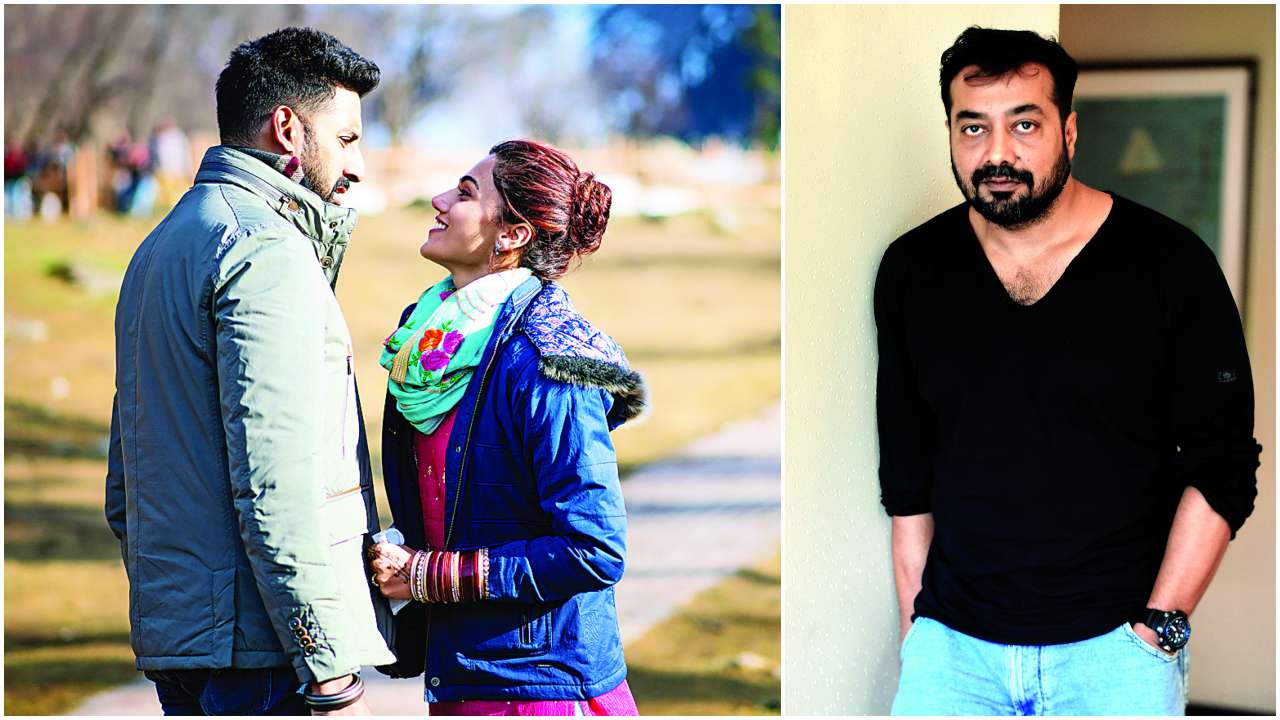
Rinky Kumar (DNA; September 4, 2018)
Anurag Kashyap is probably in one of the best phases of his career. His web series Sacred Games as well as one of the shorts, which he has helmed as part of the anthology Lust Stories, have got positive reviews. His performance as the antagonist in the recent Tamil thriller Imaikkaa Nodigal has been appreciated. The 45-year-old’s last directorial stint Mukkabaaz (2017) struck a chord with the audience for showcasing the trials and tribulations of a sportsman, who dares to take on the system. Now, the maverick filmmaker is gearing up for the release of his forthcoming movie Manmarziyaan, starring Abhishek Bachchan, Taapsee Pannu and Vicky Kaushal. As we settle down for a chat, Anurag says, “My Tamil film is getting good reviews. I’m only getting acting offers.”
However, in the same breath he adds, “I hate acting. I only want to direct. Someone had once told me, ‘Anurag, tu acting karega na, toh tu aur tera producer dono paise kamayenge. Tu direct karta hain, phir bhi paise nahin kamata.’ On that note, we begin our conversation and he tells us how cinema gives him a better perspective about life and why, in reality, he is a far cry from the aggressive filmmaker that he is made out to be. Excerpts…
What appealed to you about Manmarziyaan?
The character of Rumi played by Taapsee Pannu. We like love stories and aspire to have one in our lives. But I don’t believe most of that. Manmarziyaan is something that I believe in because it shows how people behave in love and how indecisive they are.
So, what’s your idea of romance?
The most amazing thing is the quest for it. Love isn’t there, we romance the idea of it. And everything else is included in that journey.
Dev D, which released in 2009, was a romantic musical. Your forthcoming film is also being termed as one. So, was it like homecoming for you?
Both the movies are different from each other. If I would say in filmmaker Neeraj Ghaywan’s words, ‘That was Dev’s story, this is Paro’s story.’ But I think it’s more than that. I don’t like to define things. We simplify things for ourselves by putting them in words that are understandable. I like things to be complex. And I would want people to talk about it rather than define it in one word.
All the characters in your films are quite angst-ridden. Do they come from a deeply personal space?
It’s not like that. I make crime films but that doesn’t mean I commit crime. I’m actually a peaceful person. I’m more peaceful as compared to other people who make lovely movies.
This is your second collaboration with Aanand L Rai after Mukkabaaz. How was the experience as both of you have different sensibilities?
It’s been good. I wanted to make Mukkabaaz, he wanted to make Manmarziyaan. We read each other’s scripts and decided let’s do both. As for our sensibilities, I never think about them. I connect with Aanand and always tell him whether I like his films or not. Aanand L Rai has been appreciative of my work. I enjoy a massive support system in the industry among the directors. I feel fearless while making my films because I know that tomorrow if no studio or producer will stand by me, the directors will. I get a great sense of security from Aanand. I know I will be allowed to be myself as a creative person while working with him because he gives me immense breathing space. And that gives me a lot more confidence to explore things because Manmarziyaan was his idea. Kanika Dhillon wrote it, it went to two sets of people before it came to me. I was clear that I would give it my own sensibility and interpretation. So, I changed the cast first and then the music.
Music plays a pivotal role in almost all your films…
My love for music comes from my inability to play it. You always desire what you don’t have. In the pursuit of becoming a Tansen, I became a Kansen (laughs). My thinking is that if you keep saying ‘no’ to what you don’t like, you are eventually left with what you like. That’s my process.
You also tend to improvise a lot on the sets…
I can’t deal with actors who come too prepared. They have to be in the moment. It’s not their job to keep in mind the graph of their characters.
Do you think it enhances their performance?
I don’t know, but that’s the way I work. I just want them to be believable. I want to do what I believe in, if I don’t, then it’s pointless.
In one of his interviews, Aanand mentioned that while working on this film, he felt you were much calmer...
Aanand knows me because we would meet at public events. He knew me as a filmmaker through my movies, blogs and interviews. I’ve been the same person all my life. Even when I made darker films, I was still the same person. Anyone who works with me for the first time is initially shocked because it’s the perception of me that has been with them.
On the first day of shoot, even Abhishek Bachchan was surprised to see you jumping and dancing on the set…
I was a writer for Yuva (2004). So, he and I didn’t interact much. I’ve always been an aloof person. I don’t get out of my room except when I’ve to work. But if you talk to people with whom I have worked on the first film, they will tell you I dance on the set, I never scream. Abhishek told me, ‘I expected you to sit in a corner with light falling on your brooding face’ and I told him, ‘I don’t brood.’ When I do, no one sees me because I am in my room. People have a perception of me that has been built by the media. I’m happy in my own space. Everyone thinks I’m super aggressive as I say things bluntly.
But you didn’t love his performance in Yuva..
I wrote in my blog that it could have been better. And I think Abhishek took it hard because that was a performance that everyone appreciated. He thought a writer usually doesn’t say such things. We didn’t talk to each other for 10-15 years.
So, how was it working with him now?
It was lovely; today, we have become good friends. You know when you work with someone, you think they have got your back. I felt the same with him.
You didn’t have reservations before collaborating with him?
I had reservations before I met him. But once I did, they disappeared.
What is it that drives you about cinema?
The possibility of exploring things and telling stories, baaki kuch nahin (smiles). I articulate through cinema. It’s also my process of understanding things. When I am going through something in life or something is affecting me, I put it in my film and figure out what it means in the process.
Do you enjoy acting?
Not at all…
But you usually get good reviews for your performances…
That’s because I’m a good actor. However, I like acting on stage. Recently, I met Makarand Deshpande who has directed me in his plays and he asked me, ‘Why don’t you act?’ I told him I like to do so on stage as theatre is an actor’s medium, but cinema is a filmmaker’s medium. I’m very selfish, I want it to be my medium.
How do you look back at your journey as a filmmaker?
I’m very happy. I’ve had 25 good years of filmmaking. I’ve done more than 100 films as a writer, director, producer. I came here to make one movie.
Will we ever see you helm a commercial potboiler?
Manmarziyaan is my take on a potboiler.
Subscribe to:
Posts (Atom)