Showing posts with label Anuparna Roy. Show all posts
Showing posts with label Anuparna Roy. Show all posts
Anuparna Roy clarifies Songs Of Forgotten Trees is not banned in India
10:53 AM
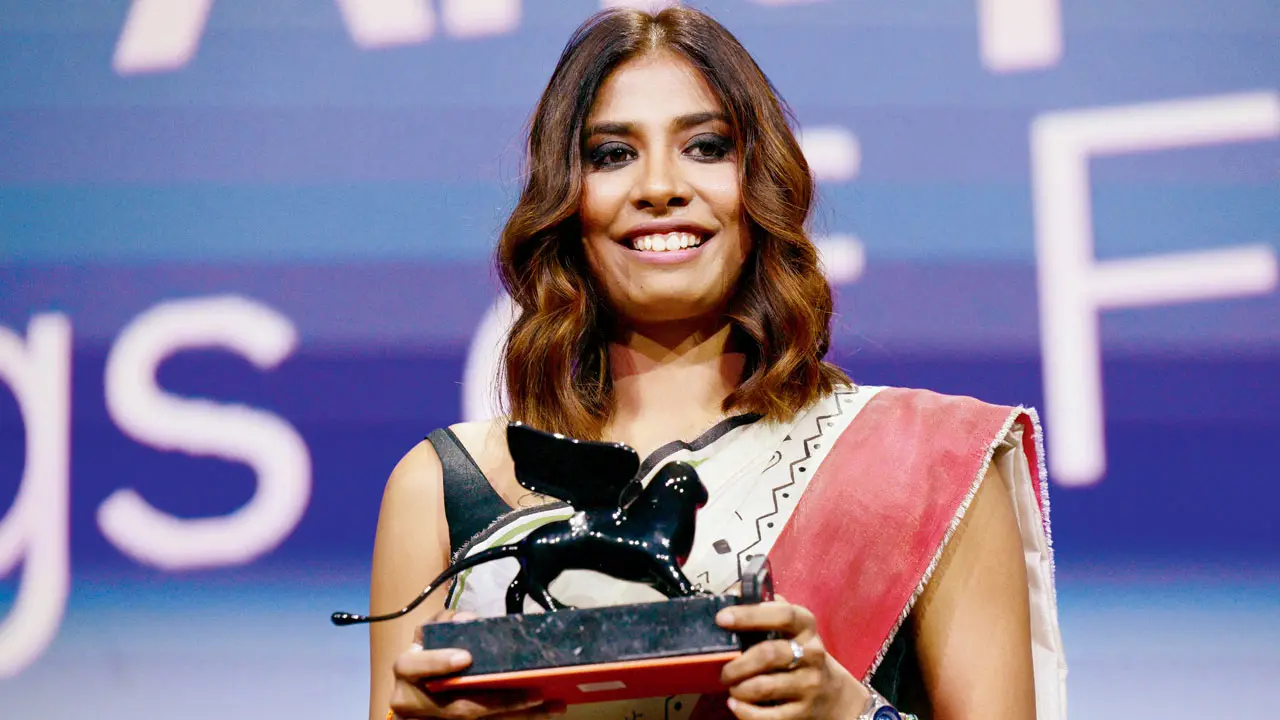
Priyanka Sharma (MID-DAY; September 13, 2026)
A day after reports claimed that Anuparna Roy’s acclaimed drama Songs Of Forgotten Trees had been blocked in India, the filmmaker has set the record straight. Speaking to mid-day from Venice, Roy said the Central Board of Film Certification (CBFC) is working towards clearing the film for a domestic release.
“I am hopeful for the constitution of India, the Indian government, as well as the censor board. I am sure they are working their best to get our film out,” said Roy.
The filmmaker’s second feature, Lovers In The Blue Night, premièred at the Venice Film Festival on September 11.
Roy also took to Instagram to clarify reports that Songs Of Forgotten Trees had been banned in India. She wrote on her Instagram Story, “I think there has been some misunderstanding about my words as English is not my primary language. I wish to clarify that my film is not banned or blocked in India.”
Songs Of Forgotten Trees premièred at the 2025 Venice Film Festival, where Roy won the Orizzonti Award for Best Director for it. “My film stands for love, bonding, and humanity between two migrants,” she added. Since then, the film has travelled to several international and Indian festivals and now awaits its domestic release.
What is ‘Songs Of Forgotten Trees’ about?
Starring Naaz Shaikh and Sumi Baghel, the film follows two women whose lives become intertwined in Mumbai
"She sold her TV to make a film": How Purulia girl Anuparna Roy became Venice winner
3:56 PM

From her grandmother’s tales to her own childhood memories, Anuparna Roy shapes deeply personal narratives into films with global resonance
Sneha Bhura (THE TIMES OF INDIA; September 14, 2025)
When filmmaker Anuparna Roy was a child, she listened wide-eyed as her grandmother spoke dreamily of a river. Her maternal grandmother, married at nine to a man in his 30s in Purulia district of West Bengal, often told her stories about the river's pure, beautiful water. "I always thought she must have seen this river, but after she died, I came to know that she actually never did. Only her dead body was taken to a riverbank," says Roy, 31, on a Zoom call from Mumbai, two days after she returned - triumphant and tired - from the 82nd Venice Film Festival. There, she became the first Indian to win the Best Director Award in the Orizzonti (Horizons) section, joining a prestigious list of acclaimed auteurs.
Those stories shaped Roy's 2023 debut short film 'Run To The River', which is based on her grandmother's life in British-era Bengal. "The protagonist is a Dalit girl married to a revolutionary freedom fighter. But even though he was fighting for his country's freedom, he failed to provide freedom to his wife," she says. This weaving of family memory with larger social and political contradictions defines Roy's cinema. Her Venice win came with her debut feature 'Songs Of Forgotten Trees' (SOFT), which follows two migrant women in Mumbai - a part-time sex worker and a call-center employee - who begin as strangers sharing a room, but slowly forge a quiet kinship.
Born to a coal-sector worker and a homemaker, Roy is now celebrated as a grassroots-to-grandeur story, rising from a Purulia village to an internationally recognized filmmaker. Without film school training, she juggled IT and call centre jobs to fund her films. Yet she is wary of the "struggle" narrative. "I was doing jobs to support myself and my family. To talk about liberation in my films, I first had to liberate myself economically," she says.
Her remote IT job even helped during the shoot of SOFT: "It was work from home. I would log in and then go off to shoot. I even received a message from my ex-manager saying he was proud of me. It was generous of him not to mention the kind of activities I used to do while 'working.' I was pathetic at that job!" she laughs.
Roy's work is driven by memories of survival and discrimination in rural India. Her latest film references a childhood friend, Jhuma Nath, whom her father forbade her to meet because she was Dalit. Married at 13, Jhuma left a deep impression on Roy. Other moments of gender bias also stayed with her - from girls being given rice in school when boys got books, to being told to cover her nose while passing a tribal village. Her grandmother's story also inspired the female kinship angle in SOFT.
"My grandmother, when she entered her marital home at nine, had a stepdaughter of the same age. The two bonded well, and after my grandfather died, these two women ran the family together. One earned, the other cooked and cared for four daughters. I began to imagine why they couldn't also fall in love with each other. That idea became the foundation of the film," Roy explains.
Literature was her early training ground: James Joyce and Bibhutibhushan Bandyopadhyay influenced her while she studied English (Hons) in Asansol. Her 21-year-old cousin Adrija, who took up the same subject because of her 'dear didi' recalls, "She struggled so much, sold her belongings, exhausted all her energy and money. She even sold her TV while making her short film." Producer Bibhanshu Rai describes her as "stubborn and persistent," crediting her resourcefulness in bringing SOFT to completion.
Roy is part of the new wave of Indian cinema centering women's agency and sisterhood, alongside names like Payal Kapadia. "My next project will return to my grandmother's story, where the freedom struggle plays out alongside the bond between my grandmother and her stepdaughter," she says.
As for advice to young, independent filmmakers from small towns, she offers a note of encouragement: "Those who are writing a script and are not able to finish it, or not able to find a producer, they are already filmmakers for me. They're trying to make something, and I know they will because they'll always find a way."
If I support Palestine, it doesn’t make me less Indian-Anuparna Roy
8:58 AM
BOMBAY TIMES (September 14, 2025)
Anuparna Roy scripted history by winning the Orizzonti Award for Best Director at the Venice Film Festival for her film, Songs Of Forgotten Trees.
In her acceptance speech, Anuparna said, “Every child deserves peace, freedom, liberation and Palestinians are no exception... it’s a responsibility at the moment to stand by Palestine....”
Her speech drew strong reactions across the country. Speaking to ANI, the filmmaker voiced her strong stance against “injustice.”
She said, “I meant whatever I said at the festival. It was said with the intention of pointing out injustice around the world. If I support Palestine, if I am standing against injustice, it doesn’t make me less Indian. People are thinking that I have spoken about it for the first time, but it’s not that. I mentioned Palestine while receiving an award in Russia. This doesn’t mean that I will not talk about the genocides or the violence in Nepal.”
Anuparna revealed that Anurag Kashyap had advised her to avoid Palestine-related comments at the event. “People are claiming that I made the comments under the influence of Anurag Kashyap, but I was strictly advised by my producers, my mentor, and Anurag himself that I don’t need to talk about it. I went beyond their advice and said it all,” she said, adding, “I will continue to speak against injustice. I believe such things should come into discussion, whether it is Kashmir, Murshidabad or Gujarat.”
------------------------------------------------
Priyanka Sharma (MID-DAY; September 12, 2025)
Pride and celebration should fill Anuparna Roy’s days, who made history on September 7 as she became the first Indian to win the Best Director award in the Orizzonti section of the Venice International Film Festival. But it takes very little for things to spiral. When we got on a call with Roy on Thursday morning, the director was amused at how her historic win had taken a backseat to her acceptance speech in which she expressed solidarity with Palestine.
“I stand by my words,” she asserted before expressing her disappointment with the ongoing public discourse. “People speculated that I am less Indian and less Hindu [because of my remark]. Some feel I’m trying to get fame out of this speech. I’m talking about justice! As a global citizen, I have to. I have to talk about what is happening in Nepal also. Secondly, I’ve been talking about Palestine since my first film. I stood in Russia and said that I am with Palestine. That doesn’t make me less of an Indian.”
Has this episode scared her about speaking her mind going forward? Not at all, Roy said. “I’m receiving threats now. Now the focus has shifted from the film and the award to my speech. But I’m also receiving positive messages. I’m not famous enough to get triggered by this,” said Roy, who thinks of herself as a “student of cinema” more than anything else.
At this point, she is easily among the most promising students of cinema around. Her debut feature, Songs of Forgotten Trees, tells the story of two women forming a companionship as they navigate their lives in Mumbai. To bring her indie film to life, she began by approaching producer Ranjan Singh. “When I started writing the script, I decided I wanted Ranjan sir [to back it] and he would take me to Anurag [Kashyap]. Vikas Kumar, Sharib Khan, Romil Modi, Bibhanshu Rai, and Naveen Shetty joined in. I want to name them because these seven men have supported a woman-centric film.”
That Kashyap believed in her project was a big personal win as it turned her father, who was skeptical of her profession, into a cheerleader. “My father loves Anurag Kashyap more than me. He approved my profession when I sent him a picture of Anurag sir backing my film. On seeing that, he said, ‘Now you can win the world.’ This morning, he told me, ‘Follow Anurag Kashyap’s advice. Don’t say anything to the media’.”
A first: Indian director Anuparna Roy bags top directing award at Venice Film Festival
9:19 AM
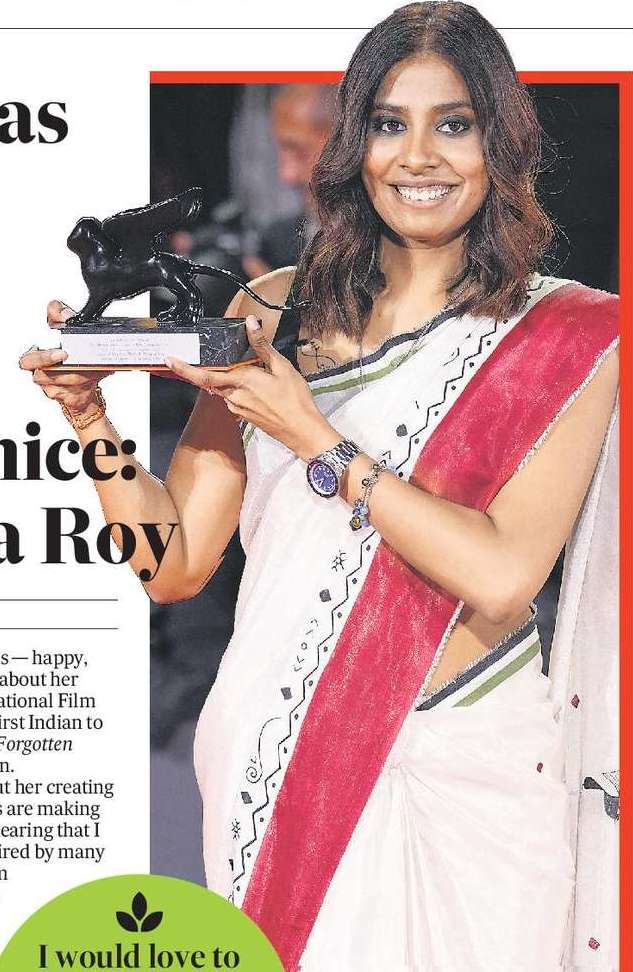
Priyanka Dasgupta (THE TIMES OF INDIA; September 8, 2025)
Kolkata: She grew up with rice rations instead of books in rural Bengal. Lost her childhood friend to marriage at 13. Debutant filmmaker Anuparna Roy drew from life to stun the 82nd Venice Film Festival by winning the Best Director award Saturday - and used the moment to plead for war-torn Gaza's children, reports Priyanka Dasgupta.
Roy, 35, became the first Indian filmmaker to win in the Orizzonti section with her debut 'Songs Of Forgotten Trees', outpacing 18 rivals. On stage, she let her victory speech take a political detour. "Every child deserves peace, freedom and liberation, and Palestine is no exception," she said in her acceptance speech. "I might upset my country, but it doesn't matter anymore."
On phone from Venice, Roy said she didn't realize she was making history when she spoke. "It is a global crisis when a powerful nation like Israel destroys justice, peace and lives. As a global citizen, I had a microphone and couldn't restrain myself," she said.
They once asked if their daughter could ever measure up to Satyajit Ray. On Sunday, Brahmananda and Manisha Roy were celebrating Anuparna Roy's Best Director award at the 82nd Venice Film Festival's Orizzonti section for her debut feature Songs of Forgotten Trees. Roy's win came decades after Ray's Aparajito won the Golden Lion at Venice in 1957. Orizzonti runs parallel to the festival's main competition.
A year ago, the middle-class couple from Kulti in Paschim Bardhaman district, 230km northwest off Kolkata, worried when their daughter quit her job to make her first feature. "We sent her to a modest village school, had no knowledge of films. We only enjoyed Uttam Kumar, Suchitra Sen, hit songs like Ei poth jodi na sesh hoy," Brahmananda said.
Brahmananda, a retired Eastern Coalfield Limited employee, lives in a flat in Kulti with Manisha. Word of their daughter's Venice triumph has already reached their ancestral village in Narayanpur. "We are waiting for her to come home so we can visit together," he said.
The father had challenged her obsession with cinema and feared for her marriage prospects. "She insisted marriage could wait. Now, after her victory and all the accolades, we feel proud," Manisha said.
She remembered her husband once asked their daughter if she thought she could hold a lamp to Ray. Anuparna had one request: give her a chance. Today, her mother has only one wish - to cook her daughter's favourite dishes when she returns.
Crew members echoed the pride. Sakyadeb Chowdhury, SRFTI alumnus and second-unit DOP with her in Venice, credited her "courage to show things as they are". He said she insisted on long takes, no cut-ins, and turned limitations into new aesthetics. "I hope her win inspires other filmmakers," he said.
--------------------------------------
Rishabh Suri (HINDUSTAN TIMES; September 8, 2025)
Anuparna Roy is a mix of emotions — happy, tired, and content — as she talks about her historic win at the Venice International Film Festival, where she became the first Indian to bag the Best Director award for Songs of Forgotten Trees in the Orizzonti Competition section.
With everyone around telling her about her creating history, she tells us, “All these statements are making me humble. I cannot lie back and enjoy hearing that I have created history. Come on! I am inspired by many other and better women filmmakers from within and outside India. It’s not just me; it’s cinema which has created history again. I would love to give the award to cinema, and my love for it.”
Songs of Forgotten Trees was the only Indian selection in the Orizzonti Competition section this year. As she accepted the award at the festival, Anuparna reveals that her mind was on her own journey and the responsibility that comes with recognition. “I remembered how Anurag (Kashyap, presenter) phrased it to me, that winning an award is not just bringing reputation but also responsibility… to make better films and better craft, even when you are uncomfortable,” she says.
She tells us that she dedicates this award to “all the beautiful women out there” and to her hometown, Purulia, in West Bengal. She says, “I have seen the women’s lives there. If any of them, after seeing this, can raise their voices, it would be great. It will be sufficient for me to keep myself motivated.”
Sharing further, Anuparna says that making a film centred on women and their intimacy, with full support from an all-male team, was deeply affirming. “It was definitely tough, but the kind of backing I received set an example for the world. Gender is literally secondary,” she says, adding, “My whole film was backed by men, and then Anurag sir was a bonus. For a film talking about friendship, outside the film too, the team members were friends and close. This is huge.”
Subscribe to:
Posts (Atom)