Showing posts with label Ankur Tewari interview. Show all posts
Showing posts with label Ankur Tewari interview. Show all posts
We have 16 songs in The Archies, some of which are as short as 20 seconds-Ankur Tewari
9:46 AM
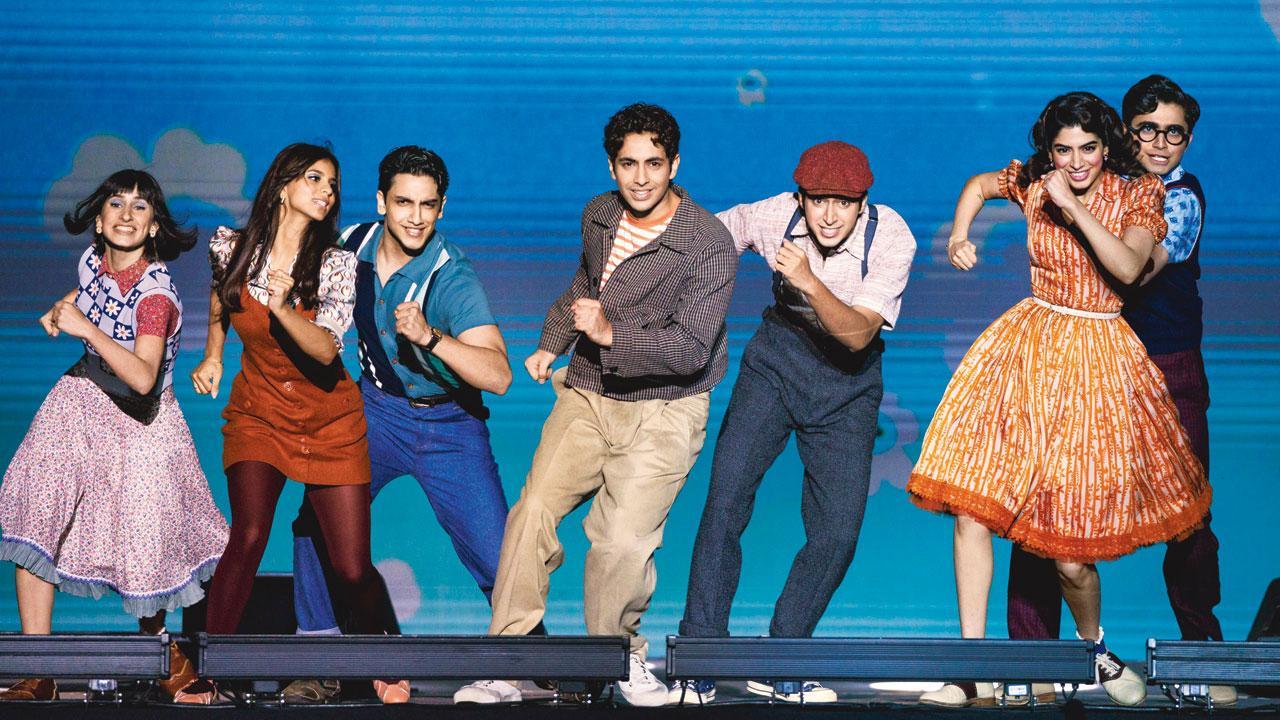
The Archies sound engineer and supervisor Ankur Tewari explains how he hopes to keep viewers entertained as they gear up for his 16-song musical
Sonia Lulla (MID-DAY; October 23, 2023)
The transitive property in mathematics states that if a equals b, and b equals c, then a equals c. In cinema though, we wonder if this equality would be challenged. Zoya Akhtar never makes a bad film; musicals rarely work in Bollywood; Zoya Akhtar is making a musical. Given Akhtar’s past streak, and the fact that The Archies is set to serve as the launch pad for the kids of the industry’s biggest stars, it’s safe to suppose that the film would be delightful. How accurately though, does it fit into the defined template of a musical? Entirely, promises sound engineer Ankur Tewari.
“We have 16 songs, some of which are as short as 20 seconds. A piece of poetry, or music, takes the story forward, and the idea was to do it in a way such that the viewer doesn’t notice that a song has begun. It needed to be done, organically, as though the audience was seamlessly flowing into and out of the dialogues and the songs. It needed to feel as natural as simply watching a scene, which is why we used music as a texture. We wanted to keep viewers on their toes—excited, and indulgent. We wanted to tease and flirt, but not overindulge. It’s interesting to see how Zoya has used the music.”
Previous successful collaborations would have, perhaps, contributed to their equation, with Tewari—who also supervised the music of Akhtar’s hit, Gully Boy—referring to the filmmaker as a friend who he “continues to learn from”.
Tewari was elated to be associated with the project for more reasons than one. Apart from the fact that he had grown up with an appetite for The Archies comics—which have inspired this film—he would get the chance to explore the soundscape of the ’60s, the “golden period of music”.
“Because it is set in the ’60s, I dug into a few books and did some research. Since it was not set in [this day and age], we recorded every bit of the album, live, including the guitars, drums, horns, vocals, and harmonica. The idea was to record as if we were doing so in the ’60s. Even when we were choosing the mics and the hardware to record on, we picked those that would not make the music sound new-age. At the same time, we created a balance so as to ensure it doesn’t sound dated. Live-recording is a different discipline. One needs more practice, and rehearsal, because [all the artistes] play together. Even though some may find it cumbersome, you find yourself at an advantage when you play off [another artiste’s rendition].”
While the film’s soundtrack was composed by Shankar-Ehsaan-Loy, Tewari also doubled up as the composer of the number, Sunoh. With the film set in an “Anglo-Indian hill station”, Tewari had to immerse himself in research work before creating the sounds.
“The screenplay is extremely breezy. [Surfing through every page], we could come up with a gazillion ideas on what we could do with the music. It is reminiscent of simpler times. So, we knew that a lot of rock and roll, and jazz would be used. That’s where we were headed, as far as the sonic palette was concerned. We wanted it to reflect the energy of the kids, and the exuberance of youth. Also, because it is Anglo-Indian, we knew it would be nice to have English in it. So, apart from taking it to Javed sir [Akhtar], we got [musician] Dot involved for the English lyrics. It was amazing to see somebody as seasoned as Javed sir sitting with Dot, who is like a new kid on the block.”

Our initial approach was a bit younger, but the characters in Gehraiyaan were more complex-Ankur Tewari
9:16 AM

Kicking off the new year with what promises to be a great musical score, Gehraiyaan sound designer Ankur Tewari on the Deepika starrer
Sonia Lulla (MID-DAY; January 3, 2022)
Raise your hands if you, like us, had a second look at the trailer of Shakun Batra’s Gehraiyaan only to listen to its balletic music, again. Sound designer Ankur Tewari — responsible for monitoring the score and soundtrack artistes for the making of a cohesive theme — discusses breathing life into the Deepika Padukone, Ananya Panday, and Siddhant Chaturvedi starrer.
Edited excerpts from the interview:
What was your initial discussion with Shakun about the film’s music?
We were sure that the music should not be mainstream. A lot of films on infidelity have been made, and they have had a certain kind of sound attached to them. We wanted to approach this with a new sound. Having said that, we first paid heed to what the script was saying. The film is about a group of young people who are going through a transactional relationship, when it come to love. We thought about the kind of music that these guys would listen to. All the songs in the film are in terms of a score. None has been [lip-synced] to. We thought about the music that would be in their playlist, and then dug deeper into each character.
Did you ask the actors what they listened to?
No. But I got sneaky. I started noticing their Instagram pages — songs they were posting about, or sharing on stories. Since I have worked with Siddhant in Gully Boy, I know the kind of music he listens to. I was also thinking about the characters. This film is very strong, even on paper. So when you have access to a script where the character is so well defined, it’s easy to work accordingly. Kabir and Savera are two musicians who have worked on the score to give it a distinct sound. Their music is precisely the kind that these characters would consume.
When you have such a fine understanding of creating music best suited for a script, how do you navigate filmmakers’ demands to create a commercial score even if the story doesn’t require it?
Unlike in the indie space, where you write as you desire, in films, every one is catering to the script. You are committed to that. Different scripts have different needs, and some of them need a commercial treatment. If that is not done, then what is the difference between your approach towards an independent song and film music. Each sound-scape has a different colour, and that can be niche, mainstream or an entirely new genre. In this film, for instance, a lot of the [music] is inspired by French [music]. The song needs to pull you further into the film; not pull you out of it with a sound that doesn’t fit.
How often do you end up changing your work after seeing the first cut?
When I saw the rough cut, I noticed that there were places where we were going off, especially, as far as Deepika’s performance is concerned. She is such a powerful performer. Also, actors put a lot of work into understanding the characters. So when you learn of a character on paper, and then see how the actor has pulled it off, you start understanding their perspective. I had to move away from the music and lyrics that I [had etched in my mind]. The brief that I gave Kausar [Munir, lyricist], before I saw the rough draft was different from the one I gave her after it. Our initial approach was a bit younger, but the characters were more complex. We had to tweak it to suit that.
Subscribe to:
Posts (Atom)