Showing posts with label Anjum Rajabali. Show all posts
Showing posts with label Anjum Rajabali. Show all posts
Whose script is it, Anyway? Writers question credit and compensation
2:57 PM
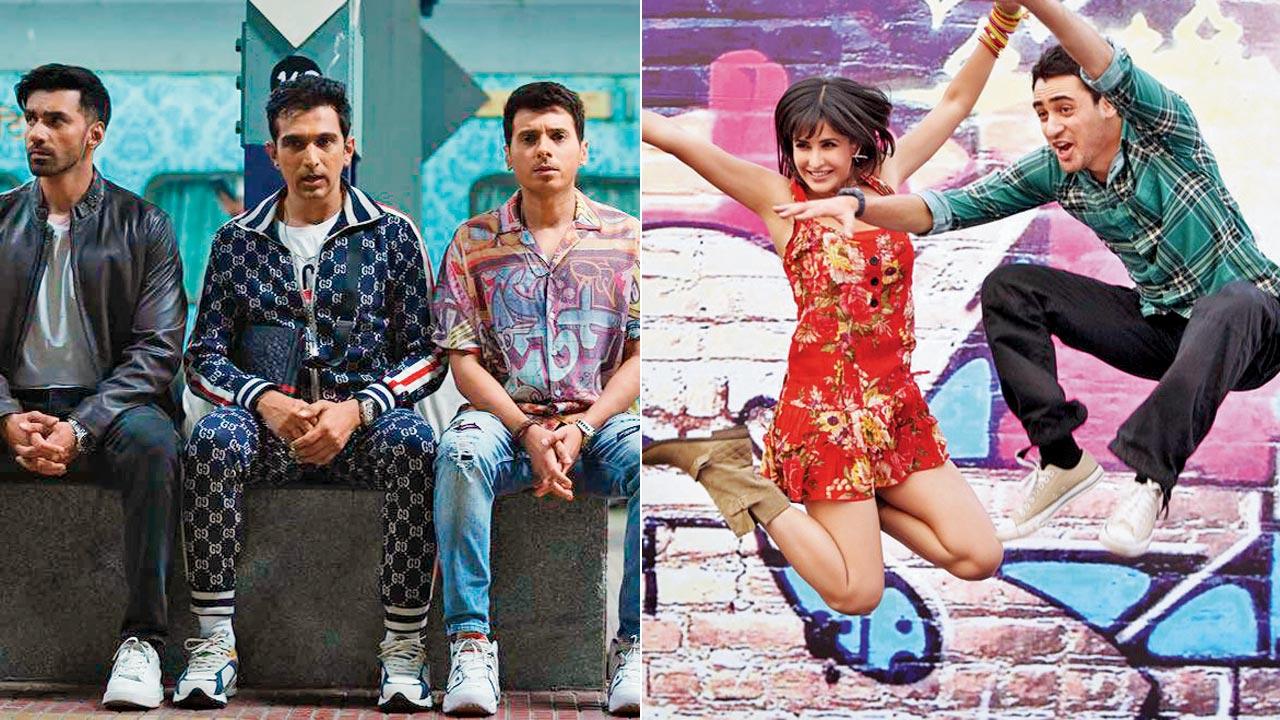
A still from Madgaon Express, which was Kunal Khemu’s first writing credit for screenplay; (right) YRF’s Mere Brother Ki Dulhan launched writer Ali Abbas Zafar
A film production house posted a call for submissions recently, but an eyebrow-raising clause has brought up the question of screenwriters’ credit and payment. It’s an age-old battle, but how should new writers navigate the system?
Junisha Dama (MID-DAY; October 19, 2025)
It was an announcement from Yash Raj Films, asking writers to send in scripts to their submission portal. Innocuous enough, until a clause screenshot from the YRF website found its way to social media, with a post titled “This is wrong on so many levels.” Soon enough, WhatsApp groups were buzzing, setting off alarm bells among film enthusiasts.
The clause reads as if it was from a dystopian contract: “Any submission, solicited or unsolicited, shall become the property of the production house unless there’s a prior written agreement, and may be exploited in any way at YRF’s sole discretion.” The fine print went on to state that those submitting their work would not be entitled to “any compensation, credit, or notice”.
What made the post blow up was its reference to YRF’s announcement just days earlier of the submission portal, “Script Cell”.
We reached out to YRF for a clarification; however, they only issued a public statement claiming that the viral clause was not part of its Script Cell terms but from a separate disclaimer (now removed) on their website.
However, screenwriters say such clauses are not unheard of. Contracts often support producers more than the writers. Independent screenwriter Sailesh Ramaswamy lists some examples, including the credit clause, which gives credit as per the producer’s or platform’s (in the case of OTTs) discretion. “Earlier, we used to be able to push back. Back in 2019, 2018, and 2020, I signed contracts where I had put in clauses that my name would be on the poster. We have regressed from there,” he says.
The second big thing, Ramaswamy says, is the shift in the payment structure. Contracts are now being structured to pay writers only 40 to 50 per cent for the final draft, and the rest in parts. Ramaswamy adds, “At times, if the writer has insisted on a buyback clause, successful producers want writers to buy it back at 40-50 per cent more than the price that they paid you for writing it.” In many contracts, payments are also tied to draft approvals: 20 per cent on the first draft, another 20 per cent on the second, and so on.
While Ramaswamy has more examples that even established writers struggle with, we wonder if it is even logical to submit scripts via a portal.
How do new writers, looking to get their foot in the door, even navigate this system? “I feel that script submissions done without knowing the person to whom you are submitting are not that useful,” says Sudeep Nigam, screenwriter and creator.
Instead, Nigam recommends pitch festivals, like the one organized by the Screenwriters Association (SWA), as better platforms to bring new scripts forward.
In the real world, where young writers have little to no bargaining power, you can’t depend only on luck. “Over the last five years there has been a lot of chatter around writers’ rights, and we want to push that discourse forward. The Writers Guild of America (WGA) strike in 2023 gave us a lot of momentum. It’s still not equitable, it’s still not great bargaining power. But at least there is chatter and there is fight,” says Nigam.
But why is credit and compensation even a question? Anu Singh Choudhary, a screenwriter who has recently transitioned to being a director and producer, says that the Copyright Act in India is strong, but it gets murky as “filmmaking is such a collaborative idea”. “At what point is a director’s voice or a producer’s voice giving input? When you have submitted your script and then they come back with feedback or “notes” and they are making it supposedly their own, does that make the material theirs? Therefore, I feel a basic minimum contract is important to have. We are only fighting for that,” she says.
The SWA, for some time now, has been working on standardizing writers’ contracts that cover fair compensation and credit with a Minimum Basic Contract (MBC). “The ecosystem is changing, and there is pushback now. Therefore, my advice to young writers is that before they sit at the negotiating table, they should be ready to walk away,” says Anjum Rajabali, a veteran screenwriter and senior activist of the Screenwriters Association.
Despite tug-and-pull, the MBC has made progress, but as Rajabali says, the contract will ensure “more vulnerable writers are protected.”
In the meantime, what can writers do at an individual level? Riya Rajkumar Sharma, counsel at AM Sports Law and Management Co, who handles gaming, media, and entertainment law, explains: “When writers submit a script on a portal, they often consent to its exploitation in line with the portal’s terms and conditions. If they’re not careful, they may inadvertently surrender all ownership and rights, including derivative rights [ie, the right to create new works based on their original material]. Moreover, when writers share their ideas through such portals, they usually have little to no bargaining power. It is therefore crucial to understand the implications of any submission. Everyone should carefully read all terms and conditions before uploading or sharing their original work on any platform.”
Sharma further clarifies that there is no intellectual property in an idea itself. “What I mean is that an idea, by itself, is merely a concept. It gains protection only when expressed in a tangible form, for example, as a written script or a painting. The intellectual property rights lie in that expression, not in the idea alone,” she adds.
Nigam also emphasizes the need for writers to speak up, instead of simply complaining about it on social media. “The more they speak up, the better it is for the entire ecosystem to not allow for this to happen. Most writers are fearful, and that’s where the problem lies. At SWA, we have a dispute settlement committee, which is specially designed just to do this. We handle over 500 cases in a year, and we have the capacity to handle even more,” he says.
Would it then help if copyright and IP law were taught as a module in film schools? It would, says Anu, adding, “Also, the art of negotiation. We can all benefit from this and learn not just our rights, but also a producer or studio’s perspective.”
Naturally, coming together as a community is crucial to this cause. Anu says that young writers should constantly check with each other on what kinds of terms and conditions one is agreeing upon. She says that trusted whisper networks do exist, and writers usually compare notes and red flags before signing projects. There is a flipside, though.
“Unfortunately, there is such tough competition and such little work that we end up taking these exploitative contracts only because everybody needs work,” she says, adding that “the responsibility of advocacy at various levels then falls on senior writers, which means constantly talking and creating awareness. And if there are red flags, let the community know. Be, in that sense, champion of the other writers. All this while, this ecosystem has really thrived on a lack of unity between the writers.”
Rajabali echoes this, “If writers stand united… collective bargaining is very strong.”
50th anniversary special: "Gabbar Singh is bad because he enjoys being bad"
3:05 PM
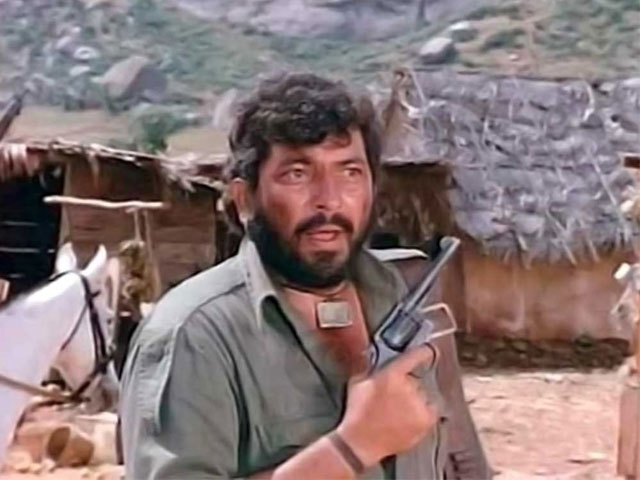
A ‘terrifyingly real’ villain without a tragic backstory or an apology – just a daaku who enjoyed being bad. This unadulterated evil, coming from a man with an un-villain-like personality and voice, is what made Gabbar an enduring pop-culture phenomenon – that’s what screenwriters now believe
Niharika Lal (BOMBAY TIMES; August 15, 2025)
Ruthless dacoits had been on the screen before Sholay, but Amjad Khan’s Gabbar Singh turned the stocky villain into a pop culture phenomenon. Such was the charming menace of Gabbar that he not only became an unlikely ‘hero’ of the film but effectively created a preand-post-Gabbar era.
‘GABBAR WAS TERRIFYING AND ODDLY CHARISMATIC’
“Villains in Indian cinema history can be divided into Gabbar BC and Gabbar AD,” says film historian Gautam Chintamani, adding, “Until Sholay , most dacoit characters followed a formula – exaggerated menace and theatrical delivery. Gabbar changed all that. In earlier films, like Mother India (1957), Ganga Jumna (1961), or Mujhe Jeene Do (1963), the dacoit was either tragic or a menace. Gabbar was realistic, terrifying, and oddly charismatic.”
However, Amjad Khan wasn’t the first choice, Danny Denzongpa was initially cast. But the latter was shooting Dharmatma in Afghanistan and had to step away. Khan, once on board, read extensively about Chambal’s dacoits, including Abhishapta Chambal – written by Jaya Bachchan’s father, Tarun Kumar Bhaduri – to make Gabbar authentic, not a caricature. Before the release, some doubted his soft voice and even suggested dubbing. But Ramesh Sippy refused. “Thankfully, the original voice stayed,” recalls Chintamani, “and those dialogues became some of the most iconic ones in Hindi cinema.”
Gabbar’s entry, too, is masterfully delayed – viewers only hear of him in fearful whispers for nearly an hour before he appears.
‘GABBAR WAS A PSYCHO LONE WARRIOR’
Gabbar became a synonym for fear says writer-director Hitesh Kevalya. “Unlike many villains before him who still feared the law or had a shred of accountability, Gabbar was a psycho lone warrior – no parents, no family, no moral compass. Kaanoon ke haath bahut lambe hote hain, but Gabbar chopped off Thakur’s arms, signalling he was above the law,” he adds.
Writer Saurav Dey feels it is Gabbar’s unapologetic evilness that makes him believable. “You’re not traumatized by the villain’s villainy, because it has that “oh, this could never really happen” feel. Even his most brutal acts, like chopping Thakur’s hands, entertain because you know retribution will follow. And unlike most villains, he doesn’t have a tragic backstory or an apology. He’s bad because he enjoys being bad and that freed the writers from inventing reasons for why bad has to be bad.”
Meanwhile, writer Deepak Kingrani credits Gabbar’s dialogues for his staying power. “After Sholay released, his lines were repeated in every household. Even today, people know them word for word. Villain jitna hum bada banate hain, hero utna hi bada hota hai.”
‘GABBAR’S SWAGGER MAKES HIM A ‘HERO’ IN A WAY’
In the film, Gabbar brags, “Yahan se 50 kos door gaon mein jab bachha raat ko rota hai, toh maa kehti hai – bete so ja, nahi toh Gabbar Singh aa jayega.” Dey notes, “Usually, it’s the heroes who are narcissistic; here, the villain has that swagger, which in a way makes Gabbar the hero of Sholay.”
For screenwriter Anjum Rajabali Gabbar’s “pure, unrepentant evil” with a stylish edge makes him memorable. “Villains like Ajit or Pran had a caricature-ish style, but Gabbar didn’t.” Rajabali believes Salim-Javed tapped into a universal truth: cruelty often stems from insecurity, and control comes from instilling fear. “Gabbar enjoyed his evil, he took pleasure in it.” He says that Gabbar’s character, who keeps saying ‘jo dar gaya samjho mar gaya’, also had a very human quality – fear.
'VILLAINS LIKE SHAKAAL OR MOGAMBO COULDN’T MATCH’
Before Sholay, villains were expected to be towering men with booming voices. But Gabbar defied stereotypes and proved that menace couldn’t be defined by just size or loud, threatening voices. “Amjad Khan was a man of average-build with a soft voice, yet he terrified audiences. His performance proved that menace can come from characterization, dialogue, and acting, not just physical presence. After Gabbar, casting became freer – a villain didn’t have to look like a giant to scare people,” says Dey.
When Sholay released, audiences kept returning to the theatres for rewatches, repeating Gabbar’s iconic dialogues loudly.
Chintamani says, “Villains who came after Gabbar, like Shakaal (Shaan), Mogambo (Mr. India), or Kancha Cheena (Agneepath) could never match his mix of realism and menace. Gabbar remains a pop culture icon because he was terrifyingly real and completely fresh in 1975 – and because audiences had no preconceived image of Amjad Khan. That shock factor still works today.”
There was a meeting at Aamir Khan’s house. It took 3 hours but producers agreed to the clauses-Anjum Rajabali
8:57 AM

In a historic moment, leading Bollywood producers and SWA have united to standardize writers’ contracts to ensure fair fee and due credits
Priyanka Sharma (MID-DAY; March 2, 2025)
Will things change?” every writer has repeatedly wondered and asked over years of being subjected to systemic disparity in the Hindi film industry. Finally, there is light at the end of the tunnel. Last week, prominent Bollywood voices spoke to mid-day about an urgent need for change in the working conditions of screenwriters. This week, writer Anjum Rajabali, the Senior Executive Committee Member of the Screen Writers Association (SWA), has the answer—change is coming.
Twelve leading Bollywood production houses, streamers and channels, including Aamir Khan Productions, Shah Rukh Khan’s Red Chillies Entertainment, Yash Raj Films, Siddharth Roy Kapur's Roy Kapur Films, T-Series, Maddock Films, Excel Entertainment, Applause Entertainment, Viacom, Tiger Baby, Amazon Prime and Sony Entertainment Television had met with the members of SWA last August to principally agree over the guiding principles on which writers’ contracts will be based.
“This is historic. For more than a decade, SWA has been trying to arrive at some kind of standardization of writers’ contracts so that those standard clauses are fair, reasonable and they don’t have to be renegotiated for every individual. There was a meeting at Aamir’s (Khan) house. It took over three hours but the producers agreed to the clauses,” Rajabali shares.
“I called Aamir, whom I have known for a long time now. I told him, ‘Writers’ contracts need to be made more reasonable, fair, and stopped from being one-sided’. Aamir, being sensitive to writers’ concerns, agreed to call a meeting with leading producers to help SWA resolve this grievance,” says Rajabali, who also wrote the 1998 blockbuster, Ghulam, in which Aamir played the lead.
The eight essential standard clauses agreed on address several long-standing issues faced by the writers—missing credits, irregular and unfair pay, moral rights to the script, indemnity, and stringent contracts.
“For writing or co-writing credit, 33 per cent of the shooting draft must be the writer’s work, with maximum three credits per element (story, screenplay, dialogue) to be accorded. When a writer-pair or a team works as one unit, their credits are counted as one. If more than 50 per cent of the shooting draft is a writer’s work, they receive top billing. More than 66 per cent, he or she will get solo credit. If it’s less than 33 per cent, ‘Additional’ credit for that element will be accorded to the writer,” explains Rajabali.
There is also a clause that the writing credits will appear in a film as one of the top three credits, along with director and producer, and in all publicity material. “Inadvertent failure to accord credit in the film will have to be instantly rectified via a press release, a copy of which should be handed to the writer/s and by re-inserting the credit/s in all digital and other versions,” says Rajabali.
Another essential principle agreed upon is that if a sexual harassment charge against a writer is proved, the credit will only appear in the film, not in the publicity material.
As far as the fee structure goes, Rs. 13 lakh has been decided as the minimum fee for a full script. “For story: Rs. 4 lakh, for screenplay: Rs. 5 lakh, for dialogue: Rs. 4 lakh. For the first and second drafts, tranches will be released on their submission. The final draft will be on the approval of the producer,” Rajabali says, adding that the first and the second drafts will be considered legitimate only if they adhere to the story and they incorporate the feedback given by the producer.
The next step for both the SWA and the producers is to translate the agreement into a legal language. “In principle, these producers have agreed to these clauses. There are certain checks and balances, and nuances that we have to be careful about. We have engaged a law firm to help us with the process. Now, in a week’s time, we intend to put the idea into motion,” Rajabali shares.
A standard agreement between the writers and the producers is not only the need of the hour for the former, but benefits the other side as well, Rajabali argues.
“Whatever we are asking is not just reasonable and fair, it is based on mutual concern. If writers aren’t stressed out or anxious or feel resentful about their contracts being one-sided, they can devote their efforts to creative work rather than hassling about these things, which only helps the writing process and a film overall."
The age of stolen stories is over; writers will finally own their worth-Anjum Rajabali
8:26 AM

Screenwriter Anjum Rajabali on his 11-year journey of bringing copyright society to life and giving writers their due
Mohar Basu (MID-DAY; January 5, 2025)
Intellectual property, which is basically creative work, has to be seen differently than any other form of property which is owned. Because what intellectual property does is that it adds a certain enrichment to society - be it painting, music, literature, cinema. This is why every society has worked out a way of incentivizing, encouraging, and protecting the work of creative people.
Now, one way of doing it is to ensure that their copyright is not violated, because this is something which has been created as an original by them. Any creation comes from deep within the artist. It is that when that work is exploited for further commerce, then they should be receiving their due share of that.
If you buy a painting, say by Tyeb Mehta, for 1 lakh rupees and 10 years later, maybe the price goes to 1 crore so you actually sell it further. Now, from that one crore that you're making, a royalty has to be ploughed back to Mehta or his heirs, which is, actually, the law. Because what you're doing is, from that person's original work, you are actually making an extra profit. From that profit, some due royalty has to go back. That is the whole definition of royalty. Likewise, the world over, when a film is shown on cinema screens in cinema halls, for that the contract is made with the writer. The sort of assignment fee has been paid to them but once it is exploited for further commerce, like outside of the cinema hall, when it goes into, a remake, or it's adapted into some other language, or if it is sold to a foreign country, or if it appears on another platform like television, or any of the OTT platforms. Then in which case, from that additional money which is being earned, based on the writer's work, some share has to be given back to the writer.
Now, in most countries across the world, this has been accepted as a law. Even the World Intellectual Property Organization, which is a branch of the UN, there also it is very clearly established that these are the protocols, and the work of artists, their copyright as well as their royalties have to be protected.
India has the Copyright Act, which was formulated in 1957. Now, for a very long time, there was no concept really of royalties for the writers. So what would actually happen is that, if a producer is paying me even 100 rupees for a script, then all the rights, everything belongs to the producer.
He would be able to do anything that he wants with it, sell it, change it, do whatever it is that he wants with it, and there is nothing that I can do, because he has actually bought it. He is the owner of that. Now, in 2012, the law was amended, and it was a radical amendment, which actually said a few very important things. One was that if I have written a script, then embedded in that, there are certain rights under the copyright umbrella, which are mine. The right to show it to the public, the right to make a film, the right to adapt it, the right to show it anywhere else, all that is mine. After a deed, I am assigning those rights to the producer. Now the producer can use those rights to make the film, to show it elsewhere, so all that becomes his right. However, the right to receive royalty cannot be transferred.
The law forbids that, saying it is illegal. Which means that the producer in advance cannot purchase your right to receive royalty. This created a huge uproar in the film industry, amongst the producers, studios, broadcasters, etc. Because this non-assignability of the right to receive royalty is actually, as a law, it is there only in Germany, and in India now. This was quite radical, and we were very grateful for that, because we had lobbied very hard. From 2009 to 2012, we really lobbied very hard with the government. The government was sympathetic, and so were all the other parties. So it was unanimously passed in Parliament. It is well known that Javed Akhtar spearheaded this whole thing in Parliament. After that came the whole protocol as to how do you collect royalty? The law very clearly said that a copyright society has to be formed, and the right to receive royalty can be assigned by every writer to the copyright society.
The other thing the Law also said, that in the copyright, there are two dimensions. Number one, there is the author, whose work it is. And number two, it is the owner to whom the rights have been assigned. They call them owners. Now both these people should become members of the copyright society, so that they are able to collect royalties in equal measure. If 100 rupees of royalty is due on say a work of mine, which is being shown on television, then 50 rupees, 50% of that goes to the producer, and 50% of that goes to the author.
So we created a company in 2013, and then we applied to the government for it to be registered as the official copyright society. Because that is part of the law, the government has to register it. And this took a very long time, almost 11 years.
In 2016, the revised application was submitted to them as per their instructions. There was a little bit of ambiguity in the wording of the law, which had to be resolved.
Now, finally on the 30th of December, the certificate was ready, and it was handed over to us. So now we are a registered copyright society of authors and owners.
Now what is next is that two things come out first. First is that the membership drive has already begun. Which means we need to ensure that all the working screenwriters of India, from every region like 20-25 thousand of them including those who may not be alive, but whose work is still within the copyright period, have to be made members. We have to educate them, make them aware of what this means for them. We have to also ask producers to become members. Secondly, the negotiations have to begin with broadcasters.
Now in every country, there is a copyright society. So the arrangement is that the copyright society of that country, let's say in France, when our work is shown on say French TV, then they will collect the royalty on our behalf and they will transfer it to our copyright society, which will then divide the royalty between the writer and the producer. And likewise, if a French film is being shown on Indian television, then we will collect the royalty and then we will transfer it to the French society. So this becomes the arrangement across the world.
Will there be arrears? So after 2012, 21st of June, when the act was actually gazetted, royalty is supposed to be due on that. Now the thing is, and the clarification is very essential, is that because this whole thing had not become operational, the copyright society had not been registered, we had not begun negotiations at that time, so broadcasters did not budget for this.So what we may have to do, is negotiate for a certain lump sum for that period.
They may not be happy about it, but I think they have resigned themselves to it, simply because it is the law. It is. And now the law has become operative.
It is the rule, world over. So, Netflix in America, and other different places, is giving royalties. Now in America, they don't call it royalties, they call it residuals, which are actually paid to writers, collected by the union, through the collective bargaining arrangement.
The biggest challenge that I foresee, is exactly this, that the negotiated amount, of the percentage of royalties, should be fair to writers. The writer who is credited, for that film, should receive royalties. To ensure that the entire system must be cleaned up, because till now, this also used to happen, that a lot of writers were being denied their credits, especially new writers. There are a lot of complaints, that we have written this, but the director took the credit, the producer took the credit, our name didn't come on the slate. Most think that our career is starting, even if our name is in the assistant, or in the associate, it’s a start. But it is widely known that actually they are the ones who have done the work. Now with royalties coming in, that has to be changed. The royalty period is for 60 years even after the death of the author.
Obviously, every writer will get concerned about their credit, because not only are they being denied, their due fees now, and their name on the screen, but for the next 100 years, they won't get any payback for their work. There is going to be a pushback, from the writer's side, to ensure that this system gets cleaned up.
Credit has to become very transparent. We will be initiating conversation in the next two weeks. The age of stolen stories is over—writers will finally own their worth.
2023, a blockbuster year for film industry; Box-office earnings pegged at Rs. 12,000 cr
10:53 AM

Box-office earnings pegged at Rs. 12k cr as diverse content, innovative marketing help Bollywood
Javed Farooqui & Shradha Sukumaran (THE ECONOMIC TIMES; December 30, 2023)
Mumbai: 2023 has been a golden year for the Indian film industry, in general and for Bollywood in particular, with four Hindi films crossing Rs 500 crore each in box office earnings and the gross box office collections projected to touch a new high of Rs 12,000 crore.
Bollywood's resurgence has been driven by diverse content offerings, innovative marketing, and pent-up demand among audiences for experiencing movies on the big screen notwithstanding the rise of streaming platforms, industry executives and experts said.
While star-studded films like Gadar 2, Pathaan and Animal did send the cash registers ringing, mid-budget films such as 12th Fail and Sam Bahadur have performed reasonably well.
After a challenging 2022, Bollywood delivered four films — Gadar 2, Pathaan, Jawan, and Animal — with box office earnings of over Rs 500 crore. In 2022, the gross box-office collection of Rs 10,637 crore was driven largely by South Indian films KGF - Chapter 2, RRR and Kantara, according to a report of consultancy firm GroupM-Ormax Media. The report said that the box collections of Bollywood films had declined 27% from 2019 to Rs 3,513 crore in 2022.
In 2023, industry executives project the box office collections of Bollywood films to touch Rs 5,000 crore.
PVR Inox executive director Sanjeev Kumar Bijli said Bollywood's growth in 2023 was driven by both blockbusters and mid-scale movies.
"Despite featuring renowned stars with massive fan followings, the success of these movies can be attributed to the resonating content that particularly struck a chord with the young audience," he added.
Bijli said the Indian film industry's box office collection is expected to reach an all-time high of Rs 12,000 crore, driven in part by the strong performances of films like Animal, Salaar and Dunki towards the end of the year.
Cinepolis India chief executive Devang Sampat said the overall box office collections grew by 10–15%, driven equally by Hindi and regional cinema.
"The rekindled audience interest in theatrical experiences can be partly attributed to a burgeoning sense of ‘OTT fatigue’, prompting moviegoers to seek the communal and emotionally rich experiences afforded by the big screen," he added.
While concurring with Sampat's take on OTT fatigue, director Nikkhil Advani said that there is a “post-Covid buoyancy” from audiences that has reflected in a return to cinemas and a waning interest in OTT content.
Larger-than-life movies
Screenwriter Anjum Rajabali feels the obvious conclusion is that spectacle, action and larger-than-life movies have a visceral reaction. "That habit of collective viewing of fans stands strong — you love going to the cinema because there is a seamless, exclusive relationship with your star," Rajabali said.
Yash Raj Films' Pathaan and Tiger 3, which together collected close to Rs 1,500 crore, fall in the larger-than-life category.
Akshaye Widhani, who is the YRF CEO, noted that 2023 has been one of the best years in the company’s five-decade-old history due to the performances of the two movies.
"As an industry, this year we have seen great content reap huge rewards, whether it is Gadar 2, Jawan, or now Animal. The entertainment industry rule book has changed," Widhani said.
Advani, who produced the hit Rani Mukerji-starrer Mrs Chatterjee vs Norway, said star power certainly has a key role to play in the success of films.
“It’s the stars we’ve grown up watching — Shah Rukh Khan, Sunny Deol and Rani — that still have that aura. You can’t deny the ingredients of a mass entertainer like Animal too," he added.
According to Zee Studios CEO Shariq Patel, big stars telling entertaining and emotional stories compelled audiences to throng the theatres in large numbers. He termed it a revenge-viewing phenomenon.
"The foundation of a good movie is a strong emotional story with stardom laced on top of it to deliver the knockout punch," he said.
Zee Studios' Gadar 2 grossed close to Rs 700 crore in global box office collections.
Viacom18 Studios chief operating officer Ajit Andhare said the box office resurgence in 2023 was driven by compelling narratives and star power woven into conversations resonating deeply with the audience.
Viacom18 Studios delivered multiple blockbuster films during the year, including Drishyam 2, Mission Impossible: Dead Reckoning - Part One, Rocky Aur Rani Kii Prem Kahaani and OMG2, he said. It is gearing up to the release Hrithik Roshan starrer Fighter, which is touted as the first-of-its-kind aerial action film.
Smaller films like 12th Fail and Sam Bahadur were the ones that worked on content and stellar performances. “There’s an earnestness that is missing in today’s cynical world and that connects to us,” said Rajabali.
------------------------------------------
Niharika Lal (BOMBAY TIMES; December 30, 2023)
The dawn of 2023 saw serpentine queues outside cinemas as moviegoers flocked to theaters in January to watch Shah Rukh Khan’s return to the big screen after four years, in the titular role of Pathaan. As if that set the mood for the year, the Hindi film industry’s success story at the cinemas continued with Jawan, Gadar 2, OMG 2, Tiger 3 and Animal.
With the audience turnout increasing exponentially with each passing quarter, theatre owners added midnight screenings for many films – Dunki even got a 5.55 am show at a Mumbai theatre. While the success of films down south (RRR, Kantara) had catapulted the post-pandemic Indian film industry to a position of stability, Hindi cinema was written off. Now, with its massive successes in 2023, the Hindi film industry is finally heaving a sigh of relief with over Rs. 11,000 crore in revenue.
2023 EMERGED AS THE BEST-GROSSING YEAR OF ALL TIME IN INDIAN CINEMA
The cumulative box office for Jan-Nov releases stands at Rs. 10,252 crore, which is 5% higher than the same period in 2022. Animal, which released on Dec 1, is not a part of this cumulative number. If we consider Animal’s box office collection at the time of publishing this report, 2023 has crossed the Rs. 11,000 crore mark already, emerging as the best-grossing year of all time in Indian cinema. – Ormax media November report
BOLLYWOOD REIGNED IN CINEMAS IN 2023
Significantly, 2023 also marked the return of the superstars to theatres – Shah Rukh Khan (Jawan, Pathaan, Dunki), Sunny Deol (Gadar 2) and Salman Khan (Tiger 3), which made for historic box-office quarters.
RETURN OF SMALL FILMS TO CINEMAS
Speaking to us on how small-budget movies fared in the theatres this year, Sanjeev Kumar Bijli, Executive Director, PVR INOX Limited, said, “The year 2023 was good not just box-office wise but also because our ‘sleeper hits’ came back. Small-budget movies were not doing well in 2022, and everyone was really bothered. In 2022, those films had disappeared, but they returned. Fukrey 3, 12th Fail, Zara Hatke Zara Bachke, Dream Girl 2 and OMG 2 have all done well.”
THE YEAR OF RE-RELEASES
In 2023, select cinemas across the country re-released several popular films. In February, a lineup of timeless romantic films was released. By the end of the year, DDLJ and Gadar were re-released in theatres. Re-releasing films was a strategy that exhibitors had used to bring back moviegoers after the cinemas reopened in 2020. In observation of the strategy’s success – with moviegoers willing to shell out money to watch a much-loved film in the theatres – re-releases became a regular phenomenon this year.
FILM INDUSTRY WAS ON RECOVERY MODE FROM 2022
As per Ormax media, a consultancy that analyses box office stats, in the backdrop of COVID-19, revenues for Indian cinema overall had shrunk by 85% in 2020, and 65% in 2021. However, the industry recovered in 2022 with a gross box-office collection of Rs. 10,637 crore.
SOUTH DUBS RELEASING IN HINDI INCREASED IN 2022-23
From only six films in 2019, the number of South dubs releasing in Hindi has increased to 23 in 2022, and is certain to go up further in 2023, with the first half already seeing 12 such releases. – Ormax media report

If content is called king then why are you not paying kingmakers, ask writers
8:14 AM
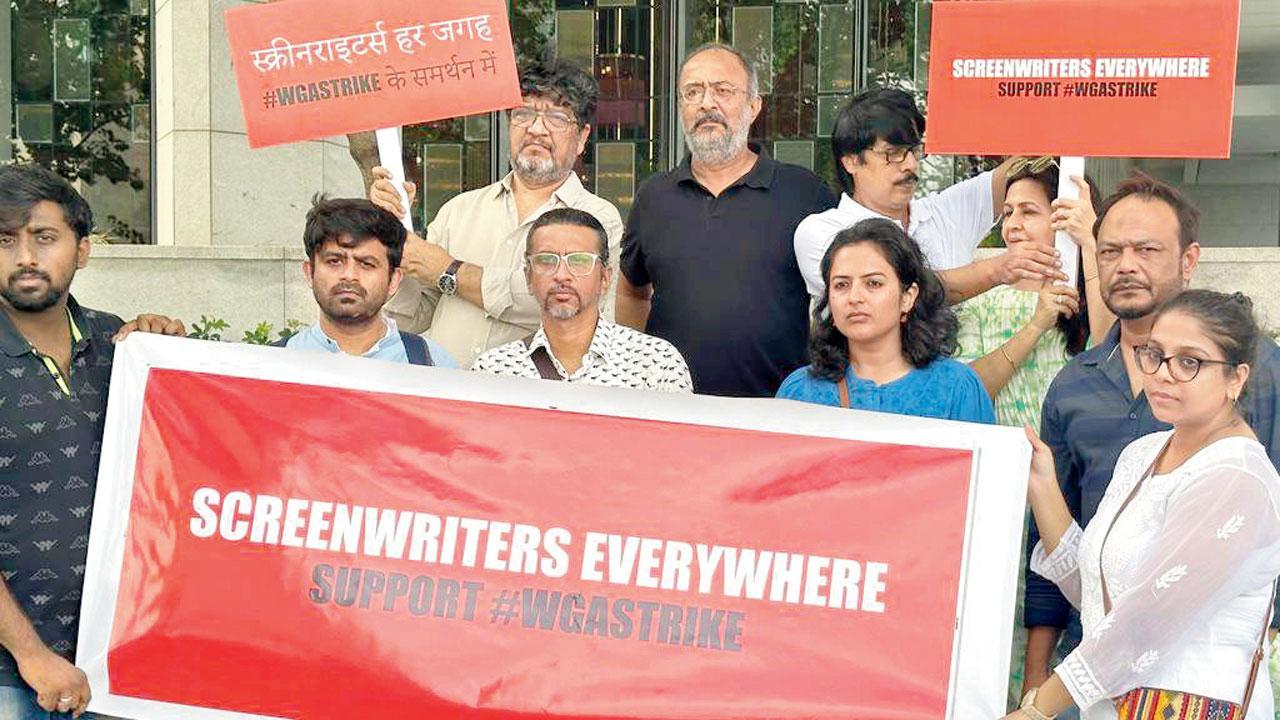
While writers in Hollywood are on strike demanding better pay from studios, screenwriters in India say that their condition is much worse compared to their US counterparts
Niharika Lal (BOMBAY TIMES; June 14, 2023)
The Writers Guild of America (WGA) strike, which kicked off in early May, is a result of a clash between writers, who see themselves working more but earning less in the streaming era, and studios attempting to rein in costs. Back in India too, writers of films and TV shows have demands that are quite similar – credit, compensation and fair contracts. However, many writers here feel that the situation is much worse compared to US.
Many writers point out, “Jinki stories pe taaliyan aur seetiyan bajti hain unko aksar screening pe bulana bhool jaate hai.” While the scenario has been slowly changing, writers feel it will take years for them to be at par with their US counterparts.
‘INDIAN WRITERS’ FEE MUCH LOWER THAN U.S. WRITERS’
In solidarity with the strike, India’s Screenwriters Association (SWA), asked all members working on US projects to stop working. SWA is fighting several battles on behalf of Indian writers. Anjum Rajabali, screenwriter and senior activist of SWA, shared his thoughts on the issues that Indian writers are facing:
‘CONTRACTS ARE ONE-SIDED’
Those who work on US projects are much better paid. In India, screenwriters, especially the new ones, receive fees far lower than the value of their work. Moreover, the contracts are one sided and protect their (producers and studios) rights, while the writer is left vulnerable. Credit is not guaranteed, termination can be at the whim of the producer, impossible indemnity is demanded from the writer.
‘OTT TREATS INDIAN WRITERS DIFFERENTLY COMPARED TO THEIR U.S. COUNTERPARTS’
More writers are now gainfully employed because of OTT. However, platforms brought in their own contract culture, with clauses that writers find unreasonable. OTT platforms treat Indian writers differently than their US counterparts. While US writers are striving to increase writers’ fees to fair levels, even their existing fees are still much higher than what Indian writers receive. Moreover, in the US, every time a show is aired anywhere outside of a cinema hall, the writer receives an additional remuneration.
‘SWA WILL NEGOTIATE FOR CREDIT’
Credit has to be given based on the work that the writer has done and not at the producer’s discretion. In case of a dispute between writers, SWA’s experts should arbitrate the issue by examining the respective written contribution of the writers to the final script and decide. Credit, dignified fees, regulation of the termination clause, indemnity, freedom to seek redress from the union are some of the clauses that need discussion with producers.
‘WHAT INDIAN WRITERS ARE SEEKING IS A SYSTEM CHANGE’
Screenwriter Mitesh Shah says, “What writers are seeking is a system change – equitable contracts, better compensation, credit guarantees, royalties. Streaming has given a lot of opportunities to writers. Things are certainly getting better but it’s still a long way to go. Be it a film or a web-series, everything starts with a blank page, and writers need to be accorded their due for filling up that page.”
Most writers say that they usually work on four-five projects at a time. Akshat Ghildial, who has written films like Badhaai Do and Badhaai Ho, shares, “From the initial idea to the dubbing, writers are paid in chunks. Kabhi kabhi chaar saal tak film ki total payment nahi aati. Agar aapne blockbuster likha hai toh aapki fees thodi zyada ho jayegi. Agar actor ki ek film blockbuster ho jaye to uski fees skyrocket ho jati hai, aisa writers ke saath nahi hota,” adding, “If content is called king then why are you not paying kingmakers?”
HOLLYWOOD STARS BACK U.S. WRITERS
The ongoing strike in US also saw many celebs step forward to stand in solidarity with screenwriters. Julia Louis-Dreyfus, Tina Fey, Rob Lowe and Modern Family stars Nolan Gould, Sarah Hyland and Jesse Tyler Ferguson, were among stars who protested with writers
WHAT INDIAN WRITERS HAVE TO SAY:
"A director doesn't ask for design credit when sharing his vision with a costume designer. But when it comes to writing credit, I have heard of many instances where directors have demanded their name be included. Sabko lagta hai writing sabko aati hai. Koi bhi aake suggest karta hai yeh dialogue work nahin kar raha"
- Akshat Ghildial, who has written films like Badhaai Do and Badhaai Ho
"It is quite common for some producers and directors to demand writing credit even for a minor input. It happened once with me when a producer wanted writer credit for giving feedback on the screenplay (that project never got made). In the last couple of years, writers have openly criticized these demands, which has changed things. Giving feedback is not the same as writing."
- Pooja Tolani, who has written Sacred Games
"The Indian screenwriting ecosystem is still learning how to read and execute a fair contract, negotiate good remuneration and deliver a good script"
- Hiteh Kewalya, who has written Shubh Mangal Zyada Saavdhan
"Because a lot of work is being done, the incremental value of writers have gone up in the last few years. But has it changed anything for writers and their rights in India? I'd say not much"
- Trishant Srivastava, who has written Jamtara
WHAT DO WRITERS DEMAND?
> Fixed minimum basic compensation
> Contract clauses like payment linked to approval, producer’s discretion if credit needs to be given
> Royalties – profit share in remakes and reruns
To express solidarity with WGA, Screenwriters Association holds symbolic protest in Mumbai
4:44 PM
Priyanka Sharma (MID-DAY; June 15, 2023)
It has been over a month since the Writers Guild of America (WGA) went on strike, following the breakdown of their negotiations with the Alliance of Motion Picture and Television Producers (AMPTP). The WGA union criticized the studios for not providing fair employment conditions to writers.
On Wednesday, 20 members of the Screenwriters Association (SWA) observed a silent protest outside the Netflix India office in Bandra Kurla Complex, Mumbai to express support for its US counterpart. The development came as a part of the decision taken by the International Affiliation of Writers Guild (IAWG) to mark World Solidarity Day.
Screenwriter Anjum Rajabali, executive committee member of the SWA, says, “Whenever any guild faces any obstacles, IAWG ensures the rest of us stand by them. This time, it was decided that writers’ guilds across the world, including India, parts of Europe, and Australia will hold a symbolic protest on the same day.”
Besides Rajabali, SWA chief operating officer Suhael Anwar, Shubh Mangal Zyada Saavdhan writer-director Hitesh Kewalya, Mohenjo Daro dialogue writer Priti Mamgain and Comicstaan writer Adhiraj Singh constituted the group.
Rajabali explains that the protest was motivated by the fact that most streaming platforms are members of the AMPTP that was in negotiations with the WGA. “This is not against [a specific streamer]. It is to boost the morale of the WGA members,” he emphasizes.
Why the historic Hollywood writers' strike matters in India
8:18 AM

While streaming has changed the way we consume content, screenwriters say some things haven’t changed — their compensation, lack of credits or the lopsided contracts
Mohua Das (THE TIMES OF INDIA; May 14, 2023)
A battle is raging in America’s Tinseltown. For the first time in 15 years, the Writers Guild of America (WGA) launched an industry-wide strike demanding fair pay and benefits rather than being treated like gig workers. In a spillover effect, writers guilds across the world united to fight back including India’s Screenwriters Association (SWA), which asked its members to stop work or not accept any new writing assignments on American films and series.
So, is a culture of collective bargaining — which has been a landmark hurrah of union power in Americ a’s film and television industry since the ‘30s — finally taking root in India’s screenwriting industry?
Writers are trying to stay optimistic. Over the next few weeks, the SWA intends to invite studios and independent producers to the negotiating table to discuss a ‘Minimum Basic Contract’ — a set of basic principles on which a standard writer-producer agreement should be based — that could tilt the scales of a lopsided industry, where writer contracts are not so much negotiated as dictated by production houses.
Anjum Rajabali, veteran screenwriter an d member of SWA’s executive committee, says that the WGA strike has come as a stark reminder of longstanding and fresh challenges that screenwriters in India face. “The WGA contract comes up for renegotiation every three years but we haven’t even reached a stage where the union can negotiate a standard contract for its members. Here each writer has to deal with producers independently and the bargaining power is disproportionate,” rues Rajabali.
The reason the Hollywood pen down has created ripples here is because the corporations that the WGA is agitating against are the same ones whose subsidiaries Indian screenwriters are working for, such as Amazon, Hotstar, and Netflix. “If the outcome of the strike is favourable, its implications could empower our writers to stand up for their rights,” says Rajabali.
But wasn’t the advent of OTT platforms and demand for more content expected to tilt the balance in favour of writers? The frustration is palpable as Rajabali says: “Not only has that not happened, it’s only gotten worse with contracts becoming harsher. The first squeeze in the budget is always the writer’s fee.”
It’s a fight about money, of course, given the “undignified low fees” especially for new writers, but also about fair treatment — one-sided contracts, lack of credit guarantees, arbitrary termination clauses and difficult indemnity demands.
Saiwyn Quadras, a screenwriter with a string of successful films like ‘Mary Kom’ and ‘Neerja’, opened up about his brush with whimsical terminations. In one instance, Quadras spent a year rewriting three drafts for a film, going back and forth with the producer, only to be told that none of it would be considered as even the first draft. The contract further prevented him from approaching the SWA for issues.
“It said that I could only go to court, which is a daunting prospect. Not every writer has the money and resources to keep a legal fight going which makes SWA’s legal cell a crucial resource because they help us decode legalese and assist with lawyers or finances.”
Even the way fees are paid is a problem. “Writers’ fees are divided into so many tranches — depending on casting to release — that we could be waiting for two years and running our homes on 30-35% of the total remuneration due to us,” Quadras exclaims. “This is my state after delivering three hits. I wonder what happens with novices.”
Rajabali says one issue is that writers are made to sign a ‘release form’, a legal agreement that absolves production houses and studios of any legal obligations and leaves writers without any recourse if their work is plagiarized. Another major hurdle is credit. “The issue of credits isn’t about vanity or ego but crucial to a writer’s future career,” points out Rajabali, known for writing films like ‘Ghulam’, and ‘Raajneeti’ and advocating for the rights of Indian screenwriters since he co-founded the Progressive Writers Group in 2008.
“However, a clause in writer contracts allows the producer or platform the discretion to determine the final credits for a film or series and there are dozens of instances where a junior writer may have done 80% of the scripting, but a senior writer engaged for rewriting the script receives the top billing and exclusive credit. Sometimes, the junior writer gets credited as ‘researcher’ or ‘additional screenplay writer’ and sometimes may even have their names knocked off, which not only undermines their creative merit but also the compensation they’re entitled to,” he says, adding that often directors and producers demand undue writing credit even if they have only given feedback.
Bhavani Iyer, who has written the stories and screenplays for ‘Black’, ‘Lootera’, ‘Guzaarish’, says the issue is far from straightforward. “It’s not just about disparity in pay and credit between senior and junior writers; it’s also about the absence of a framework for redressal.”
Writing fees in India is nowhere close to the value that a script brings to a film-Anjum Rajabali
8:28 AM

The Writers Guild of America’s action has led to the resurgence of concerns among writers in India
Rishabh Suri (HINDUSTAN TIMES; May 13, 2023)
The Writers Guild of America’s strike against Hollywood studios demanding higher pay and fairer deals, among other asks, has entered its second week. The guild is seeking a 25% hike in writer-producer minimums, for a total of 31% in the first year of the contract, reported Variety.
As a result of the strike, which has been supported by big names, including filmmaker Christopher Nolan, several projects have been impacted. The strike has revived the pay parity concern among Indian writers, too, who have time and again voiced their apprehension regarding writers’ issues.
Anjum Rajabali, who wrote Ghulam (1998) and co-wrote the screenplay of Raajneeti (2010), says, “While their strike doesn’t have a direct bearing on the Indian situation, it has brought into focus the unfair treatment that writers receive. Writing fees in India is nowhere close to the value that a script brings to a film. New and young writers are distressed as they feel exploited. The contracts that producers and studios offer are grossly one-sided.”
Lack of industry support
Writer Apurva Asrani feels that support from big actors and directors is imperative for a writers’ strike to bear fruit. The Criminal Justice: Behind Closed Doors (2020) writer says, “In the US, you have Christopher Nolan and Game Of Thrones co-creator George R R Martin supporting writers. In India, actors and directors are paid way higher than writers. So, no one really wants to change the status quo.”
Gangs Of Wasseypur (2012) writer Zeishan Quadri says there’s a lack of unity among writers in India: “There is no organized way here. Also, there’s no one to guide the writers.”
Will the exploitation stop?
Mitesh Shah, co-writer for the films Helicopter Eela (2018) and Tumbbad (2020), points out that the Screenwriters Association (SWA) “has been talking about all this for a long time”.
He adds, “But I haven’t received as many calls as I am getting now, after the US writers’ strike. Barring a few industry people, there has been very little support. I know a few writers who sold their scripts for as little as Rs. 50,000 or Rs. 1 lakh, while it should be at least Rs. 12 lakhs.”
After WGA strike rocks Hollywood, Screenwriters Association in India drafts Minimum Basic Contract
8:29 AM
After WGA strike rocks Hollywood, Screenwriters Association in India drafts Minimum Basic Contract that seeks credit, higher remuneration for writers; lines up meeting with producers for next week
Mohar Basu, Priyanka Sharma (MID-DAY; May 8, 2023)
More than 11,000 members of the Writers Guild of America (WGA) went on strike last Tuesday, following the breakdown of their negotiations with the Alliance of Motion Picture and Television Producers (AMPTP). The WGA union criticized the studios for treating writing as a freelance profession rather than providing fair employment conditions to writers.
Closer home, the Screenwriters Association (SWA) has expressed its solidarity with the WGA. The episode has reignited the conversation about writers’ rights. Taking a cue from its American counterpart, the SWA is formulating a Minimum Basic Contract (MBC). Suhail Anwar, chief operating officer, SWA, says, “We need fairer contracts for writers. Credits are not guaranteed, neither are fees despite having a pay scale.”
The contract will focus on two key areas — credit, and remuneration. Zaman Habib, general secretary, SWA, rues that the fight in India begins from the fact that writers are often not acknowledged.
“When a writer is successful, they can negotiate, but new writers are exploited. The MBC will assure them credit and remuneration. We have seen cases where a writer has delivered a screenplay for [as low as] Rs 50,000.”
In 2018, a minimum-pay scale was set up. Among other things, it stated that for a film mounted on a budget of Rs 5 crore to Rs 15 crore, the writer should be paid Rs 24 lakh for the complete script. Habib notes that while these rules exist on paper, they are often not applied by producers and studios.
“This pay scale has to be agreed upon by unions and guilds so that there is no discrepancy or manipulation. It will be fair to both producers and writers in the industry. A basic respectable amount has to be assured. In films, a writer’s total remuneration is often priced at Rs 5 lakh. The tranches are spread out over nine months to two years, depending on the benevolence of a producer.”
Habib rues, “Many producers believe in keeping writers happy, but many others are repeatedly in the habit of not paying or delaying payments.”
To address the issue, the SWA will conduct a meeting with Producers’ Guild, Indian Film and Television Producers Council (IFTPC), Indian Motion Picture Producers Association (IMPPA), and individual producers next week. He adds, “Producers like Siddharth Roy Kapur, Ritesh Sidhwani and Farhan Akhtar are encouraging [of the MBC].”
The MBC is being formulated by a team of experienced writers and lyricists, headed by Anjum Rajabali, who has long been a champion of writers’ rights in India. He highlights that a new “offensive” clause has been introduced by some producers.
“The contract has a clause, which states that the final credit of the writer will be at the discretion of the producer. This has naturally outraged all writers. Credit indicates the writer’s contribution to the film. It is an inalienable right — legally and morally. If there are multiple writers and there is a dispute among them concerning credits, then experts, who understand screenwriting, should assess their individual contribution to the film and determine their credits,” Rajabali explains.
The SWA has set up a credit arbitration committee to resolve this issue, and Rajabali says it will be a key point of discussion in the upcoming meeting.
“In the credit arbitration committee, the drafts submitted by the writers are read and the extent of their inclusion in the final script is assessed by senior writers anonymously. We now seek that all credit disputes be handled by this process, and not at the producer’s discretion,” he asserts.
Habib adds, “Credits on a film or a series will be explained in this contract. Also, credits can’t be measured on industry seniority. It will be measured by the amount of work put in. Despite being a junior writer, if someone has put in more work, his name should come first.”
Royalty is another issue. By and large, in Bollywood, the norm is that the creator/writer transfers the Intellectual Property Rights (IPR) to the production house, studio, or platform. With the MBC, Habib says they are seeking royalty that would be over and above the remuneration. Rajabali is optimistic of arriving at an understanding with the producers regarding the MBC.
“We’re fully cognisant of their points of view, and their anxieties. The changes that we’re proposing are fair to both sides.”
SWA recommends
Consideration: Make sure that the amount of consideration is given in the draft and broken down into tranches. Avoid the one-time bulk payment that shall be made once the work is completed.
Credit: Ensure you receive your due credit. Make sure that the credit clause survives the termination of your agreement. Even if the agreement is terminated by either party, you shall still be credited for your work.
Writers want due royalty for their work; copyright society being formed to enforce the law
7:51 AM

A copyright society is being formed to enforce the law that requires producers and writers to share royalties equally
Ankita Chaurasia (MUMBAI MIRROR; December 12, 2020)
Given that royalty, by definition, is a legally-binding payment made to an individual for the ongoing use of work created by her or him, it is usually assumed that creators get it by default, along with credits in a film or a show. However, in India, despite a law stating that royalties should be shared equally by owners (producers) and authors (writers), and an amendment in 2012 that makes the right to receive royalty unwaivable, writers are yet to begin receiving it.
Taking on the onus of ensuring that the law is implemented, senior screenwriters and producers like Anjum Rajabali, Vipul Amrutlal Shah, Juhi Chaturvedi, Saket Chaudhary, Kamlesh Pandey and Zaman Habib, among others have formed a copyright society, the Screenwriters Rights Association of India (SRAI). The application for registration of the society is pending with the government, which has invited opinions or objections, if any, to the registration.
Pointing out that in Hollywood, based on the arrangement between the Writers Guild of America and different TV networks and OTT platforms, screenwriters receive hefty residuals which are akin to royalties, Anjum, a veteran member of the Screenwriters Association (SWA), reveals that Indian screenwriters get very low fees in comparison. “Even senior writers often complain of feeling bullied by unfair and one-sided contracts owing to the disproportionate bargaining leverage that studios, TV networks, and OTT platforms bring to bear in individual negotiations. The amendment to the Copyright Act of 2012 was a legislative intervention to correct this gross imbalance,” he asserts.
While their application is yet to be approved, the SRAI has invited stakeholders like the Producers Guild, the Indian Film & TV Producers Council, the Motion Picture Association, broadcasters, OTT platforms, and others to discuss questions or concerns regarding the society and its role. Calling it a friendly move, Anjum says, “Instead of communicating via the government, why can’t we seek to understand each other first? After all, the producer-writer partnership is the first step that initiates any project. We are confident that every doubt or anxiety can be resolved by understanding each other’s concerns.”
Ask him if, during an ongoing pandemic and the resulting economic slowdown, producers will accept a proposal to share revenue and he reasons, “Our aim is hardly to disturb, far less disrupt the economics of our industry. Why would we do that? Everyone’s livelihood, including ours, depends on the good health of the industry. By incentivising writing, the industry will get good films and shows, which create bigger viewership, higher revenues, and benefits everyone.”
The writer of films like Ghulam, The Legend of Bhagat Singh, Pukar, Apaharan, and Raajneeti goes on to say that royalties are not paid by the producer, and are, instead, a small percentage of what’s earned during the film or show’s secondary exploitation after its run in theatres. He is hopeful that producers, broadcasters and OTT platforms will work with writers in a spirit of cooperation and partnership for the better of the industry.
Dilip Kumar and Amitabh Bachchan's 1982 film Shakti to return in a new avatar
8:14 AM

Shree Narayan Singh working on adaptation of 1982 film
Himesh Mankad (MUMBAI MIRROR; August 19, 2020)
Mirror had earlier reported (April 14) that some of Amitabh Bachchan’s popular hits, including Chupke Chupke, Kaalia, Shahenshah and Namak Halaal were up for a remake with younger actors stepping into Big B’s shoes. We have now learnt that another Bachchan film has joined this list, Ramesh Sippy’s 1982 action-crime drama Shakti, which revolved around a father-son duo, and is the only film to have featured Dilip Kumar as DCP Ashwini Kumar and Senior Bachchan as Vijay Kumar, together.
“Around 10 years ago, the idea of a remake had come up with Amitabh stepping in for Dilip Kumar as the father who, in his commitment to the force, alienates his only son, who is then caught in the crossfire between two warring gangsters. But eventually, he loses his life to a bullet from his father’s gun. Abhishek Bachchan was to play Vijay then. The project, which was put on the backburner, is on track again, but with a different team,” reveals a source close to the development, adding that Shree Narayan Singh, who has directed films like Toilet - Ek Prem Katha and Batti Gul Meter Chalu, wants to revisit the classic which bagged four Filmfare Awards, including Best Film, Best Actor (Dilip Kumar), Best Editing and Best Screenplay.
Confirming the same, Singh says, “I have been working on the film for the last two years with Anjum Rajabali and Saumya Joshi penning the script. It’s a huge responsibility, which is why we are taking time to finalise the script, even though ours is more of an adaptation than a remake. The idea is to take the film on floors by next year.”
Farhan Akhtar bags Saare Jahan Se Achha?
8:01 AM

Farhan Akhtar on board to spearhead Bollywood’s mission into space
Himesh Mankad (MUMBAI MIRROR; July 30, 2020)
 The biopic of Wing Commander Rakesh Sharma has been in the news for two years now. Titled Saare Jahan Se Achha, it marks ad-filmmaker Mahesh Mathai’s return to the big screen after Bhopal Express (2000), and traces the journey of Sharma, a former Indian Air Force pilot, to the moon. The astronaut flew aboard Soyuz T-11 on April 3, 1984, becoming the first Indian citizen to travel in space.
The celluloid mission was announced in 2018 with Aamir Khan in the titular role, but the actor dropped out subsequently. The film’s writer, Anjum Rajabali, had revealed at a public event, that it was because of his dream project, Mahabharat.
Soon after, the makers approached another Khan, Shah Rukh, who, reportedly, had even started prep while Mahesh and his team went scouting locations in Russia, seeking permission to shoot at real space stations there. SRK was to kick off the shoot in February 2019. However, shocked by the debacle of Zero, the actor, reportedly, wasn’t too keen to do another film that took him into space.
Ever since, there have been speculations in plenty about the casting. Rumours were rife that the makers had gone to Salman Khan with the script in late 2019, but the discussion fell through. The names of Vicky Kaushal and Ranbir Kapoor were also floating around last year. Now, Mirror has learnt that Mahesh finally has another actor on board, Farhan Akhtar.
“After a lot of brainstorming, the team zeroed in on Farhan as he played athlete Milkha Singh to perfection in Bhaag Milkha Bhaag. Talks are on and after finishing his current commitments, he is expected to jump into the prep, which includes body transformation, physical training and understanding the nuances of an astronaut,” revealed a source close to the development, adding that the two men have a striking resemblance in terms of height and body structure too. “The script with the dialogue draft is locked. With the lead actor on board now, they will proceed towards getting together an ensemble cast and then work on the timeline of the shoot.”
The film chronicles the journey with emotional undertones of the death of Sharma’s daughter. It will also showcase the training sessions he went through as part of the mission which was a joint program between the Indian Space Research Organisation (ISRO) and the Soviet Intercosmos Space Program.
Sharma spent 7 days, 21 hours, and 40 minutes in outer space with two other Soviet cosmonauts. The crew held a joint television news conference with officials in Moscow and India’s then Prime Minister, Indira Gandhi. When Mrs Gandhi asked Sharma how India looked from outer space, he replied, “Saare jahaan se acchha” which explains the title. The team was initially contemplating Salute before unanimously agreeing that Saare Jahaan Se Acchha was a better choice.
On his return, Sharma was conferred the Hero of the Soviet Union, the only Indian to be conferred this title. He also bagged India’s highest peacetime gallantry award, the Ashoka Chakra, along with the two Soviet cosmonaut.
Budding scriptwriters should continue writing with more enthusiasm-Aamir Khan
8:34 AM

With the on-ground event of screenwriters' contest cancelled, Aamir Khan to announce the winners of Rs 50 lakh cash prize on social media, advises young guns to remain inspired during the lockdown
Mohar Basu (MID-DAY; May 9, 2020)
What started as a passion project for Aamir Khan in 2017, has grown into an initiative that is changing the landscape for budding writers in the Indian film industry. The second edition of Cinestaan India's Storytellers Script Contest, a nationwide hunt for scripts where the five winners take home a total cash prize of Rs 50 lakh, was launched this February. Over the past three months, the four-member jury — consisting of Khan, Anjum Rajabali, Juhi Chaturvedi and Rajkumar Hirani — sifted through numerous entries to choose five compelling stories that can be taken to the screen. While the on-ground event to announce the winners has been cancelled due to the current Coronavirus scenario, the superstar will unveil the new talent on social media today.
Excited to be part of an endeavour that celebrates screenwriting — an aspect he considers the backbone of every successful film — Khan urges budding writers to not let the prevailing situation dampen their creativity. "Budding scriptwriters should continue writing with more enthusiasm, especially during these times. Every filmmaker needs a good script," says the actor.
California-based NRI Sejal Pachisia has bagged the top prize of a whopping Rs 25 lakh for her story, On The Boundary. The second and third prizes have been won by Digant Patil and Soumil Shukla for Guilt and Laakh Maavla respectively. The prize is financed by Cinestaan Digital, an internet media firm focussed on building cinema-related products for Indian audiences. The chosen scripts will become part of its story incubator programme.
Rajabali, jury chairperson, says the contest was designed to provide a platform to new talent, thus helping deserving outsiders to gain a toehold in the industry.
"It's important that we raise the standard of our scriptwriting so that the quality of our cinema improves," he states.

Screenwriters Anjum Rajabali and Juhi Chaturvedi
Screenwriter Association drafts a standard release form to help keep things fair and square for writers
8:22 AM

Screenwriters Association drafts a standard release form, which will be sent to production houses along with a request for compliance
Ankita Chaurasia (MUMBAI MIRROR; January 15, 2020)
Currently in its 60th year, the Screenwriters Association (SWA) aims to help members decode the confusing legalese that constitutes the first contract they are made to sign when submitting their script to a producer or production house. Termed ‘release form’, the contract binds the writer and producer to “honour the sanctity of a script”, but from their recent experience, SWA lawyers believe the document absolves producers of all legal obligations, leaving its members’ intellectual property vulnerable.
“We analysed release forms from around 15 production houses and found several clauses which are unfair to writers and won’t stand in the court of law,” elaborates Anamika Jha, who handles legal matters for the association. Anjum Rajabali, executive committee member of SWA, explains more simply, “It’s like I ask my neighbour to keep an eye on my house while I’m on vacation and he asks me to sign a note that I can’t sue him for stealing, even if later I see the same things in his house.”
To streamline the process, the writers’ body has now drafted an ideal contract. “It is an unbiased form, which serves the purpose of an initial contract and doesn’t victimise either party. It asks producers to honour confidentiality, respect copyright and do away with redundant clauses,” shares Jha, adding they’ll soon send out letters to all production houses and independent producers, asking for their support.
Vikas Mishra, head of the media sub-committee, points out that new writers usually don’t have bargaining power. If they don’t sign the contract, they lose out on an opportunity and if they do, it hampers their prospects. The idea is to empower them. “If they are dismissive towards our request, we will speak to the CEOs and try to work out a mutually beneficial agreement,” says Anjum, while Vikas adds that they will ask writers to not sign such contracts and also send a notice to those production houses. He, however, admits that there is no way to legally enforce their request since it is only a contract between two parties and the association is not involved in the deal.
Acknowledging that junior writers might be sceptical about letting go of opportunities, Anjum reasons, “Writers need to develop confidence in their script and take a stand. Just like they won’t agree to accept a lower remuneration, they should refuse to sign an unfair contract.”
CHANGES PROPOSED
1 The clause that prohibits writers from laying a claim or litigating if s/he believes that his/her work has been misappropriated, infringed upon or plagiarised by anyone, including a production house, is legally untenable as it violates Section 28 of the Indian Contract Act, 1872, as it asks the writer to waive his/her statutory right to seek legal remedies.
2 The material being submitted to the production house by the writer is in confidence, as it contains his/her intellectual property. The High Courts of Bombay and Delhi, in numerous judgments, have declared and established that such information by nature is proprietary and confidential.
3 There is a redundant indemnity provision in several release letters, which states that the writer shall indemnify the production house if it faces any loss due to infringing content. Such indemnity is unnecessary at this stage, since there is no assignment of rights or monetary dealing involved.
Shaukat Kaifi didn’t have a calculating bone in her body-Anjum Rajabali
7:53 AM

Screenwriter Anjum Rajabali recalls fond memories of Shaukat Kaifi, who passed away at her home in Juhu yesterday
Reema Gehi (MUMBAI MIRROR; November 23, 2019)
Theatre artiste and actress Shaukat Kaifi passed away in her home in Juhu at 5 pm on Friday after suffering a cardiac arrest. Kaifi, the mother of actress Shabana Azmi and cinematographer Baba Azmi, was 91 and had been unwell for some time. Her funeral procession will leave from 25, Janki Kutir, at 3 pm today, and end at Sunni Kabrastan, four Bungalows.
An anecdote that still fills screenwriter Anjum Rajabali’s heart to the brim is one that the inimitable actor Shabana Azmi shared after the launch of her mother Shaukat Kaifi’s autobiography, ‘Kaifi and I’. The book, the motley crew learnt, was lauded by Nobel laureate Amartya Sen. The launch was to be followed by lunch and a particularly pleased Shaukat aapa (as she was fondly addressed) changed soon enough into a beautiful saree. Her daughter apparently commented, ‘No one changes just for a simple lunch!’ And pat came Shaukat aapa’s response, ‘Yes, but not everyone gets a message for their book by someone like Amartya Sen’. “That was Shaukat aapa for you,” says Rajabali, also a close friend of her son and daughter-in-law Baba and Tanvi Azmi. “She always had this child-like innocence.”
This attribute shone in the play ‘Kaifi Aur Main’ – her book that was adapted for the stage in 2006, on the fourth death anniversary of Kaifi Azmi – and where her daughter essayed the role of Shaukat, while her husband, veteran lyricist Javed Akhtar, essayed the role of the iconoclast Kaifi Azmi. The play was directed by Ramesh Talwar and produced by the Indian People’s Theatre Association (IPTA). Both Kaifi and Shaukat were greatly involved in the activities of IPTA Bombay, as it was known then. For many years, the couple lived with their two children in a rather tiny accommodation provided by the Communist Party of India. Kaifi, Shaukat and their children shared the apartment with three other families, who like them had communist leanings and interests in theatre as well as cinema. Through them, Shaukat was drawn to theatre and films. Although she’s known for her role as Khanum Jaan in the 1981-film Umrao Jaan, Shaukat played an instrumental part in quite few of Prithviraj Kapoor’s Prithvi Theatre – she acted in Shakuntala and Deewar, and IPTA Bombay’s Dhani Banke, Africa Jawan Pareshan, Aazar ka Khwab and Tanhai.
But according to Rajabali, “it’s her generosity, openness and sense of humour which truly stands out.” “She wasn’t merely Kaifi Azmi’s wife or Shabana Azmi’s mother; she was a great achiever in her own right,” he insists. When Kaifi saab’s work in cinema picked up, the family’s fortunes changed, “but their homes were still an open house; and it was Shaukat aapa who was really the soul.”
“The ease and generosity with which I have seen her interact with people coming from such humble backgrounds is the same as she would interact with the intellectuals, writers, theatrewallas and filmmakers,” says Rajabali. “She didn’t have a calculating bone in her body. All her relationships were personal. With each person, she had a unique emotional equation. She remembered everyone’s peculiarities, including mine.”

(clockwise) Shaukat, Baba, Tanvi, Shabana Azmi and Javed Akhtar
My 10-year journey in Bollywood has taught me to walk straight in heels-Swara Bhasker
8:32 AM

Swara Bhasker reflects on her decade-long Bollywood journey
Mohar Basu (MID-DAY; September 18, 2019)
"It has taught me to walk straight in heels," grins Swara Bhasker as she reflects on her last decade in the industry. It has been a significant journey for the actor, who — armed with a degree from JNU and the courage to play unconventional characters — headed to Bollywood 10 years ago. "I didn't know anyone here; had no contacts, no connections, apart from writer Anjum Rajabali, whose office I lived in," recalls Bhasker.
While she showed promise in a slew of supporting roles, she counts Raanjhanaa (2013) as the game-changer in her career. "Before Raanjhanaa released, I often asked myself, 'Should I drop it all and go back to Delhi?' But fortunately, good work and the opportunity to associate with good people kept coming my way."
Her crowning achievement in the industry has been her production house, that she launched earlier this year with brother Ishaan. Their first project is a biopic on Krishna Sen, an Uttarakhand-based woman who duped two women into marriage, convincing them that she was a man. In the process, she extorted money from them. Quiz her on the film's progress, and she says, "We are scripting the film."
Screenwriters Association formulates plan to ensure fair remuneration for film writers
8:49 AM

Screenwriters Association has formulated a plan to ensure fair remuneration for film writers; Ritesh Sidhwani is the first filmmaker to come on board
Himesh Mankad (MUMBAI MIRROR; June 22, 2019)
 With the dialogue around writers’ contribution to films and their remuneration gathering steam, the Screenwriters Association (SWA) has come up with a definitive plan to determine minimum wage (box below). According to the plan, a writer’s pay will depend on the scale of a production. “If there is no script, there is no film, and no job in the industry. It’s the blueprint on which the entire project is based, and therefore there has to be a certain value to the script, which will encourage people to write better,” explains Anjum Rajabali, Senior Activist, Screenwriters Association.
He goes on to point out that the structure will not just facilitate better pay for writers but will also help producers get better scripts. “Today, the industry needs a good script, and to get that you must give incentives to the writers,” he reasons, adding that the association has even found the first filmmaker to adhere to the guidelines—Ritesh Sidhwani, who owns a production house with Farhan Akhtar. “I am grateful that somebody like Ritesh, who makes truly interesting films, has agreed to this. These are minimum rates, which have been decided by the Screenwriters Association.”
Ritesh, meanwhile, wonders aloud why writers are underestimated in the ecosystem. “I am not a writer, but I know it is a demanding job. We already have a system in place wherein writers over the last few years have had the option of entering into a profit-sharing agreement with us. An individual can decide if he/she wants a higher base fee or a lower amount and coupled with two percent shares in the profit. Fukrey writers got around Rs 70 to 80 lakh, as they had a profit sharing agreement with us,” he reveals, adding that he and co-owner Farhan Akhtar were instantly on board with the SWA proposal.
The filmmaker believes that the move will remove the stigma attached to the profession. “This is a reasonably good amount of money and the slabs ensure that after spending five to six months on a script, the writers will be paid a decent amount, which can be taken higher based on merit,” he says Pay scale is not the only issue that SWA is addressing with the guidelines, which has also outlined specific terms that must be mentioned in a writer’s contract to ensure due credit for their work. Story, screenplay, script and dialogue have predominantly been a collective grey area so far, which lacks clear demarcation. To combat this issue, the association has devised a section in the guidelines. “The Minimum Basic Contract guarantees credit for script, screenplay, dialogue and story separately,” Anjum reveals, adding that the new plan also discourages arbitrary termination of contract.
Next up, Ritesh intends to push Producers Guild of India to make the guidelines mandatory to make the writers’ community more secure. “This is a basic criterion that everyone should adhere to,” the filmmaker signs off.

Shah Rukh Khan is pretty shaken up post Zero-Anjum Rajabali
8:33 AM

MID-DAY (March 15, 2019)
Writer Anjum rajabali says Shah Rukh Khan backed out of astronaut Rakesh Sharma’s biopic Saare Jahan Se Achha as he was shaken up by the failure of Zero (2018). There were reports that Khan was skeptical to venture into another space film after Zero, which had its character travel to Mars for love and hence quit Saare Jahan Se Achha.
At a panel discussion at FICCI Frames, Rajabali, however, said the space angle was not the reason for the superstar to leave the film. “If you’re asking me, there was a problem with the script [of Zero]. Himanshu [Sharma, writer of the Zero] is a talented person, but things go wrong sometimes. I don’t think he said no to Saare Jahan Se Achha because of the space [angle]. I think he’s also pretty shaken up, he was banking a lot on that,” said Rajabali while moderating a panel discussion on screenwriters.
He added that asking question about Saare Jahan Se Achha was “dukhti rag pe haath rakhna” [hitting a raw nerve], but made an observation about how often makers blame everything else but the script when a film fails. “This whole practice and culture of post-mortem, of analysing what went wrong hasn’t caught on. What happens then is, there are knee-jerk reactions rather than responses even from the makers,” he said.
“The failure could be because of the space and hence we put two and two together. ‘Oh it’s because the time wasn’t right, nobody wants to see a star in a disabled person’s role’. It could also well be that there was a problem with the DNA of the script.”
Rajabali, who has penned films like Ghulam (1998), The Legend Of Bhagat Singh (2002) and Raajneeti (2010), said a writer should also be involved in this “honest introspection to be able to determine where did things go wrong.”
“Most of the times, when a film doesn’t connect in spite of the fact that the idea was good, director was talented and the stars were attractive, it’s because the script has gone wrong. That’s where we need to be investing.”
Shah Rukh Khan will bring his own maturity to the script and the character of Rakesh Sharma-Anjum Rajabali
8:20 AM

Before Rakesh Sharma biopic 'Saare Jahan Se Achha' rolls in February, writer Anjum Rajabali on Shah Rukh stepping into Aamir Khan's shoes for lead
Sonil Dedhia (MID-DAY; November 28, 2018)
While the biopic on astronaut Rakesh Sharma was conceived with Aamir Khan in mind, the actor had to let go of the project due to his busy date diary. The superstar showed that his friendship with Shah Rukh Khan had no place for competition when he graciously passed on the script of Saare Jahan Se Achha to the latter.
Writer Anjum Rajabali revealed that Shah Rukh would be a natural fit for the role, bringing his own brand of charm to the story of the real-life hero. "Shah Rukh came on board after a few days of discussion. I'm sure he will bring his own maturity to the script and the character."
The famed writer added that though Aamir played a role in arranging the meeting with Shah Rukh, getting a nod from the superstar was no mean feat. "When Aamir called Shah Rukh, he agreed to meet us, but that didn't imply that he was doing the film. We gave him a three-hour narration during which he asked a few questions. It was only when he was content with the answers that he came on board," he said, speaking on the sidelines of the Cinestaan India Storytellers Contest. He added that the Mahesh Mathai-directed venture will roll in February.
After Ghulam (1998), Rajabali was keen on reuniting with Aamir for the space drama. "Aamir and I had discussed the film in detail. But unfortunately, he was consumed by Mahabharat. Let's hope we work again in the future."

Subscribe to:
Posts (Atom)