Showing posts with label Anil Sharma. Show all posts
Showing posts with label Anil Sharma. Show all posts
We will start Gadar 3 next year-Anil Sharma
9:28 AM

Deep Saxena (HINDUSTAN TIMES; June 15, 2026)
Filmmaker Anil Sharma says he knew Gadar: Ek Prem Katha would become a landmark the moment he first heard the script, and 25 years later, he feels it is “still alive in people’s hearts”.
“The day Shaktimaan Talwar narrated the story, I knew it had the potential to become India’s biggest hit film… I tried to make it at the level of Mother India (1957), Mughal-e-Azam (1960) and Sholay (1975),” he says, adding that the film recorded nearly 10 crore footfalls, a feat unmatched even today. “Even Gadar 2 had half of this footfall,” he adds.
Recalling its 2001 release alongside Aamir Khan’s Lagaan, he says, “There was no competition like today… people would watch one film and then another back-to-back. Woh marketing nahi, woh dil ka daur tha.”
On Gadar 3, he teases, “Gadar ki story ek bomb thi, sab kahte rahe par Gadar 2 tab bani jab ek atom bomb story mili. Now, Gadar 3 will only happen if we have a nuclear bomb story. We are working on the script and God-willing if all goes on track we will start it next year!”
25 Years of Lagaan, Gadar: Two films, one release date... and the rest is history
9:27 AM

25 years ago today, Gadar: Ek Prem Katha and Lagaan hit theatres and went on to become two of Indian cinema’s biggest success stories. We speak to members of the film fraternity as they look back on the excitement surrounding this box-office clash and reflect on what makes both films enduring classics even today
HINDUSTAN TIMES (June 15, 2026)
The expectations before release day
Filmmaker and trade expert, Girish Johar recalls that Gadar was already carrying tremendous buzz before its release. Its music had become popular and audience anticipation was high. In comparison, Lagaan appeared to be lagging initially.
“People couldn’t quite understand what Lagaan was about from its early promotional material. The creative images showed 11 men in rural costumes. And at the time, (Gadar director) Anil Sharma was a far more commercially successful director than (Lagaan director) Ashutosh Gowariker, so the odds were largely in Gadar’s favour,” he says.
Johar adds that Lagaan’s lengthy runtime also posed challenges. “Being a three-hour film, only a limited number of shows could be accommodated. There was also confusion over whether the film would have one interval or two. But the clash itself was incredibly exciting. Exhibitors were eager to screen both films, but show-sharing wasn’t common in single-screen theatres then. It was a tough call which film to screen, but all these are now fond memories.”
Why both films struck a chord
Nitin Datar, former president of the Cinema Owners and Exhibitors Association of India, recalls that many single-screen theatres preferred allocating more shows to Gadar during its initial run.
Explaining the reason, he says, “Gadar was an action film in which the protagonist takes on Pakistan’s police and political leaders. It evoked national sentiments among the audiences. I still remember people shouting ‘Bharat Mata Ki Jai’ inside theatres.”
He points out that Lagaan also carried a patriotic undercurrent, though in a very different way. “Lagaan was also rooted in national pride, but the conflict was against the British and was expressed through a cricket match rather than direct action. But ultimately both the films did well.”
DID YOU KNOW?
- Lagaan became the first Hindi film to be shot using sync sound which means that dialogues and sounds were recorded live during the shoot itself.
- Lagaan travelled to various international film festivals across the world but more importantly, it was nominated in the Best Foreign Language film at the Oscars 2001. The film’s selection was a moment of pride for Hindi cinema as it was for the first time that a commercial film had been nominated at the Oscars.
- Lagaan was the maiden production of Aamir Khan’s production house.
The legacy continues through re-releases
To mark its 25th anniversary, Lagaan returned to theatres for a limited three-day re-release on June 12, 13 and 14.
“Twenty-five years on, Lagaan remains one of Indian cinema’s defining achievements. Its return to theatres is both a celebration of the film and an opportunity for audiences to experience the scale, ambition and storytelling that make cinema timeless,” says Niharika Bijli, Lead Strategist, PVR INOX Limited.
Meanwhile, Gadar enjoyed a successful re-release in 2023, becoming one of the highest-grossing Bollywood re-releases in India. According to trade experts, the film earned an impressive Rs. 7.78 crore during its repeat theatrical run.
SUNNY DEOL’S POP CULTURE MOMENT
Sunny Deol’s ‘handpump scene’ in Gadar: where his character Tara Singh uproots a hand pump and uses it as a weapon became iconic. What was intended as an over-the-top display of emotion and strength became one of the most recognizable images in Indian pop culture.
- Natasha Coutinho

Anil Sharma's Arjun Naga goes on floors; Ganesh Acharya choreographs song sequence
9:18 AM

From mahurat to a sprawling dance set-up, Ganesh Acharya leads Arjun Naga’s energetic first schedule in the Mumbai suburb
Mohar Basu (MID-DAY; May 19, 2026)
Three years after Gadar 2, director Anil Sharma has officially begun work on his next action entertainer, Arjun Naga. The film went on floors on Sunday (May 17) with its cast and crew attending the special event. According to a source close to the production, the team moved into its first major schedule soon after the launch.
“The mahurat happened on Sunday at Royal Palms with the entire core team present. A few scenes were also shot on the first day itself. From Monday (May 18) onwards, the unit has started filming an elaborate song sequence choreographed by Ganesh Acharya,” the insider revealed.
The song, mounted on a grand scale, is currently being shot in Goregaon and is said to be among the film’s first big set-pieces. The film stars Utkarsh Sharma in the lead, while Arjun Rampal has been cast as the primary antagonist. However, the actor was not part of the mahurat schedule and is expected to join the shoot shortly.
There is also industry chatter around the The Rajasaab fame, Nidhhi Agerwal being cast as the female lead, though the makers are yet to officially confirm her involvement.
Satte Pe Satta actor Madhu Malhotra passes away
2:37 PM

THE TIMES OF INDIA (March 15, 2026)
Subhash Ghai's box-office smash Hero (1983) offered a bouquet of chartbusters, such as 'Tu Mera Jaanu Hai', 'Pyar Karne Wale Kabhi Darte Nahi' and 'Ding Dong Baby Sing A Song.' But the number which seems to have aged best with time is 'Lambi Judaai', a melancholic track that Pakistani folk singer Reshma infused with soul.
Madhu Malhotra, who dressed in a multicoloured gypsy attire lip synced that song of ache on celluloid, and who was one of the leading ladies in the superhit multi-starrer, 'Satte Pe Satta' (1982), passed away in Mumbai on Friday, according to 'Film Information', a trade magazine. She was 71.
Madhu was a familiar face in the Hindi films of 1970s and 1980s acting in over 100 movies though mostly in minor roles. She was a regular in Ghai's movies doing cameos in 'Vishwanath' (1978), 'Karz' (1980) and 'Vidhaata' (1982) as well as the horror films of Mohan Bhakri such as Khooni Murda (1989) and Roohani Taqat (1991). In Satte Pe Satta, she was paired with comic actor Paintal.
Old-timers might recall her as the joyous girl in a beach hat in the song, 'Mausam Mastana'. "She had a small role in my film, Shradhanjali (1981). She was a thorough professional," said film director Anil Sharma.
Apne 2 will be made and it will be a tribute to Dharmendra-Deepak Mukut
9:05 AM

Upala KBR (MID-DAY; December 2, 2025)
Imagining the world of Apne (2007) without Dharmendra is hard not only for the legend’s fans, but also for producer Deepak Mukut and director Anil Sharma. In fact, after the veteran actor’s demise on November 24, Sharma, in a media interaction, said that Apne 2 would be shelved. However, the latest update is that the sequel — starring Sunny Deol, Bobby Deol, and Karan Deol — is being rewritten since the script originally had Dharmendra in a pivotal role.
Talking to mid-day, Mukut reveals that he had narrated the script to Dharmendra only a few months ago. The veteran actor was gung-ho about reuniting with his sons on the silver screen, and more importantly, about sharing screen space with his grandson Karan.
He shares, “Dharam ji was very excited about the sequel. It was one of his wishes to make Apne 2 with his children. We are reworking the script now, which will be told from the point of view of Sunny and Bobby’s characters. There will be some changes as Dharam ji is no more, and we’ll miss him dearly. We are working on incorporating Dharam ji’s character in some way.”
The second instalment will be the producer’s “shraddhanjali” to the late actor. “If I cannot make a movie with Dharam ji, I can pay my respects to him through it. Apne 2 will be made and it will be a tribute to Dharam ji,” emphasizes Mukut.
A family drama, Apne told the story of Dharmendra’s Baldev Singh Choudhary, who hoped to regain his lost glory as a boxer through his sons. The next edition will take the original story forward. “It is a continuation of the original, and Karan will be introduced as Angad’s [Sunny’s character] son,” reveals the producer. One wonders why Sharma announced shelving the sequel when work on it is ongoing.
Ask Mukut, and he says, “I don’t know why Anil said it. When I asked him, he flatly denied having said that the sequel is shelved.”
-------------------------------------
Dharmendra and Sunny Deol appeared together in ‘Sultanat’ (1986) and ‘Kshatriya’ (1993). The veteran actor had a cameo in ‘Sunny’ (1984), but didn’t share screen space with his son.
-------------------------------------
‘Apne’ was the first film that saw Dharmendra share screen space with his sons Sunny and Bobby Deol. The trio then appeared in the ‘Yamla Pagla Deewana’ franchise, which had three instalments.
Without Dharmendra, it’s impossible to make Apne 2-Anil Sharma
9:16 AM

Deep Saxena (HINDUSTAN TIMES; November 26, 2025)
Filmmaker Anil Sharma, who worked with the late actor Dharmendra on seven films, called the veteran’s passing on Monday at the age of 89 as a personal and professional loss. The director, who had planned a sequel to Apne (2007), states that the project can no longer proceed “without his idol.”
The 61-year-old says, “Apne to apno ke bina nahi ho sakti. Without Dharam ji, it’s impossible to make the sequel. Everything was on track and the script was ready, but he left us. Some dreams remain unfulfilled. Without him, it’s not possible!”
Sharma directed Dharmendra in Hukumat (1987), Elaan-e-Jung (1989), Farishtey (1991), and Tahalka (1992), later producing Policewala Gunda (1995), directing Apne, and a cameo in Singh Saab The Great (2013). He also worked with Dharmendra’s sons, Sunny and Bobby Deol.
Recalling their last meeting Sharma says, “I met him in early October and he said: ‘Anil, koi acchi kahani laa, acchi film karni hai…camera meri mehbooba hai, mujhe yaad karti hai. Mujhe jana hai uske samne.’” The three Deols were set to reunite on screen with the sequel after nearly two decades.
Sharma first met Dharmendra on the sets of The Burning Train (1980) as an assistant. “He put his hand on my head and said, ‘mehnat se kaam karna’. When I narrated Hukumat, he approved the story in 10 minutes. ” Recalling the shoot, Sharma said: “Dharam ji’s connection with his fans was incredible. He was a great actor — unaware of the legend he was, and will remain, even after he has gone!”.”
50 Years of Sholay: How just another dacoit tale went on to become a fable
9:13 AM

Sholay was initially declared a flop and panned by critics. Now, the all-time blockbuster — celebrating its 50th birthday on Aug 15 — is regarded as the ‘best’ and ‘greatest’ film in polls. An exploration of how director Ramesh Sippy’s film lives in our heads through its dialogues and characters
Avijit Ghosh (THE TIMES OF INDIA; August 10, 2025)
Avijit Ghosh (THE TIMES OF INDIA; August 10, 2025)
It was a warm but amiable night in Bologna. By the time the open-air screening started at the north Italian town’s sprawling Piazza Maggiore, it was already 10 pm. Yet, at least 2,000 cinephiles, mostly Italians, had turned up. This was Sholay’s restored, uncut version — an intimidating three hours and 24 minutes in length — at the Il Cinema Ritrovato festival. “But the audience was glued, watching in pin-drop silence. When the film ended at 1.30 am, the cheering was incredible. Sholay is timeless,” says Shivendra Singh Dungarpur, whose Film Heritage Foundation has restored the film.
If the viewers’ reaction in Italy in June reaffirmed Sholay’s enduring appeal across countries and generations, an X post made by Iran’s Consulate General in Mumbai in July revealed the film’s abiding impact. “Many Iranians still associate #Bollywood with this epic,” it said, adding that a newspaper in Iran had published a full-pager commemorating the movie’s 50 years.
There’s something about Sholay. Even the biggest blockbusters eventually recede from memory. With director Ramesh Sippy’s multi-starrer, the obverse seems to be true. Sholay never left us. The movie breathes in our lives through its dialogues, which have become like proverbs, and lives in our heads through its characters. When anyone says, ‘Basanti’, we know who. In India, there’s only one Basanti. As filmmaker Mahesh Bhatt says, “Nations are not built by borders. They are held together by stories. Sholay has transcended cinema. It is one of the stories that holds India together.”
The film talks to different generations in different ways. For old-timers, Sholay is inseparable from their youth, a living memory of life as it used to be. For their progeny, and their progeny, it is a family fable they have imbibed like food, and consequently discovered on TV, internet or OTT. “Some films refuse to fade because they don’t just entertain us, they actually become us,” says Bhatt. The film is a connector.
How Gabbar got embossed in our lives
The marketing men of Polydor, a record company with the film’s rights, were critical to the tattooing of Sholay into our collective consciousness. In her award-winning book, journalist Anupama Chopra writes how Polydor executives, worried at the lukewarm sales of the music album, noticed the audience being captivated by Salim-Javed’s dialogues. Within a month, a 58-minute long-playing record was released. It turned out to be a stroke of marketing genius. A TOI article noted in 1976, “the earthy outpourings of the Sholay film track” has sold “phenomenally well”. Sholay was the first film that India heard as much as it saw.
Seventies India was an audio world. This was a time when the middle-class lined up to buy rationed sugar. For most, television was just a photograph shown to nursery kids to teach the letter, ‘T’. Even record players were restricted to a thin socio-economic band. India was primarily a radio country. Paan shop transistors would tune in to Radio Ceylon or Vividh Bharati through the day.
Against this backdrop, Sholay’s dialogues blared for months at homes, in shops, markets and fairs in Inner India’s small towns, kasbahs and mofussils. By repetition of listening, even pre-teens could recall every dialogue, just like multiplication sums. Some remembered the film by heart.
The first time this reporter saw the film at a theatre, the experience was mixed. A guy sitting in the row behind would pre-empt every dialogue. He stopped only after someone told him that all of us could do the same and there was no need to show off.
This was also the first film where the most popular dialogues were delivered by the bad guy, Gabbar, played superlatively by Amjad Khan, and not the hero. “The dialogues reached a transcendental level. They are proverbial, aphoristic, dramatic. And they are fundamental to an Indian imagination in a filmy sense,” says social scientist Shiv Viswanathan.
The dialogues became unforgettable because the characters were unforgettable. “Sholay is an archetypical memory. Every character from Gabbar to Basanti to Raheem chacha, is archetypical. They all create a culture, a memory and possibility of new imitations,” he says.
Even the smallest of characters haven’t been forgotten. “Keshto Mukherjee’s cameo of a barber named Hariram is still remembered,” says film director Anil Sharma.
Stories, real and apocryphal
Mac Mohan acted in over 300 movies. In Sholay, his presence was reduced to sitting with a gun on a faraway rock. He got to say just three words, “Poorey pachaas hazaar”. But Sambha, his character’s name, became his lifelong identity. Just like Viju Khote, the recipient of Gabbar’s simple but scary one-liner, “Tera kya hoga, Kaalia?”.
In a 2015 interview, Khote told this reporter that the temperamental horse he rode threw him off at least six times. His remuneration for the aches and bruises was just Rs. 2,500. Fortunately, he did not break any bones.
Real or apocryphal, there is another story, wherein a groom refused to take the sacred vows unless the film’s dialogues were played. The missing record was brought and played. The wedding was solemnized.
For a film that has turned into lore, it is hard to believe that Sholay was dismissed as a flop in the early days of its release. In his autobiography, And Then One Day, actor Naseeruddin Shah writes about watching Sholay, running in its second week, at a “half-empty” theatre in Andheri, Bombay. Shah also writes that the blame for the failure was pinned on newbie Amjad.
Sharma, director of the megahit, Gadar, recalls coming home after watching the movie and being told by a film industry client of his father, an astrologer, “‘Sun rahe hain film flop ho gayi. Log Sholay ko Chholey (chickpeas) bol rahe hain.’ I had liked the film and told them so. But they were dismissive and said, you are too young to know about the film business. We got into a row.”
Sharma also loved the film’s impressive stereophonic sound. “When the coin was tossed and tinkled after falling on the ground, people would start looking for it beneath their seats,” he remembers.
Critics admitted to Sholay’s technological excellence but roundly panned the movie. The Illustrated Weekly of India (now defunct), a sister publication of The Times of India, said in its review: “There is nothing in the script of Salim-Javed to make this ‘the greatest story ever told’, it is just another dacoit tale on the lines of Mujhe Jeene Do, Gunga Jumna, Mera Gaon Mera Desh.”
The Statesman (New Delhi edition) said: “For nearly four hours, this film assaults one’s senses psychologically, emotionally and at the end almost physically.” Sunday Standard called it “a shaggy dog Western, sporadically funny, ludicrously heroic, monstrously violent and sprawled in loose limbed abandon”. Most reviews, barring Weekly, also ignored Amjad’s performance. The film received just one Filmfare award — for M S Shinde’s editing.
But over the decades, the film has been reappraised. In a classic case of overcompensation, Sholay was declared ‘The Best Film of 50 Years’ by Filmfare in 2005. In 2002, a British Film Institute poll hailed it as the ‘greatest’ Indian film ever made. The good times continue. “The movie is set for gala screenings at festivals in Toronto, London and New York in the coming months,” says Dungarpur.
But the critical re-evaluation aside, Sholay has become more than a movie, it has become a myth. Sharma sums it up, “Sholay now belongs to the public, not to the maker. The film has ruled over people’s hearts for 50 years. It will continue to do so for another 50 years.”
----------------------------------------
‘Fingerprint of Emergency etched in Sholay’s ending’
Sholay was released during the repressive Emergency, which lasted 21 months. Filmmaker Mahesh Bhatt says that in a symbolic sense, “Thakur, whose hands are chopped off, represented the common person’s ‘wounded conscience’. Like the people, he is ‘hungry for justice’ and helpless.” Bhatt was also shooting with Sanjeev Kumar, who memorably played ‘Thakur’, for Vishwasghaat (1977) at the same time. It is well known that Sholay’s ending, where Gabbar is arrested by cops, was forced upon the filmmaker by the censors. In the original ending, now brought back in the latest restored version, the villain meets a gory death.
“With that imposed ending, the fingerprint of those draconian times is etched on the enduring commercial classic, a reminder of the time of repression we lived in,” says Bhatt.
— Avijit Ghosh

You don’t need to be constantly busy making reels to prove your worth-Ameesha Patel
2:17 PM

Neha Maheshwri (BOMBAY TIMES; June 12, 2025)
Just when it seemed like Ameesha Patel had faded into the background, she came back into the spotlight with the massive success of Gadar 2. Celebrating 25 years in the industry, the actress who made her debut in Kaho Naa… Pyaar Hai (2000) reflects on her journey, shares her thoughts on her career choices and the importance of staying true to oneself. Excerpts:
‘I want to be part of something that’s remembered for a long time’
Ameesha says that she has always preferred her work to do the talking. “I’ve never been one to boast about my work. I let it speak for itself, and that’s how I want to continue.”
Ask her about her absence from the big screen before Gadar 2, and she says, “Taking a break to reflect on the kind of cinema and roles that resonate with you is a conscious decision. I don’t want to take up any project for the heck of being seen on a Friday. I want to be part of something that will be remembered for a long time. Also, you don’t need to be constantly busy on a set making reels to prove your worth.”
‘I was upset when I learnt about the Gadar climax being altered’
Although Gadar 2 was a box-office success, it stirred controversy. Ameesha was upset when the film’s climax was changed without her knowledge.
She explains, “I was hurt because I had agreed to do Gadar 2 with the understanding that my character would justifiably take revenge and kill the villain. However, the climax was altered, and when Anil Sharma shot it, he didn’t contact me for an entire year. He’s family to me, and I expected him to tell me that the original climax had to be changed. Had they retained the original climax, the film might have achieved an even greater cult status. But it’s in the past now — the film was a success, and it’s time to move on to the next chapter.”
Does this mean she wouldn’t mind collaborating with him again? She responds, “I’ll collaborate with anyone whose content I like, but I’ll be more cautious now when it comes to trust — once bitten, twice shy.”
‘I wouldn’t change anything about my career’
The Humraaz actress has always had an independent streak. Reflecting on her journey, she shares, “I’ve never belonged to any group. I’ve always believed that I should be given opportunities based on merit, not because I have any personal associations with any camp or social circle. In fact, the younger version of me was even more distant from all of this. I understand that being part of these dynamics could have helped my career, and yes, being part of certain camps might have opened doors. However, even then, I chose to stay away from it all, and I wouldn’t change anything about my career. God has been kind, and I have a lot to be happy for.”
‘I have been happily single for over 15 years’
Ask Ameesha about her relationship status, and she replies, “I’ve been happily single for over 15 years, and I am content with that for now. I’ve become synonymous with hardcore romances on screen, with people willing to cross borders for me (laughs!). But I’m sure I am as lucky in real life as I am on the big screen and will soon find my real-life Tara Singh.”
Hum filmein banate hain peace ke liye, lekin Pakistan peace maanta kahan hai-Anil Sharma
8:07 AM

Niharika Lal (BOMBAY TIMES; April 28, 2025)
"Sab ne apne-apne tareeqe se bataya hai India aur Pakistan ka conflict. Yashji had his take, Border showed it in a different way. When we made Gadar, we wanted to say, ‘mohabbat hi sab kuch hoti hai,’” shares director Anil Sharma. In the aftermath of the Pahalgam attack, the veteran filmmaker, who is also one of the original voices of the Indo-Pak conflict on screen, shares his take on how the subject has been portrayed in cinema over the years.
‘Made Gadar with the perspective of humanity’
Through his films, Anil Sharma tried to talk about the power of humanity in the face of conflict. He says, “More than 10 lakh people lost their lives during the partition – one of the greatest tragedies the world has ever witnessed. We asked ourselves, ‘When the people on both sides of the border were so alike, what was the need to create two nations?’ Most of the Muslims living in India at that time could trace their ancestry, in some way or another, back to Hindus. There was a deep sense of brotherhood. It is also true that it was said at the time that Hindus living in Pakistan will continue to live there and Muslims living in Hindustan will continue to live there. Then why did it happen that those summons came, like we showed in Gadar, that Hindus living in Pakistan must leave their homes? Why did that violence happen? It was all because of the game of power and religion – the game that kills humanity. That’s what we tried to show in Gadar. We made the film with this perspective – tread the path of humanity.”
‘Uri showed that aakrosh hai janta mein’
In Uri, the sentiments are very different from that of a Veer-Zaara. “If (Pakistan) comes to our home and kills us, like they killed a few days back in Pahalgam, toh hum kya karenge? Hum bhi ja ke ghuss ke maarenge. Aakrosh hai janta mein – Uri showed that. I showed the same long back in my film Tahalka (1992),” says the director.
‘If we have to improve our relations, we have to think of humanity’
Talking about the attack on tourists, the director adds, “What happened in Pahalgam – why did it happen? Naam puchh-puchh ke maara – matlab kya hai iska? Aur kyun maara pehle toh? Aap ye phailana chahte hain ki Hindu-Muslim mein jhagde ho? Aur ye unki political thinking hai, unke political achievements hain, woh poore ho? Hindustan aur Pakistan ke rishton ke baare mein baat ye hai ki ek baar dono deshon ki awaam soche – politicians toh politics karte rahenge, woh badlenge nahi. Ek baar sab log soche ki hum chalein insaaniyat ke raaste par. As long as we are alive, we must spread love and peace, and that is what can improve Indo-Pak relations.”
He adds, “Consider this : we are spending billions on weapons made by foreign countries and growing poorer by the day. How does that help us? If we have to improve our relations, then we have to think of humanity. I have always made films with that purpose.”
‘Yash ji’s Veer-Zaara was a reminder Aap mohabbat ke raaste chalein’
Our films have often captured the ebb and flow of the relations between the two countries. Sharma says, “How Yash ji depicted Indo-Pak conflict in Veer-Zaara was beautiful. Having survived the partition, he brought a mature perspective that was beautifully reflected in Veer-Zaara. It was a coherent, heartfelt reminder – ‘Aap mohabbat ke raaste chalein.’”
‘We never attack first. But there is a limit to our tolerance’
For those who have lost their loved ones to conflict, there can be no “anti” or “pro” Pakistan film. Hum film banate hain peace ke liye, lekin ye (Pakistan) peace maante kahan hain?,” says Sharma, adding, “Our films are out there for the world to see what really happens. India has always been a peaceful country. We never attack first. But there is a limit to our tolerance. Whenever they attack – we give them a fitting reply. They started the Kargil war, they started the 1965 war, Pulwama, the Parliament attack – and now Pahalgam too. Whenever India reacts to their violence, provocation, or war, we make films that show how peace is possible – but only when the truth is faced.”
The director adds that our films are 100 per cent realistic. “We haven’t portrayed all of Pakistan in a negative light. Several Pakistani characters in Gadar 1 and Gadar 2 were genuine and came from a place of understanding. Hum awaam ko positive dikhane ki koshish karte hain. Awaam ko kabhi negative nahi dikhate. Hum dikhate hain politicans ko negative, jo satya hai. I believe common people in every country are inherently good. Awaam bechari ko kya chahiye? Awaam ko toh keval roti chahiye khaane ko,” he says.
Zero sum game: Box office numbers vs Egos
8:53 AM

After filmmaker Ram Gopal Varma called out the makers of Game Changer for inflating their box office report, we ask trade experts whether this practice benefits anyone
Yashika Mathur (HINDUSTAN TIMES; January 20, 2025)
In a recent post on X, filmmaker Ram Gopal Varma took on the makers of the Ram Charan-starrer Game Changer for allegedly showcasing inflated box office numbers. Varma’s post revived the debate around filmmakers overstating a film’s earnings to create the impression of success and positive word-of-mouth reviews.
With Game Changer, however, it is clear that this issue isn’t just prevalent in Bollywood, but in southern cinema as well. Despite it being a long-standing practice, it seems to benefit no one in the long run. We ask trade experts if there is an endgame to misleading audiences.
THE GAME CHANGER’S GAME
Game Changer producers reported that the film earned Rs. 186 crore on release day, January 10. If true, this would make the film the fourth-best opening for an Indian film ever, behind Pushpa 2,Baahubali 2, and RRR.
However, as per trade sources, the film opened under Rs. 100 crore worldwide; in fact, data portal Sacnilk reported a collection of only Rs. 80 crore. A source from within the Telugu film industry tells us, “Generally, [film teams] do this within a margin of 10-15%. but what Game Changer did is way beyond 70-80%.” The insider adds, “It is usually done to satisfy the fans or a hero’s ego.”
LOST IN THE TECHNICALITIES
Distributor Sanjay Ghai explains that filmmakers often use terms such as gross or net value in their marketing to confuse audiences who might not understand the distinction. “Public ko yeh sab samajh nahin aata. Unko ko bas itna samajh aata hai ki film Rs. 500 crore cross kar gayi.”
While Ghai clarifies that distributors have no say in the numbers, he continues, “South aur north dono jagah halat kharab hai par janta sab janti hai sach kya hai.”
A GAME OF PERCEPTION
Notably, films in the past year such as Jigra and Kalki 2898 AD, among others also faced scrutiny for allegedly inflating box office figures. But why is this done?
Trade analyst Atul Mohan says that the motive is primarily to shape public perception: “Yeh sab perception build karne ke liye kiya jata hai.” Pointing out that accurate first-day collection reports are typically only made available the following afternoon, he shares, “The numbers that [makers] project in the first three days is all marketing; it is done to make people curious.”
Who said what in the past
Vidhu Vinod Chopra, Director: “Marketing today is full of lies. Influencers are paid to promote fake narratives. When theatres are empty, producers buy their own tickets and spread false box office numbers. I’m being honest—my film released yesterday, and very few people showed up. No one else will admit their film didn’t have a good opening.”
Bhushan Kumar, Filmmaker: “I can’t speak for others, but I don’t believe in this; it’s made-up. Maybe [numbers are increasing] through corporate bookings. That doesn’t mean people are buying tickets since the halls are empty.“
Anil Sharma, Director: Film agar achchi hai toh number badhao, ghatao koi farak nahin padhta. Ab time ho gaya hai branding ka, sabko brand banana hai. Kuch saal baad sirf poster reh jaate hain branding waale. But this doesn’t help the industry or actors.actors.
Karan Johar, Filmmaker: During an interview in October, the filmmaker confirmed that inflating numbers was a long-standing practice in Bollywood. “Yes, numbers are fudged, true,” he had said.
Atul Mohan, Analyst: I think this began with Ghajini (2008), when the Rs. 100 crore clubs started. Everyone wanted to brand themselves as champs. Now it’s at a point where before the first day is over, posters claim that a film is ‘close to Rs. 25 crore’ and so forth.
Kartik Aaryan, Actor: On Thursday the actor said, “Some people [inflate the numbers], and some don’t. It has reached a level where the lines are so blurred that you have to guess how much a film has actually earned. Audiences are smart... they use their own judgment rather than relying on numbers. Eventually, I think films find their [own] space.”
Many people objected to the handpump scene, calling it illogical-Anil Sharma
10:46 PM

Niharika Lal (BOMBAY TIMES; November 7, 2024)
After the string of hits - Pathaan, Gadar 2, and Jawan last year, the current state of cinema is different. This year has brought a noticeable dip, with only a handful of films managing to perform well. Why are audiences finding it harder to connect with films these days? And where have all the mass entertainers disappeared to?
Anil Sharma, often tagged as a director who makes mass entertainers, spoke to us about what goes into making a mass entertainer and says there is nothing wrong with a film being categorised as such. He explains, "We are not here to teach science or law - that's what colleges are for. I think a filmmaker's job is to entertain. Action, music, dance, romance - yehi mera motto hai. To make a film larger than life, to present a story that isn’t even real and still make it believable for the audience, is not easy."
"Hand pump ukhaada nahi ja sakta, lekin logon ko itna believe karwa dena ki yeh sach hai - yeh aasaan kaam nahi hai, yeh difficult kaam hai. Yeh kaam Manmohan Desai ji karte thay, K Asif ne Mughal-e-Azam mein kiya, Mehboob saheb ne Mother India mein kiya, aur Sippy saheb ne Sholay mein kiya. Yeh bahut mushkil hota hai."
He adds, "We (He and his team) see ourselves as stress-busters. Whether we get validation from certain people or not isn’t important - what matters is the love we get from the audience. My next film, Vanvas, will connect with 600 crore people because every family has those members."
In a recent conversation, he spoke about into what goes into making a mass entertainer.
'Maine kabhi yeh nahi socha ki main scene taaliyon ke liye likh raha hoon'
Whether it’s Gadar, Gadar 2, or The Hero: Love Story of A Spy, Anil Sharma's films have dialogues that stick with audiences years after the credits roll. But according to Sharma, the secret lies in never writing with the audience in mind. “I don't write scenes hoping for applause,” he says.
He says, "The story should carry that emotion. Jab mujhe laga ki kahani mein woh emotion hai jo 600 crore logon tak jaa sakta hai, tab main us kahani mein gaya. Agar aapki kahani mein woh emotion hai, toh woh audience tak zaroor pahunchta hai. Maine kabhi yeh nahi socha ki main scene taaliyon ke liye likh raha hoon. Scene ki requirement aur kahani ki zarurat ke hisaab se hi har scene likha."
Sharma’s films, especially Gadar, have often faced criticism for being overly jingoistic. What does he think about this? He responds, "When I first heard this, I looked up the meaning of jingoism. Main iss desh ka rehne wala hoon, aur apni bhavna ko waisa hi dikhata hoon jaise main sochta hoon. Jo log subtle sochte hain, main unki terah nahi dikhata. Main waise hi film banata hoon jaise ek aam aadmi sochta hai. Na main khud vishesh aadmi hoon, na vishesh logon ke liye film banata hoon. Jo meri film ko jingoistic sochte hain, kripya na dekhein, kyunki yeh film unke liye nahi hai."
'It seems like some directors and actors are making films only for a specific target audience and not entire country'
"When I started making films, even VCRs didn’t exist. When I decided to make Hukumat (1987) with the idea that I was making it for the masses, it became a turning point in my life. Hukumat gave me a tag, and then with Gadar, I got another one,” Anil Sharma shares.
“Now, when I look around, technology has advanced, but somewhere we’ve fallen behind in terms of content. Kahin na kahin kuch gadbad hai - there are so many talented people here, but they aren’t able to work effectively within the system.. Koi unbalance toh hai jiski wajah se filmein utni safal nahi ho pa rahi hain aaj. Last year, we saw some good performances at the box office, but this year things look different."
He continues, "Films are performing only in segments. It seems like some directors and actors are making films only for a specific target audience instead of making film for the entire country. And even when they try to make those films, perhaps the corporate side isn't supporting them. I don’t know exactly why, but the kind of momentum we once had - 10-12 blockbusters a year - isn’t there at present."
Director ko apne actor ke saath fraud nahi karna chahiye
Anil Sharma shares a long-standing relationship with Sunny Deol. What he believes makes the actor-director dynamic work, he says, “Honesty. A director should never deceive their actors by promising one role and delivering something different on set. If I change anything in the role, I always inform them. Director ko apne actor ke saath fraud nahi karna chahiye."
He adds, "Actors are inherently insecure, so, it's better to tell them which actor is doing what scene especially when it is a multi-starrer film. I make sure to tell them - yehi scene hai aur yehi karna hai - and I always have a reason for it. Truth in storytelling and honesty with actors is important."
How was the handpump scene in Gadar written
Recalling how he wrote the iconic handpump scene in Gadar, Anil Sharma says, “Mujhe agar bologe Hindustan murdabad, toh mujhe itna gussa aa raha tha ki mujhe laga building hi utha kar phenk doon. Woh emotion blast hota hai. Building toh nahi phenk sakta tha, fountains nahi phenk sakta tha, aur uss zamane mein hand pumps hote the, toh maine hand pump phenk diya.”
He continues, “We had a two-hour discussion on set about that scene, and shooting was halted because of it. Many people objected to the handpump scene, calling it illogical."
But Sharma managed to convince them. He explains, "Sometimes, an emotion is so overwhelming it consumes a person entirely. Don’t we all feel, at times, that our anger could make us destroy everything physically?”
He adds, “Jab story mein emotion itna hota hai, toh apne aap bomb ki tarah explode karta hai aur audience tak pahunchta hai. Hum emotion la nahi sakte. Emotion ko film mein import nahi kar sakte. Agar emotion andar hai, tabhi woh export hoga.”
'I want to entertain myself and audience with my films and I can never be entertained without music'
Moviegoers don’t just want good stories, they also want songs they can dance to. Sharma explains, “Music of the film is like blood to the body,” underlining that a film cannot stay memorable without music.
“Whether it was Manoj Kumar, Raj Kapoor, K Asif, or Vijay Anand - the kind of films they made had music as the lifeblood of their stories, and I’ve learned from those films. I can’t imagine a film without music, and I can’t make a film without it. I don’t enjoy films that lack music. I want to entertain people through my films, but I also want to entertain myself - and I don’t think I can ever be entertained without music.”
Elements of a mass entertainer
What are the elements of a mass entertainer? Sharma says, "Ultimately, log entertainment ke liye aa rahe hain. Aapse seekhne-samajhne nahi aa rahe hain."
- A story with emotion that resonates with crores of people
- Honesty in storytelling
- Serving truth like medicine coated with sugar
- Entertainment ka tadka, lekin tadka na lage
Filmmakers discuss ways to cut costs
8:06 AM
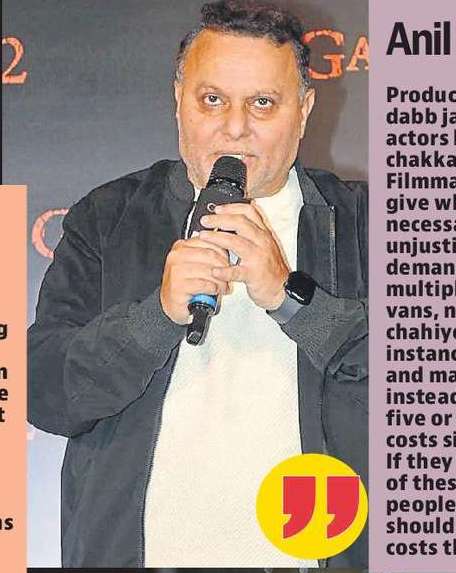
Bollywood grapples with rising budgets even as many big-screen offerings bring disappointing box office numbers. While organizations like the Producers Guild of India and Indian Motion Picture Producers’ Association are working towards solutions — filmmakers tell Yashika Mathur about steps that can help reduce costs across levels
Yashika Mathur (HINDUSTAN TIMES; August 12, 2024)
Srijit Mukherji
One practical approach to reducing costs is to adjust actors’ remuneration based on the average earnings of their last three box-office films. This method could address the financial imbalance that big-budget films underperforming causes.
Anil Sharma
Producers bechare dabb jaate hain actors ke costs ke chakkar mein. Filmmakers happily give what’s necessary but unjustified demands, jaise multiple vanity vans, nahin hone chahiye. For instance, one hair and makeup artist instead of a team of five or six, could cut costs significantly. If they still need all of these extra people, then they should cover the costs themselves.
Suparn S Varma
The cost of securing and maintaining permissions for shooting a Hindi film or series in India is exorbitant. Governments in Hindi-speaking states should consider reducing these costs, similar to how subsidies are provided for Telugu and Tamil films.
Sudhanshu Saria
Pre-production is crucial for managing budgets effectively. Spending more time planning with actors before shooting can streamline the process, This, in turn, will allow for efficient execution of complex scenes, reducing shooting days, particularly beneficial in expensive locations such as, say London (where he shot Ulajh). Additionally, being decisive during pre-production — such as finalising clothing choices and other details — can prevent budget wastage.
Ramesh Taurani
A clear script and directorial vision can help control costs. Jab ek script well-defined hoti hai and it is locked before shooting begins, it reduces the need for last-minute changes and rewrites. This can help reduce production expenses.
Actors have the audacity to increase their entourage costs when their films aren’t even working in theatres-Anil Sharma
8:23 AM
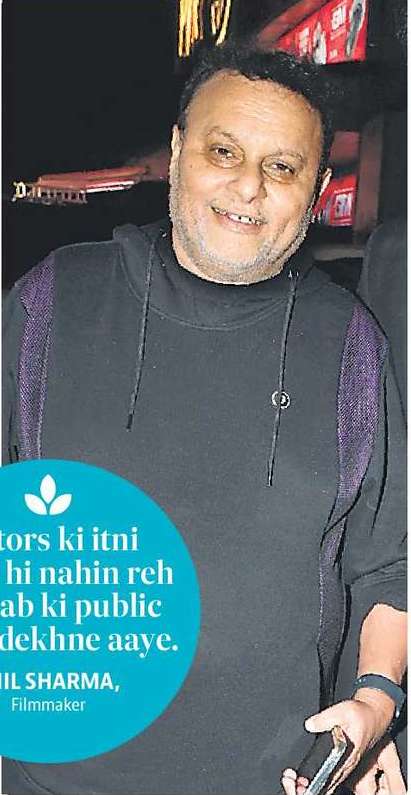
Navya Kharbanda (HINDUSTAN TIMES; July 28, 2024)
Filmmaker Anil Sharma has joined the growing list of industry insiders to share their view on the ongoing debate about the inflated fees of actors. Sharma, who delivered the 2023 blockbuster Gadar 2, tells us, “Actors have the audacity to increase their entourage costs at a time when their films aren’t even working in theatres.”
Noting that only a few actors “still have value and the pull” to draw audiences to the theatres, the filmmaker says, “Gone are the days when we (Bollywood) used to make films with (actor) Dharmendra and many others, and the tickets got booked a week in advance.”
Sharma does not mince his words while criticizing the current crop of actors. “They only work on social media. Either they are earning from Instagram or advertising; cinema se unko kuch nahin mil raha kyunki unko public dekhne hi nahin aa rahi,” he says, adding, “Apart from the 3-4 heroes in Mumbai, no one has the power to get a houseful even on a Saturday or Sunday.”
The 66-year-old also highlights a significant issue: a lack of content with substance. “I feel that many directors, writers and actors haven’t even seen the world beyond Versova and Bandra. Hence, they don’t know what kind of content works in India,” he says, adding, “If the content is good and the actor is also at par, then the film can even be a blockbuster.”
Singham Again, Pushpa 2, Stree 2: Trade experts, filmmakers talk about the phenomenon of sequels, franchises
3:57 PM
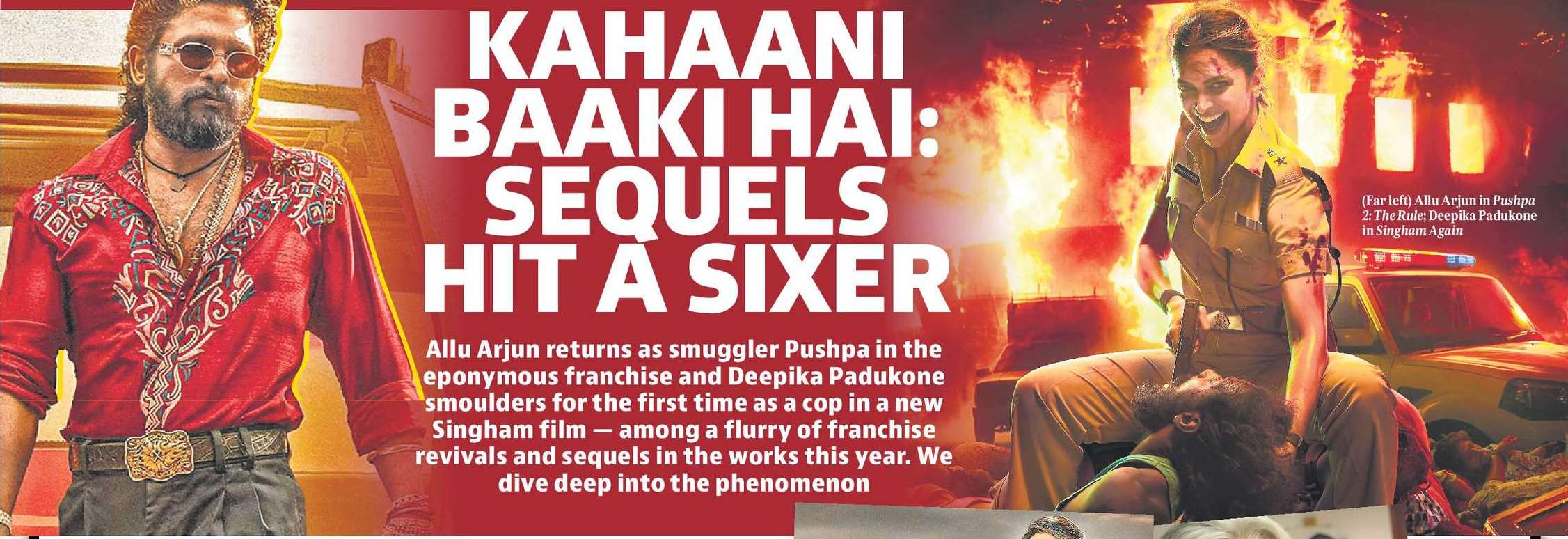
Allu Arjun returns as Pushpa in the eponymous franchise and Deepika Padukone smoulders for the first time as a cop in a new Singham film, among a flurry of franchise revivals and sequels in the works this year. We dive deep into the phenomenon
Mugdha Kapoor (HINDUSTAN TIMES; July 1, 2024)
In recent years, particularly after the pandemic, a noticeable trend has emerged in films: the rise of sequels. In 2022 and 2023, several sequels achieved remarkable success. KGF: Chapter 2, the follow-up to the 2018 hit KGF: Chapter 1, became a pan-India sensation, breaking records and grossing over Rs. 1,200 crore worldwide. Similarly, Drishyam 2, a sequel to the 2015 thriller Drishyam, amassed both critical acclaim and strong box-office returns. Bhool Bhulaiyaa 2, a spiritual sequel to the 2007 horror-comedy, and Gadar 2, which hit theatres 22 years after the first part, also did well.
According to Ormax Media data, franchise films accounted for 17% of the Indian box office in 2019, but by 2023, this figure had risen to 45%. “The most anticipated Hindi films among regular theatregoers in India include Stree 2, Pushpa 2 - The Rule, Hera Pheri 3, Bhool Bhulaiyaa 3, War 2 and Singham Again,” Sanket Kulkarni, head of business development (theatrical), Ormax Media, tells us, adding that the trend also applies to Tamil and Telugu films.
The comfort of familiarity
“Sequels, by their very nature, bring with them a sense of continuity and established connection with characters,” says director Amar Kaushik, who is gearing up for the release of Stree 2. Elaborating, Kaushik says, “When a sequel is announced, viewers feel connected to the franchise because they have already loved the first part. The audiences think of such films as their own. Log expect karte hain sequel se, ki jitna maza unhein first part dekh kar aaya tha, next part bhi utna hi interesting bana hoga aur paise vasool honge.”
Seeing characters that they have loved, and looking forward to new journeys for them, makes it compelling for audiences, notes Gadar 2 director Anil Sharma. “So, the allure lies in revisiting familiar worlds and characters they’ve grown to love,” says Sharma, adding that that’s exactly why “characters and film ka essence same hona chahiye, jo pehle part mein tha, bas”.
Financial incentives and marketability
The financial aspect of making sequels is a significant driving force behind the proliferation. “When a sequel is made, financing and selling become much easier. Studios and investors are more willing to back a project with a proven track record, just as audiences are more inclined to watch a continuation of a beloved story. These factors make sequels an attractive proposition for everyone involved,” says Sharma.
Film exhibitor Akshaye Rathi opines, “[For industry stakeholders, too], sequels are a sure shot recipe for success as filmmakers build on the popularity of a movie that’s already touched the hearts of the people.”
Sequels v/s stand-alone films
Are sequels in abundance because of a lack of original scripts and the failure of stand-alone, big-ticket films to draw audiences? “There’s no dearth of original scripts. Films such as Pathaan (2023) and Jawaan (2023) have done extremely well,” says trade analyst Taran Adarsh, adding, “Even biopics like Srikanth, which is also an original script, have done well.” Meanwhile, concurring, film exhibitor Akshaye Rathi notes that films across genres — from Laapataa Ladies (2023) and Animal (2023) to the recent Munjya — are working well at the box office.
Look forward to:
The lineup of upcoming films is dominated by sequels — Stree 2, Singham Again and Raid 2 — demonstrating that sequels are a mainstay in the cinematic landscape.
Stree 2
Pushpa 2 - The Rule
Singham Again
Raid 2
War 2
Indian 2
Welcome To The Jungle
Bhool Bhulaiyaa 2
Border 2
Hera Pheri 3
Kantara A Legend: Chapter 1
Bhediya 2
-------------------------------------------
There’s no set formula for a sequel. The first thing is to see if you have a story left [from the first part]. There should be honesty. I took 5-6 years to come up with a sequel [to Stree] because I think not just the audience, but even I, should feel excited about the story and the graph of the characters. I believe that all filmmakers who are making a sequel should maintain the essence of the first film and its characters.
-Amar Kaushik director (Stree and Bhediya)
Anil Sharma to begin Nana Patekar-starrer Journey’s final schedule with a nautanki song
8:35 AM
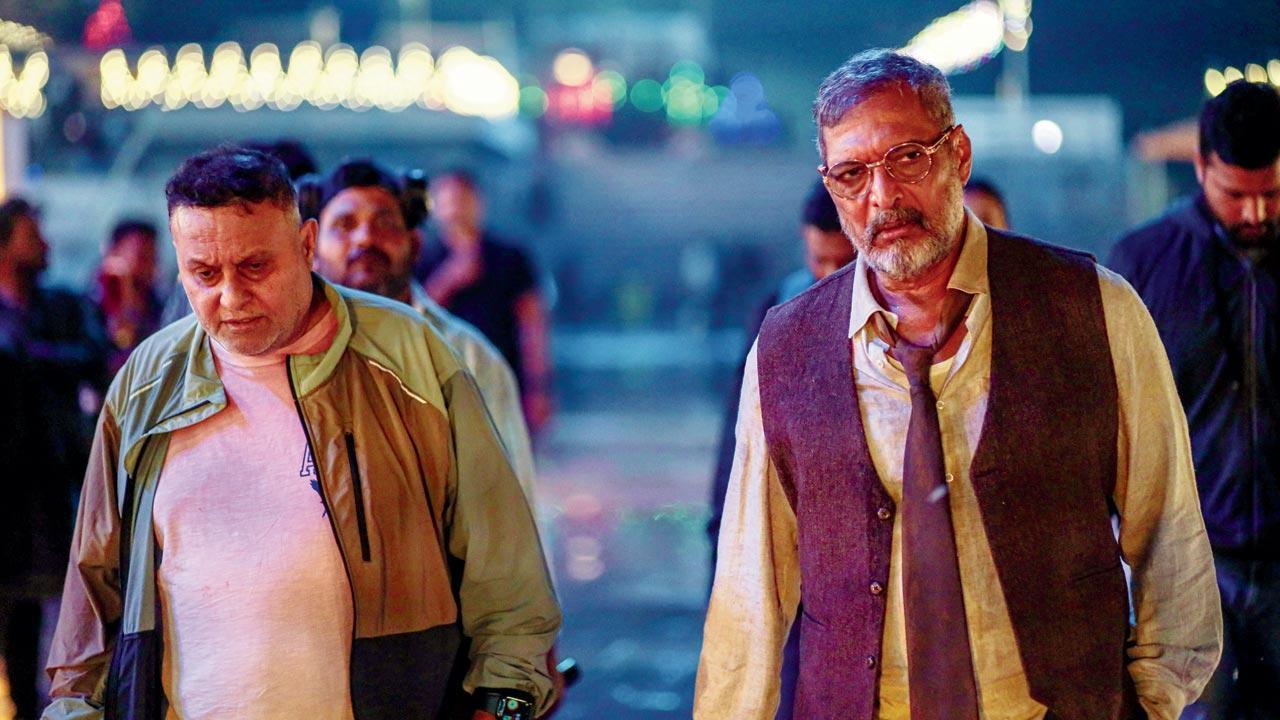
Following up Gadar 2 with Patekar-led Journey, director Anil to begin film’s final schedule with a nautanki song
Upala KBR (MID-DAY; March 9, 2024)
Only months after the stupendous success of Gadar 2: The Katha Continues (2023), Anil Sharma had started shooting his next, Journey, and hoped to wrap it up by March-end. Sure enough, the Nana Patekar-led film is now gearing up for its final schedule that will take place in Mumbai. Considering the father-son relationship drama is largely set in Uttar Pradesh, we hear the team will film a nautanki song—a folk art that has its origins in north India—during this leg. Besides Patekar, it will feature Kushboo Sundar and Utkarsh Sharma, who play his on-screen wife and son respectively.
Currently, a set reflecting the vibrant mood of Varanasi is being built in a north Mumbai studio for the dance number.
A source from the film’s creative team shares, “The final schedule will begin on March 20. Over those 15 days, Anil sir wants to shoot some talkie portions featuring the primary cast, and the nautanki song. Mithoon has composed a foot-tapping track, keeping the sounds of the folk art in mind, while production designer Muneesh Sappel is designing the set. Since the folk song relies heavily on dance, Anil sir’s brief to choreographer Shabina Khan was to imagine it as a bright and colourful number, capturing the spirit of Varanasi.”
Journey’s narrative spans three cities—Varanasi, Shimla and Mumbai. While the first schedule was shot in real locations of the Uttar Pradesh city, the unit then had a 25-day leg in Shimla in January. After the Mumbai stint is complete, the filmmaker will dive into post-production in order to ready the movie for the last quarter of 2024. The source adds, “The aim is to release the movie on a festival weekend in October or November.”
For Anil, his first collaboration with Patekar is the highlight. The filmmaker says, “All I can say is that he is an extraordinary actor who is completely involved in the film. For six months, he has only been thinking about Journey and nothing else. He loves to discuss everything [about the scene in question] before, but on set, there is no discussion about the movie.”
In the season of general elections, political thrillers grips the nation’s psyche
8:08 AM
Mimansa Shekhar (HINDUSTAN TIMES; February 7, 2024)
Bollywood’s love for political stories is not new, but with the upcoming general elections, there is an increase in political dramas. The year started with Pankaj Tripathi starrer Main Atal Hoon, biopic on former Prime Minister, late Atal Bihari Vajpayee. Several other political thrillers, including Article 370, Emergency, Bastar - The Naxal Story, Section 108, The Sabarmati Report, The Delhi Files, are set to hit the screens as filmmakers vie to present intriguing stories on political leaders and key events. But what makes such films click?
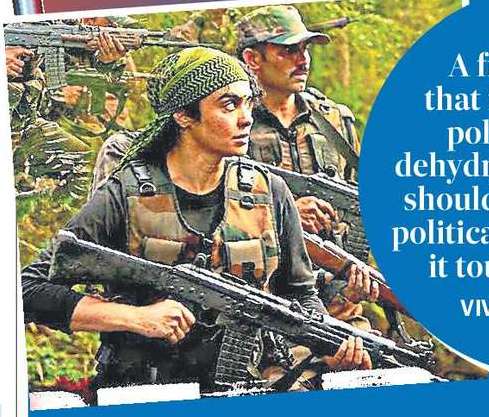
The Tashkent Files (2019), The Kashmir Files (2022) and The Vaccine War (2023) filmmaker Vivek Agnihotri says, “A film industry that isn’t making a political film, is dehydrated. Every film should address socio-political issues because it touches our life.” The filmmaker is helming The Delhi Files, which is reportedly based on the 1984 Sikh riots in New Delhi.
In the past, filmmakers like Raj Kapoor, Manoj Kumar, Dev Anand, Guru Dutt, Shyam Benegal, Prakash Jha, Sudhir Mishra, among others brought socio-political commentary in their films. And this genre continues to be a loved by the current crop of filmmakers.
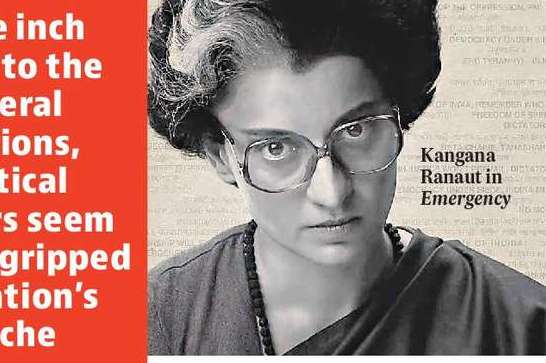
While Yami Gautam Dhar‘s Article 370 is set against the revoking of Article 370 that gave Jammu and Kashmir a special status; Emergency, headlined by Kangana Ranaut, biographical historical drama based on Indian Emergency during former Prime Minister, late Indira Gandhi’s term.
Another reason political thrillers pull in the crowds is the relatability factor. Even if not directly, several movies have subtle political undertones. Pointing at films such as Inquilaab and Aaj Ka MLA (both 1984), Gadar 2 (2023) director Anil Sharma asserts that politics is an integral part of our cinema, “Even today, if you go to the rural areas, people discuss politics sitting under a tree. Political films are a popular sentiment in India, hence it works with the audience.”
Actor Adah Sharma, who spearheaded The Kerala Story (2023), will be seen next in Bastar - The Naxal Story, that traces the Naxal movement in Chattisgarh. The 31-year-old says the final verdict of a film is in the hands of the audience: “In 2023, the biggest movies were Jawaan and Pathaan, which weren’t political thrillers, [but] The Kerala Story was part of the top films. Since time immemorial, movie watchers have embraced all genres equally. Bastar... is a political thriller, if the audience decides it’s well made, it will work.”
With Rang De Basanti (2006), Raajneeti and Rakta Charitra (both, 2010), Aarakshan (2011) and Maharani (2021), we’re seeing an upswing in this genre. The crux remains that important stories are told from every lens and aspect of the political spectrum because that’s what makes the nation think.
Experts share their views
Trade expert Atul Mohan says, “The political thrillers releasing this year don’t have an edge as the audience knows that it can only be agenda driven. Poore desh ka mahaul election ka hai, so news mein zaroor reh sakti hain, but it doesn’t necessarily mean they will do well at the box office also.”
Film exhibitor Akshaye Rathi says, “It’s tough to avoid cricket, cinema and politics in our country. People might say a film is right-leaning, like The Kerala Story or The Kashmir Files, but we’ve also had films like Mulk (2018) or Article 15 (2019), which spoke from the other side of the political leaning.”
Producer and film expert Girish Johar says, “Bheed (2023) was released at the perfect time, but didn’t do well as audiences seek both relevance and entertainment. [For political films], it’s topical as everyone is talking about elections.”
FWICE urges a boycott of Maldives shoots due to strained India-Maldives relations
8:53 AM

Despite being a sought-after backdrop for films, FWICE urges a boycott of Maldives shoots due to strained India-Maldives relations
Navya Kharbanda (HINDUSTAN TIMES; January 15, 2024)
The Maldives has been a favourite shooting location for Bollywood filmmakers, with movies such as Maine Pyaar Kyun Kiya (2005), Agent Vinod (2012), Ek Villain (2014) and Ram Setu (2022), shot in the island country. However, given the deteriorating relations between India and the Maldives lately after three ministers made derogatory remarks against Prime Minister Narendra Modi after his visit to the Lakshadweep, the Federation of Western India Cine Employees (FWICE) has appealed to the producers to boycott shoots in the Maldives.
Their statement read: “In solidarity with the nation, the members of the FWICE have decided to boycott Maldives for their shooting locations. Instead, we appeal to its members to choose similar locations in India for their shooting purpose and contribute towards developing the tourism in India.”
FWICE chief advisor, filmmaker Ashoke Pandit, says, “It was important for Bollywood to extend support to show the Maldives that we can’t be taken for granted.”
ANIL SHARMA, DIRECTOR
There are a lot of locations for us to shoot our films. Nothing matters more than our country’s pride.
GIRISH JOHAR, TRADE EXPERT AND PRODUCER
A couple of songs were scheduled to be shot in the Maldives. FWICE’s notice would dent the whole travel economy and film shoots.
RAHUL DHOLAKIA, DIRECTOR
Changing any location at the last minute costs us. It also delays schedules as you have to start the process all over again. As a filmmaker, I think it’s unfair to the director, but then, this can happen for many other reasons too, including natural disasters, airline issues, etc. I don’t think filmmakers or the film fraternity should boycott any country or location unless the government officially asks us to do so.
ANAND PANDIT, PRODUCER
We can find alternatives. We are no longer in the cinematic era where foreign locations were necessary for romantic songs. From a monetary point-of-view, I don’t see any negative impact of FWICE’s decision.
RAMESH TAURANI, PRODUCER
We have many islands in India that are like the Maldives. Maldives waise bhi bahut expensive country hai. We support PM Modi and the country with this decision. Maldives ne apna bahut nuksaan karaya hai in statements se.
Nana Patekar will sit with the director, write down each dialogue, and take notes in a book-Anil Sharma
8:50 AM
Having wrapped up first leg of Journey in Varanasi, Gadar 2 director Anil impressed by leading man Patekar’s student-like approach to work
Upala KBR (MID-DAY; December 19, 2023)
Even before the year has come to a close, Anil Sharma—the director behind the blockbuster, Gadar 2: The Katha Continues—has made his way back to a movie set. He recently wrapped up the first schedule of Journey, which is led by Nana Patekar. If Gadar 2 saw Sunny Deol’s protagonist cross the border to rescue his son, the upcoming father-son drama is understated and realistic. Sources say that Journey is along the lines of Amitabh Bachchan and Hema Malini’s Baghban (2003).
A source from the creative team reveals, “Journey spans three cities and revolves around elderly parents and their child, played by Utkarsh Sharma. It will remind viewers of Baghban, and Rajesh Khanna and Shabana Azmi-starrer, Avtaar [1983]. South actor Kushboo Sundar plays Nana’s wife.”
While the cast kicked off the shoot in the first week of November in Varanasi, the second schedule will be conducted in Shimla in January. The source adds, “Beginning January 15, a 40-day schedule has been lined up. The final leg will be in Mumbai, with Anil planning to complete the shoot by March-end.”
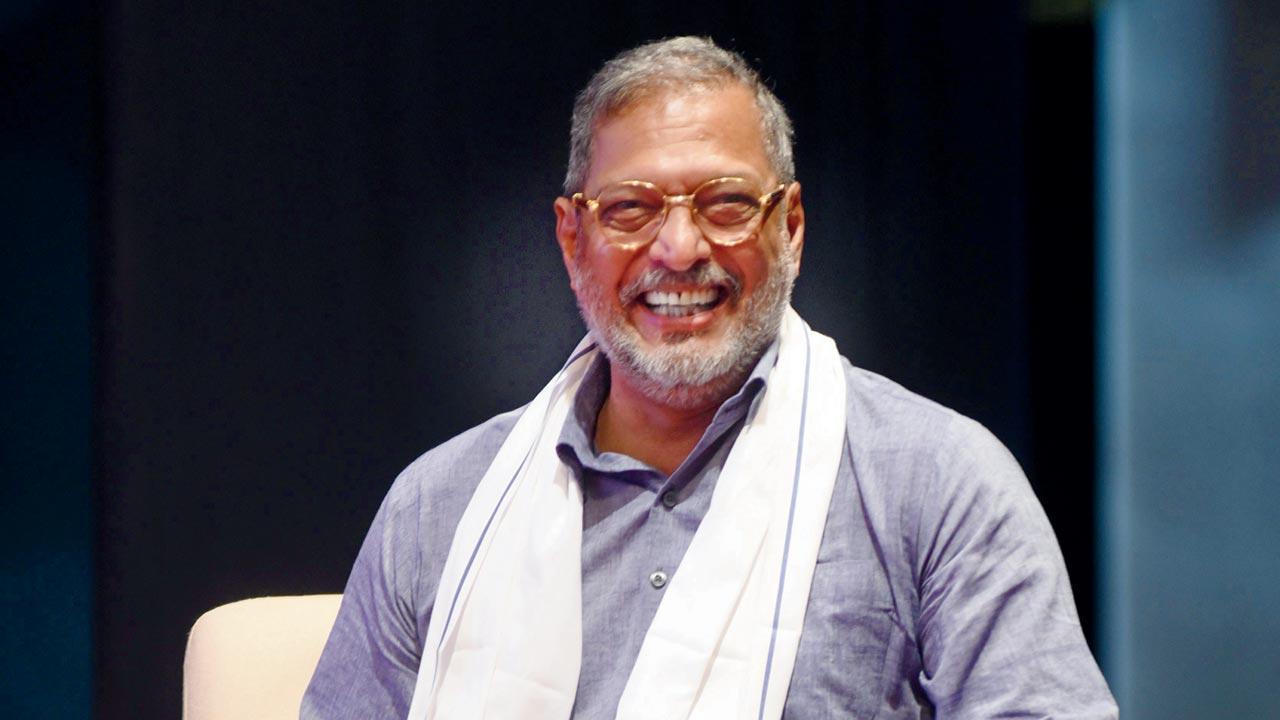
For the director, it is a pleasure to work with an actor of Patekar’s calibre. Anil says, “Once he gets the script, he is like a student. Nana-ji will sit with the director, write down each dialogue, and take notes in a book. He tells us, ‘When I come on the set, I should be fully comfortable with my lines so that I can focus on my performance.’ That’s why his dialogues and performances look so real.”
The filmmaker, who is riding the wave of success after Gadar 2, says he doesn’t feel pressured to deliver another hit. “After Gadar 2, the expectations have naturally increased, but I don’t let them affect me. If Journey manages to win people’s hearts, I will be happy.”
During Aashram, I used to feel disgusted with myself; now, playing dark roles doesn’t affect me-Bobby Deol
8:04 AM
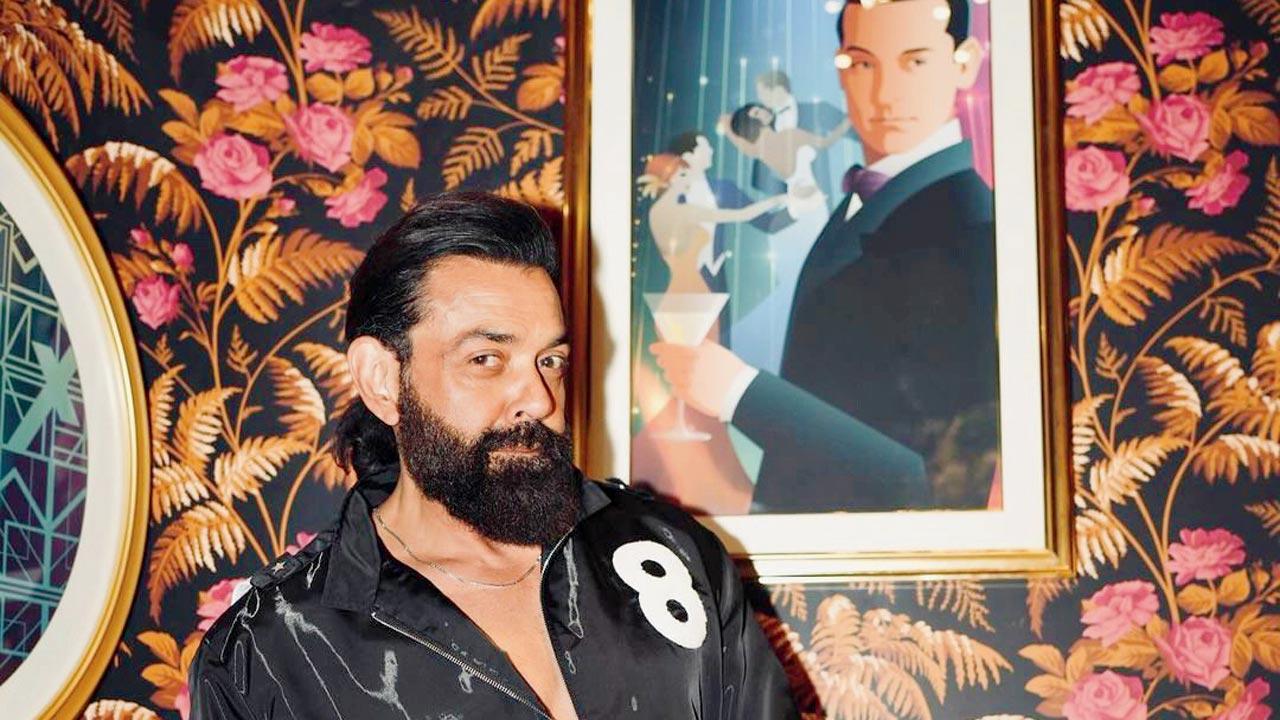
Following up Animal with a villainous act in Kanguva, Bobby Deol on switching gears to negative roles in his second innings
Upala KBR (MID-DAY; December 17, 2023)
One can’t imagine a better time for Dharmendra, Sunny and Bobby Deol to come together on screen. After all, each actor has enjoyed a blockbuster this year—from the veteran actor in Rocky Aur Rani Kii Prem Kahaani, to Sunny’s Gadar 2: The Katha Continues and Bobby’s Animal. Naturally then, there is much interest around Apne 2, which was announced in November 2020. However, Bobby says the family drama won’t roll anytime soon.
Reason—director Anil Sharma and the team haven’t found the perfect script to bring together three generations of the Deol family, including Sunny’s son Karan. Bobby says, “We have a concept, but we’re still searching for the right kind of story. It all depends when the story gets ready. We’re clear that we will make Apne 2 only when we feel that it has rich emotions and the right [dose of] drama. It should be a heartfelt emotional story upholding family values, like Apne. God has been kind to all of us this year, so now we need to be careful about what we do together.”
It has been a successful second innings for Bobby, who returned to the movies after a long hiatus with Poster Boys (2017) and Race 3 (2018). While Love Hostel (2022) and Aashram caught everyone’s attention, his popularity soared as he played the antagonist in Ranbir Kapoor’s Animal. Interestingly, in the past few years, he has continuously taken up dark roles. Has that been a conscious decision?
“I’m not always looking to play negative characters. I want to play different characters. Portraying Kashipurwale baba [in Aashram] was challenging. During the first few days of Aashram shoot, when I was playing something all-out negative for the first time, I’d feel a bit disgusted with myself. But then I accepted that the character is like that. Now, playing dark roles doesn’t affect me. I don’t carry the characters in my head.”
Up next, he will be seen as the baddie in Tamil movie Kanguva, and Telugu offering Hari Hara Veera Mallu where he will reportedly play the tyrannical Mughal emperor, Aurangzeb. “I cannot comment as the makers haven’t officially announced anything. I select roles on the basis of their substance. I’ve got offers from big banners to play the villain, but I said no because I cannot do caricature villains. I’ve been lucky to be appreciated whenever I played negative characters.”
Between Gadar and Gadar 2, I had a struggle period of 20 years-Sunny Deol
5:41 AM

Niharika Lal (BOMBAY TIMES; November 23, 2023)
Throughout his masterclass at IFFI – titled ‘No If, No But, Only Jatt’ – Sunny Deol kept tearing up while hearing his directors – Rahul Rawail, Raj Kumar Santoshi and Anil Sharma – talk about him. The directors shared, “Sunny is too emotional, even during the filming of films like Gadar, Ghayal, Arjun and several others, he’d become pretty emotional and cry a lot after filming certain scenes.”
'I'd stopped believing'
“In 2000, after Gadar came out, a struggle period started for me because nobody was coming to me with good scripts. Pata nahi kyun nahi mil rahi thi, but between Gadar and Gadar 2 there is a gap of 20 years and while I did a couple of films in between, it was not that impactful. Lekin Gadar 2 ke baad jo khushi mili, jiske wajah se aaj kal main itna emotional ho jata hoon… because I stopped believing in things (in the last 20 years). Lekin maine kabhi haar nahi maani. Main hamesha aage badhta raha hoon.”
Talking about the type of films he wanted to do, Sunny said, “When I joined the industry, I was clear that I don’t want to do formula films. I was fortunate that when I joined the industry I got to do the kind of films that I wanted. Shuru mein main nahi chah raha tha ki main papa, Amit ji aur Mithun ji jaise filmein karoon. Unka cinema alag tha. Baad mein maine uss tarah ki filmein bhi ki hai. I joined films because I wanted to become an actor, main actor banna chahta tha. Mere andar ye nahi tha ki main star banoon. Maine papa ki filmein dekhi hain, main uss variety ki film karna chahta tha.”
At the session, all three directors shared their experience of working with Sunny and pointed out that they saw that vulnerability of Dharmendra in Sunny and decided to approach him for films.
Rajkumar Santoshi, who directed Sunny in films like Ghayal (1990), Damini (1993) and Ghatak (1996), remarked, “Sunny is like Dharmendra - a combination of strength and vulnerability. He never interferes with his director. He will keep giving takes jab tak puri unit satisfy na ho jaye. Sunny ke andar ek khwahish hai to excel. Mera manna hai ki industry ne insaaf nahi kiya Sunny ke saath.”
Rahul Rawail, who worked with Sunny in many films including Arjun (1985) and Arjun Pandit (1999), said, “What I noticed in Sunny is that when it comes to films, he never says no to anything. In Betaab (1983), there is a scene when Sunny’s character slides below a horse carriage and after giving one shot, the duplicate refused to do it as he was too scared. And then Sunny was like, ‘I will do it, Rahul. don’t worry about the shot.’ And he did it quite smoothly.”
Anil Sharma, who directed Gadar (2001) and Gadar 2 (2023), said, “When I approached Sunny for Gadar 2, he was quite reluctant. Anyone else would have happily agreed, but convincing him was very difficult. He wanted to do it right for the audience as he didn’t want to ruin the legacy of the first film. Now, we are making Gadar 3.”
Sunny revealed that he initially didn’t agree to Gadar 2 because, for him, it was a lesson learned from making Ghayal Once Again.
Subscribe to:
Posts (Atom)