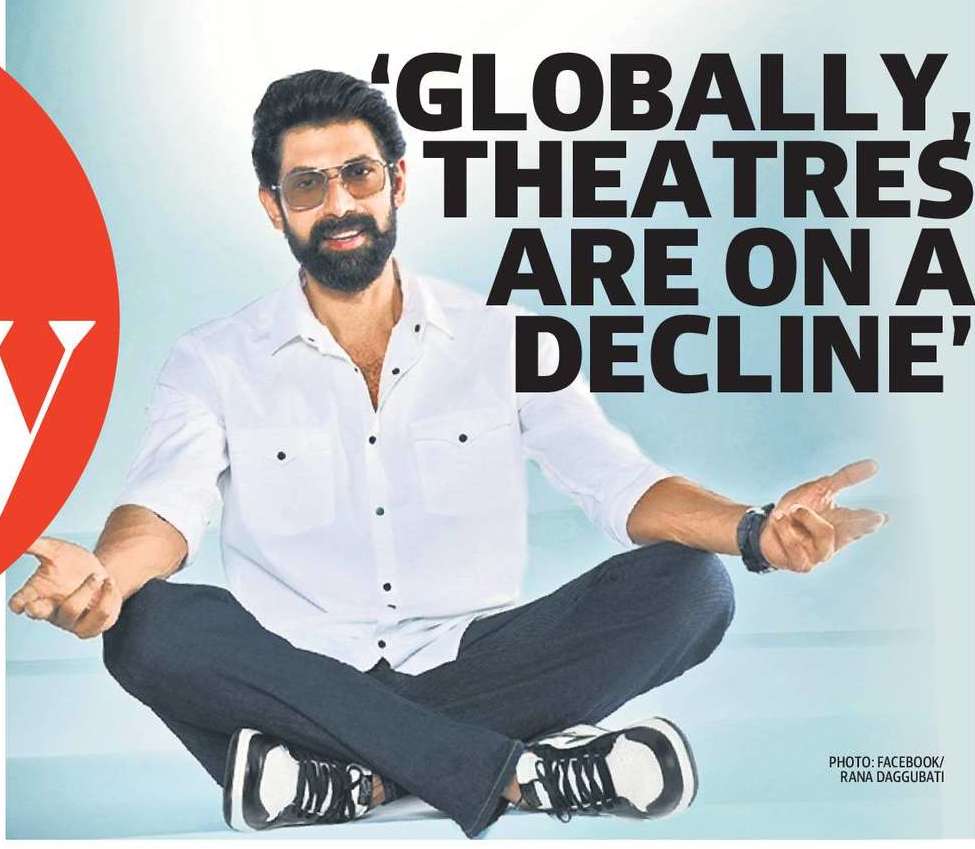
Globally, the theatres are on a decline in some manner-Rana Daggubati
9:16 AM
We shot in Thailand for 6 months alongside The White Lotus team. It was one of the most enriching experiences-Adarsh Gourav
10:22 AM
Ram Gopal Varma skips inquiry, Andhra Pradesh cops in hot pursuit of filmmaker
8:21 AM
Rashmika Mandanna deepfake case: 23-year-old 'fan' arrested
3:49 PM

With Jawan, Shah Rukh Khan isn’t making inroads, but a highway into the south film industry-Atul Mohan
2:56 PM
S S Rajamouli takes up questions on religious extremism, regional politics etc in his interviews in the West
8:40 AM
The bifurcation between what’s suited for big screen and what’s better for OTT will become clearer-Rana Daggubati
8:54 AM


People must report those fleecing them to the cops or on social media-Bhumi Pednekar
7:57 AM


Goa and Telangana under lockdown; what’s the next move for Bollywood and Television producers?
8:16 AM
Fenil's Bollywood Talk # 671
10:47 PM

AND CINEMAS SHUT ONCE AGAIN
India is in the second wave of Coronavirus right now and it’s much more extreme than the first wave. A lot of states went under lockdown or introduced curbs and as part of it, theatres were asked to shut down. This is because cinema halls are believed to be venues where the Covid-19 virus can spread rapidly. That there has rarely been a case where a person got infected after a theatre outing is a different matter! But with non-essential shops, malls, restaurants etc being asked to shut shop, cinema halls obviously won’t be left out.
On April 27, Kerala government ordered theatres in the state to down shutters. Even the Gujarat government passed a similar order earlier this week. As a result, theatres are now only open in Andhra Pradesh, Arunachal Pradesh, Assam, Telangana and West Bengal. With the cases refusing to subside in most parts of India, the fear is that in the next 10 days, even these states would ask cinemas to halt operations.
Many cinema halls in these states have already downed shutters, due to lack of content. Since April 2, no new Hindi film has been released. Godzilla vs. Kong was the last major film that worked pan-India but even that was released a month ago. And in North, West and East India, it failed to reach the desired numbers due to fear psychosis about the virus. Hence, the belief is that even if state governments don’t take the harsh decision, the exhibition themselves will stop playing films to save on the costs.
2-3 days ago, the makers of Satyameva Jayate 2 announced that their actioner stands postponed. Starring John Abraham and Divya Khosla Kumar, it was supposed to release on May 13, on Eid. The other upcoming films like Bellbottom (scheduled to release on May 28) and ’83 (scheduled to release on June 4) will soon be pushed ahead too.
The experts have predicted that the cases will reach a peak in mid-May after which there’ll be a reduction in numbers. In such a scenario, it is said that cinemas in most states will be allowed to open only after mid-June or in July.
It's not practical to release Sooryavanshi on Diwali, says Reliance Entertainment group CEO Shibasish Sarkar
8:40 AM


Hyderabad, Vizag become new shoot hubs for Bollywood?
8:21 AM

Suresh Babu, Rana Daggubati reveal A-list filmmakers want to rent their studios, which also offer accommodation, equipment, production services
Akash Bhatnagar (MUMBAI MIRROR; June 18, 2020)
 Bhushan Kumar confirmed to Mirror (June 11) that next month, the Mumbai Saga team will head to Ramoji Rao Film City in Hyderabad, with actors John Abraham, Emraan Hashmi and Suniel Shetty, among others, to wrap up its shoot. On Tuesday, he announced that another John-starrer, Satyameva Jayate 2, will roll in August, even though they have yet to fix the location.
Meanwhile, veteran producer and studio owner Suresh Babu informs that he’s been approached by several Bollywood filmmakers to rent out their three studios, two in Hyderabad and one in Vishakapatnam, for shoots.
“Producers want their team isolated together during shoots to mitigate risk of infection. When you are filming in your city, you’d want to return home to your family, which is why makers are looking at locations outside the state,” he reasons, pointing out that they wrapped up a small-budget Telugu film at Ramoji a few days ago.
 On the makers who have reached out to him, he says, “My son Rana (Daggubati) is close to Sajid (Nadiadwala) and Karan (Johar). If they need anything, as studio owners we will go out of our way for them. This is not the time for balance sheets but to help the fraternity move forward.”
Rana adds that they are ready to welcome filmmakers from across the country. “Shoots for TV and web shows have already begun according to government guidelines and several more will kick off in the next few weeks. Around next month, we should see some Hindi films readying for shoot across Telangana and Andhra Pradesh,” he shares.
The actor points out that between the three studios, they have 50-55 acres of land to erect sets and standing sets, along with a lake and in Vizag, a picturesque ocean nearby. “The studios offer end-to-end solutions, from accommodation to shooting, for which equipment including cameras can be rented, and post-production work. We have fully functional editing and dubbing rooms, recording studios and VFX facilities. Even in-house technicians are available,” Rana informs.
With Bollywood producers moving in, won’t Telugu film shoots get affected? “The big Telugu films are yet to take a call but even if Ramoji fills up, we can quickly set them up at other studios in Hyderabad,” Suresh Babu assures.
One of the most disputed guideline in Maharashtra is that actors over 65 are not allowed to resume work. In Andhra and Telangana, they have left the call to them. “If an actor needs to finish a shoot, they can come quietly and do it quickly. There won’t be officials monitoring every shoot,” Suresh Babu reasons. But with cases going up in Maharashtra, aren’t they worried? “I have a wedding coming up in my family and I am concerned on a personal level. But as a city and state, we are happy to host filmmakers from across the country,” says Suresh Babu.
The groom-to-be points out that it’s mandatory for the whole unit to be tested before shooting starts and PPE kits and sanitisation is compulsory. “We will keep units isolated during schedules, with medical support on the set. We are following a Comprehensive Sanitation Protocol Solution as outlined by the MHA guidelines and using formulations that are more effective than regular disinfectants. We are also adopting smartphone-based technologies to manage meetings, resources and inventory. We are confident of providing a safe environment for work,” Rana adds.
Swara Bhasker helps migrant workers return home
8:07 AM

Kavita Awaasthi (HINDUSTAN TIMES; June 10, 2020)
After helping 100 migrants return to their hometown safely in the Coronavirus lockdown, actor Swara Bhasker recently arranged safe transportation for 22 labourers from Begusarai, Bihar, who were stuck at their company site in Vishakapatnam, Andhra Pradesh. When Bhasker received a message on her Twitter handle, which gave details about the workers, she called them and took stock of the situation.
A source says, “Understanding the plight of the labourers, Bhasker jumped into action and contacted the district collector and the police authorities to arrange permissions and a bus to send the migrants back home to Bihar. Going an extra mile, she also ensured that all financial dues of the 22 company workers were cleared by their employer before they left for home.”
Earlier, Swara had arranged buses for 100 migrants stuck in Bahadurgarh, Haryana, to their hometown Ballia in Uttar Pradesh.
“I’ve been participating in the relief efforts using Twitter as a platform. I have been collaborating with different groups regarding the same and that’s when I heard of these migrants. I was so pleased with the prompt action by the police, especially IPS Vishal Gunni. He got everything done within five days,” she says.
She adds, “This is a time of great difficulty but also of great hope because I’ve seen people within the bureaucratic system come forward to help the migrants.”
Ram Gopal Varma denied entry in Vijayawada after threatening to hold press meet without permission
8:58 AM

MID-DAY (April 29, 2019)
In a fresh row over his movie Lakshmi’s NTR, controversial filmmaker Ram Gopal Varma was not allowed entry into Vijayawada by the city police after he threatened to address a press conference on the road. Varma tweeted that his car was stopped and he was forced to shift to another car before being dropped at the airport. The filmmaker said the police told him that he can’t enter the city. He alleged that there is no democracy in Andhra Pradesh.
Varma wanted to address a press conference ahead of his film’s release in Andhra Pradesh on May 1. As a star hotel reportedly denied him permission, he announced that he will address the media at NTR Circle. The police said since prohibitory orders were in force in view of the Model Code of Conduct for ongoing Lok Sabha elections, no meeting could be allowed in public and hence they had to send the director back.
Varma was likely to address the media after reaching Hyderabad later that evening. His film Lakshmi’s NTR, was released in Telangana last month, but the Andhra Pradesh High Court stayed its screening till the elections. As simultaneous elections to the Andhra Pradesh Assembly and the Lok Sabha were held on April 11, he announced plans to release the movie on May 1.
The film is about Telugu Desam Party founder and former Andhra Pradesh Chief Minister NT Rama Rao’s second marriage with Lakshmi Parvathi and the subsequent differences in the family, leading to revolt by his son-in-law N. Chandrababu Naidu in August 1995.
The queen is secure; Padmaavat opens without any incident in Mumbai
4:18 AM

Sanjay Leela Bhansali’s Padmaavat opens without incident; despite a slow start is expected to pull crowds over long weekend
While the release of Sanjay Leela Bhansali’s period-drama Padmaavat on Thursday was marked by sporadic violence in parts of Uttar Pradesh, Madhya Pradesh, Haryana, Rajasthan and Uttarakhand, Mumbai witnessed an incident-free opening largely due to heavy police bandobast.
On Wednesday, the 6 pm paid previews at Thane’s Korum and Viviana malls were cancelled owing to security concerns after which the police sprang into action to facilitate the 7 pm show, which began on time and ran without glitch. “Checks were in place and there was no damage to property. The 6 pm show was cancelled due to threats,” an employee informed Mirror while a cop at the venue added that security will continue through the threeday weekend.
On Thursday, the pre-emptive move proved effective as the law and order situation appeared to be more streamlined than in other cities. In Chembur’s K Star mall which houses the Fun Republic multiplex on its fourth floor, Padmaavat opened to a 60 per cent turnout, with college students constituting the majority of the morning footfall. However, turnout at the neighbouring Movietime was abysmal amidst unprecedented security at both theatres. “In the RCF (area) an extra 15–20 policemen have been brought in from nearby stations to ensure there is no trouble. We have been on duty since the Wednesday show but there was no trouble whatsoever,” a cop told Mirror even as a particularly inquisitive gent enquired if his gun was loaded.
Despite its A-list star cast and the hype generated by the raging controversy, the film has got off to a slow start. A staff member at a Santa Cruz multiplex on conditions of anonymity — “we have branches in Rajasthan and Gujarat and don’t wish to cause trouble there” — revealed that 102 bookings were made for the 9.30 am show on Thursday and 148 for the 12.45 pm slot. With five screenings a day, the 420-seater theatre clocked in a little over 507 bookings on the first day.
Chandan Cinema in Juhu which has given Padmaavat four shows, wore a deserted look. Viewers were scant at the adjacent PVR theatre, which is screening 20 shows a day (the only other notable film at the multiplex currently is Steven Spielberg’s Meryl Streep and Tom Hanks-starrer The Post), with 2D and 3D versions alternating every 45 minutes. “The first show at 8 am on Thursday saw 32 per cent occupancy which swelled to 86–90 per cent for shows after 5 pm,” a PVR Communications official informs, adding that the slow start was to be attributed to the fact that the film had opened on a weekday and not to the controversy. “It will pick up significantly as indicated by advance bookings for the weekend. We didn’t ask for extra protection but given the multiplex’s prime location, the Mumbai police have deployed security. On our part, we have removed queue managers inside the premises as they are often used to break glass during agitations,” the source informs.
Shoeb Shaikh, duty manager at PVR ECX, Andheri, is even more optimistic. The first show at 8.15 am at his multiplex witnessed 80 per cent occupancy and an overall footfall of 60–65 per cent. The neighbouring Cinepolis multiplex however opened to just 35 per cent occupancy. The central suburbs clocked in lesser bookings as compared to its western counterpart. The first show at Carnival Cinema in Bhandup was cancelled due to zero turnout, while Cinepolis saw 23-30 per cent occupancy. However, the slow start hasn’t dampened spirits in the area. The staff is confident that the cash registers will ring over the next three days. Unlike the suburban theatres, most South Mumbai screens refrained from displaying posters and hoardings of the film. Regal was an exception but Sterling didn’t even put out show timings. INOX, Nariman Point announced the film only on the BO ticker.
 Trade analyst Amod Mehra offers a more
holistic view of the situation, pointing out that Padmaavat is bound to
lose 30 per cent of its collections as it has not released in four
states, but is quick to add that the unwarranted attention to the film’s
story has only fuelled the moviegoers’ curiosity. “The only problem is
the mixed response from the audience, which ranges from good to boring.
The 3D format has backfired because it renders the film dark while
moviegoers want historicals to look vibrant. But the film will be
unstoppable over the long weekend with highly priced tickets. The
official verdict though will be determined only on Monday,” he says.
Trade analyst Amod Mehra offers a more
holistic view of the situation, pointing out that Padmaavat is bound to
lose 30 per cent of its collections as it has not released in four
states, but is quick to add that the unwarranted attention to the film’s
story has only fuelled the moviegoers’ curiosity. “The only problem is
the mixed response from the audience, which ranges from good to boring.
The 3D format has backfired because it renders the film dark while
moviegoers want historicals to look vibrant. But the film will be
unstoppable over the long weekend with highly priced tickets. The
official verdict though will be determined only on Monday,” he says.He is expecting the film to rake in between Rs 100–150 crore over the next three days. “If it crashes on Monday, it will only manage to recover costs, but the satellite deal can be renegotiated and that should help it bring in profits,” he signs off on an optimistic note.
----------------------------------------------------------------------------------------------------------------

West Bengal, Andhra Pradesh follow suit
Padmaavat release was glitchfree in West Bengal too, with the exception of Asansol district’s Kumarpur, where members of the Viswa Hindu Parishad and Rajput Kalyan Samiti burnt an effigy of Bhansali in front of Manoj movie hall. The situation was quickly brought under control.
Andhra Pradesh and Telangana also witnessed a largely peaceful first day save for a token protest at Tivoli theatre last Sunday. BJP MLA from Goshamahal Raja Singh, also did a U-turn on his call to damage the theatres, asking people to watch the movie and protest only if they find anything objectionable.
— Jatari Nag and P Pavan
Why Mersal was not released in Telugu
8:03 AM

Subhash K Jha (DNA; October 30, 2017)
While it is being speculated that the Central Board of Film Certification (CBFC) has played the villain in the release of the Telugu version of Mersal, it now comes to light that the film’s producers have themselves opted to hold back the release in Andhra Pradesh and Telangana.
According to a source, the producers now plan to release more than 800 prints of the Telugu version. CBFC chairperson Prasoon Joshi clarifies that the Board has nothing to do with the delay of the Telugu version, “Why would we cause any delay? The process of censorship takes time. That process should be respected. Having said that, we must be very clear on this: there are no cuts in the Telugu version. The Tamil and Telugu versions are exactly the same.”
Says former CBFC chairperson, Pahlaj Nihalani, “All the versions of a multilingual film are viewed separately, but certified one after another. So, there is no question of the Telugu version remaining uncertified for weeks after the release of the Tamil version. Someone is trying to gain mileage out of the controversies surrounding this film.”
Now, a biopic to be made on badminton ace Pullela Gopichand
7:47 AM

Roshmila Bhattacharya (MUMBAI MIRROR; June 28, 2017)
Pullela Gopichand, the man who stands tall on the badminton court, is all set to bring his game, set and match to the screen. The Padma Shri awardee and chief national coach of the Indian badminton team, responsible for ending China’s dominance in the sport, and regarded as the chief architect of India as a badminton superpower in the world, is now the subject of a biopic.
Vikram Malhotra who has produced films like Airlift, Baby and the upcoming Chef, has acquired the rights from the shuttler-turned-coach to produce a film on his life and achievements. The film, a Hindi-Telugu bilingual since Telugu is Gopichand’s mother tongue and he is worshiped in Andhra Pradesh, is currently being developed.
Confirming the news, Gopi, as he is fondly called, told Mirror, “I am excited at the prospect of the film and look forward to it. I liked Vikram and his team’s vision and hope that it takes the sport of badminton to millions more across the world.”
The ace shuttler is only the second Indian after Prakash Padukone to win the All England Open Badminton Championship in 2001. And while that title was reason enough for him to rest on his laurels, the unassuming guy with the shy smile and a racket in hand, wasn’t done yet. Seven years after this historic win, he founded the Gopichand Badminton Academy in Hyderabad.
A household name across the country today, the academy has produced several badminton champions, including Saina Nehwal who bagged bronze in the 2012 Summer Olympics, PV Sindhu who bettered that with a silver in the Games four years later and, more recently, Srikanth Kidambi, whom he turned from a playful joker on court into a much-applauded world champion with two super series wins — the Indonesian Open and Australia Open — in the course of a week. His list of protégés also includes talents like Parupalli Kashyap, Arundhati Pantawane, Gurusai Datt and Arun Vishnu, making him the worthy recipient of the Arjuna Award in 1999 and the Dronacharya Award a decade later.
An excited Vikram asserts that it is an honour that a legend like Pullela Gopichand has chosen his banner to tell his story to the world. “It is a huge responsibility as Gopi’s life has not only been one of inspiring achievements but also that of iconic contributions to the world of sports and our society at large. Our aim is to create an authentic and impactful rendition of his story,” he reiterates.
It won’t be easy to step into the large shoes of the 44-year-old legend, married to fellow badminton player PVV Lakshmi. Which actor do they have in mind to play Gopichand’s reel life avatar? “It’s a tough choice as the actor needs to be a combination of sports skills, acting talent and the ability to transform himself into Gopi. We are even considering doing the film with a newcomer,” says Vikram.
While they figure that out, Gopi continues to keep the Indian tricolour flying high across the world.
CM N. Chandrababu Naidu wants Ajay Devgn-Kajol to be the faces of Andhra Pradesh?
11:35 AM

Avinash Lohana (MUMBAI MIRROR; April 16, 2016)
After he was roped in to promote Bulgarian tourism, Ajay Devgn, along with wife Kajol has now been approached by Andhra Pradesh Chief Minister N. Chandrababu Naidu to be the faces for the state.
Naidu met Ajay earlier this week and according to a source the discussion was on development with focus on entertainment and business. "In the course of the meeting the Chief Minister suggested that Ajay and Kajol be the brand ambassadors for the state. Ajay has a mass appeal and connects with the locals," adds the source pointing out that he has a long association with AP.
"Rohit Shetty's Singham along and Nishikant Kamat's Drishyam were both filmed there. Ajay is keen to take up the role." The actor has thanked Naidu for the "warm and delightful meeting". "It was a pleasure to discuss your amazing vision for the new state," he tweeted.
However, for now he is totally focussed on his second directorial venture, Shivaay. "The Bulgaria schedule has wrapped and Ajay will be shooting for a month in Mumbai now. Simultaneously, he has begun post-production and dubbing," informs the source.
Indian filmmakers' open up about torturous experiences while shooting in certain parts of country
9:06 AM
There were several highs and lows in 2014 vis-à-vis the Hindi film industry, but the one thing that is encouraging is the rise of small-budgeted films. Not only that. Even the fact that they are released alongside big budget films was an appealing highlight of the elapsed year. However, the remedy of one problem has also brought to light another obstacle. Turns out filmmakers — big ticket or small — are finding it increasingly difficult to shoot in certain parts of the country.

(L-R): Nawazuddin Siddiqui, Chitrangada Singh and Tahir Raj Bhasin
In the news for his misadventure with the Federation of Cine Technicians and Workers of Eastern India, director Kushan Nandy recently claimed in a tweet that he was a victim of extortion, blackmail and his unit was held hostage for 72 hours. That might sound like a situation that mirrors the murkiness of AfPak but we are talking about West Bengal here. In Bolpur, a municipality in Birbhum district, to shoot his latest film, Nandy faced a number of problems that one would generally not associate with filmmaking. His film features Nawazuddin Siddiqui, Chitrangada Singh and Tahir Raj Bhasin in leading roles and is chugging on towards completion.
Nandy revealed that the screenplay of his film could be best picturised against the landscape of West Bengal, and after shooting for more than a month in parts of the state, the director was unable to shoot further in some interiors because of the “terrible” experience with the aforementioned federation. “While shooting in Bengal, according to rule, we have to hire 30 per cent of manpower from the local area. But the set number keeps increasing. It doubles and triples proving that there is no parity in what they say and do. Once 60 people become 180, the budgets begin to go haywire and because you have planned to do other things with that budget — instead of paying those who weren’t even present for the shoot — those feigning non-payment start hounding you,” rues the Mumbai-based director.
When we contacted Aparna Ghatak of the Federation of Cine Technicians and Workers of Eastern India, for her side of the story, she said that the matter had been resolved. According to her, the shooting would resume shortly once the payments are received. “However, what angered the workers was that they have been portrayed in a bad light, even after the team from Mumbai was aware that the hooliganism was not caused by workers registered with the federation,” clarifies the general secretary. Ironically, this federation has gathered flak from quite a few filmmakers based in the region.

Kashmir

Bollywood’s romance with Kashmir has been elaborated over more than 20 blockbusters, but recently to document the harsh realities other than the beauty of the state, the few filmmakers who have ventured out there with a small crew and big plans have faced the suspicion of political groups. Take for example, Aamir Bashir’s experience, on shooting the film Harud. In an earlier interview he had said, “Kashmir being a politically volatile place, one had to face the mistrust that local people have for anyone coming from outside with a camera. So, there was a lot of negotiating involved on a day to day basis. With just 18 people in the crew, everyone had to multi-task. A lot of the scenes are outdoors on the streets of Srinagar and crowd-control was a big headache.” While that was the experience of a filmmaker operating on a low budget, not so long ago the crew of Haider was forced to retreat after students of the Kashmir University violently opposed the shooting of a sequence that was based on a fedayeen attack.

West Bengal

Intriguingly enough, the matter does not come as a shock to Onir. The filmmaker whose films include My Brother... Nikhil (2005), Sorry Bhai! (2008) and I Am (2010), is no stranger to the situation faced by Nandy. According to Onir, while producing Chauranga (2014), he too had a run-in with the federation at Bolpur, the same location where Kushan’s local crew played truant. After shooting 70 per cent of the film in West Bengal, both Onir and co-producer Sanjay Suri had to hunt for a new location in the neighbouring state of Odisha. Onir adds, “The problem faced by Kushan or me is because the federation is not able to differentiate between a big-budget and small-budget film. In order to continue shooting for Chauranga we had to shift to Odisha where we did not face any problem.” The shoot was resumed at Keonjhar, a small town in the northern part of the state.

Kerala
“Great content can float a great film on a low budget, but just because we have the technical means to reduce costs doesn’t mean that all visual offerings are up to the mark.” Down South, filmmaker Bijukumar Damodaran, better known as Dr Biju, has several anecdotes to share on his clash with political realities. His doses of moving images might have insured that Indian cinema is far from ailing whether it was his film Perariyathavar or Veettilekkulla Vazhi but behind the scene, as can be noted, there are problems that continue to persist. According to this doctor-turned-filmmaker, the issue that compelled Nandy to cancel his shoot was a common problem until a few years back in Kerala. For better, the rules have been relaxed after a few directors, including Dr Biju himself, approached the Film Employees Federation of Kerala. “Numerous arthouse films come from our state. And to shoot these kind of films, the federation is more cooperative. This change has taken place over the past four to five years. As for the big budget productions, the rules remain the same,” the National Award-winning director asserts.

Uttar Pradesh and Bihar

The size of a film matters. Many a time, the budget makes all the difference — from a director's point of view — before it hits the marquee. Vasan Bala’s Peddlers (2012) collected a major part of its budget through crowdsourcing. It gave us deeper insight into how miniscule budget can be a boon as well as a curse for an indie filmmakers. “No matter what permission one procures there are always those extra payments that become difficult to pay for new filmmakers. Try shooting in UP and Bihar. It is a different ballgame all together; if you do not bring on board a producer who has some clout in that area then your shoot is bound to get disrupted sooner or later.” Would the big budget films reach a standstill in a similar situation? To elaborate further, Bala throws a word of caution for young filmmakers who might wish to venture out shooting our country’s backyard. “In hindsight, shooting without anyone knowing is the biggest thrill of any indie filmmaker, although it might curb the director’s vision. There might be filmmakers who might want a more nuanced approach to a scene; however, opting for a minimal crew can make the experience more thrilling.”

Madhya Pradesh

Prakash Jha has a special corner for the State of Madhya Pradesh and its people, so much so that he has already crossed a hat-trick and shot four films in the region. Popularly dubbed as a filmmaker who manages to etch a story that mirrors the harsh political realities of our nation, Jha has sucessfully built a niche for himself. Neither a commercial filmmaker nor one who woos the outsiders, Jha manages to give a balanced mix of reality and romanticism that he finds hidden against the backdrop of Madhya Pradesh. Raajneeti, Aarakshan, Chakravyuh and Satyagraha are some of the films shot extensively in the state. However, the idea of shooting in Madhya Pradesh came to him after he had some bad experiences shooting in other parts of India. It has been reported that he is proud that Madhya Pradesh is getting considerable visibility through his films. Interestingly, from the Prakash Jha Banner another film starring Arshad Warsi, playing a conman with 13 wives, is being shot in the city of Bhopal. The film that is being directed by Saurabh Shukla will bring the audience, yet again, to the central heartland of India.

Mumbai
Mumbai is home to the best studios but what happens when our new age filmmakers, as Vasan Bala rightly pointed out, “want their visuals to be as close as possible to reality?” Well, they opt out of the studios and shortlist locations that would complement their screenplays. Filmmaker and screenplay writer who directed and scripted the film Ungli, Rensil D’Silva says, “Mumbai is a difficult city to shoot in. Right from permissions to managing crowds who invade your frame. It has also become hugely expensive whether it is an advertisement or a feature.” His point is in sync with what Rajkumar Gupta had stated on his experience working on Aamir back in 2008: “I’ve done two films in Mumbai so far and in terms of logistics, it’s getting costlier day by day. There is no one particular office to take all the possible permissions from. I don’t wish to blame anyone in general, but given the scale our industry is at present, ideally speaking, it should be far more convenient for the filmmakers.” We must not forget that the authorities have become more vigilant after the 26/11 terror attacks, but “with the internet there has been a rise in visual exchange of ideas that cannot be ignored,” concludes Bala.

Andhra Pradesh
The situation in Andhra Pradesh and Telangana isn’t a unique one, especially, after the recent incident faced by the crew from Mumbai in West Bengal. Only last year, in the month of December, over a thousand cine workers called a strike after their demands were not met by the AP Film Chamber of Commerce. As mentioned above, the situation was similar to the problem faced by Nandy, only here the situation has been resolved. The workers were demanding a raise in wages, a change that the AP Chamber of Commerce was willing to oblige to, but with a few clauses. Two of these clauses throw light on the major issues that our new breed of filmmakers has been eyeing in the face of budget constraints: To be given the liberty to choose workers even if they aren’t from the federation and not to pay the same wages that the big budget film producers pay. Probably, that explains maverick filmmaker Ram Gopal Varma’s tweet: “Federation workers shud open their eyes 2 the misleadings of their federation leaders nd start a new federation suited to today’s times.”
Indian states that were beautifully depicted

A still from Aarakshan
Madhya Pradesh: The central heart of India is a paradise for filmmakers. Director Prakash Jha who has shot four films in the state says that the authorities and federation give able support to filmmakers who come to shoot in the state.

Alia Bhatt, Imtiaz Ali and Randeep Hooda on the sets of Highway
Himachal Pradesh: If you have been bowled over by the scenic vistas shown in Imtiaz Ali’s Highway, a part of the credit also goes to Himachal Pradesh government that has eased out procedures to shoot in the state. They have adopted a single window clearance system that has made it easier for film crews.

A still from the film, Haider
Jammu and Kashmir: The state has been the location for films such as Haider, Yeh Jawaani Hai Deewani, Rockstar and Jab Tak Hain Jaan. While filmmakers have faced many issues in the region, it is still hard to ignore. Most probably, it is the manner in which the state can be depicted: some resurrect its beauty and others dissect its so-called polity.

Assam: In the eastern region, particularly Assam, our Bollywood filmmakers have avoided what can very well be the initial steps towards introducing the country to a region they are still in the dark about.