Showing posts with label Amish Tripathi. Show all posts
Showing posts with label Amish Tripathi. Show all posts
Suparn S Varma clarifies that he's not directing Amish Tripathi’s Shiva Trilogy film
9:02 AM

Mahima Pandey (HINDUSTAN TIMES; May 31, 2026)
After author Amish Tripathi shut down speculation earlier this month about actor Ranveer Singh playing Lord Shiva in a film adaptation of The Immortals Of Meluha, rumours of another project based on the bestselling novel began doing the rounds. Reports claimed that director-screenwriter Suparn S Varma has been researching the project for the past two years. However, when contacted, Suparn clarifies that he is not involved in any new film adaptation of the book. “I wish I was. I would love to be, but no,” he shares.
The 51-year-old adds, “I had worked on it earlier when Roy Price (US producer and former Amazon executive) had taken the rights. It is one of my most beloved projects. But it didn’t transpire then. I think the rights have gone back to Amish.”
We also reached out to Amish, who says reports of any movie deal being signed for the Shiva Trilogy “isn’t true at all”. “Lots of deals have happened earlier but nothing has been made as yet, ” he says, adding, “Quality is more important than speed. I don’t mind it if it takes time.”
Cinema and AI: As AI-made series hit OTT, filmmakers weighs creativity against convenience
3:38 PM

For aspiring actor Vinayak Vasudeva, the biggest loss from AI isn’t employment, but individuality. Pic/Nimesh Dave
As an epic AI-made series hits the OTT screen, questions arise —filmmaking may get cheaper, but will it lose humans in the bargain?
Tanisha Banerjee (MID-DAY; November 2, 2025)
When Mahabharat: Ek Dharmayudh recently rolled its credits, there weren’t 300 names listed as is typical for a mainstream epic in India, but just 15 to 20.
On one hand, this is a mythic story retold; on the other, it is a new business model. This was a series made via artificial-intelligence-driven workflows, where massive crews are replaced by algorithms and lean teams.
Morgan Stanley Research projects that GenAI can trim overall media-production expenses by about 10 per cent and cut costs in television and film by as much as 30 per cent when the technology will be fully integrated into scripting, pre-visualization and post-production workflows. The question at the heart of this transformation is, is AI poised to become Bollywood’s biggest cost-cutting tool? For some filmmakers, it promises creative liberation, enabling stories without giant budgets. For others, it signals an industrial shake-up of seismic proportions.
This AI-reimagined series has opened the floodgates of a new era, but the real disruption is already unfolding in the backrooms of production studios. Across the globe, AI tools are quietly trimming timelines and budgets. Indian studios, too, are adopting these systems; a 2025 Broadcast and Film industry report estimates that AI could reduce overall production costs by 20–30 per cent by 2026, especially in post-production and set design.
For filmmaker Shakun Batra, who founded the experimental studio Jouska, AI is an invitation to rethink access apart from being a technical shortcut. “For Indian cinema, I think AI opens up a space for risk. We’ve always had incredible storytellers, but access — financial, logistical, or geographic — has been a real barrier. It creates a space where experimenting at scale becomes possible,” he says. His own experiments began out of curiosity but soon evolved into a hybrid workflow model where human storytelling meets algorithmic precision.
In traditional filmmaking, hundreds of people handle lighting, costume, and continuity. With AI-assisted systems, Batra envisions small, agile teams capable of producing near-studio-quality films for a fraction of the cost. The technology, he argues, may finally give independent filmmakers a seat at the table, giving access to what was once an exclusive, capital-heavy industry. Globally, studios are calling it a “business reboot.” In India, it’s beginning to look like a creative revamp.
Pre-visualization that used to take three to four weeks will now be completed in less than five days. Crowd simulations were once considered a logistical nightmare requiring hundreds of extras. Now they will be generated by neural renderers that create lifelike digital bodies, moving, emoting, and even reacting to camera angles. Lighting grids that took an entire crew half a day to set up will now be mapped virtually through AI-led scene design tools like Wonder Dynamics and Runway.
The result is staggering time compression. Where a traditional shoot could span 90 days, AI-assisted workflows are reducing production schedules by up to 40 per cent according to the Broadcast & Film industry report. India’s AI-in-entertainment market is projected to grow at 22 per cent annually through 2030, with potential savings of '70–80 crore on large-scale productions as stated in Pwc’s 2024 Entertainment and Media Outlook.
Batra describes it as “a meeting point between art and algorithm.” His teams run like creative start-ups where AI handles the grunt work, freeing humans to focus on taste, pacing, and emotion. A Rs. 100-crore fantasy once requiring multiple studios and financiers could now be visualized for Rs.. 30 crore or less. And that doesn’t just save money. It redistributes power. The question is no longer who can afford to tell a story, but who dares to.
For all the speed and savings that AI promises, a debate runs beneath the surface about what is lost when technology begins to stand in for the human touch. Actor and director Anshuman Jha, who has spent nearly two decades in cinema, calls AI “a music box pretending to be a violinist.”
“Artificial intelligence may perfect imitations,” he says, “but it can never capture the tremor of a human heartbeat. Breath is at the base of acting where every emotion has a rhythm, every performer a pulse. Replace that with code and the notes may still play, but the soul that wavers between them disappears.”
Jha sees the value in AI-assisted VFX and animation. But to use it to make a film from scratch — devoid of a set, tangible costumes and human faces — is simply a shortcut. “It’s laziness if used 100 per cent to create,” he says. “AI can function off information, but filmmaking is built on knowledge which you earn through experience, not through prompts. In today’s age, you can shoot a film using a mobile phone. Filmmaking is hard work. You can’t find a short cut way out of that.”
Addressing the loss of imagination and sensitivity of a human, Batra comments, “Yes, people will use AI to outsource creativity. But honestly? That’s the laziest way to use these tools. AI can speed things up, yes but that doesn’t mean it brings meaning. That still has to come from the filmmaker. For me, the human touch isn’t just about emotion—it’s about decisions. Why does a scene pause? Why does the silence matter? These are questions AI can’t answer unless we feed it something real to begin with.”
Jha’s critique points to a cultural crossroads. AI filmmaking is undeniably cheaper and faster, but the danger lies in what those efficiencies normalize. A creative process where irregularities like the slight tremor in a voice, the unplanned shadow in a frame, all get edited out in pursuit of polish. As the industry leans toward automation, Jha reiterates that, “at best it is a tool to make the process easier, but it can’t replace the human connect in traditional filmmaking.” In this new cinematic economy, the question is whether the stories will still breathe.
Similarly, the bustle of a set with its tailors stitching, brushes sweeping, fabrics rustling may be replaced by keyboards and prompts. For costume designer Rick Roy, this efficiency carries a cost. “Art has always been a human creative expression of emotions,” he says. “With AI, it’s visual, algorithmic, and devoid of humanness.”
Roy’s concern is anatomical. The way silk moves under studio lights or the quick fix of a safety pin before a take can’t be coded. Yet he’s pragmatic about what comes next. “If AI takes over, we’ll have to adapt. Designers will move from stitching to guiding — learning to teach AI what to create.” The craft, he believes, will survive as long as physical filmmaking does; the designer may just evolve into an AI stylist, a curator of digital texture and silhouette rather than cloth and thread.
Makeup artist Anuradha Raman, a decade into her career, sees a similar fault line. “AI can replicate faces with eerie precision,” she says, “but it loses the rawness that imperfections bring.” For her, makeup brings about emotional scaffolding. “When an actor wears a scar I’ve created, it changes how they perform. AI symmetry doesn’t bring the rawness to one’s character.”
The first revolution in Indian cinema was perhaps the arrival of colour, and the second might just be code. Author Amish Tripathi, who has watched AI transform video game development through his upcoming title Age Of Bhaarat, calls it “the next leap in storytelling logistics.” He’s not talking about automation as replacement, but augmentation. “AI won’t replace creatives,” he says, “but creatives with AI will replace those without it.”
While labour in the film industry may continue to have jobs, each stint will get shorter. For Tripathi, the promise lies in scale. What took game developers two years can now be done in five months. “Your biggest cost is time,” he explains. “If you’re paying people monthly, cutting that timeline changes the entire business.”
In film, that means a writer in Bhopal or a regional director in Kochi could now build an AI-rendered world and walk into a studio meeting with a 20 minute proof-of-concept — a tool once reserved for those with millions in pre-production funds.
Every technological leap in cinema carries its shadow. AI’s efficiency is rewriting the economics of labour. Actor Vinayak Vasudeva sees the shift as more existential than financial. “Already our mainstream cinema is made for reels. Visuals that are flashy, fast, and give you an easy dopamine,” he says.
“We’re AI’s ideal customers because what actors hesitate to do can now be generated. An item song without paying anyone for it — that’s hard to think about.” For him, the biggest loss from AI isn’t employment, but individuality. “AI can’t bring emotion or human complexity. Acting is built on individuality, which is everything that AI lacks.”
Tripathi compares this to the transition from practical effects to CGI. “There was panic then too. However, with computer graphics coming in, people’s imagination became even bigger. Stories that weren’t even attempted started being made possible.” The same may hold true here. As AI lowers costs, it could multiply the number of films being made. The industry may lose some roles but gain entirely new kinds of creators.
When Shakun Batra looks ahead, he sees not machines replacing artistes, but a new industrial chain forming around them. “We’re already experimenting with hybrid workflows that bring traditional filmmaking and AI together, not as opposites, but as collaborators,” he says. “The hope is to find a balance that’s not just efficient but creatively honest.”
Globally, that vision is already taking shape. Netflix is using AI to forecast content success and tailor thumbnails to viewer emotion; Disney’s virtual production units like StageCraft cut shooting costs by up to a third. India has always been at a disadvantage globally in terms of graphics, and perhaps this will even out the playing field. Indian studios are watching closely. The Broadcast and Film report estimates that AI-driven production could add nearly Rs, 5000 crore to the media economy by 2030, spawning an entire ecosystem of AI designers, creative engineers, and virtual production specialists.
Yet, the irony is picturesque. Mahabharat, a 5,000-year-old tale of gods and men, has become the country’s first AI-made epic. The technology that claims to simulate emotion has retold the story that once defined it.
Spot boy Pinto, who fortunately did not realize that the advent of AI may cost him his job, said, “If there is no work here, we’ll simply go back to our hometown and take up farming.”
Perhaps the question for India’s film industry isn’t whether AI can make better movies, but whether it can still make us feel. If cinema is the art of human reflection, how much of that humanity are we willing to trade for cost-effectiveness?
Fortunately, the Shiva trilogy is not being adapted into a movie-Amish Tripathi
8:25 AM

Sugandha Rawal (HINDUSTAN TIMES; May 26, 2022)
Amish Tripathi’s literary world from the Shiva Trilogy is being adapted into a web series. Filmmaker Shekhar Kapur will direct a series based on The Immortals Of Meluha, the first of the trilogy, and the author is not fretting about words getting lost in translation. “When you adapt a book for a movie or web series, there’s a difference. A movie doesn’t have the gift of time, which a novel has. My books comprise 500 to 600 pages. If you translate them word for word for a movie, it will turn out to be around seven hours long,” Tripathi says.
The 47-year-old is content because “the Shiva Trilogy is not being adapted into a movie, but a [web] series”. Tripathi adds, “You have the gift of time in a web series. Layers can only be built when you have enough time.”
This project isn’t his first association with OTT. He made his web debut as the narrator of a series, Legends Of The Ramayana With Amish. Talking about the importance of mythology in current times, he says, “Getting in touch with Indian mythology is even more relevant now. Our traditional stories give us the space to marry traditions and liberalism.”
Roy Price joins hands with Shekhar Kapur, Amish Tripathi & Suparn S Varma for the Shiva Trilogy
8:34 AM
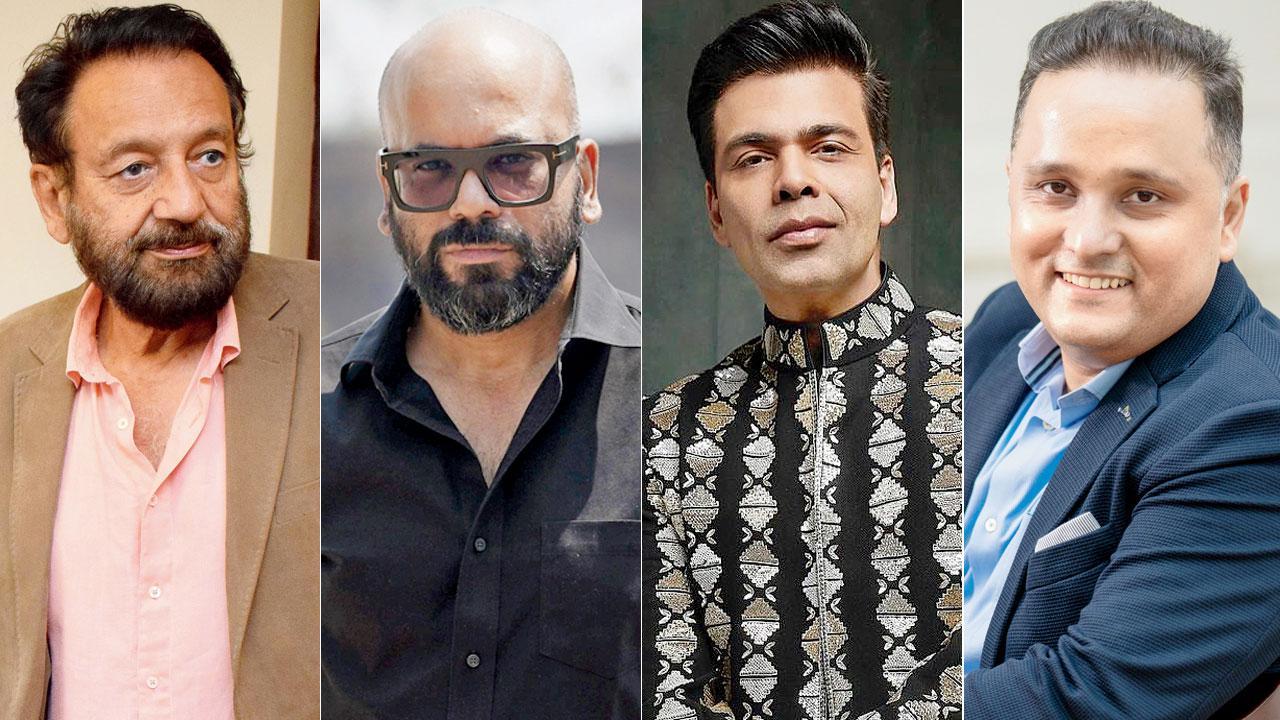
(L to R) Shekhar Kapur; Suparn Varma; Karan Johar and Amish Tripathi
BOMBAY TIMES (March 9, 2022)
Content studio, International Art Machine, led by ex-head of Amazon Video, Roy Price whose series have won multiple Emmy, Bafta and Golden Globe awards, is all set to make its mark in India with a power-packed line-up. Beginning its slate with one of India’s fastest-selling book series in publishing history, the Shiva Trilogy by acclaimed author Amish Tripathi, it has signed Oscar and National Award-winning director Shekhar Kapur to helm this project along with sought-after writer-director Suparn S Varma as director and showrunner.
Talking about the project, Shekhar Kapur said, “Amish’s Shiva Trilogy has been India’s great publishing sensation, crossing every age and class. It’s not just mythology, it’s modern storytelling at its best. Lending itself to a beautiful international series.”
“One couldn’t have asked for a better team than this to take my books into the audio-visual world. I am sure that with a team like this, we will create a web series that is worthy of Lord Shiva,” said Amish Tripathi.
“The look of the adaptation will be unlike anything seen by viewers before, the books by Amish are the blueprint to build our imagination. Now we seek to surprise the audiences and him,” said Suparn S Varma.
“I could not imagine a better project to start International Art Machine’s life than Shiva, and there is no better dream team to fully realise the potential of Amish’s novels than Shekhar Kapur and Suparn S Varma. It was meant to be!” said Roy Price, CEO and Founder, International Art Machine.
As they enter India, the content studio is committed to creating credible, creative and commercial stories across theatrical and digital platforms, and they have an exciting upcoming slate.
---------------------------
Five years after expiry of Karan’s adaptation rights, Immortals of Meluha envisioned as a series; Shekhar-Suparn to helm first part of the Shiva trilogy
Mohar Basu (MID-DAY; March 9, 2022)
In 2012, Karan Johar had created a buzz in Bollywood when he acquired the adaptation rights of Amish Tripathi’s bestseller, The Immortals Of Meluha. The adaptation, however, did not materialise, and Johar’s remake rights reportedly expired in 2017. But every story has its fate. It looks like Tripathi’s Shiva Trilogy is destined to play out on the screen. Filmmaker Shekhar Kapur has joined forces with The Family Man 2 director Suparn S Varma to helm a show based on the first book of the mythological fantasy series.
For Varma, who serves as the showrunner and director of the series, it is a responsibility and an honour to bring alive the author’s written word on the screen. He has had multiple discussions with Kapur and Tripathi to ensure they are creatively aligned. “The Meluha trilogy is a genre-defining book. With Amish, it has been a meeting of minds from the first discussion. His ambition reflected in the book is contagious, and to translate his epic on screen is a responsibility I’m happy to take on,” says Varma.
The project is all the more special as it unites him with one of his idols. “Shekhar Kapur is a film school. Collaborating with him is a journey that will involve discoveries about life, the world we live in, and the one we seek to create.”
While many filmmakers have evinced interest in adapting the trilogy, Tripathi says he is assured of Kapur and Varma’s vision for the story. “There is grandeur to the story, especially showing worlds that have never been seen before on OTT screens, such as the Indus-Saraswati civilisation. But at its core, the series will chronicle the extraordinary journey of a hero.”
Kapur views the trilogy as a story that cuts across age and genre. “It’s not just mythology, it’s modern storytelling at its best [that] lends itself to a beautiful international series,” he says. The team will begin casting soon.
Backing the trilogy is International Art Machine, which intends to foray into Indian entertainment with the project. Roy Price, CEO of the studio, says, “Our goal is to partner with creators across Asia to produce series that will carry the banner of Asian originals abroad.”
The studio also has Dibakar Banerjee’s political thriller Kitty Party, and the Preity Zinta-helmed dramedy, Gods, in the pipeline.
My film on King Suheldev will be based on Amish Tripathi’s book, which he is currently working on-Ajay Devgn
8:21 AM

Actor-filmmaker reveals he’s adapting Amish Tripathi’s soon-to-be launched book and his third directorial is in the scripting stage
Hiren Kotwani (MUMBAI MIRROR; December 25, 2019)
 For every actor/filmmaker, there’s a trigger point that drives him to tell a story. What was it for you with Tanhaji: The Unsung Warrior?
We had decided to create a franchise on unsung warriors of our history. Om (Raut, director) came to me with this story of Tanaji Malusare. It was fabulous to start our franchise with. The idea is to take stories out of the states these heroes came from, not only to other states of the country, but also worldwide.
Have you shortlisted your next subject for the franchise?
We’ve shortlisted quite a few. But the next one will be based on King Suheldev, who defeated Mahmud of Ghazni’s army in Bahraich (in Uttar Pradesh today) in the 11th century AD. Ghazni had got the Somnath Temple razed and after defeating his army, Suheldev rebuilt it. The film will be based on Amish Tripathi’s book, which he is currently working on. We have met and discussed the film adaptation.
Kajol told Mirror recently that when you offered her the part of Savitribai Malusare, you said if she liked it, you would develop the character for her.
The kind of scenes she has, required that level of performance. The film also shows the sacrifices of Tanaji’s wife, Savitribai. She knows that her husband may not come back from the battlefield. We needed a performer for this character and I told her if she liked the part, we’d write the scenes accordingly.
Saif Ali Khan as Udaybhan Rathod gives a sense of déjà vu after Omkara, in which you played the protagonist and he the antagonist.
Saif was brilliant in Omkara. We are comfortable working together and that ease comes across in our performances. When a pair attached to a film is appreciated, even performance-wise, it’s not unusual to feel déjà vu. But if a film hasn’t done well, you get a different kind of déjà vu (smiles).
What are the challenges of making a historical in the absence of adequate documented material?
While you may know the beginning, the middle and the end, you don’t know the process. How events unfolded, how Tanaji strategised the battle...For that, the writers and director had to imagine and create drama that is larger than life, connects with and inspires people, but at the same time, doesn’t get typically filmi. Whatever you do, you have to be prepared to face flak; someone will always say it wasn’t like this.
What was your favourite subject in school?
I was interested in History and Geography. I never understood Algebra. Talking of history, my fascination was with the stories; they make us converse. How someone overcame all odds and rose to great heights is compelling. Curiosity about such fascinating and inspiring stuff got me to read, whether it was ancient history like Mohenjo Daro, pre-British or during the British rule or even post-Independence.
You seem to be on a period film spree with Maidaan (based on football coach Syed Abdul Rahim) and Bhuj: The Pride of India (on IAF Squadron Leader Vijay Karnik, who rebuilt the airbase in Bhuj during the 1971 Indo-Pak war) coming up...
I just realised I have three back-to-back period films. All of them are fabulous scripts though, and I couldn’t say no. It wasn’t the intention to have them come one after the other. Now, I intend to break the pattern.
You begin Golmaal Five with Rohit Shetty and team in Sept 2020. What’s happening with Neeraj Pandey’s Chanakya, in which you play a modern-day teacher, philosopher and strategist?
Everything got a little pushed. Chanakya is not a modern-day story, but a historical (smiles). We plan to start in mid-2020. Neeraj wants to be thorough before we begin shooting.
Shooting with Akshay Kumar for Sooryavanshi (Rohit Shetty’s copactioner) must have been like revisiting Suhaag and Khakee days...
It was like getting back to where we had left. Akshay and I would often talk about the good old days.
You’re also playing a modern-day Yama (God oO Death) in Indra Kumar’s next that has Sidharth Malhotra and Rakul Preet Singh. Apparently, you’re helping him and Ashok Thakeria (producer) since they’re going through a rough patch.
All I can say for now is that it’s not a typical Indra Kumar film; it’s got comedy and drama. Indu ji, Ashok ji and I go back a long way. Not just me, all actors of Total Dhamaal went all out for them.
What’s next from Ajay Devgn, the director?
I’m writing something. I can’t reveal anything now. It’s a different space altogether. It’s also a difficult film to make and will require a year and half of prep. So, there is still time.
Looks like your son Yug will follow your footsteps into the movies...
He is just nine. He plays a lot of football and follows the sport avidly. We’ll come to know in a couple of years.
Sonam Kapoor to host panel discussion with Arianna Huffington on creating opportunities for female force
8:14 AM

Mohar Basu (MID-DAY; December 11, 2018)
 Weeks after she wrote an insightful piece about India's #MeToo movement, Sonam K Ahuja is set to host a panel discussion with entrepreneur Arianna Huffington (below), in the city, today.
Given her strong feminist beliefs, Ahuja has been chosen for the event that is being organised by Huffington's start-up. Besides discussing the need to create more opportunities for the female work force, the duo will also train the spotlight on rejection, sisterhood, and self-belief in women - subjects that have rarely been tackled.
Pointing out that the first step towards addressing a social issue is to start a dialogue about it, Ahuja hopes that the initiative will encourage men and women to work towards a society that believes in gender equality. "I believe in approaching everything with compassion. As soon as you do that, you see everything in a new light and positivity comes through," says the actor.
The evening will also see other panelists, primarily social influencers, including Amish Tripathi and Ashwiny Iyer Tiwari, discuss the changing face of society. Iyer, who has carved a niche in the industry with her social dramas, will share her personal story of resilience in a male-dominated industry. "I'm a director who happens to be a woman. Audiences don't see movies as him or her. In the day and age of equal thinking, it is the idea that matters," says Iyer.

Sanjay Leela Bhansali in talks with Tiger Shroff for his next based on Amish Tripathi book?
9:03 AM

The film in question is reportedly a mix of fiction, mythology and adventure, and is based on bestselling author Amish Tripathi’s unreleased book
Roshmila Bhattacharya (MUMBAI MIRROR; August 31, 2018)
With a body that makes him David for a modern-day Michelangelo and popularity that is growing by leaps every day, particularly among youngsters, Tiger Shroff is undoubtedly the flavour of the season after the super success of the Baaghi sequel. And while he has started brainstorming on the third instalment of the action franchise with director Ahmed Khan even as he films the sequel of Karan Johar’s Student of the Year, the 28-year-old actor is also looking at newer projects. Mirror has learnt that Sanjay Leela Bhansali is keen to rope in Jackie Shroff’s cub for his next directorial. And according to a source close to the development, what makes this collaboration even more exciting is that it is reportedly based on an upcoming Amish Tripathi book.
Says the source, “Contrary to speculation, the book in question is not The Immortals of Meluha but along similar lines. It is yet to be released and could hit the bookstores around the same time as the film’s arrival if everything falls into place. SLB and Tiger have had several meetings on the subject and both are keen to join hands with Amish on what will undoubtedly be one of the most-talked about projects in recent times. Tiger is yet to give the nod given his packed schedule, but is trying to work out the dates as he doesn’t want to lose out on the opportunity of working with one of his favourite directors.”
Amish’s Shiva trilogy — The Immortals of Meluha, The Secret of the Nagas and The Oath of the Vayuputras — is the fastest selling book series in the history of Indian publishing. KJo had bought the Indian language movie rights of The Immortals of Meluha and passed it on to his Agneepath director, Karan Malhotra and his wife Ekta, to script. Buzz was, Hrithik Roshan and Deepika Padukone would feature in it. Around the same time, in January 2014, Amish had revealed during the Jaipur Lit Fest that he had closed a deal with a Hollywood producer for the English language rights of the series as well and would be a creative consultant on both the projects. However, the Hindi film did not materialise, Karan eventually surrendered the rights to the book (which offers an interesting take on Indian mythology and Lord Shiva) admitting fear of repercussions was one of the reasons he had decided against adapting The Immortals of Meluha. Nothing more was heard about the Hollywood film either.
The source adds that the upcoming book is a mix of adventure, fantasy and mythology, right up SLB’s ally, given his success with epic extravaganzas like Ram Leela, Bajirao Mastani and Padmaavat. For Tiger, it would be a new genre to experiment with a perfectionist filmmaker and a chance to flex his muscles. As for Amish, he couldn’t have asked for a better launch date. Remains to be seen if this one gets booked for the screen.
Subscribe to:
Posts (Atom)