Showing posts with label Alok Tandon. Show all posts
Showing posts with label Alok Tandon. Show all posts
Merger was the best way to make balance sheet stronger-Ajay Bijli
8:28 AM

Vinod Mahanta and Javed Farooqui (THE ECONOMIC TIMES; March 27, 2023)
A key priority for PVR-Inox currently is improving margins through better capital and operating expenses, says managing director Ajay Bijli. In an interview with ET’s Vinod Mahanta and Javed Farooqui, Bijli talks about the contours of the deal to merge the two companies that has created the world’s fifth largest multiplex chain and what lies ahead for the combined entity. Edited excerpts:
What was the rationale behind the merger of PVR and Inox?
This (multiplex) business has always been about scale. Only when you reach a certain scale, do economies kick in. Achieving a certain scale allows for operating and cost efficiencies, as seen in large companies worldwide with 4,000-5,000 screens or more. The pandemic completely devastated our balance sheets and business. And, the best way to make our balance sheet stronger and address the challenges we faced was through the merger. The merger allowed us to take on the challenges that lay ahead in the the exhibition industry. But it also means we have more responsibility now with more screens, seats to fill, people to manage, and expectations to meet.
How is the integration process going on?
Fortunately, the integration process is going well. We started with the day-one structure and prioritized bringing people together. We hired Kornferry about three–four weeks ago to assist with this process. We developed the day-one structure to give clarity on everyone's roles and responsibilities, which was essential for our 23,000–24,000 employees. Now we are looking at synergies in every revenue line, and we have launched a new 100-day initiative called Parikrama. We're currently exploring ways to improve various aspects of our business, such as ticket prices, advertising revenue, and cost items, whether its capex or opex. There are about 13-14 initiatives that are going on simultaneously, which BCG is monitoring. We've informed the markets that it will take at least 12-24 months before we start seeing the benefits of our efforts. We have given it a value of Rs. 225 crore in synergy.
PVR and Inox promoters would own 10.6% and 16.9% of PVR-Inox, respectively. How will operational side of it work?
I have been appointed as the MD of the company by the board and shareholders, along with the Jain family as executive directors with equal representation on the board. The chairman is Pavan Jain. As MD, I am responsible for running the company for the next five years. At the operating level, we have two co-CEOs due to the large scale of our operations. We have roughly 1,700 screens, including 180 that are currently being fitted out. So, the span of control of Gautam Dutta, who is CEO of North and South, is equivalent to the span of control of Alok Tandon, who is looking after West, East and Central. Our focus is on economies of scale and adopting best practices from both companies.
Has occupancy reached pre-Covid levels? Will the higher ticket pricing hold after the Coronavirus bump subsides?
Occupancy rates vary by region, with the South having reached pre-Covid levels while West, North and East have not. We do think the ticket prices will hold. They haven't gone up by that much; it’s less than inflation in a three-year period. By the way, minimum wages have gone up, electricity has gone up, and so have all input costs. We have stayed below inflation.
Do you see a recovery in ad revenue once big-budget movies start doing better?
Everything is dependent on footfall — all our revenues are binary. The FY23-24 line-up is looking good. We have Ajay Devgn’s Bholaa releasing now, and John Wick: Chapter 4 has been released and has gotten a lot of traction. Then we have Karan Johar’s Rocky Aur Rani Ki Prem Kahani. Ajay Devgn’s Maidaan is coming.
Ground check: How safety is top priority as theatres open with fully vaccinated teams; offer touch-free tickets
8:23 AM
Uma Ramasubramanian (MID-DAY; October 22, 2021)
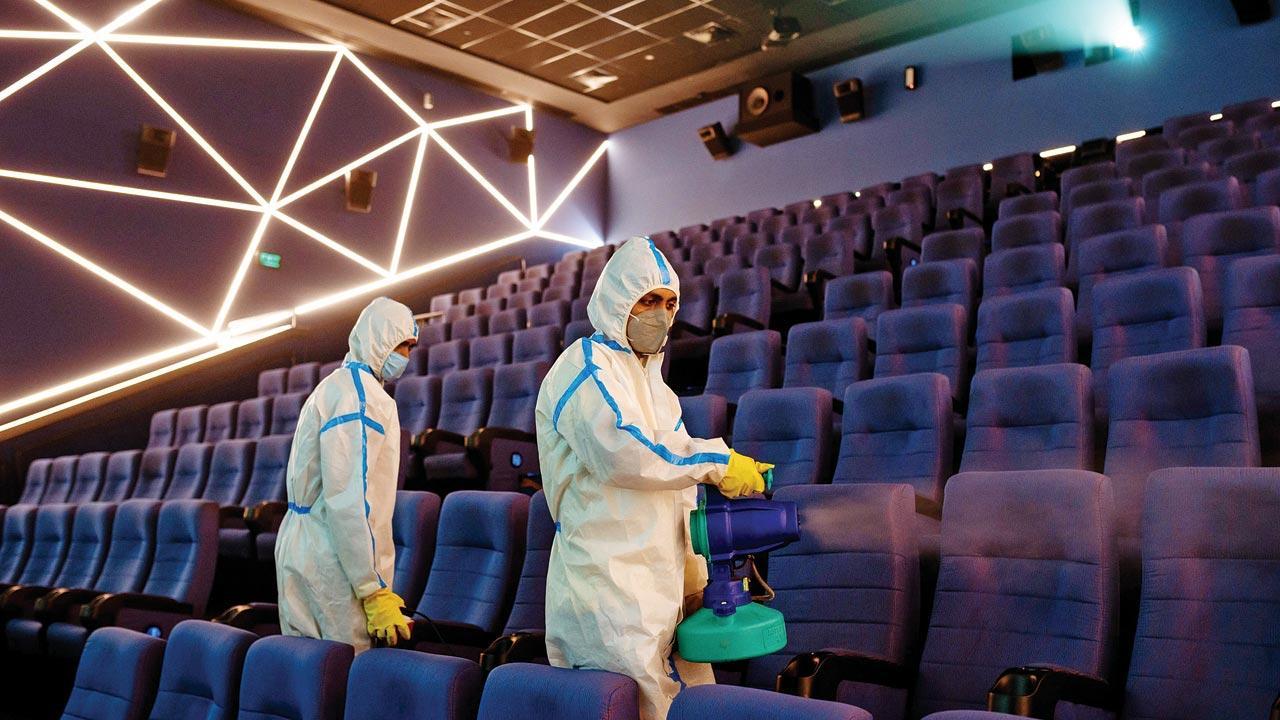
Stepping inside a theatre brought back memories of late 2020. Cinemas had then reopened in adherence with the safety norms, but had to soon bring the curtain down due to the second wave of the pandemic. As movie halls reopen today, the second time around, the safety measures are strict as ever and the resolve to stay afloat, presumably steelier.
As I stepped into INOX Malad, the implementation of the safety norms began at the entrance, with arrangements for thermal screening and disinfection scanning. Though the theatre has a fully vaccinated staff, its commitment to safety is highlighted by its efforts to minimise interaction. Viewers are encouraged to use e-tickets, with even walk-in guests being issued touch-less tickets. Inside the auditorium, alternate seats are available for use, to maintain 50 per cent capacity. Social distancing is mandatory everywhere, including the refreshments area.
The multiplex has started the initiative, #SafetyFirst, a convergence of the measures prescribed by the government and additional measures implemented by them. It includes frequent deep-cleaning and disinfection of all customer touch-points, including lobbies, restrooms and exits. The theatre opens today with screenings of No Time To Die, Shang-Chi And The Legend Of The Ten Rings, Bellbottom and Chehre. However, it has lined up only three shows per screen to avoid crowding.
Alok Tandon, CEO, Inox Leisure, is confident of the road ahead, as he says, “Now, producers will plan their releases. It will strengthen the content pipeline and usher in better health for the exhibition industry.”
Industry experts and actors speak about Gulabo Sitabo and Shakuntala Devi going the OTT way
8:47 AM

With Gulabo Sitabo and Shakuntala Devi going the OTT way, many films are likely to follow suit. We talk to industry experts and actors about the same
HINDUSTAN TIMES (May 15, 2020)
It goes without saying that the ongoing Coronavirus lockdown has dealt a severe blow to Bollywood’s business. And with no clarity in sight about theatres re-opening in the near future, it seems filmmakers have started to consider releasing their relatively smaller movies directly on OTT platforms. In fact, the first ones off the hook — officially speaking — are Shoojit Sircar-directed Gulabo Sitabo, Nawazuddin Siddiqui-starrer Ghoomketu and Vidya Balan-starrer Shakuntala Devi.
Not just that, there have been talks that a number of other films such as Laxmmi Bomb, Jhund, Ludo, and Roohi-Afzana among others may also go the OTT way. Raj Nidimoru of director duo Raj & DK likens the situation to a stock market, as he says, “Filmmakers are waiting, and we don’t know when theatres are going to open up and when the graph is going to go high. So do you take the plunge or do you have the money to hold on?”
Trade expert, Taran Adarsh says the “industry is divided on this as exhibitors may not like it.” He adds, “I understand that the producers may be feeling the pinch vis-à-vis their investments but theatres will open soon.” Producer Bhushan Kumar admits OTTs may be a “viable option for smaller films but big-budget, tent-pole movies can’t do their entire recovery [of budgets] just from them.”
For the uninitiated, theatres have been shut since March. Exhibitor-distributor Akshaye Rathi feels that a producer is “totally free to take a call, which is in his best interest”. “That way, exhibitors-distributors are also free to do that. The question isn’t about the next two quarters but of the coming 20 years’ relationship. You need to be a visionary and not trader at this point,” he says.
However, Alok Tandon, CEO, INOX Leisure Ltd, says, “In these times, we want the entire ecosystem to show solidarity and value each other’s significance, and not behave like fair-weather friends.” But Aparna Acharekar - programming head - ZEE5, which is set to release Ghoomketu, says, “You have to be where the consumer is. The industry doesn’t define where they want to be, consumers make the industry.”
Trade analyst Girish Johar feels this transition was set to happen in two years but has happened in three months.
Actors’ talk!
Actors, on their part, feel “makers know and will do what’s best for their films.” As Kiara Advani, who stars in Laxmmi Bomb and Shershaah, puts it: “There are certain films, which are meant for only a cinematic experience, while others can go on OTTs.” On the other hand, Kriti Sanon admits she will be “sad” if her new film, Mimi were to release on OTT. “We are all watching stuff on OTT platforms [during lockdown], but I feel it still doesn’t reach the masses. I want Mimi to reach the masses. And it’s also a beautiful film,” she said in an interview.
Cinemas bracing for ‘seat distancing’ after lockdown
8:43 AM

Mohua Das (THE TIMES OF INDIA; May 10, 2020)
Theaters faded to black and movies vanished from the box office as the Coronavirus turned into a massive speed bump for the burgeoning movie exhibition industry of nearly 9,600 screens in the country. After all, cinema houses are about large numbers of people huddled together, just inches away from each other.
“The pandemic has left a massive impact on the cinema exhibition industry. Movie releases are deferred, operations are shut, inflow of cash has entirely stopped. The industry has faced various crises in its history, but what it is going through was not envisaged,” said Alok Tandon, CEO, Inox Leisure, a multiplex chain with screens across 68 cities.
“Movie theatres were one of the first public spaces to shut with no visibility on when we might reopen. Most multiplexes were on a growth trajectory with funds deployed in new multiplexes which have all come to a sudden halt,” rued Sanjeev Bijli, joint managing director, PVR Cinemas.
The Multiplex Association of India (MAI), that represents around 90% of the multiplex industry in India, made an appeal to landlords in March asking for a “complete waiver from payment of rent & common area maintenance dues during the lockdown and recuperating period,” while multiplexes like Inox and PVR have already invoked the force majeure clause to their developers, to tide over the pandemic. In another plea last week, MAI urged studios, producers and content creators to respect “exclusive theatrical window” — holding and releasing their films in theatres, once they open again before opting for broader distribution, such as release on DVD, satellite channels or streaming platforms.
“This temporary relief would ensure that the cinema industry does not die an instant death leaving a significant impact on shopping malls across the country, millions of lost jobs and unwanted litigation,” explained Deepak Asher, president of MAI.
The challenge is trickier for single screen theatres that have been battling depleting revenues for years. Nitin Datar of Cinema Owners & Exhibitors Association of India (COEAI) wrote to the chief minister’s office last week appealing for “waiver on property tax” and “sharing of 70% of staff salary” to prevent retrenchment.
But even as the movie theatre business cracks under the pressure of uncertainty — with revenues of at least Rs 1,500 crore a month plummeting to zero — movie operators believe that the charm of a larger-than-life screen and people’s desire to step out will remain intact.
If history is anything to go by, many a thing has threatened movie theatres in the past — the 1918 Spanish flu, war-time restrictions, invention of television, VCRs, the Internet, and more recently the streaming platforms — yet, like a phoenix, the big screen has always found its way to rise and cope. “Because it’s integral to our social fabric,” pointed out Bijli.
Preparing to re-emerge in a world where physical distancing is crucial to survival, both multiplexes and standalone theatres are devising a chapter that will be different from what was built as a communal experience.
Apart from thermo-guns, sanitiser stations, hygiene kits, paperless transactions, and rigorous disinfecting procedures everyday, multiplexes like Inox and PVR will introduce seat distancing through “cross-allocation” of seats. “The model ensures that there’d be no one seated behind, ahead, or adjacent to the seat assigned to a guest. Online booking will be programmed to allocate seats in that order. Movie shows would be scheduled in a manner to avoid overlap of entry, intermissions and exits and to avoid crowding of lobbies and restrooms,” explained Tandon.
“The menu will be truncated to ‘hero’ items — popcorn, cola and nachos, that can be machine dispensed,” said Bijli, adding that “although it is difficult to contemplate the future, it’s reassuring when we look at China, Sweden, Korea and America that recently re-opened a limited number of theatres. We’re in touch with the Global Cinema Federation and trying to set protocols according to their standards.”
Apart from assuring seat distancing in standalone cinemas, COEAI has also urged the government for an interest-free loan of Rs 50,000 for each owner of ‘touring talkies’ — a dwindling exhibition culture of travelling theatres in rural areas — that now fears total extinction under the weight of the virus.
Drive-in cinemas are a long ride in India
8:38 AM

Radhika Bhirani (HINDUSTAN TIMES; May 9, 2020)
Imagine a big screen, but in an open space; a reclining seat but in your car; popcorn run to your vehicle; and a personal sound system. As old-school drive-in theatres are being revived across the world — Germany, Spain, Lithuania, South Korea and parts of the US for instance — amid the lockdown, experts feel the concept may not be feasible in India.
Producer Bhushan Kumar believes, “Drive-in theatre concept is far-fetched in this kind of a situation where a normal theatre’s survival is uncertain as of now.”
While drive-in isn’t an unexplored concept in the country – Ahmedabad, Chennai and Gurugram have one each – it isn’t one that has flourished. “Whether there would be renewed traction in drive-in properties because of Coronavirus or an uptake in numbers, that is something one will have to see when this whole situation is a little more settled,” says PVR Pictures CEO Kamal Gianchandani, who finds drive-in theatre an “interesting proposition” and reveals they’re developing one in the country’s film capital, Mumbai.
While drive-ins may be a “unique experience” for the millennial and Gen-Z audience, Alok Tandon, CEO, INOX Leisure Ltd, says “managing to secure a large expanse of space at a comfortable distance”, can be an uphill task. Real estate costs, especially, don’t make drive-ins a commercially viable exhibition business proposal, observes Mohan Umrotkar, CEO, Carnival Cinemas.
As trade analyst Komal Nahta says, “Drive-in theatres will take a long time to get constructed. Till then, one hopes the Covid-19 vaccine will come out.”
Subscribe to:
Posts (Atom)