Showing posts with label Alisha Chinai. Show all posts
Showing posts with label Alisha Chinai. Show all posts
Made In India was a revolutionary breakthrough because of music channels-Alisha Chinai
12:48 PM

Alisha Chinai was already an established playback singer when she released Made In India in 1995. The song and the music video achieved cult status and became a pop anthem of the 90s
BOMBAY TIMES (December 21, 2024)
‘THERE WAS A VOID IN THE POP MUSIC SPACE’
There was a definite void (in the pop music space). Nazia Hassan’s Aap Jaisa Koi for Qurbani had taken the whole nation by storm but it was a Bollywood song, and they wanted an Indian voice to fill that void. That’s when I stepped in. Made In India was my fourth or fifth album. And it brought me success. It was a revolutionary breakthrough because of music channels. At that time, the audiences could identify with the artistes and the voice of the singer. I think that’s what really set the ball rolling for the pop scene to revolutionize in India. The young people at that time needed a genre of music they could call their own. They were only listening to film songs and were not identifying with that sound. While Bollywood songs are very melodic, this was something more natural, and gave the artiste the freedom to be rebellious.
‘THE MUSIC VIDEO BECAME THE STANDARD’
Made In India was like a complete anthem, it was a pop anthem. It worked because of the title, it was the right time to do that song. The video was the icing on the cake, it looked smashing, we got a big budget for those times. It was about 20 lakh and so, even the production became better. That became the standard. But then there was Daler Mehndi, he was amazing and I love his music even now.
Standard set by international concerts has made things tougher for Indian acts-Sunidhi Chauhan
8:31 AM
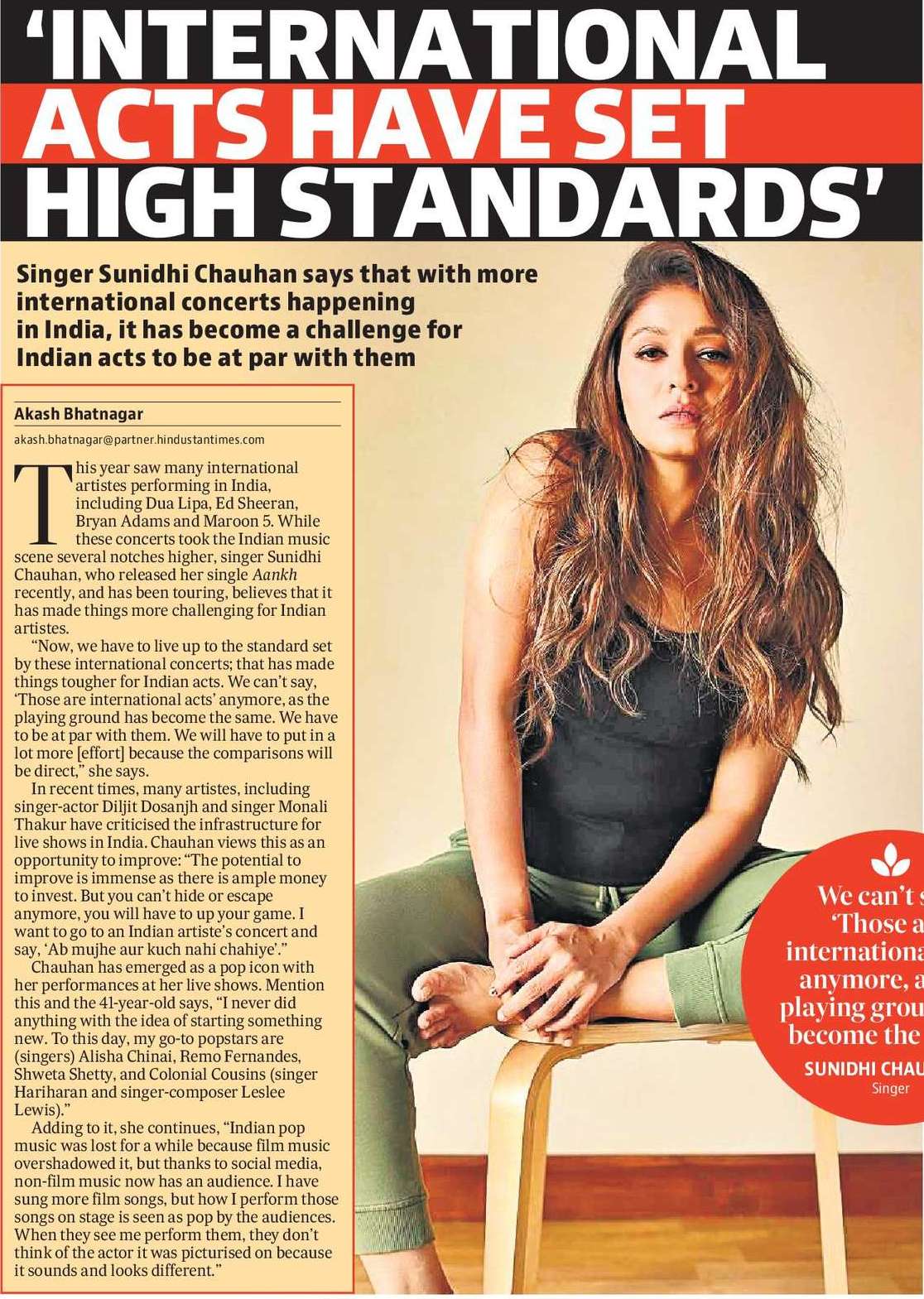
We have to live up to the standard set by these international concerts; that has made things tougher for Indian acts
Akash Bhatnagar (HINDUSTAN TIMES; December 28, 2024)
This year saw many international artistes performing in India, including Dua Lipa, Ed Sheeran, Bryan Adams and Maroon 5. While these concerts took the Indian music scene several notches higher, singer Sunidhi Chauhan, who released her single Aankh recently, and has been touring, believes that it has made things more challenging for Indian artistes.
“Now, we have to live up to the standard set by these international concerts; that has made things tougher for Indian acts. We can’t say, ‘Those are international acts’ anymore, as the playing ground has become the same. We have to be at par with them. We will have to put in a lot more [effort] because the comparisons will be direct,” she says.
In recent times, many artistes, including singer-actor Diljit Dosanjh and singer Monali Thakur have criticised the infrastructure for live shows in India. Chauhan views this as an opportunity to improve: “The potential to improve is immense as there is ample money to invest. But you can’t hide or escape anymore, you will have to up your game. I want to go to an Indian artiste’s concert and say, ‘Ab mujhe aur kuch nahi chahiye’.”
Chauhan has emerged as a pop icon with her performances at her live shows. Mention this and the 41-year-old says, “I never did anything with the idea of starting something new. To this day, my go-to popstars are (singers) Alisha Chinai, Remo Fernandes, Shweta Shetty, and Colonial Cousins (singer Hariharan and singer-composer Lesle Lewis).”
Adding to it, she continues, “Indian pop music was lost for a while because film music overshadowed it, but thanks to social media, non-film music now has an audience. I have sung more film songs, but how I perform those songs on stage is seen as pop by the audiences. When they see me perform them, they don’t think of the actor it was picturized on because it sounds and looks different.”
Thanda thanda paani: The unforgettable track that marked India's hip-hop era
9:02 AM
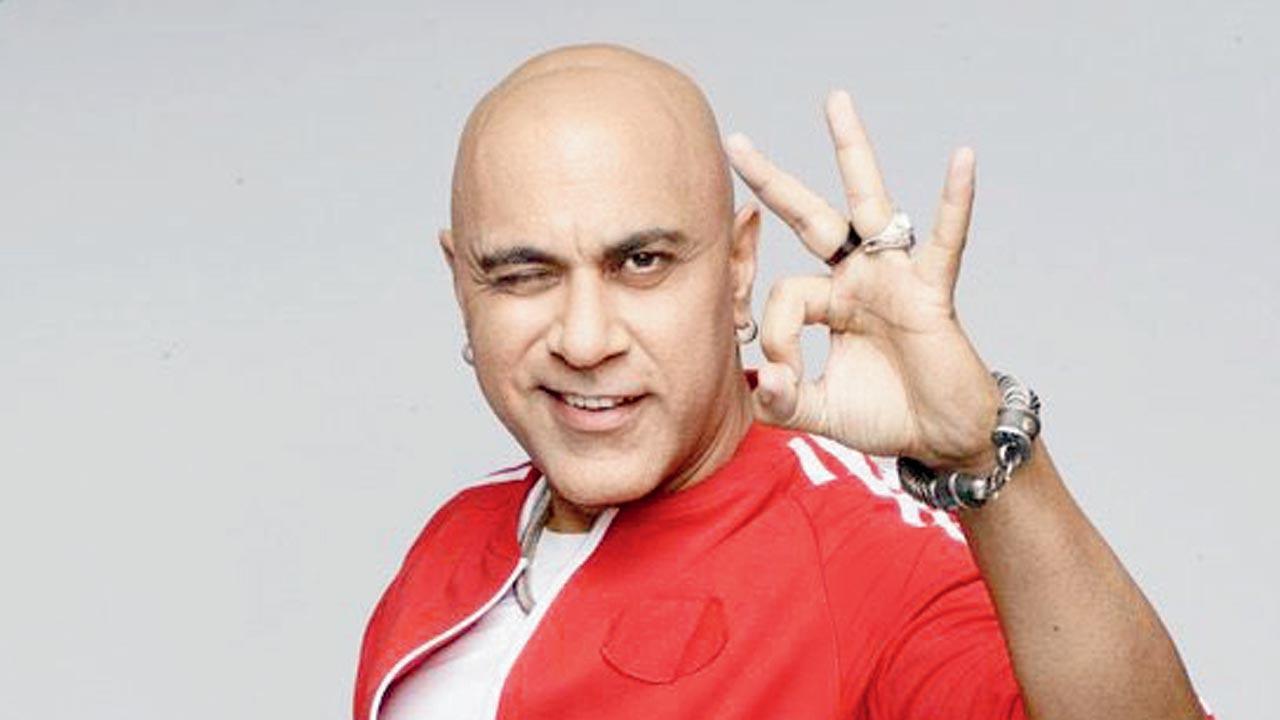
As hip hop celebrates 50 years, we chat with singer Baba Sehgal and the team behind Thanda Thanda Paani, that in 1992, marked India’s first brush with the genre
Arpika Bhosale (MID-DAY; August 20, 2023)
In was in 1992 that, in a one-bedroom on the first floor of the Jolly Maker Tower 1 in Cuffe Parade, Charles Vaz, Baba Sehgal and Atul Churamani tried to record Thanda Thanda Paani, a song that went on to have one of the highest recall value for any 90s kid. Vaz’s bedroom doubled up as a studio, with a thick curtain being the only physical evidence to earmark it as one. At the time, Vaz, was a hotshot music arranger, after working with singer Alisha Chinai, and Baba, a relatively unknown artist. But they did what they did, and the rest is history.
Hip hop completed 50 years this month, from its birth way back in 1973 in the Bronx, when Clive Campbell, known as DJ Kool Herc, improvised and played snippets in a loop on two turntables to keep the music and dancing going. And it took us back to Thanda Thanda Paani, a song that started it all in India, and sold 100,000 copies in three-and-half-months, an undefeated record to this day.
Vaz, who had arranged what Sehgal had composed in a night, shushed his father and his friends to stop talking while Sehgal belted out the famous lyrics at his home. “My father and his friends enjoyed the song too. We never knew that eventually the whole country would groove to the songs on the album,” says Vaz, who still resides in the same apartment.
Sehgal has moved to Dubai and branched out into different genres of music, even singing songs for South movies, particularly Telugu. “That album changed everything. No one had heard anyone rapping in Hindi before,” he tells us over the phone.
The album was released in August of 1992 and had not taken off much until MTV released a video of Dil Dhadke (Koi To Batade Ye Kyu Dhadke), starring Pooja Bedi, was released in September. “I am a trained engineer and at the time, it was my last chance to show my father, who had loaned me his Maruti 800 to drive down from Lucknow, then Delhi and finally Bombay, that what I was doing wasn’t a complete waste of time.”
Sehgal confirms that the sales of the record remain undefeated, “Yes, in the hip-hop genre, it is still the highest selling record in such a short time (three-and-a-half-months).”
Another important player in the success of the album was Atul Churamani, who had just moved to Mumbai and headed the offices of Magnasound, the record label that wanted break the hegemony of Bollywood film music over the Indian music scene.
“Magnasound at the time was a licensee for Warner Music, and the Magnasound owner, Shashi Gopal, had given us the clear directive that the company didn’t want to do Bollywood music. We wanted to feature artists that had an identity of their own.”
Recalling when he first the title track of the album, Churamnai says, “I think it was 1992 and it was Charles’s birthday, when another artist called Mubina, sang the original song Ice Ice Baby (the song that inspired Thanda Thanda Paani). After she was done, Baba said I’ll just do something and he went ahead and rapped his cover while on the keyboard. I told him to come to the studio to record in the day, even though we were already into the wee hours of the morning.”
Sehgal’s launch, and the entry of Magnasound, ushered in a new era of Indian pop music, says Narendra Kusnur, a music journalist who covered the music industry at the time. “With Baba, they wanted to look at someone with mass appeal, and the North of India could identify with his music. He was the lone hip hop artist of the time, and it didn’t really sustain as a movement beyond Sehgal, as they just couldn’t find anyone who could replicate the same success.” The jury’s still out on that one.
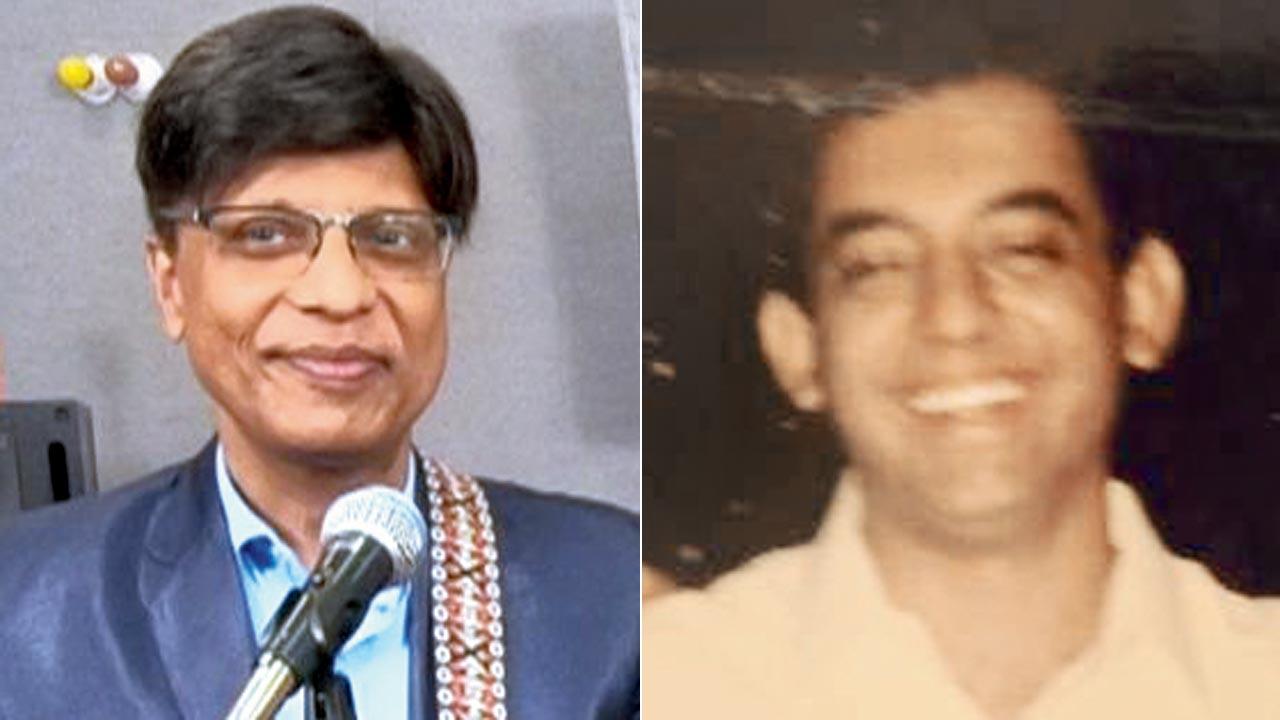
Charles Vaz and Atul Churamani
I am shocked to see so many reports stating that I have lost my voice-Bappi Lahiri
8:07 AM

Soumya Vajpayee (HINDUSTAN TIMES; September 24, 2021)
“I am shocked to see so many reports stating that I have lost my voice. It’s ridiculous and I am really unhappy,” says a distraught Bappi Lahiri. The singer-composer, speaking to us from his studio in between a recording, adds, “I was shooting three days ago with my grandson for a documentary film. How can I be unwell and without a voice? I have been working in the industry for 50 years and I’ve never experienced something like this. I have slight cough, I’m taking syrups and tablets for that. It’s a minor thing and I am much better.”
For the unversed, a few media reports recently claimed Lahiri has been unwell ever since he recovered from Coronavirus in April and has now lost his voice. Refuting the same, the veteran wrote on Instagram, “Some media outlets are spreading false news about me and my health, which breaks my heart. By the grace of my fans and well-wishers, I am completely healthy (sic).”
Speculation is rife that the singer-composer is keeping it low in terms of work. But, Lahiri clarifies that he is swamped at present. “I recorded and composed three songs, one of which is Ganpati Bappa Morya, that released recently. I’ve also recorded a song for Durga Puja with actor Rituparna Sengupta, and finished the soundtrack for a Bengali film two days ago, featuring Shaan, Alisha Chinai, Aditya Narayan, Armaan Malik and I. My fans are my God. With their blessings and by the grace of Ganpati Bappa, I’m totally alright,” says the 68-year-old.
I wish someone like Mukesh Ambani enables India to have a music industry-Palash Sen
9:45 AM

From releasing its first acoustic song, to dabbling in Bengali music, Euphoria has been stepping outside its comfort zone, says frontman Palash Sen
Sonia Lulla (MID-DAY; January 11, 2021)
Away from the razzmatazz of commercial music, Euphoria seems to be reinventing itself. The 22-year-old band, fronted by Palash Sen, has dabbled in a wide array of genres in the past few months, crafting its tracks with deftness such that several have emerged to be among its biggest hits, already.
In an interview with mid-day, Sen discusses the band's upcoming releases, including an elaborate 16-track album.
We've seen a spate of new releases from Euphoria recently. Many of the songs have become big hits in a rather short period of time.
They did. A one-minute track that we created called I Like It, earned 850 million views, and that is a first for our band. Another memorable one is a song that we made for, and with indie artistes, because they were facing several problems during the lockdown. Seventy-six indie artistes recorded their portions from their homes or gardens, and created this beautiful piece. We also had many firsts. We created an acoustic version of Kisi ki muskurahoton pe, which was a tribute to those band-mates who play at weddings.
You are also set to release your debut Bengali track this month.
On the 14th, we are bringing out our first Bengali song by Gurudev Rabindranath Thakur. The current generation doesn't know the kind of music that our elders created. We wanted to [put the spotlight on] the sangeet that deserves attention. It is a song on the beauty of mother nature, and how human beings have destroyed it.
We know that indie artistes are among those who have suffered immensely in the pandemic. Could you reflect on how this phase has been?
All of us depend on live gigs. We don't make money from our recorded songs. They may make money for music labels, but not for the artiste. We need an indie industry that takes care of the needs of all artistes.
But, taking to virtual gigs has been gratifying. A live set-up has a lot of distractions. Virtual gigs helped us connect with listeners in their personal space. We've [been able to reach out to] those listeners who don't care about the frills, and listen to us only for our music.
We are also set to bring out an album which will be a collection of songs that we have been creating for six years. It will have tracks based on love, self-belief, and expression, and will include folk, rock, qawwali and acoustic music. There will be something for each kind of listener.
You've stated that you believe India has a film industry, but not a music industry. Why do you think this industry failed to flourish when it was celebrated in the 90s?
In the '90s, there were artistes like Daler Mehendi, Lucky Ali, and Alisha Chinai, who were superstars. For the film industry, nobody apart from an actor should be a superstar. You may not know this, but there was a time when Daler Mehndi was paid a large amount of money to feature in a song with an actor, because he was not saleable, but Mehndi ji was.
The film industry realised they had the resources to dismantle this system, and did. It was easy for them to promote their music because they had budgets, and would recover costs. Think about the indie music being created by these labels — it sounds like film music anyway. India doesn't have an independent music industry. I wish someone like Mukesh Ambani decides to invest in it and enables India to have a music industry. That will bring about change.
I have to thank action director Tony Ching Siu Tung for making Hrithik fly believably-Rakesh Roshan
8:23 AM

Roshmila Bhattacharya (MUMBAI MIRROR; June 23, 2020)
 The Jadoo started with Koi… Mil Gaya in 2003. With a mentally challenged boy and his friendship with a blue-tinted alien who arrived six years before James Cameron’s Avatar, Rakesh Roshan rewrote box-office history. And encouraged by the success of this film, he took another leap of faith… Unveiled on June 23, 2006, Krrish took off from where Koi… Mil Gaya had ended, with Rohit and Nisha’s son inheriting his father’s super powers that enable him to scale mountains and fly through the air to streak past a stallion. Seven years later, when working on the post-production of Krrish 3, Rakesh ji confided that his actor-son Hrithik had actually run with the horse for his introduction scene. “It took us a day-and-a-half to shoot. I have to thank Tony (action director Tony Ching Siu Tung) for making Hrithik fly believably,” he smiled. For his son, who had grown up emulating superheroes, the film was a dream come true.
 However, the bigger challenge was the scene in Singapore, where Hrithik leaps with the fountain spray, 20 floors up. “That shot called for perfect timing. Hrithik sitting on the fountain head had to jump as soon as the jet sprouted. But either the water was slow or Hrithik missed his cue. It took us all day to get that shot,” Rakesh ji recounted, revealing that they’d discarded 50-60 masks before settling for the one Krrish picks up when a fire breaks out in the circus to hide his identity. Then, with his coat flaring like a cape, he walks into the flames to pull off daring rescues.
While daredevil action sequences and mind-boggling visual effects are a part of every superhero film, this one being mainstream Bollywood, it was left to Rakesh ji’s brother and Hrithik’s uncle Rajesh Roshan to weave songs into the narrative. The composer admits it wasn’t easy, but because the story had a strong emotional core and his brother has always inspired him while giving him a free hand, he could come up with the romantic “Aao Sunaun Pyaar Ki Ek Kahani” with Shreya Ghoshal and Sonu Niigam. The duo also collaborated on another starry-eyed Hrithik-Priyanka Chopra duet, “Koi Tumsa Nahin”, while Shreya frolicked musically with Udit Narayan to “Chori Chori Chupke Chupke.”
The romance even crossed borders, with Rajesh ji roping in Pakistani singer Rafaqat Ali Khan—son of Nazakat Ali Khan, the nephew of Ustad Salamat Ali Khan and the cousin of Shafaqat Ali Khan—and Alka Yagnik for “Main Hoon Woh Asmaan.” On the surface a happy song, it had deeper emotions simmering beneath, evident in lines like “Paas mere tu ho na agar toh kitna tadapta hai mera dil, main hoon teri nazar, mera intezaar tu, ho kar bhi hum judaa hote judaa nahi”. “The pain of loss makes a song unforgettable,” Rajesh ji asserts.
Kunal Ganjawala’s “Dil Na Diya”, which plays out in the Big Top before the fire breaks out, amidst music, dance and bobbing hearts, also has some profound lines by Javed Akhtar: “Tune chand pe bhi jamaye kadam, dariya mein bhi ghar hai banaya, tere jadoo ne ek rote huye insaan ko hai hasna sikhaya”. The melody continued in Krrish 3 seven years later, pitting the superhero against super villain Kaal, whose henchman, a shape-shifting female mutant, Kaya, loses her heart to Krrish and tries to seduce him with the dreamy, “Dil Tu Hi Bataa”.
“We opted for Alisha Chinai and the little-known Assamese singer, Zubeen Garg, over bigger names and worked on the song continuously for two months. At one point, we got stuck with the lyrics. One day, while Rakesh ji, Sameer (lyricist) and I were brainstorming, Duggu (Hrithik) walked in and came up with the words, ‘The heart always beats, but why is it that I didn’t hear these beats till now.’ He spoke in English, but Sameer ji picked them up and presented us with 'Dil Tu Hi Bata, Kahan Tha Chhupa, Kyun Aaj Suni, Teri Dhadkan Pehli Baar'. The rest is musical history,” Rajesh ji narrates, admitting that he was waiting to see what his brother would do with the song. “When I saw how beautifully he’d picturised it, I had tears in my eyes.”
Seven years have passed since Krrish 3. Rakesh ji has locked the script of Krrish 4. Once the Coronavirus pandemic is behind us, superhero Hrithik will fly again. And Rajesh ji will find more heart-to-heart connections.
Sona Mohapatra tells Anu Malik to go to a sex rehab
8:15 AM

Samarth Goyal (BOMBAY TIMES; November 16, 2019)
 Music composer Anu Malik’s long-awaited explanation on sexual harassment allegations, were greeted with fiery rebuttals by musicians who has accused him of sexual misconduct. Sona Mohapatra tweeted her eight-point reply, saying, “Anu Malik finally wrote back to all of us last evening. My response to him, next to his letter. In case mine is too long to read, have also attached a shorter, crisper one. #India @IndiaMeToo.”
Earlier on Thursday, Malik broke his year-long silence, posting a lengthy explanation, saying that he is wrongly accused. “It has been over a year that I’ve been accused of something that I haven’t done. I’ve been silent all this while as I was waiting for the truth to surface on its own. But I realise that my silence on the matter has been misconstrued as my weakness,” he wrote, adding the allegations have taken a toll on his and his family’s mental health and has left him “traumatised, tarnishing my career.”
Sona questioned Malik, who throughout his post, defended himself by saying that he wouldn’t commit “the acts he is accused of”, since he is a father of “ two daughters”. “Being a father of two daughters doesn’t prove anything. Clearly it hasn’t held your libido back. History has shown us that multiple times in multiple real live stories. ‘Some’ Men will just be that .. .The show must go on. Without you. Don’t jeopardise the hard work of so many people & the dreams of so many contestants just for your personal glory & ambitions,” she wrote.
Sona concluded the response by accepting Malik’s challenge of taking the legal route. Singer Neha Bhasin has also accepted Malik’s challenge, saying, “My intention has never been to spoil anyone’s career. But I think that’s inconsequential to me standing up to someone who has wronged women. As far as him going to court is concerned, that is his legal right and mine as well, to defend. So I’m not afraid to do that. Also, I want to be with Sona and join alliances with all women who have been wronged to bring justice to the table.”
------------------------
Singer Sona Mohapatra came out strongly against composer Anu Malik's open letter defending himself against allegations of sexual molestation
MID-DAY (November 16, 2019)
Singer Sona Mohapatra on Friday came out strongly against composer Anu Malik's open letter defending himself against allegations of sexual molestation, which were first levelled against him by Mohapatra in 2018. Thereafter, singers Neha Bhasin and Shweta Pandit had also accused Malik of sexual harassment.
On Thursday evening, Malik in his open letter on social media claimed that he feels "cornered" and "suffocated". The composer shared that he is going through a "dark phase", is "traumatised" and wants justice.
Responding to Malik in a long Instagram post, Mohapatra suggested that the composer should go for sex-rehab. Countering Malik's charge that her allegations were "false and unverified", the singer said the only truth in the matter was that "many more women" of the music industry had come out to level harassment charges against Malik.
Mohapatra wrote: "The only 'truths' that have surfaced after I called you out last year is that many more women have told their stories of sexual harassment, assault experiences with you. @shwetapandit7 told of her trauma of how you scarred her at a young age of 15. Danica D'Souza, Ex Indian Idol Producer told of how you harassed crew & contestants alike. Caralisa Monteiro spoke up too. Neha Bhasin spoke up a fortnight ago about her own story with you & many more who aren't known did too & in detail. Alisha Chinai corroborated the pattern & spoke her truth too. None of these women are connected or have anything to gain by speaking up about the predatory behaviour of one powerful, rich, perverted man."
The singer also highlighted the effect of his sexual misconduct on the mental health of the victims. She wrote: 'Unverified' allegations you say? These are multiple testimonies of independent sane women speaking coherently & they have a common story. What about the 'mental health' of all these people who have gone through this traumatic experience because of you? Did you care about them over these years? What about the mental health of the good India & all the victims & their families when they see you flaunting yourself on TV & Encouraging others like you?"
Last year, after Mohapatra's allegations first cropped up, Malik had to step down as judge of Sony TV's singing reality show "Indian Idol" Season 10. The controversy was reignited this year when the channel invited him back and Malik resumed his position as judge on Season 11 of the show.
Sona claimed that the composer is a "predator" and has no right to enjoy such a position on national television.
She further wrote on Instagram: "You have no right to be platformed on National TV till you make amends. 1.3 billion people exist in India. Not everyone needs to make crores on TV to survive or be 'judge' to young people whose safety they jeopardise. You aren't a role model. You could always take a break, go to a sex-rehab or counselling or somewhere to reflect on how to behave better. Ask your kids to do a hard days job & earn a salary. They are adults now. I started working at 22. Open a biriyani shop. Stay away from the public eye? Show remorse? Say sorry? If you did, this would not have happened. There you go! You answered your own Q. Show off shamelessly on TV & we be quiet?"
In his open letter, Malik had mentioned that "being a father of two daughters, I can't imagine committing the acts that I am accused of, let alone do it".
To which Sona countered: "Having two daughters has no link to being a predator," responded Sona. For those who had earlier accused her of trying to jeopardise "Indian Idol", a show that promotes bidding musical talent, she said: The show must go on. Without you. Don't jeopardise the hard work of so many & the dreams of so many contestants just for you. STEP DOWN."
Earlier on Thursday, the composer had claimed in his letter that the allegations against him are "false and unverified". He also alleged that these allegations have affected his and his family's mental health.
In the letter that Malik had shared on Twitter, he wrote: "It has been over a year that I have been accused of something that I haven't done. I have been silent all this while as I was waiting for the truth to surface on its own. But I realise that my silence on the matter has been misconstrued as my weakness."
"Ever since the false and unverified allegations were levelled against me, it has not only ruined my reputation, but affected me and my family's mental health, left us traumatised, and tarnished my career. I feel helpless, like I am being cornered and suffocated."
The 59-year-old composer, who is a father of two, also questioned why these allegations were not spoken about earlier.
"It's disgraceful that at this age, at this stage in my life I have to watch the most slanderous words and horrifying incidents being associated with my name."
"Why wasn't this spoken about before? Why do these allegations resurface only when I am back on television, which is currently my only source of livelihood?"
Malik had also threatened that he would take legal action to "safeguard" himself. "Fighting a battle on social media is an endless process, at the end of which nobody wins. If this keeps on continuing, I will have no option but to knock on the doors of the courts to safeguard myself," he tweeted.
He concluded his open letter saying: "I would like to thank all my well-wishers who have been with me and my family through this dark phase. I don't know how much more slander and dirt my family and I can take. The show must go on. But behind this happy face, I'm in pain. I'm in a dark space. And justice is all I want."
Suchitra Krishnamoorthi, Alisha Chinai, Baba Sehgal, Sherrin Verghese talk about making a comeback
8:06 AM

Kunal Guha (MUMBAI MIRROR; February 12, 2019)
Suchitra Krishnamoorthi remembers feeling a little concerned when she got behind the microphone after 13 years. Her worst fears were realised when she discovered that she had “literally experienced a voice block”. She says, “I’ve been singing on stage ever since I was a child. But when I stopped singing about a decade ago, I lost my core.” Luckily, Suchitra’s guru, Ravi Jule, was there to encourage her. “He told me, ‘Tum Suchitra Krishanamoorthi ki awaaz bhool gayi ho, main nahin bhula’ (You may have forgotten Suchitra Krishanamoorthi’s voice, but I haven’t).” A little help from him and a nudge from friend and music veteran Atul Churamani helped the the pop singer—remembered for her 1990s prime-time hits such as “Dole Dole” and “Dum Tara”—add a new single, “Sawan Barse,” to her repertoire last November. Despite mixed reviews, it has 2.3 million Youtube views and Suchitra is clearly on a comeback trail.
She’s not the only one. Several artistes from the ’90s ‘Indipop boom’ are trying to make their way back into public memory. Alisha Chinai, who straddled the ’80s and the ‘90s with her catchy, foot-tapping hits, “Zooby Zooby” and “Made in India”, uploaded an English track called “Wild Heart”.
The Band of Boys, the five-piece-boy-band that is down to four, also came up a number, “Dil Sar Fira”, a few months ago and is giving final touches to the music video of their next, “O Chori”. Baba Sehgal --whose bare-chested ‘Jatissmo’ in music videos pumped up hits like “Dil Dhadke” and “Manjula”— has been the most prolific, having written, composed and produced videos for at least 80 songs in the last three years. The songs have been about everything, from chicken fried rice to Donald Trump.

On a rebound
Trying to break into the market as an Indipop artiste must have been hard enough the first time. Trying to do it again, in an industry where no one buys music any longer, can be just as challenging. Luckily, our popstars are prepared for this reality. “I am producing music under my own label and hosting it on my social media channels, since no one has bought my music in the last 10 years,” says Baba. His new songs sometimes feature in jingles and TVCs, thanks to product positioning (foods company would pass up a chance to ‘borrow’ a Baba Sehgal creation extolling the virtues of vada pav?). Even his Tweets rhyme: One MB is 1000 KB/ Weekend ka kya plan hai, baby? And he knows the rules of the game: “You have to be active to survive.”
Baba struck gold on YouTube when he returned to the scene three years ago with his cringe pop single “Going To The Gym (317k views), followed by “Chicken Fried Rice” (737k views) and “Aloo Ka Paratha” (829k views) making him an overnight internet sensation. But a comeback today cannot be sustained if one rests on one’s laurels, he reasons. “Stepping out of your comfort zone gives you reach and lets you connect with audiences who may or may not listen to your music. Sometimes, you have to do something that’s not what your audience expects you to do.” Two years ago, Baba made a video of him singing and played the djembe (an African-origin drum) to “Rashke Qamar”. “A tribute to Nusrat Fateh Ali Khan and got 2.7 mn views.”

Reality bites
Sherrin Varghese, a member of Band of Boys, who also services the ad-film industry and performs live gigs on the side, opines that the music industry has made it virtually impossible for independent artists to thrive on their own. “Today, if I release a song on my own, I have to spend Rs 25 lakh just be on the shelf, and it would still get the 3 am slot, because Bollywood has bulk bought the adspace. What you see on TV are only 30-second promos and not the entire song any more. In the ’90s, songs were aired meritoriously and callers demanded them,” he sighs.
Even Alisha is not entirely oblivious of this shift in economics in the music industry. “Streaming brings in revenue only once you cross a certain number (of views) and a lot of it is available for free, so the revenue is much less now. Everyone is feeling the pinch, even in the West,” she avers. And while the singer is well aware that “there is no market for English music in India”, she asserts that social media is so big now that you don’t really need a music label and you can put out what you feel like. Her recent upload “Wild Heart” is a number synonymous with her own personality and was composed in 1990 as a demo (when she was living in New York). It lay in her wardrobe till she decided to upload it, along with a lyrics video, on YouTube. “It’s a showcase of your work — to make yourself visible again”, says Alisha who pins her absence in the last few years on personal issues.
That “Made in India” is still the largest-selling Indipop album and has 58 million views on YouTube is reassuring but it also raises the bar for Alisha. “I may have had monster hits such as 'Kajra Re', 'Kaante Nahin Kat Te', 'Sexy Sexy', 'Tinka Tinka' and others, but playback singing was just a second option for me. I was always essentially a pop artiste,” says the singer who plans to do tours later this year once she has a decent collection of new music.
Even Suchitra backs the commercial viability of live gigs. “Digital doesn’t have a reliable revenue model yet to sustain an artist so one has to turn to live performances,” she says. The singer has been performing along with her guru and solo as well. She plans to do more tours this year. “Kaveri will be going to college soon, so I plan to get myself even more busy,” she says. Her daughter released her own single, “Did You Know” two years ago.
Keeping up with the times
What’s hip today will be vintage tomorrow, and the musical preferences couldn’t be more fickle than it is today. “The consumption is so voracious today that even the best song in the world would only last for a month,” says Sherrin, admitting that their new compositions account for existing fans and contemporary listening tastes.
Baba agrees that songs have become ‘perishable’ and constantly producing new stuff is the answer: “Inspiration can come from anywhere.” His latest brainwave was triggered by a guy’s challenge in reaching his girlfriend’s apartment. The lyrics go, “Tera Flat Hain In Pachchas Mala, Open Karunga Tere Dil Ka Taala, Tere Pyar Ka Banunga Mein Caretaker, Chahe Lift Mein Aa Jaye Alligator. (Chorus) Elevator Mein Aligator, I’m Your Lover, Not Your Hater”.
Even Suchitra has stuck her neck out to try out something she never thought she’d ever consider — recording a cover. “I never did it when I was a solo artist. But now I am inspired by artists like Vidya Vox who have millions of subscribers on YouTube. There are artists who have made careers just singing covers alone,” she reasons.
Surviving social media
One aspect that the popstars weren’t prepared for was the brutality of social media and the onslaught of anonymous trolls. Among the initial comments to Suchitra’s comeback music video “Sawan Barse” was a particularly hurtful one which said ‘tera sawan baras gaya’ or some such nonsense. Given the accessible and democratic nature of social media, being open to judgement and criticism is something our former popstars have to be prepared for. Baba, for one, has developed a thick skin over the years. “When I was a social-media newbie three years ago, there would be trolls roundly abusing me. Now I still get trolled, but I’ve also acquired followers who abuse my trolls back,” he smiles, adding that one of his videos received over a thousand abusive comments. “As long as they are getting traction, it’s fine. Being abused is fine too — it means that they are being noticed. Even big stars get trolled.”

It has taken me a great deal to open up now and speak about it-Shweta Pandit
8:53 AM

Tanvi Trivedi (BOMBAY TIMES; October 20, 2018)
A few days ago, singer Sona Mohapatra accused composer Anu Malik of sexual harassment and soon after that, singer Shweta Pandit also accused him of sexually harassing her when she was 15 years old.
In a long note shared on Twitter, Shweta wrote, “It was the year 2000 when I was launched as a lead singer with Mohabbatein and was trying to get other good songs to follow up with the success of that soundtrack and the welcome it gave me in the music industry. He was recording a song with Sunidhi Chauhan and Shaan for Awara Paagal Deewana, when my mother and I walked into the monitor room. He told me to wait in the cabin inside… It was just him and me there. He then asked me to sing a few lines for a voice test. I sang it well and he said he will give me a song with Sunidhi and Shaan, but first give me a kiss now.” (sic) Anu Malik has called her allegations ‘ridiculous’ and his lawyer, Zulfiquar Memon, has issued a statement: “The allegations made against my client are emphatically denied as completely false and baseless. My client respects the #MeToo movement, but to use this movement to start a character assassination mission is obnoxious.”
Shweta, who is the grand niece of Pandit Jasraj, was in Rome for a concert, when BT contacted her. She said, “This is the whole issue. These men in power constantly think that they can get away with anything. First, it was Alisha Chinai, then Sona Mohapatra and now me. How can these allegations be baseless? Are we all mad? We were asked to keep shut at that time, because they told us that how can you go against the people who give you work? Can you imagine how numb I went when he asked me to kiss him? I was so depressed that I didn’t want to work in the industry.” She adds, “I wanted to share this so that I can warn other girls who are working with him. Truth is like fire and it spreads. All these years, we have dealt with such situations and it’s usually the women who are told to calm down. In our country, when women are sexually harassed, why are they asked to shut up? People say ‘Hota hai, jaane do’. It has taken me a great deal to open up now and speak about it. The reason why I don’t have a single song with him in my entire career is now out in the public. He asked me to sing something without any music, as he wanted to hear my voice. I remember I sang the title song of Har Dil Jo Pyar Karega as a voice test for him. I sang it well, so he said, ‘I will give you this song with Sunidhi and Shaan, but first give me a kiss now.” Obviously, I had to walk out. In fact, before this happened, I was a big fan of his music. I wanted to sing for him. These powerful men don’t understand that such harassment destroys lives. All these years, I had to struggle and deal with it. At least, the #MeToo movement is empowering women to talk about it. We are entitled to a work environment where such things don’t happen.”
Reacting to lyricist Sameer’s tweet (posted on Thursday) in which he supported Anu Malik, she said, “It is all lies. It’s a boys club supporting each other.”
--------------------------
Lyricist Sameer Anjaan defends Anu Malik, recalling Shweta Pandit’s visit to his studio over a decade ago
Soumya Vajpayee (BOMBAY TIMES; October 20, 2018)
A day after Shweta Pandit accused Anu Malik of sexual harassment, lyricist Sameer Anjaan took to Twitter to support him. When BT reached out to Sameer, he said that he was present at the recording studio when Shweta and her mother visited Anu Malik.
Recalling the incident, Sameer said, “I knew Shweta’s entire family and she would often request me to arrange a meeting with Anu ji. The day she came to his studio with her mother, I was there as we were working on a song. When Anu ji asked her to sing, she requested if they could go to another room. But Anu ji said, it’s better if everyone in the studio listens, too. After listening to her sing, he said, ‘Beta, I like your voice, but we have singers at the moment. If there’s an opportunity in the future, I will call you’.”
Sameer added, “I’m amazed with the allegations that she has levelled on Anu ji after 15 years! Just imagine, she was a 15-year-old girl back then, who came to the studio with her mom. How would anyone have the audacity to take her to another room in front of her mother? And even if we assume that he did, being a teenager, the first thing anyone would do is tell her mother immediately. What made her keep the truth under wraps for 15 years? She belongs to a musical family, so how could she accuse a senior musician like him? I have known Anu ji for many years. He respects the people he works with. If she is so sure, instead of speaking to the media without any evidence, she should go to the court.”

Every 10 years, I have a monster hit. I hope I’m third time lucky-Alisha Chinai
7:54 AM

She may have been MIA for a while, but Alisha Chinai hopes to be third time lucky with her music
Deepali Singh (DNA; September 8, 2017)
She was the original baby doll, way before Sunny Leone burst onto the screen with her seductive moves. While Alisha Chinai is self-admittedly not the greatest singer, she does have a voice texture and style which remains unparalled in B-Town till today. A couple of years ago, the singer took a sabbatical from playback singing, to give her full attention to her father who was suffering from cancer. She spends a lot of time at her place in Alibaug. “I’m up in my ivory tower there, meeting nobody but my three dogs and staff. I have made friends with myself, and I’m in a happy place,” she tells us. She is now on social platforms such as Twitter and Facebook, but that’s more to know what’s going on than to connect with her fans. “It doesn’t come naturally to me,” she admits, “But I realise that one can’t be so insular. I want to keep the vibe going,” says the singer. Here, she talks about her plans of putting out her own songs, her aversion to playback and why Made In India still remains an anthem...
You seem to be pretty active on Twitter.
It’s on and off. It’s just curiosity to know what exactly is going on in the world. I just want to touch base. There was a whole phase where I didn’t want to know. I had gone into my little cocoon. Now, I’m in a social mood. I’m in a different space now, so I want to check out what’s going on, where the music is going, where the people are going. It’s not only about music when you’re on these social platforms. There are so many other things to learn about art or food.
Who do you follow?
I joined Twitter some time ago. I followed a couple of international news sites, The Real Donald Trump, etc and of course, all the biggest pop stars of the world or people in the music business. Quite honestly, I only follow a handful of people from here. And Facebook is ridiculous, everyone wants to be my friend and I don’t even know most of these people! So, I now have two accounts, one for my personal friends and another for fans and public. Don’t be surprised if I close shop and disappear again!
Even after all these years, your voice still sounds fresh...
That’s because I don’t over sing. I don’t believe in quantity. Plus, I don’t have a voice that can fit into every mould. So in that sense, I don’t really have a ‘playback’ voice. Of course, when it was Kajra Re, it worked like magic. Aishwarya (Rai Bachchan) looked like she was actually singing that song. It was a marriage made in heaven. Or when you see Priyanka (Chopra) sing Tinka Tinka. The song is a classic!
Your last playback number was in 2013. What made you go off it?
Honestly, I just shut myself off. My dad was suffering from cancer. That happened in 2011 and the whole of 2012-13, it was all hospitals and chemotherapy, multitasking and managing everything. I used to shuttle back and forth from Alibaug. Two-three years went by and I just switched off. I became a bit introspective, asking myself if all this really mattered. At the end of the day, what matters is who you want to be with. My dad is very special to me and I wanted to be there for him. I can always get my career back or work back at it but this time with him is not going to come back. I thought he was almost gone then. He’s survived for six years after that, but he’s still fragile. That’s always on my mind and so, I can’t totally concentrate on my work. But I also keep my finger on the pulse because everyone is like, you can’t completely neglect your work. Even I feel the whole scene has changed now with so many singers.
So are you not interested in playback at all now?
I don’t know. There are a lot of new record companies and new talent. Too many singers are desperately putting themselves out for free. They are compromising everything so much that they’re short-changing themselves. Frankly, even big movies are not doing well, the scripts are bad. Movies run on music, and yet, the singers are the worst paid. There is no respect left because these people are short-changing themselves.
Actors, like Alia Bhatt, Shraddha Kapoor and Sonakshi Sinha have taken to singing. What do you think of that trend?
Actresses singing is fine, at least it’s real and makes them a little more credible. Alia is gorgeous and she may not be the greatest singer, but it’s real.
What about private albums or singles?
What I’m doing now is exploring all possibilities and trying to get my finger on the pulse, as you say. I’m warming up. Now there are YouTube and so many other platforms where you can put your own songs out. So, that’s the best way to go. I’m still trying to figure out how to re-invent myself. At the moment, I’m exploring and also creating content, writing my own songs and producing them and then, hopefully by the end of this year, I should be able to put out some singles.
Have your musical influences changed over the years?
Yes, definitely they have. I listen to VH1 all the time. All these fabulous international singers and every voice is so special. They write their own music, have their own style, which makes them so distinctive. They are real artistes. Adele, of course, writes these painful ballads which make you sob. I love Attention by Charlie Puth, it’s my current hot favourite. And, of course, I love Despacito! That’s like the current anthem.
Has your approach towards your craft changed?
So, I’m not really inspired to playback for actresses at all. It just doesn’t turn me on. I could do a one-off if it’s a very, very special thing. I want to do my own songs and explore a whole new audience. I only think and write in English. So, I’m trying to warm up and figure it out. I will start small and see where it goes.
While the independent music scene seems to be doing well, there are no Indipop singers as such. Why do you think that’s happened?
We need to have that kind of quantity and quality where it takes over everything else. There has to be a complete shift from Bollywood, or at least keep a parallel interest in it. The shift will happen but it will take time. Also, the show culture here is not as it is abroad. We don’t have the infrastructure or the kind of money that funds all that.
Are you in touch with any of your contemporaries from the Indipop days?
I’m in touch with the guys I worked with in the business. I connect with them on Facebook and here and there. But if you mean the singers, then no, I’m not in touch with them.
It’s been more than 20 years to Made In India but that songs remains as fresh as ever in people’s memories...
It’s not a song, it’s an anthem! There are songs and there are songs and there is Made In India. I’m being very pompous but that’s the truth (laughs).
You presented Milind Soman in that gorgeous avatar. Are you still in touch with him?
I know, gorgeous, haan? (Smiles) Ya, I bump into him at Alibaug at the Bohemyan Blue Cafe. He keeps pulling my leg to lose weight and run in the marathon, and I’m like, shut up, I’m happy eating! (Laughs)
Have you ever thought of remixing or revamping the song?
Yes, in fact, I was planning to put up a remix this Independence Day but I didn’t like the mix. I’m going to try and do it with an international producer now. The minute I get the correct remix, which is as good as the original or even better, then it’s great. It will be for a whole new generation. Let’s see when that happens. Before that, I want to put out some of my own English singles. I’m just going to go with the flow. I’m doing music to please myself now. It’s very self-indulgent. I’m hoping it works some magic and we get another big hit. I think my time has come. Every 10 years, I have a monster hit. I hope I’m third time lucky.
Subscribe to:
Posts (Atom)