Showing posts with label Aligarh Muslim University. Show all posts
Showing posts with label Aligarh Muslim University. Show all posts
No AMU nod to shoot, filmmaker recreates Aligarh Muslim University campus to Andheri
8:10 AM

Mohammed Wajihuddin (MUMBAI MIRROR; February 19, 2023)
Having not received any positive response from the Aligarh Muslim University (AMU) about a proposal to shoot some portions of a film on the institution’s founder Sir Syed Ahmed Khan (1817-1898), city-based filmmaker Shoaib Choudhary has created the sets in Andheri East and began shooting on Monday.
Choudhary said, despite writing multiple letters to the Vice Chancellor Dr Tariq Mansoor, seeking permission to shoot a web series he is making based on Hayat-e-Javed, the first biography on Sir Syed by his close associate Altaf Hussain Haali, the vice chancellor of Aligarh Muslim University did not even acknowledge his mails.
“They didn’t reply to me directly. After the news about their cold-shouldering my proposal appeared in the media, they issued some tough guidelines like the filmmakers were required to show them the script and story line. Then they amended the guidelines and said that instead of submitting the script, they wanted us to submit a synopsis which an expert committee would see,” said Choudhary.
The university also wanted Rs 1 lakh per day for a feature film and Rs 50,000 for web series as fees. “I was ready to pay the fees, but they didn’t give a positive response. They acted like royalty and I couldn’t have waited endlessly. I have created lavish sets in Mumbai itself,” said Choudhary.
The VC didn’t respond to queries from Mirror, but a University spokesperson claimed that Choudhary wasasked to submit the synopsis. “We asked for the synopsis but perhaps he didn’t want to share it with us and now we have heard he has started the shoots in Mumbai,” said the spokesperson.
This is not the first time that a filmmaker has wanted to shoot some scenes on the the Aligarh Muslim University campus. Several films, including Rajendra Kumar-Sadhana-starrer romantic musical Mere Mehboob (1963), were shot at the leafy AMU campus. Founded as Mohammedan Anglo Oriental College in 1877, it became AMU in 1920. The heritage section of AMU campus houses some magnificent buildings, including Victoria Gate, the Jama Masjid, Sir Syed House and old hostels built during Sir Syed’s lifetime. Choudhary said he wanted to shoot some portions in the heritage section.
Prime Minister Narendra Modi had addressed AMU’s centenary celebrations held online and called AMU a “mini-India”. A premier institution and central university, AMU has produced several eminent students, including freedom fighters like Khan Abdul Ghaffar Khan, Maulana Mohammed Ali Jauhar and Dr Zakir Hussain.
AMU ‘cold-shouldering’ bid to shoot series based on founder, says filmmaker Shoaib Choudhary
8:31 AM
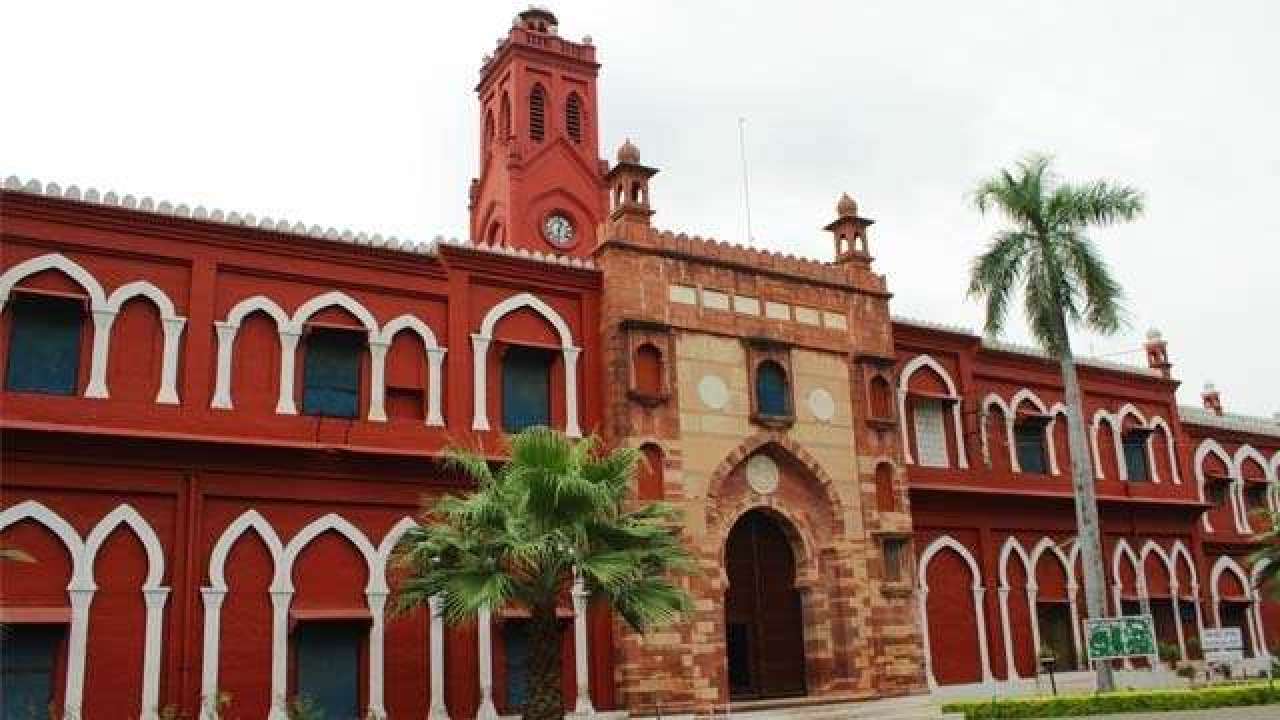
Mohammed Wajihuddin (THE TIMES OF INDIA; August 14, 2022)
Mumbai: Founder of Aligarh Muslim University (AMU) Sir Syed Ahmad Khan (1817-1898) was a 19th century reformer who battled malice, propaganda and even fatwa in his lifetime. A filmmaker has alleged that Sir Syed’s own institution has cold-shouldered an attempt to present his life in proper perspective on the silver screen. Mumbai-based film and television serial producer Shoaib Choudhary claimed that the AMU administration has been showing “gross insensitivity and non-cooperation” to his plan to shoot some portions of a television series on Sir Syed at the AMU campus.
Despite writing multiple letters to AMU Vice-Chancellor Dr Tarique Mansoor, Choudhary said that he has not yet received the permission to shoot. “I wrote the first letter to the VC on December 16, 2019, followed by four more letters, the last letter being on May 16 this year. However, the VC’s office has not even acknowledged my missives,” said Choudhary.
Based on Sir Syed’s first biography by his close associate Maulana Altaf Hussain Haali titled Hayat-e-Javed, the script has been seen and approved by many experts on Sir Syed, including some associated to AMU. Choudhary maintained that he didn’t want to put any financial burden on the university and has mentioned so in the letter as well.
When asked to comment, AMU’s VC Mansoor told TOI: “We have formed a committee to frame guidelines for such types of requests. Meetings of the committee have been held but the final report is yet to be submitted. We also want to know what is the policy of other academic institutions in these types of commercial projects.”
Choudhary says several films have been shot on the campus in the past, including Rajendra Kumar-Sadhana-starrer romantic musical Mere Mehboob (1963). He added: “This dilly-dallying shows sheer disinterest of the VC office towards Sir Syed Ahmad Khan. The lack of clarity has adversely affected the production costs and deadline.”
The pre-production is almost complete and he will now miss the scheduled release on October 17 (Sir Syed’s birthday). “Sir Syed is relevant for every age. The need to know him and his message was never more relevant than today. If someone is presenting Sir Syed through a medium popular with the younger generation, the university should help him. If Mirza Ghalib could have been depicted through films and serials, why can’t Sir Syed, who is one of the architects of modern India,” said Professor Akhtarul Wasey, former AMU students’ union leader and professor emeritus at Jamia Millia Islamia.
Filmmaker Mahesh Bhatt who in 2014 demanded Bharat Ratna for Sir Syed said: “The audio-visual medium is most effective in this digital age. It is good that someone is trying to capture the iconic personality and contributions of Sir Syed for television and he should be encouraged.”
I've been [dead] against this idea of two human beings not being equal because of their place of birth-Anubhav Sinha
10:01 AM

In less than a year, Anubhav Sinha has made films on two burning issues: the anti-Muslim environment and the broadening caste divide. He talks to us on changing tracks, from Dus and Ra.One to Mulk and Article 15
Ekta Mohta (MID-DAY; June 23, 2019)
In 1949, while writing the most important book in the country, Dr BR Ambedkar made some bits autobiographical. In Article 15, he put his thoughts and personal experiences to paper and spoke of the birthright of citizens: no citizen can be discriminated against on the basis of religion, race, caste, sex and place of birth. In 2014, a few Hindu men from Badaun, UP, who hadn't read that section, raped two teenagers and hung them out to dry from a mango tree. In 2017, filmmaker Anubhav Sinha sat down to write his first draft of Article 15, a story that includes all of that, and a story that has been 2,000 years in the making.
Releasing this week, with actor Ayushmann Khurrana in the lead, Sinha tells us that his film is actually based on several incidents. "When you see the film, and if you've been reading newspapers, you'll see all those cases. Government data tells you it happens once a day." In the film, the teenagers are raped and murdered because they demand a raise of three rupees. "When I wrote this, my CFO, Dubey ji, who is a Brahmin, said, 'Nahi sir, aisa nahi hota.' So I called a friend from Delhi, whose been a journalist for 20 years, and put her on speakerphone. She said, 'Within 15 minutes from Delhi, this could happen to a girl for three rupees.' It's not about three rupees; it's about 'I will tell you what you deserve. And if you have a voice against it, I will show you your place'."
After 20 years in the entertainment industry, and after making films such as Ra.One, Dus and Tum Bin, it appears that Sinha has finally found his place. Last year's Mulk, with actors Rishi Kapoor and Taapsee Pannu, showed the rills between Hindus and Muslims, simmering and poisoning over 70 years. As the son of Benares and the alum of Aligarh Muslim University, Sinha is an insider in both worlds. "My father's best friend was a Muslim, and he would eat with us in ceramic plates, while we would eat in steel plates. One day, my elder sister and I protested. Mom realised that we also cook mutton. So, we changed it inside the house."
What started out with regular housecleaning has now grown to include his mulk. "There was too much going on in the country at that point vis-à-vis Hindus and Muslims, and I was sick and tired of it. There was a narrative being built, which started with some headlines in the newspapers that by the year 2000 and X, there will be more Muslims in India than Hindus and some sh*t like that. And I wanted to have a voice and I did." But, it isn't like he had a sudden change of heart. His concerns were "brewing" and niggling at the back of his mind his entire life. "I always saw the wrong in things that were happening around me, whether it was class politics, caste politics, or more than the two, gender politics. I've been [dead] against this idea of two human beings not being equal because of their place of birth. There is no reason why society should not offer [someone] the same opportunity as somebody who was born 200 yards away. These are questions that you want to ask society and ask yourself. And if you can weave a story that can encompass all of that and still make an engaging viewing, then you have a movie."


In recent times, Sinha attributes his change in sensibilities to a specific activity. "I had stopped reading. I come from Benares, where music and literature are very rich. And then I became an engineer, and the whole relationship with literature was lost. And then I came to Mumbai, where I was into another art form, which I had no idea about. So, I was learning lensing and editing and blah and blah, trying to survive and make a place for myself. Somebody asked me, 'Is there something new that you started doing in the last five years?' I've started reading again. I accept and recognise that now I get attracted to a very different kind of material than what I used to sometime back." These include dog-eared copies of Republic of Caste by Anand Teltumbde, Joothan by Omprakash Valmiki, Humans by Tom Phillips, and books by Mahatma Gandhi, whom he lovingly calls "the first Indian rock star."
Article 15, in its heart, reflects his library. "I belong to a caste that doesn't belong to any of the four varnas from Manusmriti. But because Kayasthas are educated people, we are considered upper caste. So, I was never personally affected by it in an adverse manner, but I could see where [someone from] a lower caste would treat himself differently. Because that's what he's told and that's what he believes and, worst of all, that's what he accepts. When a sabziwala came to our house, the way he would try and not touch anything. The bai at home, it's okay if she washes your utensils, but it's not okay if she uses them. It's a bizarre mix of caste and class politics. And, it's not only a UP thing. Now it has reached a medical college in the heart of Mumbai."
He thinks the world has consciously divided itself into superiors and inferiors. "For thousands of years, the world has been aligning itself into this wide inequality that we see today. There is a dialogue in Mulk, which, according to me, is the best line in the film. 'Agar sab log barabar ho jayenge, toh raja kaun banega?' We have this mean, vicious streak to be the king. That's the problem. Nobody likes the same size." None of us want to be Indians, firstly and lastly, the way Dr Ambedkar imagined.
On Sinha's Bookshelf

It’s only in Aligarh that you can’t see 'Aligarh'
7:59 AM

Cinemas Take Down Film As Mayor, Others Say Gay Tale Defames City
Eram Agha (THE TIMES OF INDIA; February 28, 2016)
The only place ‘Aligarh’,
the film on the tragic life of gay AMU professor Srinivas Ramchandra
Siras, will not open in is Aligarh. Movie-goers in Aligarh, who had
been waiting excitedly to see the Manoj Bajpayee-starrer that has received
heady acclaim both in India and abroad, were surprised when they realised on Friday that no theater was playing it though the film had hit
screens across the country that day. They, however, didn’t read much
into it, thinking their “tier-2 city” would get the biopic on Saturday
instead. That didn't happen either.
Curious and frustrated, some of them started making queries. One of the calls went to the film’s production team, led by director Hansal Mehta. No one had a clue why ‘Aligarh’ had not reached Aligarh. TOI on Saturday then got to know that the film had quietly been “banned” in the city after Shakuntala Bharti, the BJP mayor, mounted a protest against its screening. She felt the film would “link the city with homosexuality”, which would be nothing short of a “defamation” of sorts.
Bharti was unapologetic about her objection to the movie. “The film is based on same-sex love and that is not Aligarh,” she told TOI. “We can’t encourage defamation of a city.” Theater owners, however, said it was not just Bharti who had problems with the film. A local group, Millat Bedari Muhim Committee, had also written to Union ministers Arun Jaitley and Ravi Shankar Prasad, and to Central Board of Film Certification (CBFC) head Pahlaj Nihalani, demanding that the name of the film be changed as it “besmirches our city”.
The film’s director Mehta was livid. “This is a homophobic decision. They do not want Aligarh to be linked with homosexuality, but now they will be linked with homophobia,” he said. There had been apprehension from several quarters about the film ever since its shooting was announced. These included questions over how AMU would be represented, since the story is based on Siras' life. University PRO Rahat Abrar had earlier said he would take legal action against the filmmakers if required and that the university was concerned about “misrepresentation of the city or university“. He had also said that the university had not given the director permission to shoot the film, which was eventually shot in Bareilly. On being questioned about it, Abrar said he did not want to comment on the issue at present.
The scriptwriter of 'Aligarh', Apurva Asrani said he was “extremely angry“ about the development. “People in distribution normally do thorough research about where a film will be welcomed and where it won't. It is sad that Aligarh will not get to see a story about itself. The mayor spearheaded protests and that led to theatre owners deciding not to screen the film. They don't want to see the mirror held up to themselves. I have been told three court cases have been filed against us. This reeks of homophobia,“ he said. “Opponents of the film will have to come to terms with the fact that 2% of India's population is from the LGBT community.“
By a little quirk of fate, some Aligarh residents, though, did manage to see the film on the day of its release on February 26 at a prominent theatre in the city.
Curious and frustrated, some of them started making queries. One of the calls went to the film’s production team, led by director Hansal Mehta. No one had a clue why ‘Aligarh’ had not reached Aligarh. TOI on Saturday then got to know that the film had quietly been “banned” in the city after Shakuntala Bharti, the BJP mayor, mounted a protest against its screening. She felt the film would “link the city with homosexuality”, which would be nothing short of a “defamation” of sorts.
Bharti was unapologetic about her objection to the movie. “The film is based on same-sex love and that is not Aligarh,” she told TOI. “We can’t encourage defamation of a city.” Theater owners, however, said it was not just Bharti who had problems with the film. A local group, Millat Bedari Muhim Committee, had also written to Union ministers Arun Jaitley and Ravi Shankar Prasad, and to Central Board of Film Certification (CBFC) head Pahlaj Nihalani, demanding that the name of the film be changed as it “besmirches our city”.
The film’s director Mehta was livid. “This is a homophobic decision. They do not want Aligarh to be linked with homosexuality, but now they will be linked with homophobia,” he said. There had been apprehension from several quarters about the film ever since its shooting was announced. These included questions over how AMU would be represented, since the story is based on Siras' life. University PRO Rahat Abrar had earlier said he would take legal action against the filmmakers if required and that the university was concerned about “misrepresentation of the city or university“. He had also said that the university had not given the director permission to shoot the film, which was eventually shot in Bareilly. On being questioned about it, Abrar said he did not want to comment on the issue at present.
The scriptwriter of 'Aligarh', Apurva Asrani said he was “extremely angry“ about the development. “People in distribution normally do thorough research about where a film will be welcomed and where it won't. It is sad that Aligarh will not get to see a story about itself. The mayor spearheaded protests and that led to theatre owners deciding not to screen the film. They don't want to see the mirror held up to themselves. I have been told three court cases have been filed against us. This reeks of homophobia,“ he said. “Opponents of the film will have to come to terms with the fact that 2% of India's population is from the LGBT community.“
By a little quirk of fate, some Aligarh residents, though, did manage to see the film on the day of its release on February 26 at a prominent theatre in the city.
Manoj Bajpayee to play gay professor; Rajkummar Rao journalist in Hansal Mehta's next
7:44 AM

Vickey Lalwani (MUMBAI MIRROR; November 19, 2014)
Mirror (July 8) was the first to report that this year's National Award winning director for Shahid, Hansal Mehta, was setting up the stage for his next film inspired by an Aligarh Muslim University professor.
Just days before he was to retire, he was suspended after being filmed on spy-cam while having consensual sex with a rickshawallah, in his apartment within the campus.
Manoj Bajpayee will play the professor and the film, to be produced by Sunil Lulla and Hansal, will go on floors in January 2015.
While the rickshaw puller has yet to be cast, Hansal's favourite actor Rajkummar Rao will play an important part, that of journalist, Deepu Sebastian, who broke the story.
Though Hansal and Manoj have been friends since 1993, the filmmaker was apprehensive about approaching the actor. So he asked casting director Mukesh Chhabra make the call. "After he spoke to Mukesh, Manoj called me up and let loose a volley of expletives, demanded to know why I hadn't asked him myself," laughs Hansal.
The story idea was mailed to Hansal by a girl, Ishani Banerji, and it blew his mind. "Thank god, I don't erase my emails without reading them. Apurva Israni, who edited Satya, makes his debut as a full-fledged writer with this film. A similar case happened in Baroda. We will borrow from both these incidents and a few others," says Hansal, asserting that it is a story that needs to be told.
"Why do we marginalize people in our society on counts like religion, sexual preferences and the likes?" he asks, clenching his fist. "This film is about the draconian article 377 of IPC. How does it matter to anybody what two consenting adults do in their bedroom? I have several gay friends whose housing societies mirror the state that has become the moral police."
Buzz is, he had Nawazuddin Siddiqui in mind for the role of the professor. "I had spoken to him sometime ago," admits Hansal, adding that the actor was quite entusiastic about the role. "But after that we both got busy and lost touch. Nawaz is a phenomenal actor and I would love to work with him in future."
He has worked with Manoj in Dil Pe Mat Le Yaar and insists the actor is an ocean of talent whose best is yet to come. "Look at his body of work. Do I need to say anything more?" he raves
Wasn't he tempted to ask Rajkummar to step into the professor's shoes? "He's too young for this role. He's more apt to play the quirky journalist from Kerala," Hansal quips.
Will Manoj be comfortable doing intimate scenes with another man? "That won't be a problem, Manoj is a director's actor. He has even started learning Marathi and getting into a professor's body language," Hansal shoots back.
Isn't the film going to be a risky proposition considering its bold subject? "I am in the risk group. I am 47 years old, tomorrow, I can fall anywhere. Why should I live my life looking over my shoulder?" he asks.
Hansal Mehta’s next based on murder of gay professor of AMU?
8:30 AM

Vickey Lalwani (MUMBAI MIRROR; July 8, 2014)
In 2010, an Aligarh Muslim University professor, on the verge of retirement, was suspended after he was filmed on spy-cam having consensual sex with a rickshaw-puller in his apartment inside the campus.
The video was later sent to the university authorities who suspended the 64-year-old Dr Shrinivas Ramchandra Siras, reader and chairman of Modern Indian Languages at AMU, under Statute 40(3)(c) of the University Statutes. He was also ordered to vacate the house allotted to him by the university. Less than two months after he was suspended and hounded out of the campus, Siras was found dead in mysterious circumstances at his rented single-room accommodation in Aligarh's Durga Wadi neighbourhood.
After depicting the life and tragic end of human rights activist Shahid Azmi on screen, National Award winning director Hansal Mehta has taken up Dr Shrinivas Ramchandra Siras's story for his upcoming biopic.
The film is as yet untitled. he lead cast is yet to be finalised and other modalities too are being worked upon. But according to a close close to the filmmaker, "Hansal is working on this subject as well as the Saaransh remake. Most probably, the Saaransh remake will go on floors first."
Subscribe to:
Posts (Atom)