Showing posts with label Aligarh. Show all posts
Showing posts with label Aligarh. Show all posts
I don't even have 8 hit films in 32 years. Doesn't my being here negate this language of trade and box office?-Manoj Bajpayee
10:28 AM

Anshul Chaturvedi (BOMBAY TIMES; March 31, 2026)
Manoj Bajpayee was in Delhi for a session at the IFFD (International Film Festival of Delhi). When an alumnus of Ramjas College, talks about cinema, in Delhi, a throwback is inevitable – the journey to come to Delhi to learn acting from his village in Bihar at 18, a lifetime back. The struggle, the uncertainty, and the 32 long years spent in an industry, that he strongly feels, is too star-centric. That industry, along with a media and the audience that is too star-struck, just does not give many talented actors their due in time, he rues. Not wistfully, but angrily. Anger about the years lost before they are given their due. About the discrepancy in money and stature – ‘second-class citizens’, he calls them. About the fixation of evaluating movies, and actors, basis their box office numbers. Read on to see the otherwise gentle Family Man in unchecked Shool mode:
Back in 2012, when you were in Cannes for the premiere of Gangs of Wasseypur, you had told me, ‘Indian media hamari baat nahi karta hai. Aaj ka media baat karta hai ki stars ne kaun se kapde pehne.’ You and Nawazuddin were saying that the stage that star kids reach with their debut – multicrore films, producers chasing you – you don’t reach that in many many years. I had asked you, 'aapko nahi lagta samay aapke haath se nikla ja raha hai?’ To which you had said something that has stayed with me:
‘Badi lambi ladai hai hamare liye - khud se bhi hoti hai, poora system lad raha hota hai. Ya toh khaane ko le kar jaddojahad hai, ya jo logon ke perceptions ban jaate hain hamare baare mein, usko le kar jaddojahad hai, hum apni jagah banana chahte hain, uski jaddojahad hai. A lot of our energy, which should have gone to our craft, instead goes into these fights. By the time people want to use your talent in the right way, tab tak bada late ho chuka hota hai. Like I am a very desperate man right now. I want to work with all the fantastic filmmakers. Mujhe lagta hai, mera samay nikla jaa rahaa hai, jaldi karo, jaldi karo...Yeh samay kyun nikla? Kyunki hum bina matlab ke jaddojahad me phanse reh gaye.’
How do you feel about that sentiment now?
I am at a stage when a lot of roles are physically not possible for me. Or I will not be able to do a mentally exhausting role - iss dar se ki kya main isko survive kar paunga? Kya koi ghatna toh nahi ghat jayegi. Kanu Behl hamare Hindustan ka ek bahut hi pahuncha hua filmmaker hai. Zyada log usko tavajjo nahi dete hain kyunki Rs 1,000 crore ki film nahi banayi hai usne. Lekin uss generation mein bahut hi kam brilliant, international level ka jise kahein, woh director hai Kanu Behl. I did Despatch (2024) with him, jo mujhe lagta hai meri behtareen film aur behtareen performance mein se hai. After that, he came to me with another story, but I told him, 'Kanu, kaash ki main 30-40 ki umr mein hota, toh teri film zaroor karta'. Kyunki Kanu ka apna ek process hai jismein aadmi bahut thak jata hai, mentally aur physically. Bahut demanding hoti hai uski direction. Mujhe afsos iss baat ka hai ki main uss umr mein nahi hoon ki main Kanu Behl ki film kar paoon. Late isliye hua. Late hua hai. Aur bahut late hua hai.
Uska karan sabse bada ye raha hai ki media aur darshak dono hi busy rahe stars ko celebrate karne mein. They don't care that a very talented Nawazuddin Siddiqui has been 15 years late in his career. No one cares that it's late for a Pankaj Tripathi. They got the respect and recognition so late - by then they can't do a lot of roles. But the good thing is that at least jab bhi woh aaye - aapne unke talent ko pehchana. Lekin, yakeen maaniye late ho gaya. Agar woh 25 saal ki umr mein ya 30 saal ki umr mein unko woh pehchan ya maanyata mili hoti toh bahut saare roles thay joh woh kar sakte thay. Ab uss age category mein woh log rahe nahin.
Hamare Hindustan mein talent ko kabhi celebrate hi nahi kiya gaya. If you go on social media now, you'll see that the films that are doing well - no one is talking about the performances in them, or the director's brilliant craft. What are we talking about? Today the film crossed Rs 100 crore - kal 150 ho jayega, koi dusra kehta hai nahi, 200 ho jayega. Films are celebrated as numbers or that actor's hairstyle was so good or who wore which designer. Hum log filmon ke baare mein ya kisi bhi kaam ko lekar ke - hum na talent ki baat karte hain, na craft ki baat karte hain. Humne apne aap ko ek darshak ke taur pe - ek media ke taur pe usi daayre mein rakha hai.
If box office numbers are so amazing that they decide everything... I've been in this industry for 32 years. I don't even have 8 hit films in these 32 years. So how am I here? Doesn't my being here negate this language of trade and box office? 8 filmein bhi hit nahi hai meri - Satya se le kar ke ab tak. Toh box office number kitne valid hote hain? Kahin na kahin darshakon ko ya filmmakers ko Manoj Bajpayee chahiye tha. Unke karan maine unki filmon mein kaam kiya.
Anurag Kashyap didn't take me in Gangs Of Wasseypur after seeing box office numbers. Meri kaabiliyat dekh ke liya tha usne. Ram Gopal Verma ke paas jab mujhe Satya mili thi tab dar-dar bhatakne wala ek actor tha main. Kabhi kisi serial ke episode mein dikh jata tha ya kisi actor ya producer ke darwaze pe dikhta tha.
The way we have started celebrating box office numbers - it not a sign of a good film industry. If I give a story, a script to a trade journalist and ask kitne hazar crore ka ya kitne 100 crore ka collection ye film karegi? No one will be able to tell. Ye sab batane lagte hain jab film lag jati hai. Iska matlab ye hai ki sab mithya hai. Ye sab bakwas hai. When the audience starts changing - the films will start changing.
So if a film is recognized and celebrated based on how much money it makes, an artiste’s stature is also recognized by how much money they command. Back then, you had shared that actors like you - the people you named earlier - the problem you face is that when you are cast in a big budget film, you get a side role, so you don't get big money. And when films cast you in the lead role, the people making it do not have big money. So either way - paisa nahi aata. Is that still the same or has anything changed?
Nothing has changed. Ek hero ne bahut achhi baat mujhse kahi thi - main naam nahi lunga. Maine kaha - bhai, aap bahut secure actor ho, yaar. Toh unhone kaha tha - yaar, bahut seedhi si baat hai. Tu bahut badhiya kaam kar raha hai. Lekin agar film hit ho gayi toh tere Rs 400 badhenge aur mere Rs 4 lakh badhenge. Toh aap samajh sakte hain hum kahan par hain?
Isi system se ladai karte hue mujhe itne saal ho gaye hain. I say it with a lot of pride that I got a lot of films, big films, but I said no to them because they treated those doing secondary roles as secondary citizens. Whether it is about the level of amenities or the level of pay.
That was my fight. That's why I tried that either I don't say yes to multi-starrer or if I do them, I make sure that the amenities that the others are getting, I also get the same. Self-respecting aadmi hoon.
In this tale of your struggle, I think a defining moment was the film 1971. You had told me earlier: 'Isko dekhne ke baad Anurag Kashyap ne aur mere bahut saare doston ne kaha ki this was the best film on the Army they had seen. Aur uske baad na uss film ki tickets sell hoti hain, na uss ko kisi awards function mein koi tarjeem di jaati hai toh bahut... I wouldn't say it broke me, but yes, it taught me a big lesson. Ki yaar agar ab kuch bhi karna pade, naachna pade Juhu Circle pe jaa kar toh woh bhi karenge, humko compete toh karna hi padega... Humari jaisi film ki koi jaankari nahi milti hai public ko, aur nah hi woh jankari lene ke liye kahi jayenge.'
It is very difficult for small films to compete in this industry. Chhoti filmein achha bhi kar rahi hoti hain toh unke shows ghata diye jaate hain. Meri apni film - Aligarh ho, Bhonsle ho, Gali Guleiyan ho - main khud dekhne nahi jaunga subah 9 baje. Toh main audience se kaise expect karunga ki jo exhibitor ne time diya hai 9 baje ka meri chhoti si film ko - woh audience dekhne jayegi?
Ye jo pura system hai - it is so flawed. And it is so dominated by hierarchy - ki ismein compete karna bahut mushkil kaam hota hai. Lekin mere bahut saare aise actors dost hain - unko jab main ye kehta hoon ki tum ye sab ladai lado toh kehte hain ki sir, hum log aapki terah nahi hain na.
Lekin main isliye ladta hoon kyunki main gaon se aaya tha. Aur main saara samaan le kar aaya tha toh ab wapis ja bhi nahi sakta hoon. I have no other option in my mind, but to fight - fight to survive, fight to showcase my talent.
Post COVID - ye pura system jo hai woh hil gaya hai, uske foundation hil gaye hain, power centre hil gaya hai industry mein.
Coming back to your first thing - lekin hamare liye toh late ho gaya na! Lekin saath hi saath main ye dekhta hoon ki kitne saare talent iss industry ne barbaad kar diye - some of them became alcoholic, some of them ended their lives.
When I look at all of that - I feel blessed and grateful ki at least upar wale ne, darshakon ne aur kuch ek directors ne mujhe woh jagah di jiska phal mujhe mil raha hai. Mujhe ek position diya - so, I feel grateful about it.
Talking about 1971, uski journey jo hai bahut hi inspiring hai. When the film released, the distributor couldn't even put up a poster outside any cinema hall. Aur mera manana hai, ya aap Anurag Kashyap se ja kar bhi puchhiye, jin logon ne bhi film dekhi thi uss samay - unhone kaha tha ye Hindustan mein banne wali best Army film hai.
But the film met a terrible fate. When we went to promote it, we were told there's no one in the theatre, so if you sell the tickets, people might buy.
If you are in this profession, toh haar maan kar kya kar loge? Kaun aap ke sar pe haath rakhega? Haar maan liya toh iska matlab jaiye phir!
But that is not the option. The option is to be here, and to keep fighting, to keep fighting to do good work.
That fight was, however, difficult for your director right?
After 1971, the film's director (Amrit Sagar) went into depression. When the National Award submission was announced, I was at a party in Delhi. An official told me Manoj ji aapki koi film hai toh bhej do submission ke liye. When I called the director, he said, 'mujhse aage se aise mazak mat karna yaar!' Daant diya usne mujhe woh itne depression mein tha. Maine uske father ko keh kar ke film ko submit karaya. When 1971 got two National Awards (Best Film and Best Audiography in 2007), maine apne director ko phone kiya toh woh rone laga gusse mein - ki tu mere saath itna bura mazak kyun kar raha hai. Sochiye aap kitna toot chuka tha woh!
During the pandemic, he called and said, '1971 ko toh koi dekh nahi paya. Isko hum log YouTube par daal de?' Usne creative bheja, maine khud daala, usko promote kiya. It became the first digital blockbuster (in India). 50 million views in no time. No time.
That proves that there is a lacuna in the system. There is a flaw in the system where we don't celebrate, we don't promote good work. We don't.
Personal level pe, individual level pe, media ka ek-ek aadmi, audience ka ek-ek jagrook aadmi decide karta hai toh woh bahut kuch badal sakta hai.
Akele actor aur creative log nahi badal sakte hain. Woh ek hi cheez kar sakte hain - tikey rahein.
Lekin, main aapk bataoon hum yahan tike hue hain. With or without your support, with or without your best wishes - hum tike hue hain. I am personally here - even after 32 years. I am here - working, fighting and fighting to do the work - all the time.
The middle-of-the-road, independent film is gone-Apurva Asrani
8:46 AM

Stating that ‘The Pact’ was born from his relationship with his late father, editor and writer Apurva Asrani says it was crucial to turn producer with it
Mohar Basu (MID-DAY; January 20, 2026)
It has been five years since Apurva Asrani’s last work, Criminal Justice: Behind Closed Doors (2020), was released. In the interim, the writer and editor wrote three series that have yet to see the light of day. More importantly, that pause coincided with a personal loss — he lost his father in 2023. Asrani’s upcoming short film, The Pact, was born from that grief.
“I had known my father as a strong, strict, larger-than-life personality. Vulnerability wasn’t part of his language,” started the writer, when we got on a call with him.
“As I saw him become dependent — say, when I had to lift him and take him to the washroom — I realized he believed his vulnerability was a burden on the family. I kept trying to talk to him, but I didn’t have the wisdom to offer comfort. I loved him dearly, but I was also afraid of him. That generation believed discipline and distance mattered. I wished we had found a language, but men usually don’t.”
Led by Parambrata Chattopadhyay, The Pact tells the story of a man confronting his memories as he revisits his late father’s home. The title comes from a real incident.
Asrani shared, “Once, my father had hit me. Later, he felt immense guilt. He took me out for ice cream, apologized profusely, and said, ‘Let’s not be trapped by father-son roles. Let’s be friends.’ That moment told me he was trying. I held on to that vulnerability.”
While Lakshmi R Iyer took the directorial reins, Asrani decided to turn producer with the short film. “When a story is this personal, a lot can be lost in translation. Producing allowed me to protect it,” he explained.
The result is a meditative film, miles away from the over-the-top movies that are dominating the scene today. Asrani, who broke out with Satya (1998), rued that such films have no space anymore.
“The middle-of-the-road, independent film is gone. I’ve survived because of these films — Satya, Shahid [2013], and Aligarh [2016]. They’re stories about real people, universal struggles. Today, you’re either making an arthouse film that only plays at festivals, or you’re expected to deliver a big, marketable product. There is no space for stories about real people anymore. Whenever the industry chooses commerce over storytelling, it pushes storytellers to tell their stories independently.”
Manoj Bajpayee to play Mahatma Gandhi in Subhash Ghai’s Gandhi: A Perspective
9:45 AM
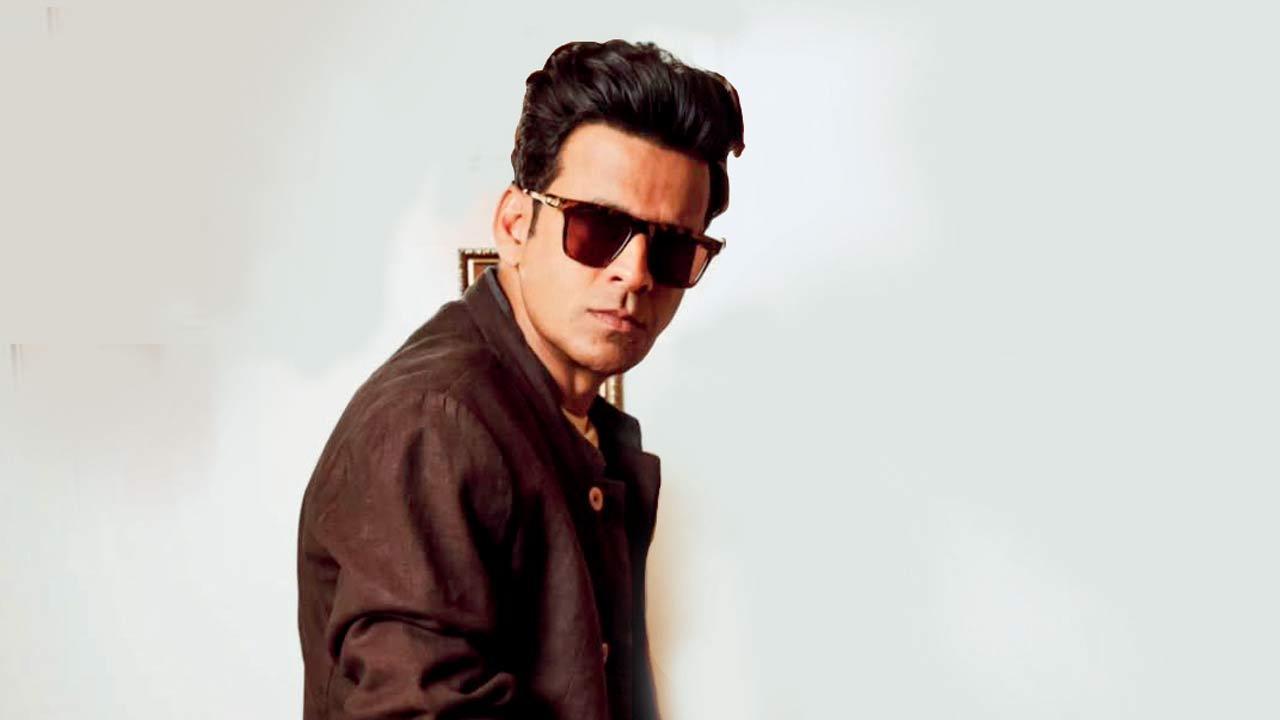
Portraying Mahatma Gandhi’s follower in Subhash Ghai’s Gandhi: A Perspective, Manoj Bajpayee reveals how he turned down a web series on the leader
Upala KBR (MID-DAY; February 7, 2025)
Manoj Bajpayee’s desire to work with filmmaker Subhash Ghai can be best understood in an anecdote he reveals. “When I landed in Mumbai to become an actor, the first set I went to was Subhash-ji’s Trimurti [1995] and the first office was Shyam Benegal’s. Since Subhash-ji works with big stars, I knew I stood no chance, but I kept on trying my luck on his movie sets,” he recalls. The then-aspiring actor’s wish was to be fulfilled over 30 years on. Today, Bajpayee fronts the director’s short film, Gandhi: A Perspective, and he couldn’t be happier about it.
“When I got a call to be directed by him in the short, I grabbed the opportunity. I admire the larger-than-life cinema he created. When I compare his films with today’s mainstream entertainers, which are VFX-heavy, his cinema makes more sense,” says the actor.
With Gandhi: A Perspective, Ghai wants the youth to better understand the renowned leader’s ideals and values. Bajpayee says that the film shows how the Mahatma is “misrepresented” by people today.
He shares, “Without understanding Gandhi-ji, people are commenting on him in a frivolous manner. That bothered Subhash-ji. He has written the script, which revolves around a teenager, who doesn’t have much idea about Gandhi-ji and talks about him in a derogatory manner. His idea changes [when my character] familiarizes him about the Mahatma’s teachings.”
The actor says that he has been fascinated with Gandhi since childhood, and has read extensively about the leader. So, would he like to play the Mahatma on screen?
“I keep myself away from playing famous figures. If you give me a biopic of an unknown person, like Aligarh [2016] was [about Dr Shrinivas Ramchandra Siras], I have freedom to give my own interpretation to it. But the moment you play a famous personality whose life has been read about and seen by everyone all over, people start critiquing it differently. They don’t look at the actor’s performance; instead, they get into comparisons of how successful the actor was in copying the real-life personality. I was offered to play Gandhi-ji in a web series, but I said no. Such projects require a year of prep. You have to change yourself mentally and physically as Gandhi-ji is not an easy personality to play. Watch Ben Kingsley’s process in Gandhi [1982], and you understand how tedious it was for him to play the part.”
My nationalism is different. Nobody can force that nationalism on anyone-Anubhav Sinha
8:28 AM

Anshul Chaturvedi (BOMBAY TIMES; December 31, 2024)
Anubhav Sinha’s first OTT project, IC 814: The Kandahar Hijack, hit some turbulence almost as soon as it took off, but held on to its flight path, broke through to calmer skies after a while, and coasted thereafter. The director looks back at 2024 from the lens of the series. The initial days were a mix of audience appreciation and unexpected trolling, he says, but as he looks back, he is happy at the reach of the show and the praise for his work, and wants to make more films on India’s intelligence agencies. Excerpts from a chat:
You entered the OTT space for the first time in 2024 with IC 814, and the series was talked about a lot, continues to be. What has been the feedback, other than the immediate controversy around release time?
Bahut tareef aati hai. I’m not saying I’m endorsing it, but people in general believe this is my best work. I was with Naseer bhai recently and he doesn’t need to, but he was still saying how wonderful it was to make the show, and how people reacted to it. The reviews, too, were very kind to the show. So, I have no complaints about that. In terms of the audience love and press’s love, it was outstanding. The PR teams were constantly telling me that 10/10 reviews, not a single lukewarm review. I’ve been told by responsible people that this is the best show of the year. Aur mujhe zyada shows karne bhi nahi thay, ek karna tha, woh kar liya maine.
Do you agree with the view that it’s your best work?
That’s not my call. I don’t think my best work is my call, and I don’t think best work is an absolute measure... that there can be a measure to judge your best. It is the way sometimes people express love, and I don’t think it has any bearing on you or any of your other good work. I don’t take it very seriously. But two things happened – one, most people ended up calling it a ‘movie’, and my deduction is that because they binged it, it felt like a movie. And two, a very large percentage of the reactions said, ‘This is your best work’. I don’t know if there is a way to measure if it is. But it’s their way of expressing love.
You didn’t talk too much when the series released, perhaps because much of the public conversation veered off into what was probably a needless controversy. As you look back at the year, what stays with you from the whole thing?
I think it was such a huge hit. The actors get more feedback than us, because actors meet people on a daily basis. And also, the numbers that Netflix keeps telling me. It is probably their biggest hit of the year. And baaki haan, thodi bahut controversy thi, thoda shor tha. Ab you know how internet has become so... it has become very impossible to figure what a human being is saying and what a computer is saying.
You had made a point regarding the portrayal of the people from the intelligence services – that you brought them with their flaws, as they were as people, and not like some Avengers entity. In Hollywood films, like a Zero Dark Thirty or any other, they also struggle with their flaws, and that’s how things happen in real life. Perhaps our audiences are not as accustomed to the grey portrayal. Did the community ever get back to you? Because it’s easier to put a policeman or an intelligence officer as one of those heroes on a horse who just come and do everything.
There’s a shot when they get out of the aircraft in Kandahar – the first time the four of them walking in. That’s my most favourite image from the series, actually. So, I thought what we accomplished... How ridiculous is it that a plane which is carrying close to 200 people is hijacked by some people that we don’t know who, why for three days and they take it to a city called Kandahar, where Osama bin Laden lives, where Mullah Omar lives, who are also internally at war. How ridiculous is that situation! And guess what? We brought them all back!
Ever since I’ve worked in this series, I have studied a lot about spying and intelligence gathering and all. It’s not as easy as it sounds. I think the four guys that went to Kandahar did a fabulous job, all four of them. They were talking to extremely unreasonable people, but they got everyone back safe. I think we did fairly well. And you know, such mature people who at the end of it are discussing, did we win? But they got the people back and that’s what the series is.
When I did my research, I realized our agencies are quite fantastic. But you know, you can see anything in any light. And that’s okay. US mein filmein banti rehti hain unki agencies ko celebrate karne ke liye. Hamare yahan unko celebrate karne ke liye filmein hi nahi banti. Bahut rare. I can’t remember many. And the things that our agencies have done are outstanding, and I’m a fan. I think I’d love to make more films about their achievements.
Do you feel under pressure to reassert your pro-nation credentials?
By whom?
Just by the trolls, or random critics who can question your nationalism over micro points in a show?
No, I don’t even read them anymore. I used to when it started in Mulk. I used to, but not anymore. I am who I am. I have loved Gandhi all my life. I have loved Bhagat Singh all my life. I want to read Vivekananda. These are the stalwarts of this country.
My nationalism is different. Nobody can force that nationalism on anyone. I deeply love where I am from – Banaras. My company is called Benaras. I have been saying this for years that I am made up of two cities – Banaras and Aligarh. These are two of the most precious cities to me as an individual.
I don’t question anyone else’s nationalism. Yours can be different, mine can be different. You celebrate, I crib and I fix. As long as... Country is a word, country is a geopolitical word, it’s the society that we’re talking about. It’s a society that we live in. Country is people. If I think there’s something that I need to do to criticize some of those people, I will.
As to the controversy at the time of the release – I mean, when you’re receiving 40 calls a day praising this thing and calling it your best work and what not, then this noise, at the same time, obviously is not welcome. And there are moments when you’re disturbed. But no, I think I’ve learned to deal with it.
You’re not new to being disturbed.
Just the other day I was talking to somebody, and he said, ‘Anubhav, your films love India so much. Not many do’. I asked, ‘Why do you say that?’ He said, ‘Because a man is looking at his country in a manner that a 4,000-year-old, 5,000-year-old tradition bothers him and he says, let’s correct it.’
I’m a great believer of this country. And the more I travel, the more I think we are probably the greatest country in the world. But we need to fix some problems, and we will fix them. We are a very young country. We’ve only just begun. The US got liberated in 1776. What was it doing 75 years later? It was still struggling with slavery. It still had the long civil war coming up. India is way ahead of that in 75 years. And you know, it’s a 10,000 times more complex society.
Expectations will be higher now. Iss saal ka ye aap ka best work tha toh ek do saal rahega woh pressure thoda?
Haan, but I can’t pay much heed to it. Aisa bahut zyada seriously leta nahi main inn sab baaton ko, na apne aap ko. I like to be happy. I like to eat good food. I’m playing the piano from the past 18 months – learning. That’s my big high every day.
Are you calmer, or more cynical, as the year ends?
Both, interestingly. I was telling Sudhir bhai (Sudhir Mishra) the other day – I said, ‘I’m getting more cynical’. He laughed. But I find myself way calmer now. Like this time, I did not react to the controversy. I did not feel like it.
The calm of the cynic?
I don’t know what that is. What is a cynic? A cynic is one who foresees the futility of things, right? So ya, but it has no contradiction with calm. The more you live, the more you understand the futility of most things, and it makes you cynical. Wiser, cynical. I think wise and cynic are close to each other. Wisdom is a problem. And age gets you wisdom, you can’t help.
Has age got you wisdom?
Yeah, I think so.
The film industry is more inclusive than many professions-Hansal Mehta
8:16 AM
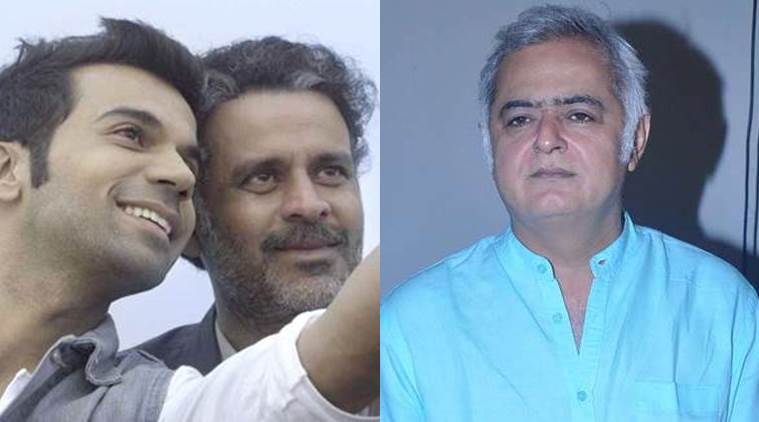
Filmmaker Hansal Mehta says the film industry has embraced the queer community with far more sensitivity than it gets credit for
As told to Renuka Vyavahare (BOMBAY TIMES; June 14, 2023)
There is an improvement in the depiction of queer characters on screen. As this generation is getting more woke, there is more understanding. People are cautious about not being insensitive. While there is a long way to go in bridging the gap given the discrimination the LGBTQIA+ community has suffered in the past, there are steps being taken. Our film industry has embraced the queer community with far more sensitivity than it gets credit for. It is far more inclusive than many other industries and professions.
For stronger queer representation, we need to work on our casting choices and the stories we tell. They need to be more mainstream. The short film (Baai) I made for Modern Love Mumbai, I chose to tell that story because it had a lot of sensitivity, and it represented the community with a lot of love and empathy. Baai focuses on the love story of Manzar (Pratik Gandhi) and Rajveer (Ranveer Brar).
I wanted to treat it like a regular love story as opposed to being seen as a gay love story. It had songs, family drama, familial opposition...all the tropes of a mainstream Hindi film or a heterosexual love story. Stories are stories. They are not driven by someone’s sexual orientation.
‘YOU LEARN THROUGH YOUR STORIES’
You learn through your stories, and exploring them makes you more empathetic. Aligarh played a huge part in my life in building that empathy. I made Aligarh because Apurva Asrani was a part of it as a writer and editor. The writing was nuanced. Manoj’s performance and Apurva’s script gave me a better understanding of why we need to evolve as a society. When you look at queer stories told around the world, they have gone beyond the ones we tell here. We are still dealing with queer problems and are bogged down by societal attitude.
‘PUT YOUR MONEY WHERE YOUR MOUTH IS’
If a studio or streaming platform allows me, I will cast actors from the queer community for relevant roles. However, representation through stories is far more important to me. An actor is an actor, and the best actor should get the job. Aligarh without Manoj Bajpayee won’t be Aligarh. Can you imagine anyone but Tom Hanks in Philadelphia? Our mainstream actors still turn down such parts. You cannot be inclusive in real life and exclusive in choosing your characters. Put your money where your mouth is.
‘POPULAR STORIES WILL BRING MORE QUEER REPRESENTATION’
When I made Baai, some people from the community rightly caused a furore about the absence of gay actors playing gay parts. Ultimately the idea was to get this story to be seen by maximum people and cast the best actors for those roles, so I got Pratik Gandhi. Should there be more actors from the community playing queer roles? Yes, of course, but let’s take one step at a time. As you make the stories more popular, there will be more queer representation.
OTT no longer a haven for small films, say experts
2:40 PM
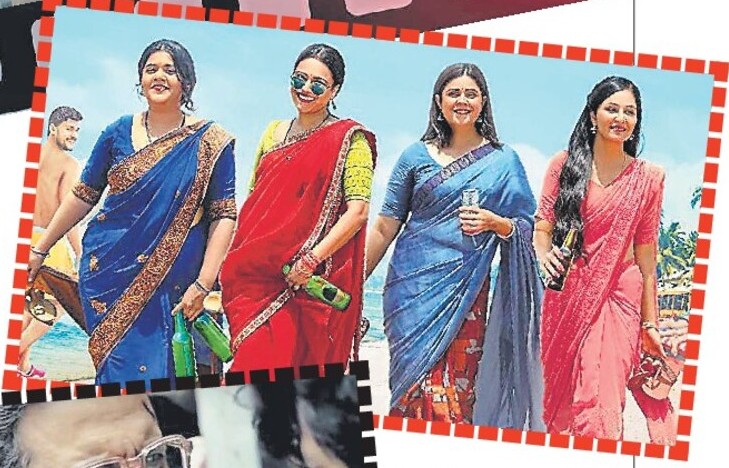
As theatres make a post-pandemic recovery, makers shed light on whether content still triumphs over big budgets on OTT
Rishabh Suri (HINDUSTAN TIMES; November 12, 2022)
Content does all the talking on OTT — this is the popular notion that has been attached to the medium for some time now. The OTT boom that was witnessed during the pandemic further strengthened this belief as a barrage of fresh and unique content flooded the web space. However, is the scenario still the same, now that theatres have become operational again? Is it still easy for small films, which are driven by good content, to get an OTT release? Experts weigh in.
‘OTT IS NOT A MESSIAH’
Recently, Manoj Bajpayee told us in an interview that it’s a struggle to release films regardless of the medium. He said, “What I have gone through in getting films like Aligarh (2016) and Bhonsle (2020) to cinema halls, and then OTT, has been quite a journey. One gets tired.” Attesting to the same, Devashish Makhija, director of Bhonsle, recalls, “Originally, we wanted a theatrical run, no matter how limited. But when Covid-19 hit, there was no scope for it. That’s when we got in talks with some OTT platforms.”
Makhija says the expectation for OTT to be a messiah for smaller films shouldn’t exist in the first place. “It’s filmmakers like us, who ascribe a lot of value to alternative mediums. I don’t remember OTT saying, ‘We are here to champion independent films’,” he says, and adds that they just got lucky as a newly-launched platform took a chance with them with Bhonsle. “Today, a big platform turns away original voices. They say, ‘We want to make money, we’re answerable to our bosses’,” he adds.
Echoing similar sentiments, Vinod Bachchan, who produced Jahaan Chaar Yaar, starring Swara Bhasker and Shikha Talsania, says he is yet to find an OTT platform for his film. “Sirf content criteria nahin hota. Many OTT platforms have grouped together. They don’t care whether the content is good or bad, but focus on stars,” he says.
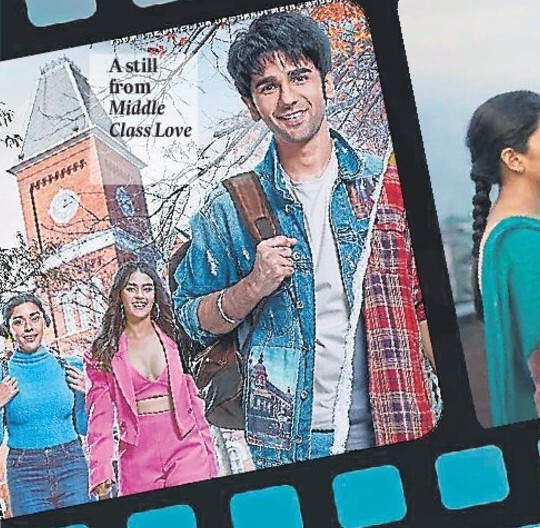
NOT ALL OTT
However, there are also some makers, who have had a good experience on the medium in the recent times. Director Ratnaa Sinha, who created Middle-Class Love, starring newcomers Eisha Singh and Prit Kamani, says the journey becomes easier for a small film when a production house owning a streaming platform, gets on board. “It is really difficult to make a film with new faces. Very few people believed that we could actually pull it off. Once we got a producer on board, however, it was fine. They gave us a good theatrical release, and since they own an OTT platform, we will get a release there automatically,” she says.
Palash Muchhal, director of the film Ardh, says the trick for him was to not approach any OTT platform, but to instead produce the film and then present it to the web teams: “We decided that we will sell the rights to the first platform that approaches us. I produced the film by selling off my car, but made back double profit.”
BOX OFFICE MATTERS
How a film performs at the box office is also a parameter now for OTTs. Trade expert Atul Mohan says films, which failed to attract footfall, were let go of by streamers. “During Covid-19, majboori thi OTT platforms ki as there was a lot of demand. Later, they realised yeh film jiske liye humne Rs. 20 crores diye, yeh toh Rs. 10 crores ke layak nahin thi. The journey is difficult for small films,” he says. Tara Vs Bilal was one such film whose OTT deal fell through after a dismal box-office run, a source reveals.
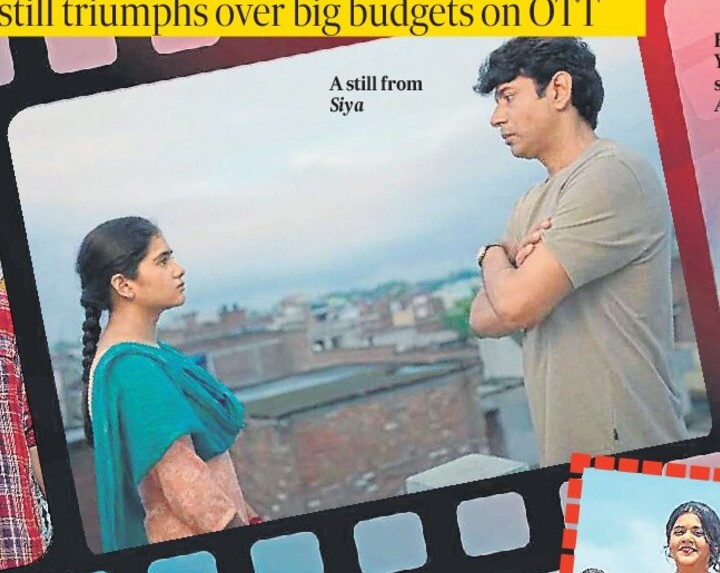
Actor Vineet Kumar Singh, whose film Siya got a theatrical release recently, says, “Things are changing fast. I’ve heard from people that streamers say, ‘Release in theatres first, we’ll take your film after that’.”
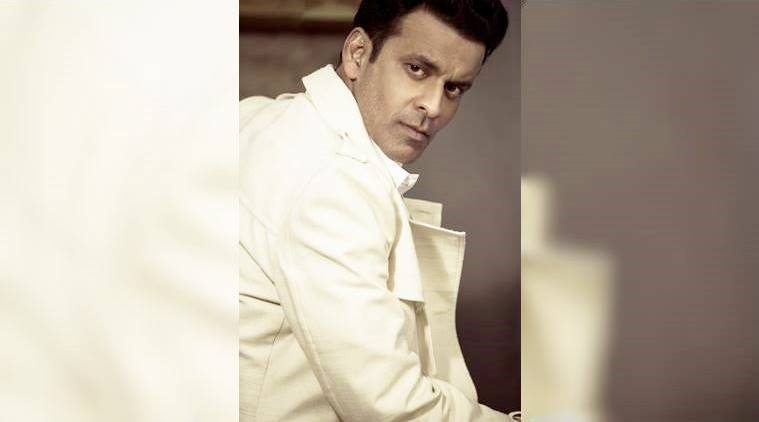
South blockbusters have sent a shiver down the spine of Mumbai film industry-Manoj Bajpayee
8:31 AM
Anshul Chaturvedi (BOMBAY TIMES; May 2, 2022)
In the phase where halls were shut and anticipated blockbusters were on hold, OTT revitalised and rebranded Manoj Bajpayee yet again. However, he isn’t riding that wave to do mainstream projects at all. “I had a resolve that I will attach myself with middle of the road or independent cinema, and I am sticking to it,” he explains. And as to mainstream Hindi cinema, he has a word of caution: It has largely missed addressing the non-multiplex audiences for a while and so is unprepared for the current surge of the south. Excerpts from a chat:
You have acquired quite a degree of prominence via OTT in the phase when halls were closed and big-budget movies were on hold. But you haven’t used that to work with a big studio – you are instead working with a number of filmmakers who are, for want of a better word, non-mainstream. Stardom nahi chahiye aapko?
Star kaun hota hai hamare yahan? Dekhiye, star toh wohi banega, jo exhibitor aur distributor ki requirements ko puri karta ho. Woh requirement kya hai? Requirement hai: Larger Than Life. Extravaganza. Pushpa ne uss gap ko fill kiya, RRR ne kiya.
I had a resolve that I will attach myself with either the middle of the road cinema or with the independent cinema, and I am sticking to that. It is also about empowering all these filmmakers so that not only do I get to play those roles that I always wanted to play, work with scripts that I always wanted to be part of, but also, in that process, some very talented people are being empowered. And today one can take these decisions because of OTT. Kyunki agar woh (film) theatre mein nahi aayegi toh woh OTT pe aa jayegi.
When I work with Rahul Chittella (for Gulmohar), it gives me immense joy not only to play the character that I am playing, and be part of the film, which I am so proud of, but also I see a fantastic director-writer coming into the film world. Isiliye mere liye Rahul Chittella, Devashish Makhija, Kanu Behl, Dipesh Jain, ya phir Abhishek Chaubey, Ram Reddy – all of these directors have become very important for me. Mere liye bahut important baat hai. Main yeh nahi keh raha hoon ki industry ka har actor woh kare jo main kar raha hoon. Nahi, lekin woh mera resolve hai. I have been following this without even talking about it. But now I have to say this. I have to tell people what I am doing and why I am doing it. Inki filmein karte hue mujhe badi aantrik santushti hoti hai.
Independent cinema means smaller pay cheques for the actors, right?
That is true. Inke saath jab main kaam karta hoon toh mujhe apni bhi bahut saari sahuliyaton ko – jo dimag mein hai ki bhai yeh sahuliyat honi chahiye, ki itne saal ho gaye mujhe kaam karte hue, mujhe luxury chahiye – uss luxury ko mujhe cut down karna parta hai. Which is very good!
You are chasing the creative element over material luxury, or is this some sort of personal CSR, that you have to give back to the industry?
This is a responsibility that I have taken upon myself. I do things in a personal capacity, where I feel I have to give back, but I don’t talk about it. Many of us in the industry do what we can, where we can, but we keep it to ourselves.
Secondly, har actor ki yeh journey hai. Jahan bhi woh pahuncha hai uske liye bahut tyag karna pada hai. Maa-baap ka tyag karna pada hai, bhai-behen ka tyag karna pada hai, apne comfort ka tyag karna pada hai, apne ghar ka tyag karna pada hai. Woh kai raat rota-rota soya hai, bhookha toh chhor hi dijiye.
Har actor – actor as opposed to star?
Even stars. There are stars who have become so huge in our industry who have come from middle-class families. They have sacrificed so much before they have become what they’ve become. Lekin jab woh ban gaya hai toh (log) kehte hai samaaj ke liye kuch kyun nahi kar rahe ho? Samaaj ke liye karna na karna uska apna chunav ho sakta hai. Hum uss ke upar dabav nahi daal sakte hain. Kya yeh dabav hum corporates pe daalte hain? Kya hum unke accountable hone ke liye unke ghar ke bahar pradarshan karte hain? Nahi karte hain. Kyunki wahan par pradarshan kar ke humein kuch nahi milne wala evaj mein. Jab main Twitter pe ek star ko gaali deta hoon, toh uske evaj mein bahut kuch mil jata hai. Ek pehchan milti hai – ek identity.
(Pauses) We have always been looking for identity – for heroes. Unfortunately, we found our heroes in film stars. But they could not be. They cannot be. They are entertainers. They are actors.
This resolve to work with the names you have spoken of – is this purely on the basis of how good a filmmaker they are or is this because somewhere in your mind you are saying let me act as a bridge or let me use my stronger presence in box office because now I’m a name with a stature there, so let me bring this greater aura to their movies?
The intention comes from two-three things. I have always been looking for subjects that are genre-bending or stories which are not told or filmmaking that is not very familiar to our audience. These are my personal interests. When I watch a film say by Inarritu (Mexican filmmaker Alejandro González Iñárritu), it is a very new way of storytelling and I want to be a part of it. Where and how can I be a part of it? Definitely, Inarritu doesn’t know me. He is not going to cast me. So I have to find my own filmmakers here, whose films or storytelling I can be a part of. And yes, my own professional credibility will empower them to take the film forward.
Why is this space more interesting for you than conventional, mainstream Bollywood?
Had I chosen, say, only mainstream format, or maybe gotten a place as a celebrated villain, then I would have been finished long back, because even heroes look for new villains after five years. I would have been used, abused, and thrown away. Maybe because I wanted to do things differently, in my own way, so that I could be relevant, these filmmakers came to my mind as a rescue or as an alternative to really keep me going, keep my interest in filmmaking and acting going. And I’m still as interested. I am still as interested and enthusiastic and as angry as ever. That anger is only towards making these films possible for my own self and for the audience. I am really seeing to it that they get a platform and medium where they can showcase their work. Purely that.
Now, from Delhi, I have to go to Jharkhand where Devashish Makhija and the unit is waiting for me (for Joram). They want a certain kind of discipline from Manoj Bajpayee and they are not going to compromise on that. And I am not ready to compromise on my effort either. So everything is back-breaking, kneebreaking.
In 2012, Gangs Of Wasseypur in mainstream cinema and in 2021, The Family Man on OTT – they seem to be the projects that gave you the comfort to do things on our own terms, to be able to pick and choose, right? When you get a hit in the industry, it gives you the space for a while to make your choices
You said it. You just nailed it. You know, one Gangs Of Wasseypur (2012), one Rajneeti (2010), and then Special 26 (2013) has given me so much strength to do Aligarh (2016), Bhonsle (2018) and Gali Guleiyan (2018) and so many others...If I do Aligarh or Bhonsle, for me it is self-satisfying. I sleep very peacefully after doing it. And then The Family Man has given me choices that I never had till now.
That’s how I tried to maneuver my career. I always needed one project which could empower me, give me that strength to go ahead and be a part of these filmmakers’ vision which could help me to reinvent myself, and rekindle my energy. It’s all mutual when I am doing these films. For my next scene (as he was at a set) I’m ready to go, I’m all prepared. I’m ready to go. Everything is prepared. But having said that I must tell you that I am not a genre-specific person. After five-six films, you may see me in a complete mainstream film doing all sorts of stuff because it has attracted me, not the genre but the matter, the film as such or the passion of the director.
So you are saying that you’re not taking high moral ground ki mainstream nahi karna hai. But you are saying that I don’t need to be seen in mainstream for my inner satisfaction. If it works, it works, if it doesn’t work then it doesn’t work.
If it doesn’t work then it doesn’t work. I have done Baaghi 2 and Satyameva Jayate. I have done many films in the past, so the filmography itself says that I have done those films. I have never regretted, rather I have enjoyed because I don’t judge them. Because for me cinema is far more important. Films are important.
(Pauses) Itni blockbuster ho rahi hai (from the south). . . forget about Manoj Bajpayee and the likes of me for a minute, it has sent a shiver down the spine of all the mainstream filmmakers from the Mumbai film industry. They really don’t know where to look.
The south industry is shaking up Mumbai?
Yes! I have been part of Tamil films and Telugu films. I exactly know why this is happening.
Educate us. One reads so much about actors saying ‘the culture’ is different in making South films but one doesn’t get the specifics. Kya culture hai, koi samjhata nahi.
Koi nahi samjhaega aap ko kyunki apne aap ko criticise karna padega. Maine kaam kiya hai wahan pe. They are unapologetic, they are passionate, and every shot they take as if they are taking the best shot in the world. And so much thought and passion goes into it. Not even once do they talk about the audience in a demeaning way. They don’t say that the audience will understand. ‘Yeh massy hai, yeh chal jayega’ – they never talk in this language. They shoot a film as they have envisioned it, they don’t dumb it down for the audience because they hold their audience in the highest regard and their passion is supreme.
If you see Pushpa or RRR or KGF, the making of it – it is immaculate. Each and every frame is actually shot in a manner as if it were a life and death situation. This is what we lack. We started thinking about mainstream films only in terms of money and box office. Hum criticize nahi kar sakte na apne aap ko. So hum unko ‘different’ keh kar alag kar denge.
But it’s a lesson. This is a lesson for Mumbai industry mainstream filmmakers on how to make mainstream cinema.
As an observer, what you seem to be arguing broadly is that if somebody is looking for cinematic satisfaction as a viewer, he’s saying maybe OTT is giving me better choices. As an actor across all genres, you are doing half a dozen films outside of ‘mainstream’ Bollywood saying that is giving me more satisfaction and more space, and it excites me more. So your excitement quotient is not being met by the mainstream, at least at this moment in this space. But on the other hand, when it comes to the larger-than-life scale – then the south is doing better than Bollywood. Right?
I will tell you one thing – do you know that Ram Charan and Junior NTR and Allu Arjun and Pawan Kalyan were already stars in the B, C cities before their recent films became big hits. Their older films were already being watched in a dubbed version in all the interior places. Those were the films which were actually satisfying the B, C cities of this country. But we were satisfied with the multiplexes and popcorn films thinking that we are making the best mainstream cinema which is reaching everyone. No, it was not reaching everyone. That section – the audience of the smaller cities, the single screens – was really not entertained. They (mainstream Bollywood) stopped addressing those viewers. When multiplexes become very expensive and far away from their (audiences’) reach, then who is their star? Who is entertaining them all this while? For you, as a person who buys a ticket in a multiplex in Delhi, when you see RRR, Junior NTR is someone you have seen for the first time – but not for the viewers in the B, C cities. They have already seen him.
Someone told me before RRR’s release – “Bhaiyya, aap Junior NTR aur Ram Charan ko le kar chale jaiye Haryana ke kisi gaon mein, woh aaj bhi mob ho jayenge. Aap ka (Bollywood) superstar wahan mob nahi hoga kyunki woh audience unki filmein nahi dekhte hain. Woh inki filmein dekhte hai, dubbed version.”
That’s because Hindi cinema wasn’t giving them this content?
Upper middle class ko jab hero mila, aur multiplex bhi usi waqt aaye, uske baad humne ye space miss kar diya. Lekin multiplex mein jaana sabke bas ki baat rahi nahi. Ab Zanjeer, Naseeb, Khalnayak kahan banti hai? Ya Vishwanath? Kalicharan? Hamari upper middle class ka hero NRI ban gaya tha. Upper middle class ka aspiration woh raha. The successful huge megastars that we have created – they were not megastars of B, C cities.
----------------------------------------
‘THE MESSAGE WAS TO SPREAD HARMONY WHEN WE FIRST SHOT BHAGWAN AUR KHUDA TWO YEARS BACK’
Recently, a two-year old video (Bhagwan Aur Khuda ) of Manoj reciting a poem on harmony between religions has been circulating. He tells us, “This video was made during the lockdown. I was in Uttarakhand and Milap (Zaveri, film writer and director) wrote this poem and sent this to me, asking me to recite it. Mujhe poems recite karna waise bhi achcha lagta hai, and I really liked what he wrote, so I recorded it and sent it back to him. He then called me to say ki isko shoot kar ke bhej do agar wahan koi assistants hain jo mere saath phanse hue hain. It so happened that two assistant directors were there, stuck along with me, Sagar and Ashok. So we spent some time and shot it together.”
He reminds us that he also shot for another video during the first lockdown – Bambai Me Ka Ba for Anubhav Sinha. While it was initially posted online two years ago,it’s been seen more recently than it probably was then. “Jab uss samay daala tha tab bhi kaafi chala tha, lekin iss samay jis tarah se iss ka swagat ho raha hai woh unprecedented hai,” says Manoj, adding, “Mera apna maanna hai ki Bharat ko aage jaana hai toh sab ko saath mil ke chalna hoga. The message was to spread peace and harmony when we first shot this two years back. I am of course surprised that it has gone viral at this point. But as to why, perhaps the simplest answer is in what one of my co-actors messaged me: It was relevant then, it is relevant now, and it will always be relevant.”
‘I DELETED WHATSAPP TO STOP EXPECTATIONS’
While reaching out to Manoj for this interaction, we realised that our WhatsApp messages to him weren’t landing. The actor subsequently clarified that it was on account of him having deleted the app. “WhatsApp pe bahut saare known, unknown messages aate hain, everyone expecting you to respond to them quickly. There are invitation to all kinds of functions and then people expect you to respond in a positive manner. There are so many forwards – many of which are not in sync with my sensibilities – spams, unknown numbers and bulk messages coming in every day, unknown calls coming every day. It’s humanly not possible for any of us to entertain each and every message and answer them in positive. And your answer should match their expectation, which was getting a little too much. I also wanted to just keep a lot of time for my reading, for watching content and spending time with my family rather than just being stuck on the phone and being busy answering people. So I think it was just very, very important for me to delete it so that the expectations stop.”
Now, the wish is to play my last innings well-Virendra Saxena
8:51 AM

Deep Saxena (HINDUSTAN TIMES; January 7, 2022)
Veteran actor Virendra Saxena shares his secret mantra of getting all his performances right. The actor feels that his life experiences and small-town upbringing mirrors in the characters played by him in a career spanning 37 years.
“I was raised amidst many hardships which taught me the actual life lessons. And probably, that’s what reflects in my performances. With your experiences, emotions, observations of life, your surroundings and small-town environment which you don’t get in big cities and metros you get to go deep in understanding the roles you play,” says the Sonu Ke Titu Ki Sweety (2018) actor.
The 64-year-old, who was busy shooting for filmmaker Anubhav Sinha’s Bheed in Lucknow, adds that to keep himself relevant, he makes conscious efforts and stays fit so he can easily play roles younger to his age.
The actor is happy with the kind of work he being offered and says, “Now, the wish is to play my last innings well.”
Saxena says that he does not believe in doing a lot of work. “For actors of my age, as it is there is less work, so I know that those who offer me roles are the ones who really want me in their projects. I am sound enough on monetary front, thankfully, so no stress! I only work when the role is really good or the pay-cheque is high. I try to balance both but at times you can’t refuse your friends so you have to work in projects even if it pays less. Kyonki Mathura, UP, ka banda hoon isliye emotional ho jata hoon.”
Talking about his personal life, Saxena, who is married to actor-writer Samta Sagar, says, “Her play got made into TV serial Gudiya Hamari Sab Pe Bhari. Samta’s other play Jana Tha Raushanpura is being made into a film while rights for Mini Humesha Mere Saath Rahegi have been bought too. As there are just the two of us, so we don’t care much about money.”
On working with Mulk (2018) director, he says, “I have good relations with Anubhav (Sinha, director). His first play was with me in Aligarh and even stayed with me when he came to Mumbai. I’m happy with his current films. He is like a younger brother and the way he treated me during this project was a very emotional experience for me.”
The timing of Chhattisgarh verdict, coinciding with Criminal Justice winning this international honour, was just crazy-Apurva Asrani
8:29 AM

Naina Arora (HINDUSTAN TIMES; August 31, 2021)
For writer Apurva Asrani, starting a “conversation in society” through his work is of utmost importance. Recently, the show written by him, Criminal Justice: Behind Closed Doors, bagged the Best Asian Drama Series award at ContentAsia Awards 2021. But the recognition has come at a time when the Chhattisgarh High Court ruled that ‘sexual act with one’s wife is not rape, even if forced’.
This has put the spotlight back on marital abuse in India. “The timing of the verdict, coinciding with our show winning this international honour, was just crazy. On one hand, the civilised world is moving towards undoing the evils of domestic abuse, and on the other, Indian courts are giving men a free hand to rape their wives. Many women and men are under the misconception that control is equal to love. It’s in fact the opposite. Let’s raise our voice against the awful Chattisgarh verdict,” he says.
“I’m blessed to find collaborators who feel deep empathy towards such stories. My film Shahid (2012) talks about minorities wrongly imprisoned under draconian laws, fighting for justice. Then Aligarh (2016) made the case for a teacher who happened to be homosexual, fighting for his right to privacy. Made In Heaven, where I worked as an editor, took that conversation into an urban space,” he adds.
Asrani shares how women reaching out to him on social media is his greatest reward. “Women of all ages watched the show and sent me messages about their domestic situation,” he says, adding, “One woman begged me to save her from an abusive husband. I was shaken till I connected her to an NGO.”
So, how important is it to create content such as this? “I wept the day I learned Criminal Justice Behind Closed Doors was a big OTT hit. Not just because every artiste strives for recognition, but it also meant households were ready to talk about what happens behind closed doors,” he adds.

I didn’t sleep for nights fearing that a cop would show up at the door and shame my parents-Apurva Asrani
8:15 AM

Rishabh Deb (BOMBAY TIMES; June 15, 2021)
For film editor and writer Apurva Asrani, 2020-21 has been a challenging phase. He lost several friends to COVID-19, and his 14-year-old relationship with partner Siddhant Pillai came to an end. Despite all the events that unfolded in the span of a year, he is taking things in his stride and trying to cope. He finds solace in writing new stories, taking long walks on the pristine beaches of Goa, playing with his cats and bonding with family. In a Pride Month special interview, we catch up with the Aligarh writer and editor and speak about self-love, coping with loss and more. Excerpts:
‘FOCUSING ON SELF-LOVE AND BONDING WITH FAMILY’
Mental health and self-care are his top priority and Apurva, who has moved in with his family after decades, is focussing on himself now. He says, “It’s been a difficult time for everyone since COVID-19 struck. I have lost friends, friends have lost loved ones, many are out of work… everyone I know is coping and surviving somehow. Most things are fine for me by the grace of god. Yes, my 14-year relationship ended during this period. But I am taking it in my stride.”
“Writing gives me a lot of clarity and peace. Bonding with my family, my cats, and playing online games; that’s how I am taking care of my mental health,” says the National Award winner. Sharing certain habits that he picked up during the lockdown to take care of himself, Apurva adds, “I have learnt that sometimes not doing anything and chilling is also okay. Living with my parents, for the first time in decades, allowing myself to cry when I’m down, meditating every day, finding joy, reconnecting with old friends that I had lost touch with; these are some of the things that I started doing in the recent past, things that I would normally not do.”
‘GETTING USED TO BEING SINGLE AFTER 14 YEARS’
Though Apurva and Siddhant parted ways, they continue to share mutual respect. “We may have gone separate ways, but he will always be a valuable part of my life,” shares Apurva, adding, “I haven’t been single in 14 years. Just getting used to the fact that I don’t need to seek someone’s approval before making a decision is something new.” After the two parted ways, Apurva moved in with his parents and is spending a lot of time with them. “There are times I miss the companionship, but I also recognise this as a time when I can rebuild myself into a better, more evolved person. My work gets a lot more attention. I am also taking care of my fitness and diet,” he says.
‘TIMES HAVE CHANGED SINCE I CAME OUT’
Apurva, who came out as gay back in 1998, says that life has changed for him ever since he came out. “Honestly, I have celebrated freedom from Section 377 every single day since the 2018 judgement. Earlier, Pride Month used to be more of a protest and visibility month for me. Now, it’s about having discussions with other LGBTQIA+ folks about how we can make life better for ourselves. We are no longer outliers, we are now looking to integrate in the mainstream and carve a legitimate, respectable place for ourselves,” says Apurva.
On how the scenario has changed in the last two decades for people from the community, he shares, “Circa 1998, you hardly read the word gay in the media unless it was referring to a joke, a crime or HIV. There were no respectable gay movies made in India. A little later they started underground parties where you could meet others like yourself, but these parties were fraught with uncertainty because they often got busted by cops. There was this one party I was at, where five police vans filled with armed cops swarmed down on us as if we were terrorists. They then lined us up and made a news cameraman film us. We were detained, our addresses taken, and they threatened to ‘out’ us to our parents. I didn’t sleep for nights fearing that a cop would show up at the door and shame my parents. It is one of the reasons that I began a sort of gay rights advocacy. I knew we deserved respect. The world has changed so much now, more so for the urban people, but at some level also for all LGBTQIA+ folk. We have so many movies, shows, openly gay celebrities, industrialists and even sportspeople to draw inspiration from. There are events, parties, and forums. I’m glad I’m still young enough to enjoy this time.”
‘REPRESENTATION IN CINEMA AND SHOWBIZ HAS EVOLVED’
While a hearing on the pleas regarding recognition of same-sex marriage in India is awaited, Apurva feels that it’s a basic right that should be respected. He quips, “Whether one believes in the institution of marriage or not, all LGBTQIA+ citizens should have the same right to marriage as their heterosexual brethren. By denying us this right, the constitution is not being respected.” And what about him getting married? “I would ask my mother to find a suitable boy to arrange my marriage,” he laughs.
Speaking about queer representation in Indian cinema, Apurva says the industry is doing well on that front. “In just the last five years, we have seen so much quality queer content. Margarita With A Straw, Aligarh, Kapoor & Sons, Made In Heaven, LOEV, Ek Ladki Ko Dekha Toh Aisa Laga, Shubh Mangal Zyada Saavdhan etc; each one is so different from the other and all cater to diverse audiences. We are doing well. In the West, they were at this juncture many years ago, which is why their content today normalises LGBTQIA+ folk. We, as a decriminalised community, are barely three years old. We still have the angst of our closeted lives to purge. We are still building our identity. And our content reflects that,” he opines.
‘NEED MORE AWARENESS ABOUT COUNSELLING’
Highlighting the plight of the community amid the pandemic where many have had to return to their parental homes and deal with families that do not respect their orientation, Apurva says, “Plus, the respite that they may have found by meeting, interacting with people from the LGBTQIA+ community has come to a standstill and they are stuck with people they need to pretend for. It might be a lonely time for them and the implications on their mental health might be far-reaching. We need more awareness about counselling and therapy in the future.

Give makers the liberty to self censor on OTT-Manoj Bajpayee
8:15 AM

Kavita Awaasthi (HINDUSTAN TIMES; December 5, 2020)
As the world attempts to go back to the pre-Coronavirus pace of life, actor Manoj Bajpayee has been working non-stop in back-to-back projects, and loving it. “I’m happy to be shooting, wrapping up my commitments. We are following guidelines on the sets and being immensely careful,” he shares.
Last month, his film Suraj Pe Mangal Bhari was the first project to release in theatres after they reopened after being shut down for months. And Bajpayee considers it a success. “The response has been great... I am happy that we chose to go ahead [with a theatrical release]. It was a risk that paid off,” he says.
The two-time National Award winner is hopeful that other filmmakers will follow suit and go for theatrical releases. Other than movies, the Padma Shri recipient has been busy with web shows as well. Ask him if the constant stream of new content on OTT platforms is overloading the space and he replies, “People are consuming everything as they are at home. If they don’t like something, they immediately switch it off.”
Reacting to the subject of censoring OTT content, Bajpayee says, “It’ll be sad if that happens. It’ll curtail the wings of filmmakers. At times, people do go overboard, but if it is a story requirement, then it’s okay. I think makers should get the liberty to self-censor as restrictions would hurt everyone.”
Mention his recent win at Asian Academy Creative Awards for The Family Man and Bajpayee is all humility. The 51-year-old, who earlier won Asia Pacific Screen Awards for Aligarh (2016) and Bhosle, says, “Nomination itself is a big thing, even if you don’t win. My work getting appreciated globally means my audience base is increasing, and that’s what matters to a performer. No bigger award than people loving your work.”
I would have liked to do songs but things are so controlled in the Bollywood music industry...-Karan Kulkarni
8:14 AM

Raat Akeli Hai and Shakuntala Devi's background score composer, Karan Kulkarni says to do what he does, you need to love movies as much as music
Aastha Atray Banan (MID-DAY; August 2, 2020)
 "Making background scores… it all happened by accident," says Karan Kulkarni. A fortunate accident it would seem, because Kulkarni is the man behind the scores for Abhishek Bachchan-starrer Breathe - Into The Shadows, and now, Amazon Prime's upcoming film Shakuntala Devi and Netflix's Raat Akeli Hai. Both released this Friday. The Punekar, who moved to Mumbai to make it as a musician, tells us why he shifted tracks.
"I would have liked to do songs, and I have done many, but things are so controlled in the Bollywood music industry, that only a few directors manage to get their songs into movies. So here, I am, doing background music," he laughs, adding, "I guess, it's best to adapt."
 Since Kulkarni moved to Mumbai nine years ago, he has given music for a short film directed by Vasan Bala. This was after he returned from Australia where he signed up for a music production course. He then started assisting music director Amit Trivedi, but it was with Bala's Peddlers in 2012 that his career truly kicked off. "That movie never released, but it gave me the chance to do something. Then I did Aligarh and Shahid, and it all took off from there."
He also may have been well accustomed to the wily ways of the music industry, and thus, started composing jingles for brands like Amazon and Flipkart. "I did Tumhari Sulu and Mard Ko Dard Nahin Hota, but as I said, it's all very controlled here—how much work a person actually gets [depends on other forces]. Web series have opened up the floor, and the bar is raised high, since you are competing with the best in the world. For example, Stranger Things, which has a great background score, is available to watch on the same platform as my work," says the 34-year-old.
Ask him what makes a music composer different from one who makes background scores, and his answer is deceptively simple. "You need to love movies! Otherwise, how will you know what fits with what? You also need to be able to tell a story through music—and be aware that change is constant, as emotions keep changing. So your music has to based on what's happening on the screen."
Keeping this in mind, Kulkarni's score for Breathe is more "psychological", with character themes for everyone. For Raat Akeli Hai, which is a murder mystery starring Nawazuddin Siddiqui and Radhika Apte, the music had to be darker. "For Shakuntala Devi, everything was more upbeat and positive. There is a certain brightness to it."
Personally, Kulkarni is inspired by music that is technology-driven, so composers like Trent Reznor are high on his listen list. After all, who can forget the brilliant score Reznor gave for Social Network, where the piano melody harbours the power to give rise to an emotion. And Kulkarni has made good use of technology this Coronavirus lockdown. He and his team completed the full score for Shakuntala Devi in four months of lockdown, sometimes going to a studio, but mostly working out of their bedrooms. "It was quite tricky, but we managed. We exchanged samples, and put it all together. It has been a lesson."
Here on, Kulkarni has decided to take on less work. "There are a few projects that have come up, but I am going to take it slow. I am utilising this time to study. I am practising guitar, and also working on the tabla, which is a brand new instrument for me. After a very long time, I am a student again, and I am completely enjoying it."
OTT frees me from the vagaries of a Friday-Hansal Mehta
8:26 AM

Prashant Singh (HINDUSTAN TIMES; July 14, 2020)
Due to the Coronavirus scare, film theatres were among the first ones to down their shutters. Immediately after that, when certain filmmakers chose to go towards OTT platforms, a debate around ‘OTT vs theatres’ started to rage. Hansal Mehta, for one, feels “theatres aren’t going anywhere”, but also adds that OTT has come as a boon for many.
“Honestly, the magic of big screen/theatres will continue to thrive. But at the same time, for a filmmaker like me, the presence of OTT platforms mean that, if need be, I don’t have to be tied to the vagaries of a Friday,” says Mehta, whose films such as Shahid (2012), Citylights (2014) and Aligarh (2015) are available on streaming platforms.
“The kind of feedback I have got from people, who have watched Shahid or Aligarh now on OTT, is tremendous. Many may have missed out on watching them in theatres but it’s a great feeling for me, as a filmmaker, that people are appreciating my work, regardless of the platform,” says Mehta, who has Rajkummar Rao-starrer Chhalaang as his next release. “Let’s see what the producers do (with regards to its release plans). Right now, there is no clarity on theatres reopening, so I don’t know what’s going to happen,” he says
But Mehta “feels great” that due to OTTs, he doesn’t have to depend on Fridays to showcase his work to audiences. “Every platform, at the end of the day, is going to coexist, but streaming platforms just frees a filmmaker like me from so many things or pressures that may come with a Friday,” says the writer-director, who is currently stationed at his Lonavala home, along with the family.
“I am enjoying my family time here. Besides doing all cooking that I really enjoy, I am also taking out time for work. So, I do my weekly meetings — with my writers and actors — for my show as well as Chhalaang, and my next directorial, too. I don’t see myself coming back to Mumbai anytime soon, or at least till the time when I have some work in the city,” says Mehta, who has also finished two scripts during the lockdown.
My Pataal Lok character Ansari was born during chats with Mangolpuri cops-Ishwak Singh
8:36 AM

A theatre actor noticed for his role in Pataal Lok, says it's when he spent days with officers who operate on the fringes of Delhi, that a believable character took shape
Aastha Atray Banan (MID-DAY; May 31, 2020)
 To prep for his role as young police officer and IAS aspirant Imran Ansari in the recently dropped web series Pataal Lok, which is centred around the team at the fictional police station of Jamna Par in New Delhi, Ishwak Singh says he had to literally cross the Yamuna. "These areas are referred to as the outer districts… places like Mangolpuri, where the crime rate is very high. I hung out there, made friends with the cops and saw what their daily life was like. Most of them end up tackling 100 cases each. You begin to empathise with them, you know [what they do] is difficult. When they shared their stories, the details of their interrogations, that's where Ansari was born."
Singh, who is trained in theatre, says the method seems to have worked, with the entertainment circuit calling him the new "find". His phone has been ringing off the hook, with calls and messages from fans and seniors who matter. He thinks Ansari stands out because he represents the good in a story that's centred around greed, corruption and disillusionment, within the media, the police force and society in general.
But this journey to attention has taken a while. Singh's first big break was Hansal Mehra's 2015 film, Aligarh. He is philosophical about the right break. "It's all about doing it well; I would've waited 15 years if needed," he says. The Delhi resident had studied to be an architect like his brother, but couldn't get the urge to act out of his head. "An actor just knows! But I was far removed from this world. I was scared to even say that I wanted to do it."
After college, he signed up for a weekend acting workshop and took up small roles. It was at Asmita Theatre Group, that he came into his own, and after someone noticed him during a stage performance, he received a call from Yash Raj Films. "That role didn't work out, but then I met Mukesh Chhabra [casting director], Aligarh happened, and then Tamasha." Singh then went back to theatre, because he knew that to hone his craft he had to continue to act. "I started to look at it seriously—as a profession. The more you do it, the better you get. I played the same character again and again; that's how you develop techniques and characters."
It came in handy when developing Ansari, the positive and upbeat Muslim cop. "He has to be right. He is a member of a minority community, and has to keep the larger picture in mind. He can't afford to slip into cynicism. He is not in his comfort zone as a young Muslim police officer. He has to keep going and prove himself, much the way I'm trying to do in Bollywood."
Having been termed crush-worthy on Instagram, means he may be the new flavour of the season. Singh is enjoying it because "without the audience, we are nothing".
The medium of Gaman came from Calcutta, inspiration from Aligarh and soul from Awadh-Muzaffar Ali
8:20 AM

Filmmaker Muzaffar Ali on his 1978 directorial debut — about a taxi driver from Uttar Pradesh in Bombay — which chronicles the plight of migrants in the big city
MUMBAI MIRROR (May 17, 2020)
 I was moved to read Trisha Gupta’s piece, Tell me how long the train’s been gone, which appeared in Mirror last week. I am happy to see Gaman is still relevant after so many years. Each film is a world in itself. A universe we create out of ideas and emotions that have been a part of our building blocks. It is a pictorial canvas of what we have seen, and would like to show to this world, with the utmost honesty and sincerity.
Many a time we make films that people would like to see with equal sincerity and artistry, yet there is a fine difference between the two, and people can see the difference. It is what you want them to see that lives on.
Gaman is about displacement. In scientific terms, it is the adding of an external element and thereby the replacement of the original organic element. I saw the emergence of a Gaman-like world in Bombay when I moved there in 1971: The influx of people from all over to displace the original character of the city. The making of a metropolis is the unmaking of a place. Spaces are threatened in layers, year after year, and each year changing the aesthetics of an urban cityscape, rendering the earlier out of date. The enormity of this tragedy was rendering people faceless.
‘Kya koi nayi baat nazar aati hai hammeiñ Aeina hameiñ dekh ke hairan sa kyoñ hai’
 A question of becoming a stranger to oneself: Bombay, to becoming Mumbai, a strange mirror that reflects our past with a perspective of the future. Bombay was a series of fading mirrors that pulled one, each time one saw oneself in them. Most of these mirrors find their way from sacred spaces to the crowded narrow gullies of places called Chor Bazaar.
Gaman is a journey of changing images in such mirrors. It is the reflection of the dynamics of roadscapes of a city, which never sleeps, in the rear-view mirror of a taxi in the eyes of a helpless driver. Spaces that are yours and not yours: A river that can never afford to stop. The protagonist of this ceaseless flow is a throbbing heart, beating, yet lifeless like a stone. Seeking reasons, yet finding none.
‘Dil hai to dharakne ka bahana koi dhoondhe Pathhar ki tarah behiss o bejaan sa kyun hai’
Where music is the melodic refrain for the orchestration of a mechanical world — this was me in Bombay in the 1970s, a city, which I saw from atop the Air India building, where I worked on the 18th floor. From where for hours on end, I watched yellow-roofed taxis crawl like ants. I wondered whether under those yellow metal sheet roofs was a man like me far away from his home. How far was his home; it was anybody’s guess. What he had left behind was beyond anyone’s imagination. The feeling was enough of an answer. Was it worthy of a film, I thought to myself? Was this loneliness our inevitable destiny — a wilderness beyond what meets the eye? On one hand, the ocean, and on the other, an endless sea of humanity...
‘Tanhai ki ye kaun si manzil hai rafiqo Ta hadde nazar ek biyabaan sa kyun hai...’
But certainly it was an emotion as deep as the Arabian Sea. It was an emotion in which I saw the fathomless tenderness of a thumri. Each time our eyes met in a rear-view mirror, a truth transpired. One saw beyond what the eyes could see. I saw the piercing eyes of Khairunnissa wait for Ghulam Hasan. I saw the eyes of Farooq Sheikh and beyond that the piercing helpless gaze of Smita Patil. Was it still worthy of a film?
What was beyond these frozen frames? There were moments of truths and more truths, of humans waiting at traffic lights on metalled roads and zebra crossings, metal bridges across mighty rivers ferrying helpless souls packed in metal cabins. Amidst this human exodus were shattered windows of glass, allowing the last ray of the setting sun play its flute on a windswept face.
‘Aaja sañwariya tohe garwa laga luñ Ras ke bhare tore nayan...’
It was a lonely journey. Can the loneliness of this phenomenon become a collective journey of a film? I had found the words, which described the emotional angst of the migrant. When Krishna leaves, would Radha’s tears drown Braj? In this diabolical answer, I felt, I was near the beginning and the end.
 Everything was in the mind of these mindless travellers, at times, bringing the odd tear when emotions aligned themselves to the sound of the changing tracks. But the sharp tearing horn of a railway diesel engine wiped it off in an instant as the morning sun rose in the formidable ghats and one was sucked into an endless tunnel. One wonders which side one is on. The ones in the train or those they are going to displace. I had become a ‘Ghati’ and a ‘Bhaiyya’ in the same breath. For many years I had been in that train not knowing the difference between the beginning and the end of these journeys.
Hence Gaman: A name given by my friend Asghar Wajahat to this feeling. Something I had begun to see with the inner eye. But Gaman was more than I could hold in one glimpse. It had too many metaphors, both vivid and fading. Khairunnissa sniffing and wiping her nose with her chadar as she extinguishes a night fire at dawn. Clothes becoming one’s second skin, fading and becoming sensuous, looking nostalgic and inviting with their faded textures under the smoke filled thatched roof, turning black with soot. The soot and the smoke was not different to the soot and the smoke from the speeding train... one was towards darkness and gloom and the other towards the light at the end of the tunnel.
‘Aap ki yaad aati rahi raat bhar Gham ki lau thartharati rahi raat bhar...’
One was static in a moving environment and the other moving in a static world.
‘Dard ke chaand dil mein utarte rahe Chandni muskurati rahi raat bhar...’
Gaman was yet to be born. And was it worthy of being a film? I didn’t care anymore. I had begun to unearth the city called Bombay.
The medium of Gaman came from Calcutta, inspiration from Aligarh and the soul from the heart of Awadh... and my palette from my paintings, having sketched out each frame. I was fascinated by khaki from the paper of my paintings and was fascinated by the khaki clad taxi driver protagonist of my film. Symbolically as a migrant taxi driver and as a migrant, he had no identity left but to become khaki, the colour of dust.
No matter how talented we were, girls always flocked to Shah Rukh Khan-Manoj Bajpayee
8:28 AM

Ahead of Hitlist Web Awards, the 'Family Man', over a long sit-down chat, traces his journey from farmland in Bihar
Mayank Shekhar (MID-DAY; March 7, 2020)
In a way, the journey of Bombay cinema's transition into millennial cool, late-90s/early-2000s onwards — what with even 'indies' beginning to merge with Bollywood mainstream — starts from a street in Delhi. It's officially named Sudhir Bose Marg, where colleges of Delhi University's (DU) North Campus are lined up one after another, on either side.
If you survey this street late '80s onwards, you'd find Manoj Bajpayee enrolled in Ramjas College, fresh off a train from Bihar. Bajpayee says he also used to perform in plays at the next-door Hindu College, where there was actor Ashish Vidyarthi. When not representing university in cricket, Vishal Bhardwaj (from Meerut) would score music for those plays. "Rekha, Vishal's girlfriend [later his wife], was learning classical music."
To the right of Shishir Bose Marg is Khalsa College, where Saurabh Shukla graduated from. To the left is Hansraj College, where Shah Rukh Khan was reading economics. Few years later, Imtiaz Ali (from Jamshedpur) founded Hindu College's dramatic society.
At about the same time as Anurag Kashyap (originally from Banaras), who was at Hansraj. "Oh there are just way too many people [to name]," Bajpayee trails off, as we stage an unscripted, hour-and-half long edition of Sit With Hitlist, before a live audience.
Will continue to use full names, just so you can correlate them with their relevance to current Bollywood. The point for most of these DU students — who later made the move to Mumbai and cinema — wasn't quite to crack their final exam in history (Bajpayee), or zoology (Kashyap). It was firstly to gain access to the thriving theatre scene in the Capital.
This is where Bajpayee co-founded the theatre company, Act One. It had, among others, Imtiaz Ali, actors Gajraj Rao, Piyush Mishra: "Shoojit Sircar used to design background music, and assist director [N K Sharma]. Anubhav Sinha assisted [in direction], and was an important part of the circle."
During the day Bajpayee trained under Barry John and his company Theatre Action Group (TAG), to secure a place in Delhi's National School of Drama — that ultimately rejected him four years in a row. It's at TAG that he first met Shah Rukh Khan: "No matter how talented we were, girls always flocked to Shah Rukh." Nothing's changed.
"Shah Rukh, along with Divya Seth, Jeeturaj, were English theatre actors, from privileged backgrounds in South Delhi," Bajpayee recalls. While everyone really made it on their own in Mumbai/Bollywood, with zero family connections, the one to scale the steepest climb is still likely to be Bajpayee. He was born into a famer's family, with six siblings, raised in a village called Belwa in Bihar, bordering Nepal, where there wasn't even a local cinema, growing up.
Besides, being Bihari meant a strong regional accent that he had to shed, in order to ready himself for multiple parts on stage/film: "If you're an actor, you can't be 'one type' in your real life — a Bihari, for instance. You should be able to play a Marathi, Punjabi.... For many years, from my Hindi, many people couldn't figure out where I was from."
What he worked on harder still is English. Which is just a language, yes, but it also denotes social access in India: "I always knew English is a tool to compete in this country; to fit in, and get your work done—even if I decide to work in the Hindi film industry. I didn't take it as a burden."
It was quite common for Bihari students (nicknamed 'Harries') to land up in DU, to pursue courses in sciences and liberal arts, and take a shot at several entrance exams later — chiefly for the civil services. Bajpayee made sure he spent significantly more time with the few foreign students in his college, rather than the 'Harry gang': "The Kenyan/Nigerian guys would listen to my English, quietly, without judgment. Five hours of my day spent with them meant only speaking English, flat-out — gaining command/confidence over the language. Barry John, who took me under his wing, started giving me roles in English plays as well."
This interview is wholly in English. He's as fluent as it gets. This, he says, surprises his former flat-mates — a full-on 'English medium type' in particular, who'd make fun of him back in college. By the early '90s, having spent enough hours perfecting his diction, reading literature, watching plays, doing street theatre, exposing himself to arts and [alternate] cinema, what he calls the "best days of my life", Bajpayee began to 'belong' — to Delhi's intensely active stage scene.
"We were Turram Khans [of the circuit]," he says, also of fellow actors Seema Biswas, Nirmal Pandey, and the like. This is the catchment area filmmaker Shekhar Kapur, along with his assistant and casting director Tigmanshu Dhulia, tapped into to cast for Bandit Queen (1994). Post its commercial success, the Bandit Queen 'alumni' pretty much migrated en masse to Mumbai.
"Nirmal Pandey became a star. Seema Biswas got [the lead role with] Sanjay Leela Bhansali. Aditya Shrivastav got busy as well. Saurabh Shukla in fact was the busiest…" And Bajpayee? Because his character Maan Singh in Bandit Queen didn't have many lines, despite strong screen presence, he remained relatively unnoticed.
He did move to Mumbai with a "major role in Prakash Jha's Mrityudand" though, and a TV series with director Pankaj Parashar in hand. Both fell through. He was kicked out after the first day's pilot shoot of the latter. As from three other leading roles — in a TV show, corporate film and a docu-drama — all on the same fateful day!
What followed is four years of "no work, consequently no food," and life in a chawl. The primary talent he developed in these years, Bajpayee jokes, is an ability to time his entry into friends' homes — right at the moment when lunch was getting served; or a booze bottle was being cracked open! An important lesson that showbiz teaches most aspirants though, and something that Bajpayee appears to have imbibed as a personality trait, is the strength/perseverance to repeatedly face rejection, and calmly move on, before it breaks one's resolve/spirit.
"I am basically dheeth [stubborn]," Bajpayee says more than once to describe himself. While playing the popular character Sunil in the television series Swabhimaan certainly turned his meagre fortunes around —"I could eat at fancies restaurants now" — the turning point in Bajpayee's career is obviously the iconic/immortalised 'Bhikhu Mhatre' from Ram Gopal Varma's Satya (1998).
Varma, Bajpayee reckons, is the man who singularly altered the landscape of Lokhandwala, and indeed (mainstream) Hindi films. Varma was looking for writers for Satya. Bajpayee introduced him to Anurag Kashyap and Saurabh Shukla. Satya led to Varma's Kaun? (1999), also written by Kashyap, and a role that Bajpayee says he practically remodelled on the first day of shoot — turning Sameer Purnavale into a goofy bloke, rather than a serious fellow.
Shool (1999), written by Kashyap as well, followed. Among Bajpayee's contributions to this lead part of a quiet cop, diametrically opposite to the boisterous Bhikhu, was the name Samar Pratap Singh. Samar was what Bajpayee wanted to officially change his own name to, but couldn't do paper-work for, before the release of Bandit Queen: "Everybody in Bihar is called Manoj — Manoj Cyclewallah, Puncturewallah, Bhoojawallah, Littiwalllah…." His parents had named him after the actor Manoj Kumar (born Harikishan Goswami). Who, in turn, named himself after Dilip Kumar's character from the film Shabnam (1949)!

Up until Chandraprakash Dwivedi's Pinjar (2003) that won Bajpayee his second National Award (first was for Satya), what you sense is an unlikely Bollywood star, on an enviable dream run, both at the box-office, and with critical acclaim. And then everything starts tumbling downhill thereafter — for seven frickin' years straight!
He had a fall-out with Varma, when the latter was at the top of his game: "I used to be angry, sensitive — not an easy person to deal with." Kashyap and he parted ways. He was going to both act in, and co-produce Kashyap's debut: "Anurag had mistakenly presumed that I wasn't interested in the role/film."
He looks back at the fallow period, "Those weren't easy times. No work was coming [my way]. And whatever was, didn't match up to standards. Also, I was not keeping well." On the IMDb trivia page, Bajpayee may well boast of the longest list of shelved films for a filmography that could've been. There is at least one major movie mentioned on the user-generated page — Rakeysh Omprakash Mehra's Rang De Basanti, that he was replaced from. It's true, he says.
Bajpayee's actual career graph effectively resembles a symmetrical ECG report, with extensive highs and lows, almost equally spaced out! He agrees, "I still call filmmakers for work, if I've enjoyed their recent film. The hardest part was to convince friends that I was still good enough — aur woh mooh chura rahe thhe [and they were sheepishly looking away]. When I reminisce [those times], I feel only I could've survived it. Because I don't take it to heart. The only thing that could break me is [upheaval on the] personal front. The professional life, even now, doesn't bother me much. Mumbai says it most beautifully, 'Yaar, load kyun leta hai [Why take stress?]'.
"TV crews that used to hound me started putting their cameras down, watching me enter events. I could hear the reporter, who wouldn't even lower his voice, instructing this to his crew. A friend with me felt bad observing this and said, 'Jabda tod denge [I'll break his jaw].' I told him, jabda tootega. And that happens with work. I was sure I was going to come back. But I needed a role. When I got Raajneeti, I knew this was it. I knew what I wanted to do with Duryodhan's role."
Raajneeti (2010), a major hit that Bajpayee, 51, admits resurrected his floundering résumé, was an adaptation of Mahabharat, set within contemporary Indian politics. It was directed by Prakash Jha, whose offer for that "major role" in Mrityudand (1997; that eventually went to actor Ayub Khan) Bajpayee had optimistically landed in Bombay with.
Similarly, he earned matchless street-cred as Sardar Khan with Kashyap's masterpiece Gangs Of Wasseypur (2012). Kashyap and he are back to being friends. Of which he laughs, "Anurag is incredibly talented, but a loner. If you meet him for three days in a row, he starts hating you!"

Further, his most challenging lead role in the current phase could well be as the Marathi, gay Professor Siras in Aligarh (2015): "A leading journalist had written about how actors' careers got ruined, once they played gay characters on screen. My career got made as a result." Aligarh was directed by Hansal Mehta, with whom Bajpayee had collaborated in the under-rated cult film Dil Pe Mat Le Yaar (2000), co-written by Saurabh Shukla, during the first upswing in his career.
In 2019, Bajpayee stormed into mainstream web with Amazon Prime's smashing success, The Family Man, directed by Raj-DK, playing a spy Srikant Tiwari, who could be any other guy on a Mumbai street. As a basic brief, even that sounds a little lot like Bajpayee's breakout role in Satya: "Bhikhu Mhatre was the most real [gangster] that this country has ever seen on the big screen. He could be standing by a restaurant or a paan shop, and you wouldn't know he's a dreaded don. Which is true for people doing extraordinary things —they're extremely unassuming in day-to-day life. Srikant Tiwari has all the same elements, but we went a little further ahead in this realistic direction — he's even more casual, nervous, anxious [than Bhikhu]."
If life/career must indeed be shaped into a circle, let's look at Bajpayee's last major film, Sonchiriya (2019) that, while not quite creating waves at the box-office, finds itself nominated in critics' categories across most major awards, including winning the Filmfare black lady for Best Film (Critics).
The film is set in the same time-frame and location (ravines of Chambal) as Bajpayee's debut, Bandit Queen. Like with his debut, Bajpayee appears as a quiet dacoit named Maan Singh. It's directed by Abhishek Chaubey (Ishqiya, Udta Punjab) who, like his mentor (and Bajpayee's contemporary) Vishal Bhardwaj, went to Hindu College, from the same Sudhir Bose Marg in Delhi.
Cast Your Vote For The Hitlist Web Awards
- Manoj Bajpayee has been nominated in the Best Actor (Male) category for Amazon Prime’s The Family Man.
The other nominees are:
- Arjun Mathur (Made In Heaven; Amazon Prime)
- Nawazuddin Siddiqui (Sacred Games S02; Netflix)
- Vikrant Massey (Criminal Justice; Hotstar)
- Dhruv Sehgal (Little Things S03; Netflix)
- Mohit Raina (Kaafir; Zee5)
- The Family Man enjoys six nominations, including Best Series, Best Creator, Best Actor (Male), Best Supporting Actor (Male), Best Supporting Actor (Female) and Best Writing.
- There are 14 categories that the public can vote in. Log on to www.hitlistwebawards.com to cast your vote.
- You can also vote via SMS. Send HITLIST <space> category name <space> your choice (a/b/c/d as on the website) to 57575.
- Voting lines extended by a day, to close on March 9

Subscribe to:
Posts (Atom)