Showing posts with label Ajinkya Deo. Show all posts
Showing posts with label Ajinkya Deo. Show all posts
I’ll always remember Seema Deo tai's sweet, homely, warm, motherly face-Kishori Shahane
8:23 AM

Rajesh Khanna, Seema and Ramesh Deo in Anand (1971)
Kishori Shahane Vij and Aruna Irani reminisce about the late actor’s down-to-earth nature, and her equation with actor-husband Ramesh
Upala KBR, Hiren Kotwani (MID-DAY; August 25, 2023)
Filmmaker-actor Ramesh Deo considered actor-wife Seema Deo his lucky charm. Apparently, her mogra grabbed his attention when they first met on a train. The couple had a beautiful relationship until Ramesh passed away last year. Born Nalini Saraf, Seema is best known for her performance in Hrishikesh Mukherjee’s Anand (1971). Seema, 81, breathed her last at a private hospital on Thursday morning after a long battle with Alzheimer’s and other ailments.
The actor was part of over 80 Marathi and a few Hindi films. But people mainly remember the actor for her motherly roles. Reminiscing about her 35-year association with Seema, dancer-actor Kishori Shahane Vij says that the Deos were the “first family of Marathi cinema” she got to know at the start of her career.
“I’ve known Seema tai since the initial stages of my career. I have acted in their productions too. They were active for a long time and always spread cheer on the set, even in the later years. Despite being such a great actor, Seema tai would do all the grocery shopping herself. I would often bump into her at Sahakari Bhandar in Juhu, and she would say, ‘It is our home, so we only have to do things for it.’ She was not too active professionally after marriage but would do select projects; often Ramesh kaka would be there. Makers [often] wanted her to play his wife on screen. Ramesh kaka and Seema tai were respected and loved as a couple,” shares Shahane, who has also worked with the Deo sons—Ajinkya and Abhinay.
While the family was warm and welcoming, Shahane shares that her bond with Seema was different. “Seema tai was more like a mother. I’ll always remember her sweet, homely, warm, motherly face. She was always caring. During the making of Jivan Sandhya [2021], she would hold my hand, sit together, and discuss the scene. She was so natural as an actor that I’d never know whether she was speaking her lines or talking to me,” she shares, further adding that the late actor taught her an important life lesson earlier on in her career.
“Rarely do you get to meet such a warm person from the same profession. When I worked with her on Jeeva Sakha [1992, which also featured Ajinkya], I asked her how she went about her career. She told me, ‘Always listen to your heart. Don’t think about the people around you. If something makes you happy, keep doing it. Your happiness will soon spread among others too.’ That was an important piece of advice I’ll cherish forever.”
Remembering their camaraderie, yesteryear actor Aruna Irani, who worked with Seema in Sansar (1987), says that the senior actor was “humble, homely, and a multi-tasker. Ramesh and she were so much in love. They were a lovely couple. I met her at a beauty parlour seven years ago, and she was as warm as ever. Seema worked in movies, but her heart was at home. She never got involved with what others were doing but rather focused on her work. She was a great actor—simple and sweet-looking, like the characters she used to play. On the set of Sansar, Seema, Rekha, and I would form a trio and have fun together,” shares Irani.
The Deo family
Ramesh Deo: The film and TV actor tied the knot with Seema in 1963. He worked in more than 285 Hindi films, 190 Marathi films, and 30 Marathi dramas with over 200 showings in his career, before passing away last year at the age of 93. His last film was Ghayal Once Again (2016).
Ajinkya Deo: The actor and the eldest son of Ramesh and Seema made his mark in Marathi and Hindi cinema and television. His 1987 film Sarja won the National Film Award, where he played the lead role. His latest outing was the Salman Khan-starrer Kisi Ka Bhai Kisi Ki Jaan.
Abhinay Deo: While his family has a background in acting, youngest son Abhinay chose to stay behind the scenes. His directorial debut, Delhi Belly (2011), became a cult favourite, which garnered him awards. He also helmed the series 24, starring Anil Kapoor.

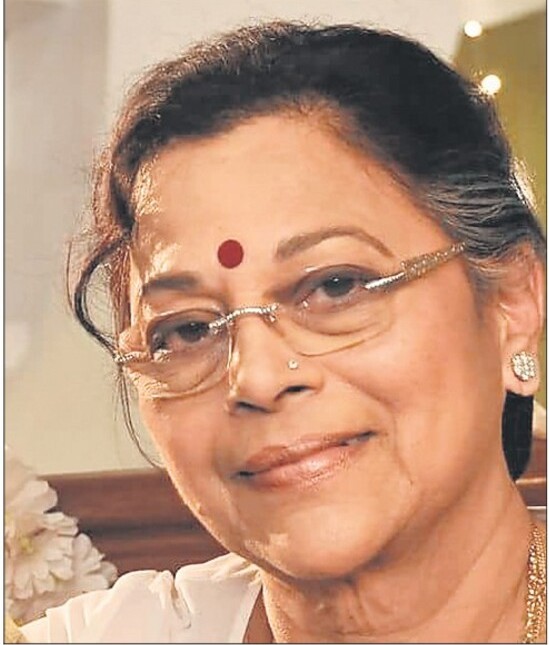
Noted Marathi-Hindi film actor Seema Deo passes away
8:20 AM
Bella Jaisinghani (THE TIMES OF INDIA; August 25, 2023)
Mumbai: Seema Deo, who acted in over 80 Marathi and Hindi films in a career spanning more than six decades, passed away at her Bandra residence on Thursday. She had been suffering from several age-related ailments including Alzheimer's. She was 81.
Her notable movies include ‘Jagachya Pathivar’, ‘Juna Te Sona’, ‘Anand’, ‘Bhabhi Ki Chudiyan’, ‘Kora Kagaz’, ‘Apradh’, ‘Janaki’, ‘Bezubaan’, ‘Koshish’, ‘Sansar’ and ‘Yehi Hai Zindagi.’
Born Nalini Saraf, her gentle manner and warm smile often led her to being typecast as the sweet sister, daughter-in-law, mother or aunt or a hostel warden as in 'Bezubaan'. In producerdirector Sadashiv J Row Ka vi’s hit, ‘Bhabhi Ki Chudiyan’ (1961), which had Meena Kumari and Balraj Sahni in central roles, she was paired opposite Shailesh Kumar as a young couple in love.
Seema's husband, actor Ramesh Deo, died in February 2022. In a TV interview, Ramesh once recounted how he had proposed marriage on a bullock cart during a shooting. "Seema's mother knew I was fond of her so she kept a close watch on her during our shoots. One day we were filming a bullock cart scene. I drove the cart out of sight of her strict ‘helicopter’ mother! Seema thought it was part of the scene. But I said no, I have brought you here to persuade you to marry me. Now say you will marry me. And she agreed!"
Seema and Ramesh recreated their real-life partnership in 20 movies such as ‘Anand’, ‘Kora Kagaz’, ‘Jagachya Pathivar’, ‘Vardakshina’, and the Marathi hit, Molkarin. Many would remember the scene in Anand where Rajesh Khanna lip syncs ‘Maine tere liye hi saat rang ke sapne chune’ as Amitabh Bachchan and the Deos listen in attention. In an odd instance, Seema also played Ramesh’s sister in 'Saraswatichandra'. The couple was conferred the Raja Paranjape Lifetime Achievement Award in Pune in 2014.
Seema is survived by two sons, actor Ajinkya Deo and adman-director Abhinay Deo. Abhinay told PTI, "My mother passed away at 8.30-9.00 am at her residence in Bandra due to old age. She had withdrawn completely, and eventually it was just old age. Alzheimer's is such a thing that you stop figuring out how to function. She had dementia leading up to Alzheimer's and she was suffering from it for over three years."
"There's no specific reason (for her death). Due to Alzheimer's and dementia, the person forgets how to walk. The muscle memory starts coming down and one by one, the organs start shutting down."
Maharashtra CM Eknath Shinde and various film celebrities, including actor Ashwini Bhave, offered condolences. The last rites were scheduled to be held at Shivaji Park crematorium at 5.00 pm on Thursday.
------------------------------------------------
HINDUSTAN TIMES (August 25, 2023)
Yesteryear actor Seema Deo, known for her roles in iconic films such as Anand (1971) and Kora Kagaz (1974), died on Thursday morning due to age-related ailments, her filmmaker son Abhinay Deo said. She was 81. The actor, who acted in over 80 Hindi and Marathi films, passed away at her Bandra (Mumbai) home. She was suffering from Alzheimer’s disease for over three years.
“She passed away around 9 am. Alzheimer’s is such a thing that you stop figuring out how to function. She had dementia leading up to Alzheimer’s and she was suffering from it for over three years. She had withdrawn completely. There’s no specific reason [for her death]. Due to Alzheimer’s and dementia, the person forgets how to walk. The muscle memory starts coming down and one by one, the organs start shutting down,” Abhinay told PTI.
Her husband, Ramesh Deo, also a veteran of Hindi and Marathi cinema, died in 2022 at the age of 93. She is survived by two sons — actor Ajinkya and Abhinay.
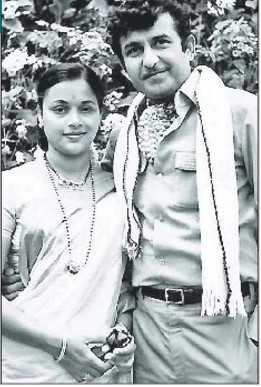
He had vigour to live till 100, says Ajinkya Deo on his father Ramesh Deo
8:09 AM

Vinay MR Mishra (HINDUSTAN TIMES; February 4, 2022)
Veteran actor-filmmaker Ramesh Deo died on Wednesday night at a Mumbai hospital due to cardiac arrest. The 93-year-old had featured in more than 250 Hindi films and nearly 200 Marathi movies, in a career spanning six decades.
As his son, actor Ajinkya Deo, was preparing for the final rites that took place on Thursday, he spoke briefly to us on a call: “He lived a king-size life — full of energy and enthusiasm. On Wednesday, at 6 pm when I was with him, he was quite in his spirits. Then, in an hour, everything deteriorated and he was gone.”
His Hindi film outings included Anand (1971), Mere Apne(1971), Aap Ki Kasam (1974) and Dream Girl (1977), among others. One of his most popular roles was in filmmaker Hrishikesh Mukherjee’s 1971 classic Anand.
Ramesh was also a television veteran. He also produced feature films, turned director, backed TV shows and over 250 ad films.
Ajinkya, who starred in Tanhaji: The Unsung Warrior (2020), adds that they are celebrating the legacy his father has left behind. “Instead of saying we are saddened by his demise, I would like to say that we celebrate his life in full glory, the way he celebrated it and the way he would have wanted us to celebrate,” he says.
The veteran had celebrated his birthday on January 30. Although he “was not keeping well”, his family met and had a “quiet” celebration. “He had the vigour to live till 100. He wanted to do that, we hoped he would.”
On a parting note, Ajinkya mentions that he is “grateful to be his son and carry on his name”. “He made me what I am. Even if I achieve 5% of what he has achieved, it will be a notable achievement for me,” he concludes.
Ramesh Deo passes away at 93
8:02 AM

Avijit Ghosh (THE TIMES OF INDIA; February 3, 2022)
Actor Ramesh Deo, who enjoyed a popular and prolific career in Marathi and Hindi films over a staggering seven decades, died of heart attack at a Mumbai hospital on Wednesday. He was 93.
Several roles performed by Deo remain vivid as ever. The only and wily distant relative who sweet-talks an elderly Meena Kumari to move in with them, only to reduce her to a house help in ‘Mere Apne’ (1971). The amiable but worldly-wise doctor, who sits with his wife (real-life wife too, Seema) in ‘Anand’ (1971) as Rajesh Khanna sings ‘Maine Tere Liye Hi Saat Rang Ke Sapne Chune’.
Who would have forgotten the scene where ‘Jumping Jack’ Jeetendra sings and whips him in the same breath, belting out the title track in ‘Jaise ko Taisa’ (1973). Only a first-rate actor could have displayed the different shades that these roles required with such effortless ease. Deo, also a performer of repute in the Marathi theatre world, did it with ease and elan.
Born in Kolhapur, Deo went to school and college there and got a break in the Marathi film industry as a junior artist in the early 1950s. He went on to set up his own production house: Ajinkya Theatres. Deo became a top star. ‘Umaj Padel Tar (1960), ‘Vardakshina’ (1962), ‘Molkarin’ (1963) and ‘Aparadh’ (1969) are just four of his memorable films.
Director Phani Majumdar’s superhit, ‘Aarti’ (1962), the first film produced by Rajshri Films, was among his early Hindi films. He got the much heftier part of a senior police officer in the thriller ‘Love And Murder’ (1966) directed by the famous Marathi director Raja Paranjpe. The veteran was to play a cop in dozens of other Hindi films, ‘36 Ghante’, a desi remake of Hollywood’s ‘The Desperate Hours’, being one of them.
Deo was the lead villain in the Amitabh Bachchan-Hema Malini starrer ‘Kasauti’ (1973), a box-office hit. Deo continued to be a familiar face in Hindi films over the decades. Some years ago he was a regular on TV, endorsing products like Surf Excel, Vijay Sales and Lufthansa. It helped that with his sons, he also ran a vastly successful ad production house. According to IMDB, his last film, ‘Jeevan Sandhya’ (Marathi) was released in 2021.
Deo’s grandfather came to Kolhapur to work as an engineer for Rajarshi Chhatrapati Shahu Maharaj and his father worked as a legal advisor to the Kolhapur Sansthan. According to his company website, Deo acted in over 285 Hindi films, 190 Marathi films and 30 Marathi dramas. He is survived by wife Seema, and sons Ajinkya and Abhinay. Ajinkya is an actor too and Abhinay is known for directing films such as ‘Delhi Belly’.
Deo contested the 1996 Lok Sabha election from Kolhapur at the insistence of Sena supremo Balasaheb Thackeray but lost in a triangular fight.
I’d like to blackmail the Coen brothers so that they give me one of their scripts to make-Abhinay Deo
8:14 AM

Renuka Vyavahare (BOMBAY TIMES; April 5, 2018)
He swears by the Coen brothers, and just like the acclaimed Hollywood filmmakers, he too has a few quirks. There are two things that put him off — badly made chai and people mistaking his name for Abhinav. The man has acting in his genes; his parents Ramesh and Seema Deo are veteran Marathi and Hindi film actors. Yet, Abhinay was always fascinated by the art of storytelling. In an interesting conversation with BT over a cup of invigorating chai (just the way he likes it), the director talks about his forthcoming black comedy, Blackmail, starring Irrfan, and also tells us why Bollywood needs to take a leap and make more genre-bending cinema. Read on…
Your parents Ramesh and Seema Deo and brother Ajinkya, are actors. Were you never drawn to acting?
Yes, aai, baba and my brother are into acting, but how many members of the family should do the same thing? (laughs!) From the start, I was inclined towards directing as facing the camera never appealed to me. What matters to me is how I can tell a story differently. I wrote my first screenplay at the age of 14 and I did it hoping I could direct it. My writing was always directorially driven. I remember taking the script to my father. He told me, “First finish your studies and come to me when you are 21.” Education was always a priority at home, but it was never just about getting a degree or a job.
It was about knowing and exploring things beyond the surface. They never stopped us from doing what our heart wanted and that killed our desire to rebel. I am an architect first, then an ad filmmaker and then a filmmaker. My brother is a computer engineer. We are academically qualified, and only after we completed our studies we decided to enter the film industry. I guess it’s a very Maharashtrian way of life. I must have accompanied my father to a film set not more than 6-7 times. My parents weren’t really in favour of taking me along on the set.
Coming from a home where your parents were both renowned actors, did you interact with actors from those times?
The atmosphere at home was very simple. My parents weren’t as social or starry. They consciously kept us away from the limelight or filmy parties, but I have fond memories of dadamoni (Ashok Kumar sahab) coming over and having varan bhaat with tup (ghee) in our house. I was little but I also remember Rajesh Khanna visiting us and chatting with my father for long hours in the afternoon. He used to smoke cigarettes and I was very fascinated by his tin of cigarettes and the way he smoked them on our terrace. It was all very informal. Even if we met stars we never met them in the capacity of Bollywood actors. We met them as family. I don’t remember any fancy parties at home like the ones we see today.
Delhi Belly put you on the map. It set a benchmark for dark comedies in India but that genre largely continues to be untapped. Blackmail comes six years after Delhi Belly and it’s a dark comedy, too.
I love that genre. I have grown up with a quirky sense of humour myself and I am a huge fan of the Coen brothers. Their stories are inspired by true events, their characters are realistic and yet their films are so quirky. That is exactly the genre that Blackmail and Delhi Belly are set in too. You are laughing at someone else’s misfortune. Having said that I also love other genres like action, which is why I made the television series 24, Force 2 and Game. Conceptually, I don’t like to repeat the same thing again. I want to explore newer territories and keep coming back to what I love the most. With Blackmail, I feel like I am coming back to the genre I love the most.
Filmmakers who make comedies always stress on the fact that making people laugh is tough business. More so, when you are making a black comedy, it has to be intelligent and funny. Your films also have a good dose of toilet humour. It can be hilarious, but tricky too…
Yes, I enjoy the kind of toilet humour I use in my movies, but I am aware that the writing needs to be clever, not crude. It is a delicate genre. You need to handle it cleverly because if you cross the line then it becomes slapstick. The minute it becomes slapstick, it’s anybody’s game. To do it subtly is the challenge. Dark humour, particularly, is the most difficult to pull off. Slapstick is relatively easy to write or perform. To keep a straight face, do less but show more and make people laugh without doing much is challenging.
Blackmail seems like a zany take on infidelity...
The story is part real and part fiction. The premise is real, but of course, it’s a fictionalised tale of a straightforward middle-class guy, who discovers that his wife is sleeping with someone else. Think about the common man’s predicament. Can he beat up his wife’s lover or the wife? No. So he gets smart. He has an EMI problem so he decides to blackmail his wife’s lover and kill two birds with the same stone. It’s a quirky way of handling a very grim, realistic problem.
An actor like Irrfan must have added his own quirkiness to a story like this?
Irrfan was my first choice. I wanted somebody to look like an aam aadmi and who can act like he doesn’t have the balls to tackle his boss, his own wife or her lover. He is a zindagi se haara hua aadmi. The character needed someone who can deliver with the least amount of lines and expressions on what’s going on inside him, and there was no one better than Irrfan who could pull it off.
While working with Irrfan, did you have the slightest inkling of his illness?
No. Even he didn’t! Nobody knew. It’s so unfortunate. My heart goes out to him and his family. They are fighting this battle well. They are incredibly strong and amazing people. I am sure they will win this fight and will be back soon. I met Irrfan before he left for his treatment. I showed him the film and he loved it. What he has managed to do with the writing is spectacular.
If you had a chance to blackmail someone for a day, who would be that be and why?
I’d blackmail the Coen brothers so that they give me one of their scripts to direct! They can sue me after that but this is what I would love to do (laughs!). You keep thinking about their films long after you’ve watched them and they make you smile. Burn After Reading for instance, was insanely funny and an actor like Brad Pitt played a daft role. Matt Damon does so many crazy cameos too. He does an Ocean’s series and then a Bourne film, where he is the lead star. More Indian actors should be open to doing such stuff.
Do you think Indian actors have a long way to go before they give preference to great scripts over their screen time in a film?
Unfortunately yes. I would appeal to all the Bollywood actors that for every two commercial films you do, do one for yourself or for the craft or the story. What they don’t realise is that the so called ‘mass audience’ that we try and cater to is slowly converting. They want better ideas and better films. Imagine a film like Pad Man releasing 25 years ago. It would not even hit the theatres. Actors like Akshay Kumar and Aamir Khan take risks. Ajay Devgn is pushing the envelope as well. An actor is as good as the audience and an audience is as good as the actor. You can’t wait for the audience to get smarter and then do something different. You need to start the trend. If it wasn’t for genre bending films like Jaane Bhi Do Yaaro and Dil Chahta Hai and, we would still be making the same kind of cinema today.
Have you ever thought about directing your parents?
My father is 90 and mother is 80, I really hope that one day I’ll be able to direct them and make a film on their love story. That’s been on my mind for a while.

British actor Rupert Everett arrives in Jodhpur to shoot for a film on Rani Lakshmibai
7:50 AM

The actor has been shooting in Jodhpur for his turn as Sir Hugh Rose in an upcoming British-Indian co-production
Sanyukta Iyer (MUMBAI MIRROR; November 1, 2017)
Acclaimed British actor Rupert Everett arrived in Jodhpur last week to secretly start shooting for a Brit-American production based on Rani Laxmibai, Swords And Sceptres, which is directed by Swati Bhise.
The 58-year-old actor, who plays Sir Hugh Rose in the film, has been shooting with Arif Zakaria (featuring as Gaus Khan, Rani Laxmibai’s chief advisor-strategist who dies in the Battle of Jhansi alongside the Queen) for the last six days.
Expected to release in 2018, the period war-drama features a mix of Indian and British actors, including Derek Jacobi (Gladiator, The King’s Speech) as Lord Palmerston and Nathaniel Parker (The Outcast) as Sir Robert Hamilton, who also arrived in Rajasthan last week. Milind Gunaji (Virasat, Godmother) will be seen as the Maharaja of Jhansi, Gangadhar Rao, and award-winning Marathi actor Ajinkya Deo plays Tatya Tope, while Devika Bhise (The Man Who Knew Infinity) will appear in the titular role and Hollywood actress Jodhi May as Queen Victoria.
“The film will be shot for eight weeks in Jodhpur and Jaipur and there are extensive schedules planned with different members of the cast in London and Morocco,” a source close to the development told Mirror, adding that the grand Moroccan desert will double up as India in the film’s upcoming schedule. It was picked because the desert backdrops are a favourite with the international producers. Recently, it featured as Iraq in two war films – the Clint Eastwood-directed American Sniper and Alexandre Moors’ Yellow Birds. For The Night Manager featuring Tom Hiddleston and Hugh Laurie, Morocco was shown as Egypt for six weeks.
Subscribe to:
Posts (Atom)