Showing posts with label Aijaz Khan. Show all posts
Showing posts with label Aijaz Khan. Show all posts
Jammu & Kashmir film body to vet scripts before giving permission to shoot; filmmakers dissect the policy
7:57 AM
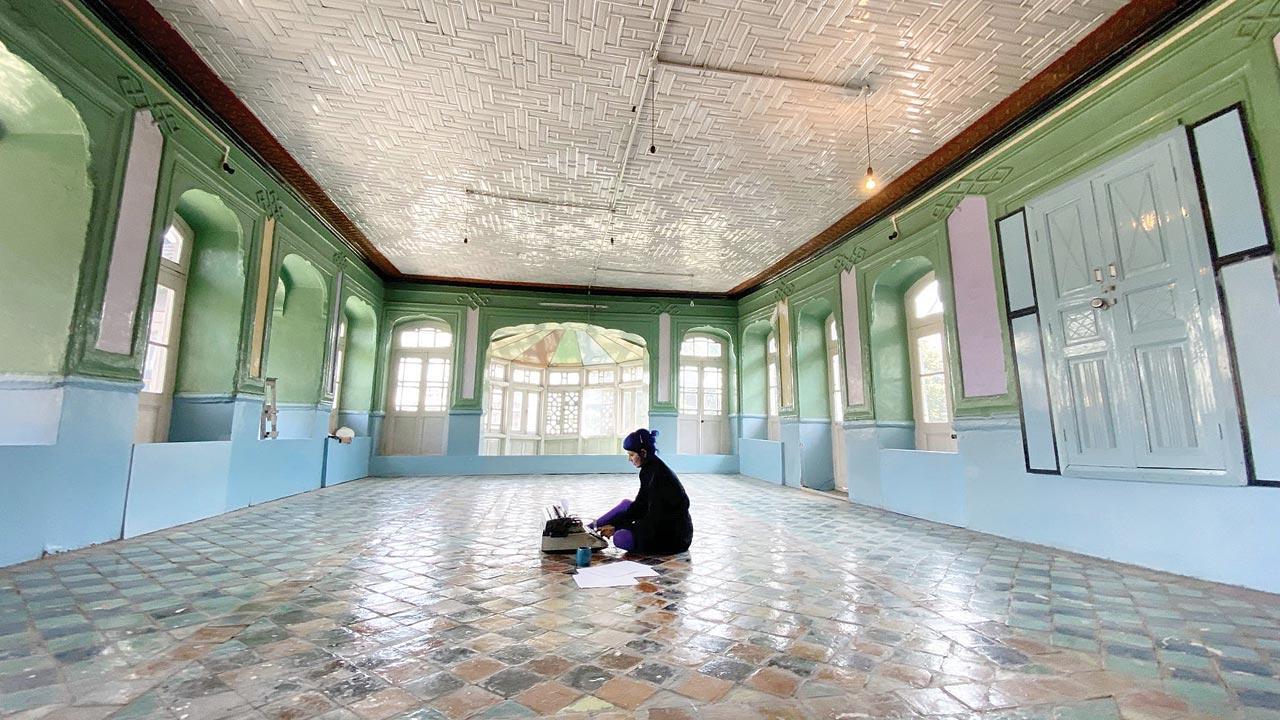
A still from Janaan, a music video which was a collaboration between hairstylist-filmmaker Sapna Moti Bhavnani and Kashmiri folk musician Noor Mohammad. The song was shot in the Valley
As the J&K film body releases a set of policies that include vetting scripts before giving permission to shoot in the Valley, filmmakers dissect the implications of the move
Anju Maskeri (MID-DAY; August 22, 2021)
Last September, hairstylist and filmmaker Sapna Moti Bhavnani visited Kashmir to assist a local Sufi musician, Noor Mohammad, with his music video. “He wanted me to star in it. It was such a soulful Kashmiri song that I decided to co-produce it,” says Bhavnani, who divides her time between Mumbai and Kamshet. The track, titled Janaan, promoted by Zee Music, has received 2.4 million hits in the last nine months. During her stay in the valley last year, Bhavnani also visited Baramulla, reportedly one of the volatile areas in the state, to give a talk “on being a hajaam”. “Many people on Twitter, including locals, told me not to go [to Baramulla] , but I went ahead and it was a great session. Kashmir embraced me like I was one of its own.” Buoyed by her experience, she planned a “horror” movie set in the Valley for which a script is ready. But, for that, Bhavnani will now need a green signal from the state.
In a recent move, two years after the reading down of Article 370, the Lieutenant Governor of Jammu and Kashmir, Manoj Sinha, announced a new “film policy” for the Union Territory. The Jammu and Kashmir Film Development Council’s (KFDC) website states that the synopsis and script of a film, complete with dialogues, will have to be submitted by a filmmaker who is seeking shooting approvals and availing subsidies. The website clarifies that the “script will be evaluated by an expert from a panel constituted by the Union Territory of the Jammu and Kashmir Film Cell. It adds that security arrangements for “approved filmmakers” will be made free of cost.
Incidentally, the Uttar Pradesh government too, has posted similar rules on the website of Film Bandhu, Uttar Pradesh, where filmmakers seeking shooting approvals in the northern state are required to get their scripts and dialogues vetted by the authorities. The requirement earlier applied only if the filmmaker was seeking subsidies.
Bhavnani is baffled by the development. “I don’t see the logic,” she says. “The state wanting to vet your script and decide whether you’re showing them in a good or bad light goes against all forms of artistic freedom, which is all that filmmakers really want.”
Her decision to shoot the film in Kashmir stems from her need to capture its ethereal landscape, which she says lends itself to her narrative. “My characters have nothing to do with Kashmir or Kashmiris. I’m simply keen to use the Valley as a location. And to be honest, the state could really do with more tourism at this point. The pandemic has worsened an already bad economy.”
Director Aijaz Khan who made Hamid, a cinematic adaptation of the play Phone No. 786 by Mohammed Amin Bhat, seconds Bhavnani’s opinion. “When we have a Censor Board to vet commercial films after they have been completed, why do we need to get the script evaluated at the start just to get permission to shoot? There’s no need for state intervention at this stage. I think it’s not fair at all,”
Khan, whose 2018 film about seven-year-old Hamid went on to win a National Award in 2019. It’s the story of a boy, whose carpenter father disappears. After he learns that 786 is God’s number, he decides to dial so that God can connect him with his father.
Khan was mulling on filming a trilogy on Kashmir, but is now rethinking his decision. Bhavnani believes the move will sting indie filmmakers more than their commercial counterparts because they have a host of other hurdles to surmount, including arranging finances and finding a platform to release their films.
What’s welcome, however, says Khan, is the introduction of the single window clearance mechanism by the KFDC, which will ensure filmmakers don’t need to run from pillar to post to secure permissions. “This, I think, is wonderful because I remember how much my crew and I had to run around while shooting Hamid. We had to figure out with the local line producers whether a certain area is safe to shoot. Before shooting in Badarkot, Tangmarg, we checked whether any riots had taken place, because the situation can worsen quite quickly there. The other good thing they’ve done is made provisions for resources and equipment for outdoor filming.”
According to filmmaker Shyam Kishore, it’s documentary filmmakers who will be the worst hit. “Docus are rooted in reality and you want to get as close to facts as possible, whether past or present, so this policy could make it harder for non-fiction storytellers.”
In 2017, Kishore shot a documentary in Pahalgam with his Kashmiri Pandit actor friends, Ashwath Bhatt and Amit Wanchoo. “The story is about two Kashmiri Pandits, Bhatt and Wanchoo — one who was part of the mass exodus of the community in 1990, and the other who chose to stay back in the Valley.” He also points to certain “grey areas’ in the newly-introduced policies such as the mention of grants being provided for films produced to patronise One Nation, Best Nation (Ek Bharat Shresth Bharat), on the website.
This statement is open to interpretation, he thinks. “Does this mean you need to pander to the government’s ideology? And what if your idea of ek Bharat is different from theirs? It’s tricky.”
He says some restrictions such as making certain locations out of bounds for filmmakers, are understandable and even necessary to maintain the sanctity of the place. “The KFDC has created an exhaustive list of shooting locations accessible to filmmakers. I’ve seen the websites of both the UP and Jharkhand governments, which also have a similar film policy, and they are not as thorough and detailed. The KFDC also assures a revert within the shortest time [two to four weeks after submitting the complete application on the Single Window Portal].”
The Government of Jammu and Kashmir will now promote the establishment of film studios and processing laboratories until a fully active film city is established in the state, and encourage owners to reopen closed cinemas.
Mushtaaque Ali Ahmed is one of the leading filmmakers and festivals directors from the Valley. Supportive of the new policy, he feels vetting is a minor quibble if you look at the overall picture. “What I feel is that they [the authorities] want Kashmir to be portrayed in a positive way and not as a state battling unrest. Therefore, the idea is to eliminate any idea that perpetuates this at the very outset.” He, however, admits that filmmakers will need to be mindful of the subjects they take on.
“Yes, controversial subjects such as militancy or extra-judicial killings might be tough subjects to tackle now.”
The subject of Delhi Crime needed to be dealt with sensitivity-Rasika Dugal
8:32 AM

Fetching Best Actor and Best Supporting Actor nominations for Out of Love and Delhi Crime in the upcoming mid-day and Radio City Hitlist Web Awards, Rasika explains why doing the latter was cathartic
Letty Mariam Abraham (MID-DAY; February 18, 2020)
Ever so rarely, an actor comes across a piece of art so strong that it almost becomes cathartic. For Rasika Dugal, Delhi Crime proved to be that. Based on the 2012 Nirbhaya case, the Richie Mehta-directed series was widely appreciated for its powerful storytelling. "All of us had felt a lot of emotions about the Nirbhaya incident. [Among other emotions], I felt the guilt of having moved on from it too quickly. By being a part of this show, I tended to the incident in the way I wanted to," says Dugal, whose quiet but steely act as probationary officer Neeti Singh has earned her a Best Supporting Actor (Female) nomination in the upcoming mid-day and Radio City Hitlist Web Awards.
The actor reveals that she did two rounds of auditions for the police procedural — one for the casting director, and another with co-star Shefali Shah. "The subject needed to be dealt with a lot of sensitivity. But I was confident that Richie would have written something important." To prep for the series, Dugal shadowed a police officer. "I didn't want to depict anything incorrectly in the police procedural. If I am playing a cop, I [can't afford to] get the salute wrong. Similarly, I will never do a scene where I am seen waking up with make-up. These are few things I had in mind when I graduated from film school," she smiles.
Her conscientious approach has held her in good stead. The actor is one of the few artistes to have bagged two nominations at the upcoming gala, including the Best Actor (Female) nod for her act in Out Of Love (below). "Since I had never headlined a show, before Out Of Love, I wanted to check if I could hold the audience's attention when I am in every frame."
She credits directors Tigmanshu Dhulia and Aijaz Khan for extracting a fine performance from her in the drama. "I remember being anxious while doing the dinner-table sequence. I felt my emotions were not intense enough for the camera [but the director okayed the shot]. Finally, when I saw it on screen, it was pitch perfect."
More About Delhi Crime, Out Of Love
- The makers of Delhi Crime didn't get an official nod from Nirbhaya's parents to narrate the story. It was alluded that they raised concerns about its fictional nature
- The house that forms the backdrop in Out Of Love was the one also seen as the Kapoors' residence in Kapoor & Sons (2016)
Cast Your Vote For The Hitlist Web Awards
Rasika Dugal has been nominated in the Best Actor (Female) category for Hotstar's Out Of Love.
The other nominees are:
- Shefali Shah (Delhi Crime; Netflix)
- Sobhita Dhulipala (Made In Heaven; Amazon Prime)
- Shweta Tripathi Sharma (Laakhon Mein Ek; Amazon Prime)
- Geetanjali Kulkarni (Gullak; Sony LIV)
- Mithila Palkar (Little Things S03; Netflix)
- Dia Mirza (Kaafir; Zee5)
Dugal is also nominated in the Best Supporting Actor (Female) category for Netflix's Delhi Crime.
The other nominees are:
- Shivani Raghuvanshi (Made In Heaven; Amazon Prime)
- Priyamani (The Family Man; Amazon Prime)
- Amruta Subhash (Sacred Games S02; Netflix)
- Nidhi Singh (MOM; ALTBalaji)
- Navni Parihar (Little Things S03; Netflix)
- There are 14 categories that the public can vote in. Log on to www.hitlistwebawards.com to cast your vote.
- You can also vote via SMS. Send HITLIST <space> category name <space> your choice (a/b/c/d as on the website) to 57575.
- Voting lines close on March 8

Bollywood goes all the way at the 66th National Film Awards
8:45 AM

Hindi cinema on a high as Ayush, Vicky share Best Actor nods; AndhaDhun, Uri and Badhaai Ho bag top honours
Mohar Basu (MID-DAY; August 10, 2019)
 Its pan-India appeal notwithstanding, Hindi cinema — not too long ago — would get outshone by its regional counterparts when it came to the National Awards. In what can be seen as a sign of how Bollywood has evolved, the 66th National Awards were largely dominated by Hindi movies, with Ayushmann Khurrana and Vicky Kaushal walking away with the Best Actor gong, while Aditya Dhar (below) earned the Best Director nod for Uri: The Surgical Strike.
After bagging several gongs for his blind pianist act in Andhadhun, Khurrana is ecstatic to round off the year with the most prestigious win. "When I entered the industry seven years ago, my choice of films were considered offbeat. Today's win is gratifying and it makes me braver as an artiste as I have always tried to back disruptive content. This is a validation of my belief system."
 Having been adjudged the Best Director, Dhar is over the moon. "Vicky and I were screaming with joy on Facetime," says the first-time director, whose film Uri saw Kaushal earn the Best Actor award. "National Award has always been an aspiration. But it's crazy to have won it for my debut film. It takes a great team and a great script to make a worthy film. This is a victory of my team." Kaushal expressed his joy on social media, writing, "For my work to be recognised by the honourable National Film Awards Jury is a moving moment for me (sic)."
 Director Amit Sharma was congratulating Surekha Sikri for her Best Supporting Actress win when he learnt of Badhaai Ho winning the Best Popular Film. "When someone called me to give the news, my instant reaction was that they are confusing it with Surekha ji's win. A National Award win is otherworldly for any filmmaker. The fact that conventional cinema is changing was a reminder all year, but the film doing so well proved that the audience is ready for new ideas."
Writer Pooja Ladha Surti, whose Andhadhun won the Best Hindi Film and Best Adapted Screenplay, says, "Our main worry was the film's divisive end. I am glad we stuck to our guns."
It is a mixed feeling for director Aijaz Khan, whose Hamid won the Best Urdu film. "The moment I came to know that Talha Arshad Reshi has won the Best Child Actor Award, I wanted to share the news with him. But I was unable to reach him due to the network outage in Kashmir."

How Kashmir went from reel to real
8:18 AM

Far away from Bollywood stereotypes, independent films tell stories of love and resilience in the Valley, minus pretty landscapes and gun-toting militants
Sonam Joshi (THE TIMES OF INDIA; March 31, 2019)
When 50-year-old Hussein Khan began working on his film Kashmir Daily in 2013, friends asked him whether he had gone mad. He had no financial backing, there was little infrastructure for shooting and post-production, and the Valley’s last cinema theatre had closed in 2010. Yet, Khan persisted, working for four months, then using the earnings to shoot for a few days. Five years later, Kashmir Daily, the first locally shot and produced film in 45 years, finally got a limited release last October.
“There have been many films on terrorism. As a journalist, I thought of focusing on other problems such as unemployment and drug addiction so people understand why we’re losing our youth,” says Khan.
His movie, which ran for a fortnight in a Srinagar auditorium, seems to have paved the way for several recent independent feature films, often starring Kashmiris, that go beyond Bollywood stereotypes of the picture perfect Dal Lake or snow-capped peaks or gun-toting militants. They shift the focus to the emotional trauma of women and children, and issues such as corruption and sexual harassment. While films such as Hamid and No Fathers In Kashmir have managed commercial releases, others like Widow Of Silence and Half Widow have had to be content with critical acclaim at film festivals.
Kashmir entered popular consciousness through Hindi films from the 1960s onwards. However, these showed it as a place of escape for young metropolitan Indians, mostly non-Kashmiris, says Ananya Jahanara Kabir, a professor at King’s College London. “The Kashmiri person was not a part of this modernity. Usually a shepherd, a boatman or a heroine to be romanced and educated, they were simple and rural,” she says. This trend persisted in the 1970s and 1980s, when “the Valley was reduced to a visual backdrop for romantic song sequences”. From 1990s onwards however, films began to depict the changing political situation but were unable to find a solution for it. Popular cinema has flattened the complexities of Kashmiri identity, using it mainly to “serve Indian anxieties about Islam and Pakistan,” Kabir writes. Bollywood has produced the odd ‘real’ film like Meghna Gulzar’s Raazi,which examines the notion of patriotism with more nuance and less jingoism but that’s still an exception.
“Most people only think of Kashmir in terms of its tourist attractions,” says Praveen Morchhale, whose self-funded film Widow Of Silence entirely eschews visual clichés associated with the landscape. It is about a half widow’s struggle to get a death certificate for her missing husband, while dealing with corruption and sexual harassment, and looking after her 11-year-old daughter and mother-in-law. Except for the lead character, the film shot in villages near Sonamarg and Drass comprises of local non-actors whose chit-chat gives it an air of authenticity.
Los Angeles-based filmmaker Danish Renzu grew up without seeing a single film in a theatre in his home town, Srinagar. Yet, after studying screenwriting at UCLA, he returned home to make his debut feature film. Titled Half Widow, it explores Neela’s struggle after her husband is picked up from their house in Srinagar by the armed forces, but also her desire to tell her own story by learning how to read and write. “We want to focus on human stories emerging out of the conflict,” says Renzu, an electrical-engineer-turned-filmmaker who hopes to revive Kashmiri cinema by setting up a production company with local talent he’s trained himself.
If Half Widow and Widow Of Silence delve into the interior lives of women, films such as Hamid and No Fathers In Kashmir portray the Kashmir conflict from the perspective of children. Released this month, Hamid is an adaption of Kashmiri playwright Amin Bhat’s play Phone No. 786. The film revolves around a seven-year-old boy who dials the number 786 to request Allah to ask his missing father to return, but is instead accidentally connected to a CRPF jawan who is coping with demons of his own.
Unlike his previous documentaries, Inshallah, Kashmir and Inshallah, Football, Ashvin Kumar’s forthcoming feature film No Fathers In Kashmir has a romantic arc that follows a teenage British-Kashmiri girl Noor and a local boy Majid, whose search for their missing fathers takes them to a dangerous military camp near the Indo-Pakistan border. Kumar uses the themes of young love and heartbreak to strike a chord with young viewers. “You see how it is difficult it to fall in love at all in Kashmir, and how difficult it is to dream in Kashmir,” says the Oscar nominated director.
Challenges in filming, funding and censorship persist. “During shoots, there were times when a few stones were thrown at us,” says Hamid director Aijaz Khan. “We’d take shelter and later shoot again.” The team also had to change the script to get permission to shoot in a CRPF camp, and postpone the release after the Pulwama attack.
But filmmakers are not giving up. Morchhale’s next film is based on the life of a gravedigger in Kashmir. Hussein Khan and his team have set other films in the region: 2 Band Radio looks at the coming of the radio to a village during the 1970s, and Lines is about two elderly sisters who live on either side of the India-Pakistan border. “Terrorism is only in the backdrop. We want to tell our local stories to the world,” he says.
We will think of Hamid's release when the situation has mellowed down-Aijaz Khan
8:08 AM

In light of the Pulwama terror attack on Thursday, Hamid director Aijaz Khan pushes March 1 release of drama that revolves around CRPF jawans in Kashmir
Mohar Basu (MID-DAY; February 16, 2019)
 Rasika Dugal-starrer Hamid, that explores the conflict in Kashmir through the perspective of an eight-year-old boy who develops an unlikely friendship with an Army soldier, was slated to hit theatres on March 1. However, in light of the Pulwama terror attack on Thursday, the makers have decided to postpone the release of the Aijaz Khan-directed drama.
"Our film talks about the socio-political situation in Kashmir. But at this juncture, we wish to stand in solidarity with the jawans. We will think of a release when the situation has mellowed down," asserts the director.
The film's team was to kick off the promotions with a special screening for the CRPF jawans in Srinagar on February 18. "It is shocking for us because we were to leave for Kashmir yesterday. How can we promote a film given the present scenario? Right now, we need to take a stand."
Dugal, who plays the mother of the young protagonist, offered her condolences to the kin of the martyrs. "This is a time to quietly grieve with them. I stand by Yoodlee Films' [production house] decision to push the release. I hope that when the movie comes out, it will contribute to a gentle dialogue around the situation in Kashmir."
Kashmiris are unhappy that they were primarily depicted as stone pelters-Rasika Dugal
7:43 AM

Rasika Dugal on learning dialects for her act as amother from the Northern state in Hamid
Sonia Lulla (MID-DAY; November 1, 2018)
Rasika Duggal was weary about playing mother to a boy who wants to speak to God about his missing father in Aijaz Khan’s Hamid — set in Kashmir — as she did not want to do injustice to a land she knew little about.
“I didn’t want to be part of a film on Kashmir without enough knowledge. I told Aijaz to find a Kashmiri actor because I didn’t want [the film to be portrayed from] an outsider’s [herself] gaze on Kashmir. The role I was playing needed to have an actor with a first-hand experience of what people were going through,” says Dugal, quick to add that she was also taken by the narrative, and hence eager to play the part. “Mainstream narratives on conflict situations usually carry a political undertone. The human stories from these situations are usually left out. This was a story that people across borders could connect with.”
With the role landing in her lap, Dugal ensured she left no stone unturned to look convincing as a Kashmiri mother. Apart from lapping up books based on the goings-on in the state, she was particularly moved by a documentary about a Kashmiri woman, Parvina Hangar, whose son was reportedly abducted. “The documentary saw her, along with another woman, speaking about their story of their missing children, rather matter-of-factly. Parvina runs APDP [Association of Parents of Disappeared Persons], which works for families whose loved ones have disappeared. A small couplet that they used in the documentary, which translated to ‘I’m waiting, can you please come back,’ was something that stayed with me.”
The actor made her way to the Northern state a week in advance to settle in and get familiar with the local village accent, which, she says, is far distanced from “the way people speak even in Srinagar”. “There are so many different accents used [in Kashmir], so it was tough to understand which I should follow. It was also about adapting that accent in Hindi, because the people may not use that language.”
The locals she interacted with, she reveals, were warm and courteous, and particularly bothered with the way they had been stereotyped. “People were conscious that what was being reported about them in the mainstream media was primarily about stone-pelting, and showed them as violent people. They were unhappy with this depiction, especially since they are warm.”
Check out Rasika Dugal shooting in Kashmir for Hamid
9:47 AM

The actress’s next project, which was shot in the Valley, is now gearing up for a premiere there in a few months
Natasha Coutinho (MUMBAI MIRROR; June 4, 2018)
After playing Saadat Hasan Manto’s wife in Nandita Das’s biopic on the renowned Pakistani playwright, Rasika Dugal will be next seen in Hamid, which is directed by Aijaz Khan. Now, the film, which was shot entirely in Kashmir, is returning in the next few months to the Valley for its first screening. It sees the actress in the role of a mother to seven-year-old Hamid, played by Talha Arshad Reshi, a Kashmiri local whose father goes missing in the film.
“The story idea came from a line from a Kashmiri acquaintance: A seven-year-old Kashmiri boy, whose father has disappeared, dials 786 on the phone to speak with Allah. The idea fascinated me so much that I developed it into a screenplay. After several months of arduous auditioning, we found our Hamid. But two days before the shoot, the boy developed cold feet and walked out of the film. We were flabbergasted,” Aijaz told Mirror, adding that the team had to go back to audition tapes. “When we relooked at the top five contenders, Talha’s caramel eyes and angelic face caught everyone’s eye and he was asked to join immediately.”
The team shot at Budderkote, a quaint village on the foothills of Gulmarg that they discovered after travelling through Kashmir and Manali. “Manali was Plan B, just in case we faced resistance in Kashmir but Badderkote embraced us. The villagers opened their homes to us. Fragrant cups of Kahwa and the delectable local bread Girda became our staple food,” Aijaz said.
Meanwhile, Rasika reveals that she was initially skeptical about the film even though its innocence had appealed to her. “My primary fear was the fact that it is difficult to tell a story of a land and people who have been through so much. I felt like no matter how much I prepared, I would not be able to do justice to the part, which would be a disservice to Kashmir. But I’ve previously shot in Kashmir for Santosh Sivan’s Tahaan and it gave me, with all its beauty and sadness, more than I had expected. It’s like the place just opens itself up to you to let you tell its story,” the actress signed off.

I am nervous if a story requires sensitivity-Rasika Dugal
7:43 AM

Rasika Duggal on playing a mother in a film that traces Kashmir’s conflict zones
Sanyukta Iyer (MUMBAI MIRROR; October 12, 2017)
After portraying a young mother in the recently released Tu Hai Mera Sunday, Rasika Dugal will play Ishrat, a Kashmiri mother, in the upcoming drama, Hamid. Directed by adman Aijaz Khan, who has helmed films like The White Elephant and Baankey Ki Crazy Baraat, Hamid talks of Kashmir’s conflict zones through an emotional mother-son journey and an eight-year-old boy’s quest to find his father.
“Aijaz has wanted to work with me for a long time but I almost didn’t do the film because of several delays and lack of time for prep. I get really nervous when a story requires sensitivity,” Rasika told Mirror. But after she wrapped up Nandita Das’s Manto, in which she plays Safiyan, wife to Nawazuddin Siddiqui’s titular character, the actress thought it was ideal to step into another interesting space and signed Hamid, which is produced by Saregama’s Yoodle Films. “I began my homework by reading up and watching documentaries on the life of Kashmir’s ‘Lady of Iron’, Parveen Ahangar, the founder of Association of Parents of Disappeared Persons (APDP), who was nominated for the Nobel Peace Prize in 2005 for her pacifism and human rights activism. Her 16-year-old son was picked up at 3am in 1990 and she never heard of him since,” Rasika says.
The actress also watched Iffat Fatima’s 26-minute documentary, Where Have You Hidden My New Moon Crescent, which tells the story of Mughal Masi, who died waiting 20 years for her son to return. “The documentary is in Kashmiri and I watched it with subtitles. The poem that the film ends with moved me to the core,” the actress adds. She laughs when asked about her rapport with the film’s eight-year-old-protagonist, Kashmiri child actor Talha Reshi, admitting that while celebrities pretend to get along even if they cannot stand each other, children are not a part of “this professional game”. “I was anxious because he was making his debut and if he didn’t like me, there would be nothing I could do! But he’s a bundle of raw talent and we connected well,” she signs off with a smile.
Ismat Chughtai's grandson Aijaz Khan turns director with Baankey Ki Crazy Baarat
7:37 AM

Sanyukta Iyer (MUMBAI MIRROR; August 14, 2015)
If Ismat Chughtai were to catch a screening of her grandson's directorial debut, Baankey Ki Crazy Baarat, she'd leave with a smile and ask him to do better in his next film, believes Aijaz Khan.
Growing up, his cousins and he would sit in a circle around Ismat. "She would ask each of us to give her a sentence, every line taking the thought forward and together we'd create our own stories," Aijaz reminisces.
He remembers his grandmother's controversial short story, Lihaaf, which celebrated homosexuality through a tale of lesbians. "It was way ahead of the times. She always encouraged me to do things I believed in, which made me happy and that's exactly what I've done," he says.
His satire, produced by Anita Mani, follows the journey of a groom, with a fault in his kundli, who uses a 'proxy' to deceive the bride and her family and complete the marriage rituals. But on the wedding day, the proxy doesn't show up.
Didn't Aijaz want to remake a Garm Hawa or Junoon, scripts of which had been written by Ismat? "I would like to make one of her stories, Jangli Kabootar. It has always fascinated me. And I'd love to direct a film full of Urdu phrases, but this one is set in Himachal and packed with Bhojpuri slangs," he laughs.
Subscribe to:
Posts (Atom)