Showing posts with label Adar Poonawalla. Show all posts
Showing posts with label Adar Poonawalla. Show all posts
Universal Music India acquires a stake in Excel Entertainment; can corporate investments ever be married to creativity?
9:45 AM

Akshita Maheshwari (MID-DAY; January 25, 2026)
In December last year, when we first heard rumours of Netflix acquiring Warner Bros, the thinkpieces came thick and fast. People said this was the final nail in the coffin for theatrical films, the moment algorithms would officially replace auteurs, and boardrooms would decide not just what gets made, but what kind of stories are even worth telling. A streaming giant swallowing one of Hollywood’s oldest studios seemed to confirm everyone’s worst fears, that cinema would finally become content, IP would matter more than ideas, and risk, originality, and the mid-budget film would be the first casualties.
Closer at home, Universal Music India (UMI) just acquired a 30 per cent stake in Farhan Akhtar and Ritesh Sidhwani’s production house, Excel Entertainment. This comes after Saregama Music invested in Bhansali Productions in December last year, and vaccine billionaire Adar Poonawalla acquired a 50 per cent stake in Dharma Productions in 2024. When corporate deals that haven’t even gone through in the West cause such a stir, is there any panic of a corporate takeover of the movies at home?
Managing director at Mukta Arts production house, Rahul Puri, says, “Giants have always existed in the business. Mukta was one of the first companies that went public and raised money from the equity markets. Then you had PNC [Pritish Nandy Communications], Balaji [Telefilms], Tips [Industries] in those early days. Even when there was a corporate interest, companies — like the [Aditya] Birla Group with Applause — tended to build organically. They didn’t necessarily partner with anyone because they had enough capital to come in and attract talent.”
He adds, “Now the mindset has changed. Corporate houses have recognized the value that creators and production houses bring. They bring a network of talent and relationships, and our business is very much about those networks.”
The style of filmmaking too has changed today. Going to the cinema is a theatrical event, reserved only for big-ticket spectacles.
“Whether it’s action films with big sequences or films on a large canvas with international travel, budgets are much bigger,” says Puri, “There’s also the ambition to make Indian films competitive globally, so quality has to go up, which affects production costs. Corporate investment is a way to de-risk producers while also giving them capital to be able to make these large projects.”
Among the three deals mentioned, interestingly, two of them happen with music labels entering films. In Indian cinema, music and films have always shared a special relationship, in business and in bed. Even bad films could rely on a banger album to be able to succeed. Before phones and social media, music was the first taste of a film, and often the biggest factor that invites the audience in.
“Unfortunately though in India, music is perceived as free. We never want to pay for music. Since the piracy boom, music has been seen as an add-on to everything else,” says Rajdeep Anand, who works in music licensing, “With UMI and Saregama getting into films, music will finally get its due.”
For Anand too, the deal is like music to his ears. “The older model was that someone would come up with a movie and a set of songs, and then labels would bid for it. But now, everything in Excel’s future that relates to music will go through UMI. Universal doesn’t have to worry about any other player coming in. If I already know my slate for the next five to ten years — what’s coming on OTT, what’s coming in theatres — I can spend time developing new talent and strategically placing which singer gets attached to which project. It gives artistes a platform even before they start off,” he explains, “Look at something like Mismatched (2020-26), Kho Gaye Hum Kahan (2023), or Gehraiyaan (2022), or something as big as Dhurandhar (2025) — they could take much bigger bets with their music. Excel has always had a great ear for music, so I am hopeful that this collaboration will bring music to the forefront.”
Puri also adds, “It is also a play to give music labels a strong flow of content separate from their traditional business, which is essentially just music distribution. They’re taking advantage of a dynamic content monetization space.”
Filmmaker Arati Kadav, whom you may recognize from Mrs (2025), shares why she thinks corporates are investing in films. “First of all, there is always the charm of being associated with the film industry,” she says, “We hear of many films making Rs 100 or Rs 200 crore, but we confuse revenue for profit. Even if a film makes Rs 100 crore, the production cost has gone up so much that the profit we earn is very less.”
Puri argues that big-ticket films might actually help with cash flow. “If a film like Dhurandhar [Jio Studios] does really well, that money can flow into smaller films. Big stars can’t make infinite films, so the surplus has to go somewhere. Ideally, into more creative films.”
Kadav also agrees, “Corporates coming in might actually impart some autonomy to production houses. For example, Dharma [Productions] could make the beautiful film, Homebound (2025) because they had the backing of Adar Poonawalla.”
We ask, what if algorithms start to dictate storytelling? She says, “Unfortunately, the climate has already become like that. Algorithms are dictating the shape of our stories already. Actors are chosen by follower counts. The world has become like that, regardless of corporations. At least if a producer with a good sensibility gets corporate money and support, and if they have good convincing power, they might actually be able to break out of that.”
Although Puri, Kadav, and Anand make this sound like a sweet deal, there are still sceptics who worry that this might mean a death for their creative vision. Filmmaker Aditya Kripalani shares his concerns, “Within corporations, you have a whole board of people and their aim is to not lose their job. I’m not saying they are wrong. But for them, the peak point of their life is to keep that job at the platform,” he says, “If I’m at a platform, it’s easy for me to have a checklist: Did it go to Cannes? Does it have a star? What numbers has that star’s previous film done? Once I have that checklist, my head will not roll if I take the film. But if I say ‘I like the film’ and the film doesn’t work, my head will roll.”
Kripalani calls back to when Netflix co-CEO Ted Sandoros said that he thinks Sacred Games (2018-19) may not have been the best choice to open in the Indian market; he would have liked to go with something more “populist”. “Exactly, there you go,” says Kripalani, “For me, the 100 per cent corporatization is when a platform makes a film. Because then the creative individual — which is the director — has no power. They are hired hands, no matter how big that director is.”
Eros International, a music giant, produced Raanjhanaa (2013), while Aanand L Rai directed it. When the film was re-released, Eros could change the ending of the film with AI, without the director’s consent, completely changing the meaning of the film. Rai was then dragged in a copyright infringement lawsuit by Eros for making Tere Ishk Mein (2025) too similar to Raanjhanaa.
An important loss in the race to corporatization is the mid-budget film. “The '1-crore films, we used to call them,” says Kripalani. According to him, movies will now split into big-ticket spectacles or OTT releases. The traditional trajectory for a director to get a big-budget would be to start with AD-ing, get to mid-budget, and then big-budget event films. With corporatization, we may just be witnessing the death of a mid-budget hit.
“In the 1990s, you used to get 2 to 3 such films a year each from Ram Gopal Varma, from Dharma [Productions], from Yash Raj [Films]. Even Munna Bhai MBBS (2003), Rock On!! (2008), Dil Chahta Hai (2001) were all mid-budget films. A film made for a certain budget with a known face, these are gone,” he says, “In the last couple of years, you have seen Superboys Of Malegaon (2024), Laapataa Ladies (2024), and maybe one or two more — there’s a handful of this kind of film that I can name.”
“I think the people who are in the biggest problem are the mid-level people. New people — like a crazy YouTuber making great content — can still get picked up. And if you’re already an established [Martin] Scorsese or [Christopher] Nolan, you’re okay,” says Kripalani, “But the people who have made five to eight films and are in the middle of their career. There is no platform left for them.”
But what do we lose when we lose mid-budget films? “We lose stories with depth. They may not deal with dark subjects, but they touch you deeply — family dynamics, interpersonal relationships,” says Kripalani, “The indie space deals with the darker sides of society. Big films are just popcorn films, which is fine. Now you’ll get either mindless spectacle or very dark films. When was the last time you got something like Dil Chahta Hai? That middle space is disappearing.”
Karan Johar calls expensive Oscar campaign for Homebound a ‘bottomless pit’
10:00 AM

HINDUSTAN TIMES (January 17, 2026)
Director Neeraj Ghaywan’s Homebound (2025) being shortlisted at the 98th Academy Awards in the Best International Feature Film category marked a moment of pride for producer Karan Johar. Yet, the excitement came with a sobering reality: mounting an Oscar campaign is a demanding process.
In a recent interview with PeepingMoon, Karan revealed, “I told Adar (Poonawalla, his business partner in Dharma Productions) that doing an Oscar campaign will cost money, and sometimes it’s a bottomless pit, because you don’t know whether you will even make to the shortlist of 15 and then five.“
He elaborated on the scale of the effort involved: “You have to employ publicists, pay for travel and do media and screenings abroad. But Adar said let’s do everything in our capacity. Let’s not think of profit and loss on this one. Let’s think of passion over any monetary benefit.”
The 53-year-old added, “That’s what we did. It’s not a money making exercise for us. It is about credibility, we will do other films for survival, but Homebound was always a passion project. There is no monetary game in that film.”
Tuning up the band: Music labels bet on movie companies to hit the high notes
2:52 PM

Saregama & Universal’s investments in production houses aimed at a bigger play in entertainment industry: Analysts
Rajesh N Naidu (THE ECONOMIC TIMES; January 9, 2026)
Mumbai: Recent investments by music labels Saregama India and Universal Music in film producers Bhansali Productions and Excel Entertainment, respectively, point more to a larger play in the entertainment sector than consolidation of film production houses, industry experts told ET.
These investments are disparate both in structure, strategy and goals as opposed to the Adar Poonawala-Dharma Productions deal, and they have been triggered largely by the bearish business conditions in the music industry, they added.
"After a few years of bull run of over 20% compounded annual growth rate in revenue from streamers, YouTube and digital sources, labels today are seeing a bear phase as the industry consolidated, streamers merged or shut shop and free streaming is moving towards paid subscription," said a top executive at a leading industry player, on the condition of anonymity.
"Some of these labels seem to grow through reverse consolidation to build acquisition moats and create a robust pipeline. They may end up producing films," said the executive cited immediately above.
Another aspect that has triggered these investments is the fiercely competitive space of buying music rights in the open market.
"These investments ensure consistent availability of new content at a reasonable cost. In the past few years, competition intensity for music rights in the open market has become too high," said Vaibhav Muley, lead analyst, media and entertainment sector, Yes Securities.
Labels pay Rs. 10 crore-Rs. 33 crore per film if they buy music in the open market, shared analysts. A multi-year deal for music with a production house is almost 30-50% cheaper for labels, they pointed out.
Business Case
Also, these investments are effective from the standpoint of return on capital employed (RoCE) ratio-how effectively a company generates profits using its capital. Analysts shared that monetizing music across avenues provides RoCE of 30-40%, while films generate RoCE of 11%. This shows why buying a stake in production houses is a relatively less risky proposition than directly producing films.
Acquiring stake in production houses is also a win-win strategy, pointed out analysts.
"Today, labels have reasonably good cash on books. They are looking for low-cost avenues to buy music. Investment in production houses is one such route. Production houses get a minimum guarantee amount to start a film and labels in turn get music rights and ownership of films in proportion with their stakes," said an analyst, who declined to be named.
Furthermore, consolidation in the music label industry has prompted incumbents to look for adjacent diversifications.
"Labels are chasing growth. Acquiring labels have become expensive after consolidation (three labels shut shop). Then, there is subdued growth in revenue from streamers due to a shift in subscription mode. These deals reflect these realities," said the analyst cited immediately above.
Industry experts say the distinction between these investments and the Adar Poonawala-Dharma Productions deal.
"These investments do not amount to consolidation among production houses. They are different from Adar Poonawala-Dharma Productions, which is about equal partners. Whereas, after the investments, labels will function as 'strategic investors.' Along with owning music, they will own film rights in proportion with their stakes," explained Gaurav Dagaonkar, co-founder and chief executive officer of Hoopr, a leading platform for music licensing.
Analysts expect labels would integrate talent from their talent management division into the films produced by the production houses more effectively, right from the scripting stage, while also improving the monetization of music assets in these entities.
Saregama to invest Rs 325 crore in Bhansali Productions
9:26 AM

Javed Farooqui & Rajesh Naidu (THE ECONOMIC TIMES; December 17, 2025)
Saregama India has entered into a structured, long-term investment agreement with Bhansali Productions that gives it the option to take majority control of Sanjay Leela Bhansali’s film studio by 2030, while immediately securing rights of all future music created by the banner.
Under the deal, the Kolkata-headquartered music record label and content company will invest Rs. 325 crore in Bhansali Productions through compulsory convertible preference shares (CCPS), the companies said. It will subscribe to 9,960 CCPS of face value Rs. 10 each on or before February 14, 2026.
These preference shares will convert into equity in 2028, at which point Saregama’s stake will be between 28% and 49.9% of Bhansali Productions, depending on the conversion formula.
Following the conversion, Saregama will have the option, but not the obligation, to acquire additional shares to take its holding to 51% by 2030, giving it majority control of the studio.
Pricing for the additional shares will be determined through pre-agreed mechanisms linked to Bhansali Productions’ audited financials.
Alongside the equity investment, Saregama has entered into a music rights agreement under which it will acquire the rights to all future music created and produced by Bhansali Productions.
This provides immediate strategic value to Saregama, regardless of whether it ultimately exercises the option to become a majority owner, amid the ongoing chase for intellectual property in the entertainment industry.
The investment is expected to be earnings-per-share accretive for Saregama by FY27 and to improve margins across both its music and video segments.
“Bhansali Productions’ excellence in storytelling and content creation perfectly complements our leadership in music and entertainment,” said Avarna Jain, vice chairperson of Saregama India.
She said the partnership reflects the company’s strategy of aligning with leading creative talent while delivering long-term shareholder value.
For Saregama, the partnership strengthens two priority areas. It bolsters the video segment of its business and further consolidates its leadership in music licensing, with Bhansali Productions providing access to a steady pipeline of premium original music.
Under the partnership framework, Bhansali Productions will retain complete creative control, while Saregama will provide governance oversight and financial discipline. Bhansali Productions will also retain ownership of the intellectual property of all its films going forward.
Sanjay Leela Bhansali, founder of Bhansali Productions, said meaningful cinema requires time, trust and respect for the creative process. “In Saregama, we have found a partner that understands this philosophy. We share a deep respect for art, music and storytelling that is grounded in tradition and resonates across generations,” he said.
Aligned with its evolving content strategy, Saregama will gradually streamline its in-house film production activities over the next one to two years, focusing on strategic partnerships with marquee creators.
The company currently produces films through its in-house arm, Yoodlee Films.
In FY25, 16% of Saregama’s revenue came from video content, spanning films, digital and short-format programming. Its total revenue for the year stood at Rs. 1,171 crore.
For Bhansali Productions, the capital infusion will support a significant expansion of its content slate across formats, while allowing the studio to retain ownership of its film intellectual property.
The company has a pipeline of more than 10 feature films planned over the next three years. Upcoming projects include Love & War, directed by Sanjay Leela Bhansali and starring Ranbir Kapoor, Alia Bhatt and Vicky Kaushal, and Do Deewane Shehar Mein, a romantic drama directed by Ravi Udyawar and featuring Siddhant Chaturvedi and Mrunal Thakur.
“This is a landmark transaction, coming close on the heels of the Adar Poonawalla–Dharma Productions deal,” said Nitin Menon, managing partner at NV Capital, an investment firm focused on the media and entertainment industry. “Legacy creative brands like Bhansali Productions have strong recall value, and this reinforces the belief that high-quality IP continues to attract long-term capital.”
Over the years, associations have developed between leading film production houses and music labels. Recently, Universal Music partnered with Maddock Films to start a new music label, Mad4Music.
“Strategically, this acquisition makes sense. From the perspective of the industry, consolidation is not necessarily unhealthy,” said Tanuj Garg, partner at film production company Ellipsis Entertainment. “The deal, however, could result in increased concentration of capital among a few players,” he added.
“There is a need for more democratic models for mid-sized and independent producers who churn out equally, if not more, compelling content. This is becoming even more important,” Garg said.
ET had reported on December 2 that several Bollywood studios, including Bhansali Productions, were exploring fundraising amid market volatility driven by changing consumer behaviour, rapid OTT adoption and flat theatrical footfalls.
Despite this, M&A activity in the sector has been limited, making this only the third major Bollywood deal in the past five years.
Founded in 2003, Bhansali Productions has produced some of Indian cinema’s most successful films, including Devdas, Bajirao Mastani, Padmaavat and Gangubai Kathiawadi, as well as the Netflix series Heeramandi.
For FY25, the company reported revenue of Rs. 304 crore, Ebitda of Rs. 60 crore and profit after tax of Rs. 45 crore.
Kotak Investment Banking acted as the exclusive financial advisor to Bhansali Productions on the transaction.
Dharma Productions takes full control of talent JV after split with Cornerstone
9:02 AM

Javed Farooqui (THE ECONOMIC TIMES; December 12, 2025)
Mumbai: Dharma Cornerstone Agency, the joint venture between Karan Johar’s Dharma Productions and Bunty Sajdeh’s Cornerstone Sport and Entertainment, has been restructured, with the two partners opting to pursue independent strategies, according to people aware of the development. The split has been amicable, they said.
As part of the restructuring, Dharma is buying out Cornerstone’s 45% partnership interest in the talent management LLP. With this acquisition of Cornerstone’s entire contribution and economic rights, Dharma will assume full control and ownership of the limited liability partnership, the people said.
Financial terms of the arrangement weren’t available.
The agency represents actors including Janhvi Kapoor, Sara Ali Khan and Tiger Shroff. The talent roster currently housed under the venture is expected to remain with Dharma, which will continue to manage ongoing and upcoming engagements, the people said.
ET could not independently confirm details of the internal arrangements with artists.
The joint venture reported a turnover of Rs 110 crore for FY25, compared with Rs 77 crore in FY24. Net profit at Rs 12 crore was marginally lower than the Rs 14 crore the previous year.
The venture was set up in 2020 with the objective of supporting emerging and established talent by combining Dharma’s content and production ecosystem with Cornerstone’s expertise in talent representation. With full ownership of the agency, Dharma is expected to build a more integrated talent strategy that aligns management, training and development with its film and digital content pipeline, industry executives said.
Dharma Productions chief executive Apoorva Mehta and Cornerstone’s Sajdeh declined to comment.
Executives tracking the sector said consolidation within the talent vertical can enable tighter alignment across casting, long-term career planning and brand strategy at a time when the creator economy and influencer-led IP continue to expand.
Cornerstone will continue to operate independently through Cornerstone Sport and Entertainment, the people said. The company plans to scale its presence across sports, entertainment and digital talent. It manages K L Rahul, Sidhant Chaturvedi, Sania Mirza and Manu Bhaker among others.
People familiar with the matter said the split is cordial and reflects the strategic priorities of both entities as they refine their long-term plans. The people they manage have been informed of the development and Dharma is expected to continue honouring existing contracts and commitments, they said.
The restructuring comes at a time when India’s entertainment landscape is undergoing rapid transformation driven by streaming expansion, social media, and the growth of sports-led intellectual property. The move positions both Dharma and Cornerstone to respond more effectively to emerging commercial opportunities.
The development also coincides with a broader internal consolidation at Dharma. Dharmatic Entertainment, its digital arm, has been merged into the parent entity following Adar Poonawalla’s acquisition of a 50% stake in Dharma for Rs 1,000 crore. The merger, effective April 1, 2025, was aimed at streamlining operations and preparing the studio for its next growth phase.
Investor interest wanes as Bollywood loses the plot
8:57 AM

Bollywood’s traditional biz model lacks scalability of startups; partial exit of Disney, Viacom adds to the woes: Experts
Rajesh N Naidu & Javed Farooqui (THE ECONOMIC TIMES; December 2, 2025)
Box-office volatility, high star fees, shrinking streaming budgets, a string of big-ticket failures, rapid artificial intelligence disruption, and shifting audience tastes have stalled consolidation among film production houses, even a year after the Adar Poonawalla-Dharma Productions deal worth Rs. 1,000 crore, producers and analysts told ET.
The 50% stake sale to Poonawalla signalled the mounting financial pressure on producers as big-budget releases struggled to recover costs. Excel Entertainment, Sanjay Leela Bhansali Films, and Abundantia Entertainment are among the companies reported to be in early stake-sale talks.
“After the Dharma deal, investors have realized that the Hindi film industry, despite its iconic brands, is a highly volatile and high-variance business,” said Karmic Films co-founder and director Suniel Wadhwa. “The valuation was a premium bet on legacy, not on predictable cashflows.”
“When marquee studios show fluctuating profitability, it impacts flow of capital. Investors today are prioritizing stability, repeatability, and data-driven scalability, none of which Bollywood’s traditional model is guaranteeing,” added Wadhwa.
Executives said weak investor confidence stems from the industry’s inability to exhibit scale and returns, a mood worsened by the partial exits of global studios like Disney and Viacom from India.
“Indian M&E industry needs to work on showcasing and creating awareness,” said Reliance Entertainment CEO Shibasish Sarkar. “The sector is still fragmented, so more consolidation is needed so that mid-size companies can reach a certain scale to attract capital. India also needs to create awareness to recognize IP as a real asset class, strengthen incentives and expand copyright terms.”
Dharma Productions absorbs Dharmatic Entertainment in structural overhaul
10:31 AM

Javed Farooqui (THE ECONOMIC TIMES; October 4, 2025)
Dharmatic Entertainment, the digital arm of leading film production company Dharma Productions, has amalgamated into its parent company as part of the Bollywood powerhouse's strategy to consolidate operations amid the changing entertainment landscape.
The fast-track merger application, filed with regulatory authorities, has received approval from shareholders and creditors of both companies, according to company filings.
This is the first significant move by Dharma Productions following the sale of a 50% stake to entrepreneur Adar Poonawalla for Rs 1,000 crore last year, valuing the company at Rs 2,000 crore.
The consolidation, effective April 1, 2025, is aimed at streamlining the group structure by trimming the number of entities, cutting administrative overheads, and simplifying legal compliance.
With Dharmatic already wholly owned by Dharma, the amalgamation does not entail any financial consideration. The existing holding of Dharma Productions in Dharmatic will stand extinguished due to the merger.
“Dharmatic was envisioned as a digital-first creative studio, but the industry has evolved in ways that make integrated operations more impactful. This merger allows us to optimize resources and run a leaner, more efficient organization while continuing to tell powerful stories across platforms," a company official said.
Dharmatic Entertainment was launched in 2018 as a content studio focussed on creating fiction and non-fiction content for streaming platforms. It has produced shows like Fabulous Lives vs Bollywood and Koffee with Karan for OTT platforms Netflix and JioHotstar.
Explained: What the Rs 1000 crore deal means for Karan Johar and Adar Poonawalla
8:47 AM
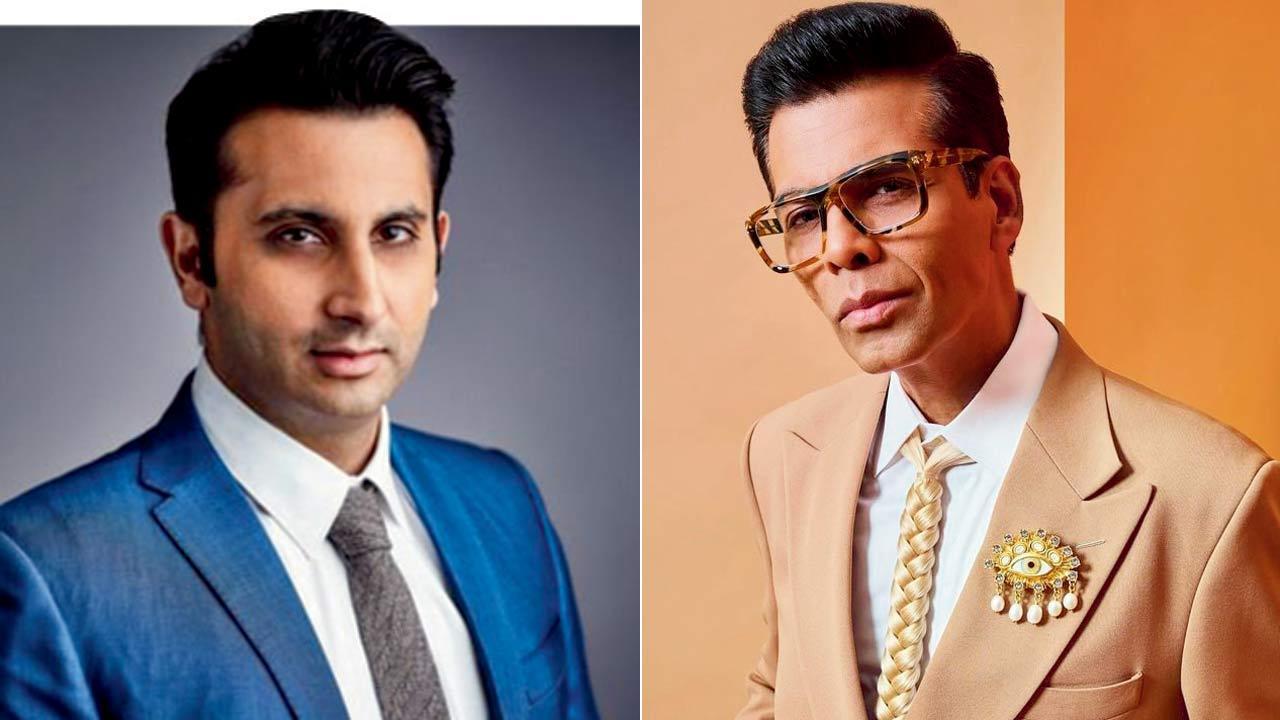
Arijit Barman and Javed Farooqui (THE ECONOMIC TIMES; October 22, 2024)
Billionaire vaccine maker Adar Adar Poonawalla, CEO of the Serum Institute of India, is picking up a 50% stake in Dharma Productions and Dharmatic Entertainment, for Rs 1000 crore, valuing Karan Johar’s film and television production and distribution flagship at Rs 2000 crore, further underpinning the ongoing flurry of consolidation in the entertainment industry.
ET broke the story online on Monday morning, ahead of a formal announcement.
Poonawalla’s is making this investment in his private capacity through Serene Productions. Dharma will retain the residual stake with Johar continuing to remain as the creative spearhead of the company, as Executive Chairman. Apoorva Mehta remains the Chief Executive Officer.
Dharma is owned 90.7% by Karan Johar and 9.24% by his mother, Hiroo.
“I do foresee consolidation in this industry. Internationally, we've seen a lot of consolidation due to new content creation methods and distribution channels,” Poonawalla told ET. “With the evolving landscape of content production and distribution, I see significant potential for such partnerships both internationally and nationally.”
The key factor that led to stitching together this alliance is Johar retaining creative control while partnering with a deep pocket family he is familiar with. The Poonawalla investment will help the production house with enough financial muscle to navigate the fast-changing demands of digitally savvy consumers who are often digital natives. The investment will also boost Dharma’s efforts to double down on content for new platforms and formats while continuing to deliver interesting stories for a global audience.
“This partnership will help us create more verticals within the organization and allow us to take creative chances. This gives us the bandwidth to expand Dharmatic Entertainment and create much more in the digital domain,” added Johar. “It also allows us to capture a lot of value in the value chain which comes with owning IP and catalogue – we have already been doing that and hope to double down on it with this capital.”
Film production is a volatile business with earnings linked to box office successes of films. Major Hindi film production houses, including Dharma, have been cautious in greenlighting new projects due to the unpredictable nature of the box office, which also impacts the value of streaming and satellite rights, ET had reported on October 14.
Johar said, the company’s attempts will be to increase the value and create more content. “We aim to produce a higher volume of films with this partnership compared to what we're currently doing. With shrinking audiences and an overreliance on streaming rights, Johar feels a strategic business shift is already underway. “Mid-budget films are the backbone of the film industry's economics, and we need to explore this segment further, alongside our tentpole productions, to create a more diverse and sustainable portfolio of films,” he said.
CHANGING DYNAMICS
The industry is experiencing major upheavals due to shifting consumer preferences, influenced by exposure to global content and the increasing dominance of on-demand consumption in urban areas. Additionally, the economic model is strained, with star salaries often consuming up to 70% of a film’s budget. Consolidation on the demand side, with the emergence of large broadcasters, streaming platforms, and multiplexes, is also putting pressure on content companies like Dharma. Satellite rights, once a steady revenue stream, have plummeted to historic lows, and the value of streaming deals, which was funding movie costs in many cases, is being corrected, further straining the economics of the film business.
In the theatrical space, multiplexes now dictate a film’s success, contributing an estimated 60–70% of Hindi films' box office revenue, while single-screen theaters continue to struggle. Post-COVID, many viewers prefer to wait 8–10 weeks to watch films on OTT platforms, leading to reduced footfall in cinemas.
Some industry players are already contemplating profit share model or box office linked payouts to offset rising star costs. “It's essential not to overload our above-the-line costs. While we respect actors' talent and craft and want to pay what's fair, all artists must understand the current challenges in the entertainment industry. There's enough potential in big films for everyone to gain,” said Johar.
Dharma has been actively seeking investments for a while and had engaged in talks with several large conglomerates and industrialists like Sanjiv Goenka’s Saregama, a company they already have business ties to become part of a cash-rich conglomerate. Some discussions with Reliance Industries and Jio Cinema also did take place.
Raine Group was the advisor to the deal.
Dharma Productions posted a nearly fourfold surge in revenue to Rs 1,040 crore in FY23, from Rs 276 crore the previous year. Net profit, however, fell 59% to Rs 11 crore due to a 4.5-times rise in expenses at Rs 1,028 crore, according to the company's latest available financial data accessed from Tofler. In FY23, the company earned Rs 656 crore from distribution rights, Rs 140 crore from digital, Rs 83 crore from satellite rights, and Rs 75 crore from music. This compares with earnings of with earnings of Rs 19 crore, Rs 167 crore, Rs 34 crore, and Rs 21 crore from these streams, respectively, in FY22.
HITS & FLOPS
Founded by Johar’s father Yash Johar in 1976, with its first venture starring Amitabh Bachchan in a film called Dostana, Dharma has been led by Johar and his team since his father passed away. Johar directed his first movie at 25, ‘Kuch Kuch Hota Hai’, and has gone on to produce close to 50 Bollywood including hits like 'Kabhi Khushi Kabhie Gham, Yeh Jawaani Hai Deewani, 2 States, Kapoor & Sons and Dear Zindagi’. Seen as a launch pad for several young actors, many from well-known film families like Allia Bhatt, Varun Dhawan, Janhvi Kapoor, Ishaan Khatter and Ananya Pandey among others. In 2018, the company launched Dharmatic Entertainment to diversify and create original content for global streaming platforms and has worked with global OTT platforms like Netflix and Amazon Prime to create and produce shows like “The Fabulous Lives of Bollywood Wives”, “Call Me Bae”. From blockbuster films Johar was also among the first of his peers to migrate to multi-media himself, becoming a chat show host for the popular Koffee with Karan show.
----------------------------------
Dark horse vaccine baron beats biggies for a 50 per cent stake in marquee Bollywood production house
Priyanka Sharma (MID-DAY; October 22, 2024)
Serum Institute of India CEO Adar Poonawalla-led Serene Productions on Monday said it will pick up a 50 per cent stake in Karan Johar’s Dharma Productions and Dharmatic Entertainment for Rs 1,000 crore.
The past few months had witnessed speculation in the entertainment industry that Karan Johar was planning to sell a stake of Dharma Productions. Saregama and Reliance were said to be frontrunners.
With this deal, Poonawalla—the CEO of Serum Institute of India (SII), and Chairman of Poonawalla Fincorp—is foraying into entertainment through his Serene Productions.
The deal, which sees Karan retaining his position as the Executive Chairman and Apoorva Mehta as the CEO, is being viewed as a win-win for both parties. In terms of numbers prima facie, this deal values Dharma— which includes its digital arm, Dharmatic Entertainment—at Rs 2,000 crore. Sources say it is an optimistic valuation.
An insider says, “Karan has got a good valuation. Technically, Dharma’s revenue fell by 50 per cent in the last financial year. In 2022-2023, its revenue was said to be at Rs 1,000 crore. Brahmāstra: Part One—Shiva [2022] was a major contributor to the profit. However, in 2023-24, even though the company witnessed a spike in its digital and music earnings, its total revenue had a 50 per cent drop as it did not have a blockbuster. But Adar has invested in the company, looking at its equity and Karan’s creative might. A part of the Rs 1,000-crore investment will be directed to the original investors—Karan and his mother Hiroo Johar—while the remaining will be allocated towards production.”
For Poonawalla, who has long been friends with Karan, it is a strategic investment as it gives him a significant stake in the media industry. Another source breaks it down, “For Adar Poonawalla, it’s a great diversification after dominating the pharmaceutical and financial sectors. This move will bring corporate culture into the corridors of Dharma. All the heavy lifting that Karan and Apoorva had been doing, in terms of cost management, will now be delegated.”
As is the norm with such deals, the company is expected to undergo restructuring. “Some of Adar’s people will take key positions at Dharma, and there will be a lot of lay-offs,” says another source.
It is understood that the roles will be clearly divided in the 50-50 partnership. Decades after his filmmaker-father Yash Johar founded Dharma in 1976, Karan took the company to new heights with his vision. He not only helmed many blockbusters—from Kuch Kuch Hota Hai (1998) to Student Of The Year (2012)—but also backed many directors, becoming something of Bollywood’s big daddy.
“Now, Karan will spearhead the company’s creative operations and lead it from the front. Adar wants to stay away from the creative aspect. So, everything related to films will be handled by Karan, including the star fees and the budget on which a film is to be mounted. Adar will look at the operational aspects, probably telling him how much money can be spent on the workforce, how much bonus to be given, and so on.”
The equal partnership that Poonawalla’s deal afforded was one of the reasons why Karan inked the deal. In contrast, Saregama, owned by Sanjeev Goenka, and Reliance Industries were reportedly in the bidding war to buy a majority stake in Dharma.
A source reveals, “Saregama was willing to acquire the stake for Rs. 800 crore. Adar outbid both the players. But another crucial reason is that neither of those giants would have gone into a 50-50 partnership. It has been seen historically that Reliance eventually acquires the companies it buys stakes in.” The partnership is being viewed as a huge boost for the Hindi film industry, which has been struggling since theatres reopened after the pandemic-induced shutdown.
When pharma meets films
- Adar Poonawalla is the CEO of Serum Institute of India, the world’s largest vaccine-producing company in terms of volume, which produced Covishield in India. He is also the Chairman of Poonawalla Fincorp.
- The Rs 1,000-crore investment in Dharma Productions marks the pharma tycoon’s foray into the entertainment industry with Serene Productions.
- In the 50-50 partnership, Karan Johar will retain his Executive Chairman position and spearhead the creative operations. Apoorva Mehta will continue as the CEO.
- Part of the investment will be directed to the original investors—Karan and his mother Hiroo Johar—while the remaining will be allocated towards production.
- Saregama and Reliance Industries were said to be in the bidding war to buy a majority stake in Dharma.
Subscribe to:
Posts (Atom)