Showing posts with label Aamir Bashir. Show all posts
Showing posts with label Aamir Bashir. Show all posts
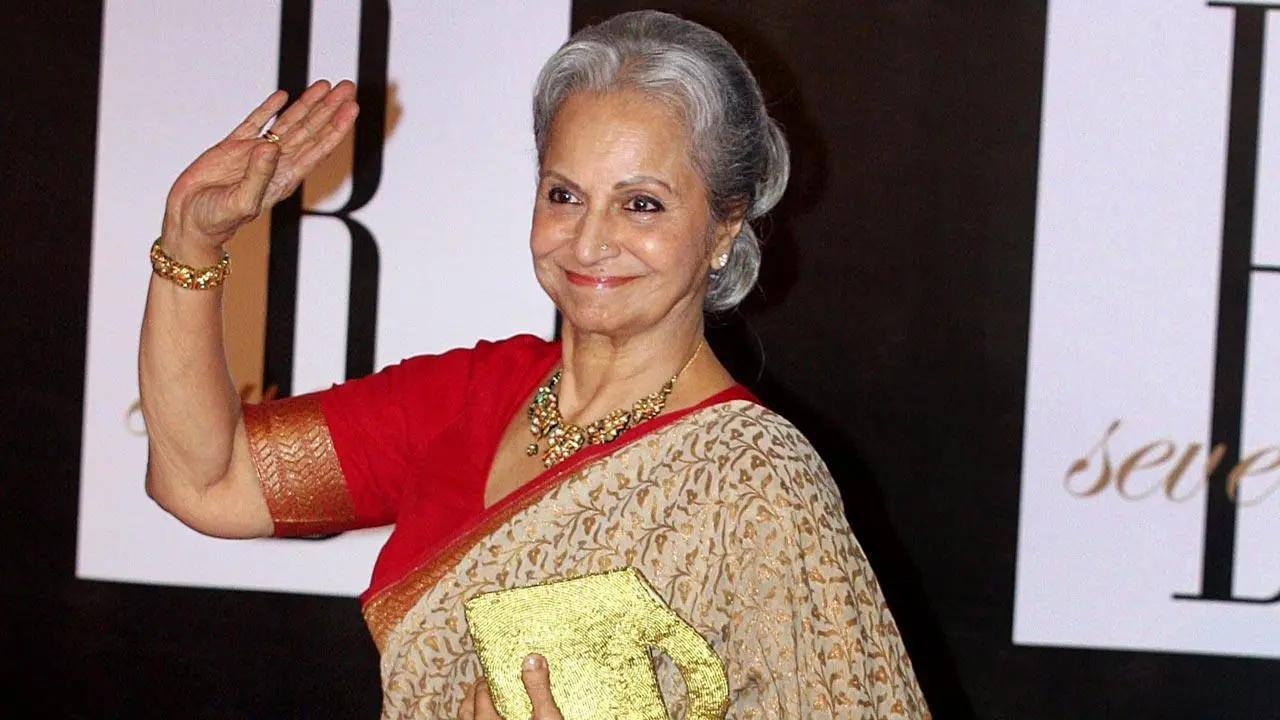
Waheeda Rehman to make rare screen comeback as Mahatma Gandhi’s mother Putlibai in Manoj Bajpayee starrer
4:36 PM
Iti Shree Misra (BOMBAY TIMES; September 21, 2026)
It took more than a few sittings and a promise of the best food in Lucknow to coax Waheeda Rehman back onto a film set. After a brief, memorable appearance in the 2021 OTT film Skater Girl, the veteran actress had been reluctant to take on new assignments, citing age and a desire to step back – until now. The actress will be seen in a major role in Sudhir Mishra and Anubhav Sinha’s next.
The pitch that worked
Director Sudhir Mishra was adamant about having Waheedaj i in his Mahatma Gandhi film, and producer-director Anubhav Sinha backed him with a series of patient meetings.
“Waheeda ji was rather unsure of coming back to acting in another movie. But Sudhir was very keen on having her as part of the cast,” Sinha says.
Over several rounds of conversation, Mishra reassured her about the role, while Sinha leaned into charm and cuisine. “I promised to feed her the best food in Lucknow,” he says.
Waheeda Rehman, who had visited Lucknow a long time ago and wasn’t very familiar with the city, finally agreed. She is now in Lucknow, shooting for the film and playing what the team describes as a very important part although not Putlibai, as some reports suggest.
Sinha further shared, “Waheeda ji found the script very exciting and the character very interesting but she was reluctant and unsure if she wanted to come back to acting. But Sudhir and my insistence and the story convinced her enough to say yes to the role.”
For the two filmmakers, securing Waheeda Rehman was less about casting and more about legacy. Sinha says that sitting with her to discuss cinema and this particular script has been ‘an incredible honour’.
A 21-day chapter, a starry ensemble
The yet-untitled film, currently working under the title Gandhi And My Mother, focuses on a lesser-known 21-day chapter from Gandhi’s life. Manoj Bajpayee essays the Mahatma, reuniting on screen with Saurabh Shukla after Satya (1998) and Aarakshan (2011).
The ensemble also includes Divya Dutta, Aamir Bashir and Ashwath Bhatt in significant roles. Divya, incidentally, plays Sushila Nayyar, Gandhi’s personal physician and close associate, who authored several books on her experiences with him. Her brother Pyarelal Nayyar served as Gandhi’s personal secretary.
“For me to be playing such an iconic character is a real high”: Divya Dutta on playing Sushila Nayyar
For Divya, signing up for the biopic felt like a double win. “For me to be playing such an iconic character is a real high. Being on the set and just playing the role takes me back to that remarkable era and that feels amazing,” says the actress.
The film also marks her first collaboration with Mishra, a filmmaker she has long admired. “To be part of the cast of such a talented and amazing director is like a dream come true,” she says. With producer-director Anubhav Sinha, meanwhile, it’s reunion time. “This is my second film with Anubhav who’s an amazing friend and being back on the set with him is like party time,” Dutta adds.
Though Divya and Manoj Bajpayee have acted together in several films earlier, this will be the first time they share screen space in the same frame, a milestone she notes with quiet excitement. In a project that blends legacy, craft and camaraderie, Dutta’s enthusiasm is simple, “It’s an all-out win-win situation for me!”
I wanted Irrfan Khan to play Nawab of Baitar in A Suitable Boy-Mira Nair
8:01 AM

Mira Nair recounts how she missed last chance of working with Irrfan Khan on A Suitable Boy
Mohar Basu (MID-DAY; October 29, 2020)
In one of the most beautiful scenes of Mira Nair's The Namesake (2006), Irrfan's Ashoke Ganguli stands by the sea and tells son Gogol, "You and I made this journey to a place from where there was nowhere left to go." Even six months after the actor's demise, his fans around the globe have yet to come to terms with his loss. With Nair's A Suitable Boy dropping on Netflix India last week, it was hard not to look for him throughout the six-part series.
It is known that Irrfan was to be part of the screen adaptation of Vikram Seth's novel of the same name, but eventually dropped out due to his ill-health. Nair, who had also worked with the late actor in Salaam Bombay (1988) and New York, I Love You (2008), says, "I had reached out to him. Frankly, he could have had any part he wanted! But I wanted him to play the Nawab of Baitar. I even tapered the role so it wouldn't be too hectic for Irrfan, but it was not to be." The role was eventually essayed by Aamir Bashir (below).
Nair admits it was disappointing to not have one of her trusted collaborators in her passion project. "The disappointment was about not working with him again. The enormous sadness for all of us is that Irrfan, who was such a light, such a fire, was gone."

New innings of Inside Edge to arrive sooner than expected?
7:51 AM

Sources say shoot of Inside Edge 3 complete; to release by mid-2020
Sonil Dedhia (MID-DAY; December 19, 2019)
Barely a fortnight into the release of the second season of Inside Edge, one would assume that the makers have put their feet up and are revelling in the clicks earned by the Vivek Oberoi and Richa Chadha starrer. But mid-day has learnt that the creative team, led by showrunner Karan Anshuman, is busy working on the post-production of the third season.
A source reveals, "The second and third seasons of the cricket drama were commissioned together. The actors were asked for bulk dates so that both editions could be simultaneously shot. Since Season 2 has been well-received, the makers want to cash in on its success by releasing the next instalment by mid-2020. The road ahead will see Aamir Bashir and Vivek's characters engaging in a power battle, and will also track the back-story of Angad Bedi's character."
Discussions regarding the fourth edition are apparently underway between the creative heads at Excel Entertainment and head honchos at Amazon Prime Video.
Inside Edge 2 actor Aamir Bashir joins Vinay Pathak in Mira Nair’s A Suitable Boy
7:02 AM

Mohar Basu (MID-DAY; December 13, 2019)

The latest addition to the cast is Aamir Bashir, who is enjoying his moment in the sun, courtesy his act as Bhaisaab in Inside Edge 2. The actor, who will portray the role of the pious Nawab Sahib of Baitar, is ecstatic to add a Nair project to his résumé. “To be a small part in Vikram Seth’s magnum opus, a piece of literature that drew comparisons with the works of Leo Tolstoy, is an honour. That Mira, who I have always admired as a filmmaker, found me worthy enough to play the Nawab of Baitar is a privilege,” he says.
Vinay Pathak will slip into the role of Agarwal, the conservative Home Minster of Purva Pradesh, for the BBC series. Looking forward to reuniting with Nair, Pathak says, “Mira has a keen eye for the conflict in the story, but the most wonderful [aspect] is the way she works with actors. I have done one short film with her before, and can’t wait to get back in the same room as her!”
The ensemble cast includes Vijay Varma of Gully Boy fame, Vijay Raaz, Rasika Dugal and Mahira Kakkar, among others.
With Inside Edge, we have the first mover advantage-Richa Chadha
7:56 AM

Dismissing the notion that Inside Edge wasn’t as celebrated as Sacred Games despite its Emmy nomination, Richa Chadha says the second season will be a game-changer
Mohar Basu (MID-DAY; December 3, 2019)
A lot has changed in digital entertainment in the two years since Inside Edge dropped online, marking India’s first homegrown original for Amazon Prime Video. With bigger players joining the fray and projects being mounted on lavish budgets, the web space has continually evolved. As the countdown for the second season of Inside Edge begins, Richa Chadha believes the show will continue to enjoy the first mover advantage. “Developing the second season took time, but it was for the better. The makers went back to the drawing board and tried to enhance everything. It’s mounted magnificently; we shot abroad as well,” begins Chadha, who plays Zarina Malik, the owner of a cricket team in the sports drama that also stars Vivek Oberoi and Angad Bedi.
From its first episode, the Karan Anshuman-creation made its intentions clear — the series wanted to delve into the underbelly of the cricketing world and the power play that is at work off the pitch.
Chadha’s character Zarina — as mysterious as she was manipulative — was at the centre of the drama. Quiz her how her character has evolved in the second season, and Chadha says, “Zarina felt screwed over by powerful men, so she no longer wants to be a puppet or dummy. She wears her confidence proudly, and has her career under control. I had to change my body language for this season. With Bhaisaab’s [Aamir Bashir’s character] support, she feels protected now. Even in our field, when actors belong to a certain camp, people are wary of taking them on.”
One wonders if playing a character, season after season, can be exhausting. “I wouldn’t say it’s difficult but it takes a few readings of the script to nail her. I don’t get tired or bored of Zarina,” she says, adding, “In a film, we play a character for 50 days. In a show, we become that person [for few months] and subsequently, we detach. We personally evolve in the interim, and [when it’s time for the next season], we pick up from where we left, in a renewed way.”
Only a week ago, Indian cinephiles had their eyes peeled for the International Emmy Awards, rooting for Sacred Games’ team to come home with the gong for the Best Drama Series. Flashback to a year earlier: Inside Edge was the first Indian web series to earn a nomination at the prestigious awards gala. Did she feel that the celebration was subdued compared to the reaction that Sacred Games’ nomination elicited this year? “The show was the first to be nominated; it’s immaterial whether it registers [with the audience] or not. And how are we determining the ‘registering’? Basis a Twitter trend? That’ll be forgotten the next day.”
While fans of the 10-part offering argue that it didn’t get its due, Chadha doesn’t share the view. “I don’t feel that way at all. This was India’s first [Amazon] original, the platform launched with it. We were trying to understand the grammar of the format. We’ve learnt from it, and made season 2 better. We have the first-mover advantage.”
Naseeruddin Shah fights over a faulty photocopy machine in Hope Aur Hum
7:53 AM

Naseeruddin Shah plays a patriarch whose refusal to part with a faulty piece of equipment leads to conflict and hilarity in his next
Sanyukta Iyer (MUMBAI MIRROR; April 11, 2018)
Debutant director Sudip Bandhopadhyay admits that his film, Hope Aur Hum, is autobiographical in that it takes after the idiosyncrasies of his own family members. The family-drama, which he has written and directed, features Naseeruddin Shah as the 70-year-old patriarch Nagesh Srivastava, who is unwilling to get rid of his malfunctioning photocopy machine for emotional reasons. Aamir Bashir and Naveen Kasturia play his sons.
Sudip points out that the slice-of-life film follows each character as they adapt to change in their own way. “While circumstances are the film’s main villain, I managed to cast fantastic sons for Naseer with Aamir, who plays a bank employee waiting for a promotion, and Naveen, who plays the younger brother who is an architect. They not only look like real brothers, but are also spitting images of Naseer from his younger days.”
The filmmaker adds that Sonali Kulkarni plays Naseer’s daughter-in-law and a mother-of-two. “Sonali’s character Aditi comes from a royal family and even though her in-laws are well-off, she is frustrated with the space constraints that come with sharing a Mumbai house with a joint family. She is keen to get rid of the copy machine so that she can convert the space into a room for her kids. It leads to funny arguments within the family,” Sudip reveals.
The ad filmmaker-turned-director had auditioned child actor Kabir Sajid Shaikh for several commercials in the past, but had never managed to cast him in a role. “I finally found a role for him in Anu, Aditi’s son, who loves playing cricket,” Sudip says.
Since the family is Mumbai based, the unit shot in Bandra and Madh island, with some portions canned at a palace near Palgarh. “I was keen to request veteran, award winning cinematographer Ravi K Chandran, who resides in the same building as me, to spare one of his assistants to shoot my film. He’s constantly shuffling between Chennai and Mumbai and I caught him once asking him it was possible. He asked me about my film and then questioned me in return as to why I wasn’t asking him to shoot my film. I told him it was a small, independent feature but he insisted. I was thrilled. He came on board with a plethora of experience and the cast was so excited to have him on board,” Sudip says.
Wazir makers do away with paedophilia sequence after no actor agreed to play the role?
7:44 AM

Asira Tarannum (MID-DAY; March 25, 2015)
Of late, Bollywood has been getting bolder as far as movie themes and scenes are concerned. But for most actors, paedophilia appears to be a subject best left untouched — apparently that’s what the makers of Wazir have found out.
Sources say the Bejoy Nambiar film, which stars Amitabh Bachchan, Farhan Akhtar and Aditi Rao Hydari, had a paedophile character. “The makers approached a few actors, including Pankaj Kapur, but none of them agreed to play the role,” an insider says.
Later, Aamir Bashir of Haider fame was finalised, but the deal didn’t come through, states the source, adding: “So they had no other option but to completely do away with that paedophile part from the script.” Bejoy, however, denies the buzz about the film featuring a child molester. “No, it’s not true,” he says.
But our source maintains that the makers originally wanted to keep that part under wraps and when they were forced to exclude the sequence, they decided not to talk about it.
Indian filmmakers' open up about torturous experiences while shooting in certain parts of country
9:06 AM
Sanat Mehra (MID-DAY; January 4, 2015)
There were several highs and lows in 2014 vis-à-vis the Hindi film industry, but the one thing that is encouraging is the rise of small-budgeted films. Not only that. Even the fact that they are released alongside big budget films was an appealing highlight of the elapsed year. However, the remedy of one problem has also brought to light another obstacle. Turns out filmmakers — big ticket or small — are finding it increasingly difficult to shoot in certain parts of the country.

(L-R): Nawazuddin Siddiqui, Chitrangada Singh and Tahir Raj Bhasin
In the news for his misadventure with the Federation of Cine Technicians and Workers of Eastern India, director Kushan Nandy recently claimed in a tweet that he was a victim of extortion, blackmail and his unit was held hostage for 72 hours. That might sound like a situation that mirrors the murkiness of AfPak but we are talking about West Bengal here. In Bolpur, a municipality in Birbhum district, to shoot his latest film, Nandy faced a number of problems that one would generally not associate with filmmaking. His film features Nawazuddin Siddiqui, Chitrangada Singh and Tahir Raj Bhasin in leading roles and is chugging on towards completion.
Nandy revealed that the screenplay of his film could be best picturised against the landscape of West Bengal, and after shooting for more than a month in parts of the state, the director was unable to shoot further in some interiors because of the “terrible” experience with the aforementioned federation. “While shooting in Bengal, according to rule, we have to hire 30 per cent of manpower from the local area. But the set number keeps increasing. It doubles and triples proving that there is no parity in what they say and do. Once 60 people become 180, the budgets begin to go haywire and because you have planned to do other things with that budget — instead of paying those who weren’t even present for the shoot — those feigning non-payment start hounding you,” rues the Mumbai-based director.
When we contacted Aparna Ghatak of the Federation of Cine Technicians and Workers of Eastern India, for her side of the story, she said that the matter had been resolved. According to her, the shooting would resume shortly once the payments are received. “However, what angered the workers was that they have been portrayed in a bad light, even after the team from Mumbai was aware that the hooliganism was not caused by workers registered with the federation,” clarifies the general secretary. Ironically, this federation has gathered flak from quite a few filmmakers based in the region.

Kashmir
Bollywood’s romance with Kashmir has been elaborated over more than 20 blockbusters, but recently to document the harsh realities other than the beauty of the state, the few filmmakers who have ventured out there with a small crew and big plans have faced the suspicion of political groups. Take for example, Aamir Bashir’s experience, on shooting the film Harud. In an earlier interview he had said, “Kashmir being a politically volatile place, one had to face the mistrust that local people have for anyone coming from outside with a camera. So, there was a lot of negotiating involved on a day to day basis. With just 18 people in the crew, everyone had to multi-task. A lot of the scenes are outdoors on the streets of Srinagar and crowd-control was a big headache.” While that was the experience of a filmmaker operating on a low budget, not so long ago the crew of Haider was forced to retreat after students of the Kashmir University violently opposed the shooting of a sequence that was based on a fedayeen attack.

West Bengal
Intriguingly enough, the matter does not come as a shock to Onir. The filmmaker whose films include My Brother... Nikhil (2005), Sorry Bhai! (2008) and I Am (2010), is no stranger to the situation faced by Nandy. According to Onir, while producing Chauranga (2014), he too had a run-in with the federation at Bolpur, the same location where Kushan’s local crew played truant. After shooting 70 per cent of the film in West Bengal, both Onir and co-producer Sanjay Suri had to hunt for a new location in the neighbouring state of Odisha. Onir adds, “The problem faced by Kushan or me is because the federation is not able to differentiate between a big-budget and small-budget film. In order to continue shooting for Chauranga we had to shift to Odisha where we did not face any problem.” The shoot was resumed at Keonjhar, a small town in the northern part of the state.

Kerala
“Great content can float a great film on a low budget, but just because we have the technical means to reduce costs doesn’t mean that all visual offerings are up to the mark.” Down South, filmmaker Bijukumar Damodaran, better known as Dr Biju, has several anecdotes to share on his clash with political realities. His doses of moving images might have insured that Indian cinema is far from ailing whether it was his film Perariyathavar or Veettilekkulla Vazhi but behind the scene, as can be noted, there are problems that continue to persist. According to this doctor-turned-filmmaker, the issue that compelled Nandy to cancel his shoot was a common problem until a few years back in Kerala. For better, the rules have been relaxed after a few directors, including Dr Biju himself, approached the Film Employees Federation of Kerala. “Numerous arthouse films come from our state. And to shoot these kind of films, the federation is more cooperative. This change has taken place over the past four to five years. As for the big budget productions, the rules remain the same,” the National Award-winning director asserts.

Uttar Pradesh and Bihar
The size of a film matters. Many a time, the budget makes all the difference — from a director's point of view — before it hits the marquee. Vasan Bala’s Peddlers (2012) collected a major part of its budget through crowdsourcing. It gave us deeper insight into how miniscule budget can be a boon as well as a curse for an indie filmmakers. “No matter what permission one procures there are always those extra payments that become difficult to pay for new filmmakers. Try shooting in UP and Bihar. It is a different ballgame all together; if you do not bring on board a producer who has some clout in that area then your shoot is bound to get disrupted sooner or later.” Would the big budget films reach a standstill in a similar situation? To elaborate further, Bala throws a word of caution for young filmmakers who might wish to venture out shooting our country’s backyard. “In hindsight, shooting without anyone knowing is the biggest thrill of any indie filmmaker, although it might curb the director’s vision. There might be filmmakers who might want a more nuanced approach to a scene; however, opting for a minimal crew can make the experience more thrilling.”

Madhya Pradesh
Prakash Jha has a special corner for the State of Madhya Pradesh and its people, so much so that he has already crossed a hat-trick and shot four films in the region. Popularly dubbed as a filmmaker who manages to etch a story that mirrors the harsh political realities of our nation, Jha has sucessfully built a niche for himself. Neither a commercial filmmaker nor one who woos the outsiders, Jha manages to give a balanced mix of reality and romanticism that he finds hidden against the backdrop of Madhya Pradesh. Raajneeti, Aarakshan, Chakravyuh and Satyagraha are some of the films shot extensively in the state. However, the idea of shooting in Madhya Pradesh came to him after he had some bad experiences shooting in other parts of India. It has been reported that he is proud that Madhya Pradesh is getting considerable visibility through his films. Interestingly, from the Prakash Jha Banner another film starring Arshad Warsi, playing a conman with 13 wives, is being shot in the city of Bhopal. The film that is being directed by Saurabh Shukla will bring the audience, yet again, to the central heartland of India.

Mumbai
Mumbai is home to the best studios but what happens when our new age filmmakers, as Vasan Bala rightly pointed out, “want their visuals to be as close as possible to reality?” Well, they opt out of the studios and shortlist locations that would complement their screenplays. Filmmaker and screenplay writer who directed and scripted the film Ungli, Rensil D’Silva says, “Mumbai is a difficult city to shoot in. Right from permissions to managing crowds who invade your frame. It has also become hugely expensive whether it is an advertisement or a feature.” His point is in sync with what Rajkumar Gupta had stated on his experience working on Aamir back in 2008: “I’ve done two films in Mumbai so far and in terms of logistics, it’s getting costlier day by day. There is no one particular office to take all the possible permissions from. I don’t wish to blame anyone in general, but given the scale our industry is at present, ideally speaking, it should be far more convenient for the filmmakers.” We must not forget that the authorities have become more vigilant after the 26/11 terror attacks, but “with the internet there has been a rise in visual exchange of ideas that cannot be ignored,” concludes Bala.

Andhra Pradesh
The situation in Andhra Pradesh and Telangana isn’t a unique one, especially, after the recent incident faced by the crew from Mumbai in West Bengal. Only last year, in the month of December, over a thousand cine workers called a strike after their demands were not met by the AP Film Chamber of Commerce. As mentioned above, the situation was similar to the problem faced by Nandy, only here the situation has been resolved. The workers were demanding a raise in wages, a change that the AP Chamber of Commerce was willing to oblige to, but with a few clauses. Two of these clauses throw light on the major issues that our new breed of filmmakers has been eyeing in the face of budget constraints: To be given the liberty to choose workers even if they aren’t from the federation and not to pay the same wages that the big budget film producers pay. Probably, that explains maverick filmmaker Ram Gopal Varma’s tweet: “Federation workers shud open their eyes 2 the misleadings of their federation leaders nd start a new federation suited to today’s times.”
Indian states that were beautifully depicted

A still from Aarakshan
Madhya Pradesh: The central heart of India is a paradise for filmmakers. Director Prakash Jha who has shot four films in the state says that the authorities and federation give able support to filmmakers who come to shoot in the state.

Alia Bhatt, Imtiaz Ali and Randeep Hooda on the sets of Highway
Himachal Pradesh: If you have been bowled over by the scenic vistas shown in Imtiaz Ali’s Highway, a part of the credit also goes to Himachal Pradesh government that has eased out procedures to shoot in the state. They have adopted a single window clearance system that has made it easier for film crews.

A still from the film, Haider
Jammu and Kashmir: The state has been the location for films such as Haider, Yeh Jawaani Hai Deewani, Rockstar and Jab Tak Hain Jaan. While filmmakers have faced many issues in the region, it is still hard to ignore. Most probably, it is the manner in which the state can be depicted: some resurrect its beauty and others dissect its so-called polity.

Assam: In the eastern region, particularly Assam, our Bollywood filmmakers have avoided what can very well be the initial steps towards introducing the country to a region they are still in the dark about.
There were several highs and lows in 2014 vis-à-vis the Hindi film industry, but the one thing that is encouraging is the rise of small-budgeted films. Not only that. Even the fact that they are released alongside big budget films was an appealing highlight of the elapsed year. However, the remedy of one problem has also brought to light another obstacle. Turns out filmmakers — big ticket or small — are finding it increasingly difficult to shoot in certain parts of the country.
(L-R): Nawazuddin Siddiqui, Chitrangada Singh and Tahir Raj Bhasin
In the news for his misadventure with the Federation of Cine Technicians and Workers of Eastern India, director Kushan Nandy recently claimed in a tweet that he was a victim of extortion, blackmail and his unit was held hostage for 72 hours. That might sound like a situation that mirrors the murkiness of AfPak but we are talking about West Bengal here. In Bolpur, a municipality in Birbhum district, to shoot his latest film, Nandy faced a number of problems that one would generally not associate with filmmaking. His film features Nawazuddin Siddiqui, Chitrangada Singh and Tahir Raj Bhasin in leading roles and is chugging on towards completion.
Nandy revealed that the screenplay of his film could be best picturised against the landscape of West Bengal, and after shooting for more than a month in parts of the state, the director was unable to shoot further in some interiors because of the “terrible” experience with the aforementioned federation. “While shooting in Bengal, according to rule, we have to hire 30 per cent of manpower from the local area. But the set number keeps increasing. It doubles and triples proving that there is no parity in what they say and do. Once 60 people become 180, the budgets begin to go haywire and because you have planned to do other things with that budget — instead of paying those who weren’t even present for the shoot — those feigning non-payment start hounding you,” rues the Mumbai-based director.
When we contacted Aparna Ghatak of the Federation of Cine Technicians and Workers of Eastern India, for her side of the story, she said that the matter had been resolved. According to her, the shooting would resume shortly once the payments are received. “However, what angered the workers was that they have been portrayed in a bad light, even after the team from Mumbai was aware that the hooliganism was not caused by workers registered with the federation,” clarifies the general secretary. Ironically, this federation has gathered flak from quite a few filmmakers based in the region.
Kashmir
Bollywood’s romance with Kashmir has been elaborated over more than 20 blockbusters, but recently to document the harsh realities other than the beauty of the state, the few filmmakers who have ventured out there with a small crew and big plans have faced the suspicion of political groups. Take for example, Aamir Bashir’s experience, on shooting the film Harud. In an earlier interview he had said, “Kashmir being a politically volatile place, one had to face the mistrust that local people have for anyone coming from outside with a camera. So, there was a lot of negotiating involved on a day to day basis. With just 18 people in the crew, everyone had to multi-task. A lot of the scenes are outdoors on the streets of Srinagar and crowd-control was a big headache.” While that was the experience of a filmmaker operating on a low budget, not so long ago the crew of Haider was forced to retreat after students of the Kashmir University violently opposed the shooting of a sequence that was based on a fedayeen attack.
West Bengal
Intriguingly enough, the matter does not come as a shock to Onir. The filmmaker whose films include My Brother... Nikhil (2005), Sorry Bhai! (2008) and I Am (2010), is no stranger to the situation faced by Nandy. According to Onir, while producing Chauranga (2014), he too had a run-in with the federation at Bolpur, the same location where Kushan’s local crew played truant. After shooting 70 per cent of the film in West Bengal, both Onir and co-producer Sanjay Suri had to hunt for a new location in the neighbouring state of Odisha. Onir adds, “The problem faced by Kushan or me is because the federation is not able to differentiate between a big-budget and small-budget film. In order to continue shooting for Chauranga we had to shift to Odisha where we did not face any problem.” The shoot was resumed at Keonjhar, a small town in the northern part of the state.
Kerala
“Great content can float a great film on a low budget, but just because we have the technical means to reduce costs doesn’t mean that all visual offerings are up to the mark.” Down South, filmmaker Bijukumar Damodaran, better known as Dr Biju, has several anecdotes to share on his clash with political realities. His doses of moving images might have insured that Indian cinema is far from ailing whether it was his film Perariyathavar or Veettilekkulla Vazhi but behind the scene, as can be noted, there are problems that continue to persist. According to this doctor-turned-filmmaker, the issue that compelled Nandy to cancel his shoot was a common problem until a few years back in Kerala. For better, the rules have been relaxed after a few directors, including Dr Biju himself, approached the Film Employees Federation of Kerala. “Numerous arthouse films come from our state. And to shoot these kind of films, the federation is more cooperative. This change has taken place over the past four to five years. As for the big budget productions, the rules remain the same,” the National Award-winning director asserts.
Uttar Pradesh and Bihar
The size of a film matters. Many a time, the budget makes all the difference — from a director's point of view — before it hits the marquee. Vasan Bala’s Peddlers (2012) collected a major part of its budget through crowdsourcing. It gave us deeper insight into how miniscule budget can be a boon as well as a curse for an indie filmmakers. “No matter what permission one procures there are always those extra payments that become difficult to pay for new filmmakers. Try shooting in UP and Bihar. It is a different ballgame all together; if you do not bring on board a producer who has some clout in that area then your shoot is bound to get disrupted sooner or later.” Would the big budget films reach a standstill in a similar situation? To elaborate further, Bala throws a word of caution for young filmmakers who might wish to venture out shooting our country’s backyard. “In hindsight, shooting without anyone knowing is the biggest thrill of any indie filmmaker, although it might curb the director’s vision. There might be filmmakers who might want a more nuanced approach to a scene; however, opting for a minimal crew can make the experience more thrilling.”
Madhya Pradesh
Prakash Jha has a special corner for the State of Madhya Pradesh and its people, so much so that he has already crossed a hat-trick and shot four films in the region. Popularly dubbed as a filmmaker who manages to etch a story that mirrors the harsh political realities of our nation, Jha has sucessfully built a niche for himself. Neither a commercial filmmaker nor one who woos the outsiders, Jha manages to give a balanced mix of reality and romanticism that he finds hidden against the backdrop of Madhya Pradesh. Raajneeti, Aarakshan, Chakravyuh and Satyagraha are some of the films shot extensively in the state. However, the idea of shooting in Madhya Pradesh came to him after he had some bad experiences shooting in other parts of India. It has been reported that he is proud that Madhya Pradesh is getting considerable visibility through his films. Interestingly, from the Prakash Jha Banner another film starring Arshad Warsi, playing a conman with 13 wives, is being shot in the city of Bhopal. The film that is being directed by Saurabh Shukla will bring the audience, yet again, to the central heartland of India.
Mumbai
Mumbai is home to the best studios but what happens when our new age filmmakers, as Vasan Bala rightly pointed out, “want their visuals to be as close as possible to reality?” Well, they opt out of the studios and shortlist locations that would complement their screenplays. Filmmaker and screenplay writer who directed and scripted the film Ungli, Rensil D’Silva says, “Mumbai is a difficult city to shoot in. Right from permissions to managing crowds who invade your frame. It has also become hugely expensive whether it is an advertisement or a feature.” His point is in sync with what Rajkumar Gupta had stated on his experience working on Aamir back in 2008: “I’ve done two films in Mumbai so far and in terms of logistics, it’s getting costlier day by day. There is no one particular office to take all the possible permissions from. I don’t wish to blame anyone in general, but given the scale our industry is at present, ideally speaking, it should be far more convenient for the filmmakers.” We must not forget that the authorities have become more vigilant after the 26/11 terror attacks, but “with the internet there has been a rise in visual exchange of ideas that cannot be ignored,” concludes Bala.
Andhra Pradesh
The situation in Andhra Pradesh and Telangana isn’t a unique one, especially, after the recent incident faced by the crew from Mumbai in West Bengal. Only last year, in the month of December, over a thousand cine workers called a strike after their demands were not met by the AP Film Chamber of Commerce. As mentioned above, the situation was similar to the problem faced by Nandy, only here the situation has been resolved. The workers were demanding a raise in wages, a change that the AP Chamber of Commerce was willing to oblige to, but with a few clauses. Two of these clauses throw light on the major issues that our new breed of filmmakers has been eyeing in the face of budget constraints: To be given the liberty to choose workers even if they aren’t from the federation and not to pay the same wages that the big budget film producers pay. Probably, that explains maverick filmmaker Ram Gopal Varma’s tweet: “Federation workers shud open their eyes 2 the misleadings of their federation leaders nd start a new federation suited to today’s times.”
Indian states that were beautifully depicted
A still from Aarakshan
Madhya Pradesh: The central heart of India is a paradise for filmmakers. Director Prakash Jha who has shot four films in the state says that the authorities and federation give able support to filmmakers who come to shoot in the state.
Alia Bhatt, Imtiaz Ali and Randeep Hooda on the sets of Highway
Himachal Pradesh: If you have been bowled over by the scenic vistas shown in Imtiaz Ali’s Highway, a part of the credit also goes to Himachal Pradesh government that has eased out procedures to shoot in the state. They have adopted a single window clearance system that has made it easier for film crews.
A still from the film, Haider
Jammu and Kashmir: The state has been the location for films such as Haider, Yeh Jawaani Hai Deewani, Rockstar and Jab Tak Hain Jaan. While filmmakers have faced many issues in the region, it is still hard to ignore. Most probably, it is the manner in which the state can be depicted: some resurrect its beauty and others dissect its so-called polity.
Assam: In the eastern region, particularly Assam, our Bollywood filmmakers have avoided what can very well be the initial steps towards introducing the country to a region they are still in the dark about.
Peepli Live director Anusha Rizvi's next is a mystery series for TV
7:37 AM

Vickey Lalwani (MUMBAI MIRROR; November 11, 2014)
Anusha Rizvi, the director of critically acclaimed film Peepli (Live), is now headed towards the small screen. The filmmaker is helming an upcoming crime drama, Private Investigator. The show will be a weekly series with each episode offering a different plot.
A source close to the show told Mirror, "Every episode will be high on suspense and will wrap up with the mystery being solved."
The cast will be toplined by Mrinal Dutt, who had earlier featured in TV shows like Webbed and Roomies. Mrinal plays the protagonist, Raffe Roy Choudhary.
The show also stars Sandhya Mridul, Vrajesh Hirjee and Aamir Bashir. Mirror has learnt that Sandhya plays Mrinal's mother, Vrajesh is a cop and Aamir essays the role of an ex-RAW agent.
The channel confirmed the news, saying, "The show will go on air in the second week of December."
When contacted, Anusha reiterated, "Yes, I am involved with this show. I would prefer to discuss the details later. I am looking forward to it."
Her previous project, the 2010 release Peepli (Live), was India's official entry for the the Academy Awards in the Best Foreign Film category.
Subscribe to:
Posts (Atom)